How to Make an App Like TikTok in 2026: Step-by-Step Guide
Key Takeaways
- The success of TikTok and its regulatory issues creates many opportunities for upcoming short-video platforms by 2026.
- A successful TikTok-like app depends on three core pillars: smooth video experience, AI-powered recommendations, and scalable cloud infrastructure.
- Your MVP should prioritize video uploads, personalized feeds, creator profiles, and social engagement before introducing other features.
- Monetization can be through ads, virtual gifts, subscriptions and creator-brand collaborations.
- Building a scalable short-video platform needs careful planning around performance, content moderation, and data privacy compliance from day one.
- A cross-platform MVP typically takes 16–24 weeks and costs significantly less with an India-based development team compared to North America.
Introduction
TikTok is no longer solely a social media app. It is a cultural engine that has changed the way the world consumes content. TikTok’s active users worldwide have surpassed 1.9 billion, and the short-video category remains one of the fastest-growing areas of the digital economy.
But the bigger opportunity lies beyond TikTok itself. Ongoing ban threats in the US and increasing regulatory pressure in Europe have opened the door for new players to enter the market. Many users are already testing alternative platforms, creators are looking for better monetization opportunities and more control over their audience data, and brands want platforms they can rely on for lasting growth.
If you've been considering building a short-form video app in 2026, this is the right time to invest in Custom Mobile Application Development Services.
This guide covers everything you need: current market data, must-have features, a proven 8-step development roadmap, tech stack recommendations, and cost analyses.

TikTok in 2026: Market Stats That Matter
- Daily active users in the US: 90+ million
- Monthly active TikTok users in the EU: 178 million
- Average engagement rate: 3.73% (Highest of any major social platform)
- 16,000 new videos are uploaded every minute
The TikTok Ban Effect: A Real Opportunity for App Builders
In January 2025, TikTok was briefly taken offline in the United States following a federal law requiring its Chinese parent company, ByteDance, to divest the platform. While the ban was paused, it exposed a critical vulnerability that users, creators, and advertisers had been ignoring: platform dependency risk.
The fallout turned out immediate and instructive:
- Creators quickly migrated their audiences to Facebook, YouTube Shorts, and emerging substitutes like Lemon8 and Clapper.
- Brands paused and spent hundreds of millions of dollars almost overnight.
- Competitor apps saw explosive download spikes.
For product builders, this episode validated several things simultaneously:
- No single platform is irreplaceable. Users will move if they have a strong reason.
- Creator loyalty is portable. Audiences follow creators, not platforms.
- Market gaps open fast; the window to capture displaced users is narrow but real.
If you've been waiting for the "right time" to build a short-video platform, the popular TikTok app disruption has already proven that alternatives can gain traction overnight when positioned correctly.
How Does TikTok Actually Work?
TikTok lets users create, watch, and share videos of different lengths, from short 15-second clips to videos up to 10 minutes long. Some creators can also upload videos up to 60 minutes. This is a big change from TikTok’s early version, where videos could only be 15 seconds long before the platform slowly increased the limit starting in 2021.
Users can shoot videos directly in the app or upload videos they already recorded. They can also add music, filters, text, voiceovers, and other effects to make their content more engaging. TikTok supports both vertical and horizontal videos, offers live streaming, and includes a Creator Marketplace where brands and creators can work together on partnerships.
TikTok's Algorithm: How Content Goes Viral
But what’s really driving TikTok’s expansion is its recommendation algorithm, which represents one of the most sophisticated content distribution systems ever created for a consumer app.
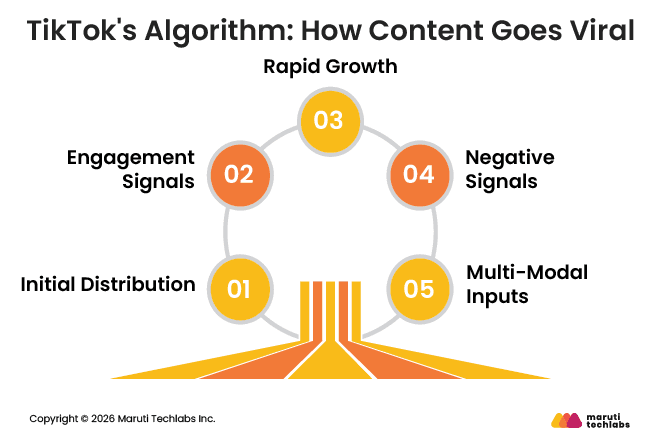
Here's how it works:
- Initial Distribution: When a video is uploaded, it's served to a small, algorithmically selected test audience based on content tags, sounds, and creator history.
- Engagement Signals: The system tracks watch-through rate, replays, shares, comments, and likes. High retention equals greater distribution.
- Rapid Growth: If a video performs well with a small group of users at first, TikTok starts showing it to more people with similar interests. This helps videos quickly grow from a few hundred views to millions.
- Negative Signals: Users can tell TikTok they do not like certain content by selecting “Not Interested.” The platform then updates future recommendations based on that feedback.
- Multiple Content Signals: TikTok looks at captions, hashtags, music, on-screen text, and even the video itself to understand what the content is about and recommend it to the right audience.
To replicate this level of recommendation precision, you need a team that understands both ML architecture and scalable infrastructure.
Top 11 Features of a TikTok-Like App
TikTok features are divided into basic (onboarding, profiles, personalized feed, engagement tools, push notifications) and advanced (video editing, live streaming, music library, geolocation, duet/stitch, AI recommendations).
Basic Features
| Feature | What It Does | Key Technical Requirement |
| Sign-in / Onboarding | First touchpoint for users. Supports email, phone, social SSO (Google, Apple), and guest access with auto-generated profile | OAuth 2.0, JWT-based session management |
| Create & Edit Profile | Users manage bio, profile photo, contact details, privacy settings, and linked accounts | Cloud-hosted media storage (S3 / GCS), CDN delivery |
| For You Page (FYP) | Personalized infinite scroll feed driven by AI recommendation; includes trending hashtags, captions, and soundtracks | Real-time ML inference, Redis caching, websocket feed updates |
| Like, Comment & Share | Core engagement layer; supports third-party sharing to Instagram, WhatsApp, X, and more | Social graph DB (Neo4j or similar), third-party share APIs |
| Push Notifications | Timely alerts for likes, comments, followers, live streams, and trending content; user-configurable frequency | Firebase Cloud Messaging (Android), APNs (iOS) |
Advanced Features
| Feature | What It Does | Key Technical Requirement |
| Video Recording / Upload / Editing | Full in-app camera with filters, speed control, AR effects, text overlays, trimming, and multi-clip stitching | FFmpeg for processing, ARKit / ARCore for effects, GPU-accelerated rendering |
| Geolocation | Location-based content discovery and proximity alerts for creators that the user follows | Google Maps API / Core Location, spatial indexing |
| Live Streaming | Real-time broadcast for accounts with 1K+ followers; supports virtual gifts and audience interaction | WebRTC, HLS/RTMP streaming, low-latency CDN |
| Music Library | Licensed music and sound database; users can add songs to videos or use trending audio | Rights-managed music API (e.g., Musickit, Epidemic Sound integration), audio fingerprinting |
| Duet / Stitch | Duet: side-by-side video with another creator's content. Stitch: clip and embed segments from another video | Server-side video compositing, permission-based content access |
| AI-Based Recommendation | Personalized FYP powered by collaborative filtering, content-based signals, and deep learning behavioral models | TensorFlow / PyTorch, A/B testing framework, feature store |
8-Step Guide to Build a TikTok-Like App
TikTok-like mobile app development involves eight sequential stages, from market research and feature and monetization planning to intensive testing and app store deployment.
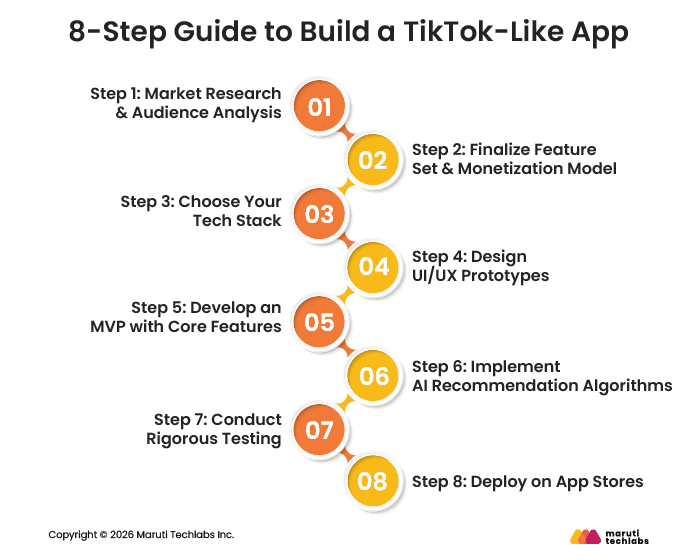
Step 1: Market Research & Audience Analysis
- Define your target segment. Is it Gen Z creators, a regional language community, fitness buffs, or professionals?
- Study your top competitors (TikTok, Instagram, YouTube Shorts, Clapper) and identify gaps.
- Analyze app store reviews, creator complaints, and usage patterns.
- Your research should directly inform your feature priority list and differentiation angle.
Step 2: Finalize Feature Set & Monetization Model
- Identify your MVP feature set: what's essential for launch versus what's a Phase 2 addition.
- Map each feature against your monetization strategy: will you run ads, charge subscriptions, enable virtual gifts, or a combination?
Step 3: Choose Your Tech Stack
- Pick a technology setup that can grow with your app from day one. As more users join, upload videos, watch content, and interact with creators, the platform should continue running smoothly without slowing down.
- Create a fast and easy-to-use mobile experience, supported by a strong system that can manage growing traffic, store videos securely, and deliver content quickly to users across different regions.
- It’s also important to include features like personalized recommendations, real-time notifications, and smooth live streaming to keep users engaged as your platform scales.
Step 4: Design UI/UX Prototypes
- Create interactive wireframes and high-quality prototypes in Figma to visualize the app experience and spot usability glitches early.
- Design the app for one-handed use. Actions like recording, liking, commenting, and sharing should seem natural and easy to reach with a thumb. Early testing with real users can help improve these flows.
- People stay on apps that feel fast, simple, and effortless to use. A smooth experience from the first interaction plays a big role in turning new visitors into frequent active users.
Step 5: Develop an MVP with Core Features
- Start with an MVP that focuses on the core experience: user sign-up, video upload and playback, a simple personalized feed, social interactions like likes and comments, and creator profiles.
- Break development into agile two-week sprints so the team can release updates faster and improve features continuously.
- Before a public launch, roll out a private beta with around 500 to 1,000 invited users. This helps gather real user feedback and understand actual usage patterns before scaling further.
Step 6: Implement AI Recommendation Algorithms
- Train your initial recommendation model on beta user activity data that includes watch time, skips, replays, and follows.
- Deploy collaborative filtering (people who liked X also liked Y) and content-based models (video topic, audio, hashtags).
- Use A/B testing tools to continuously evaluate and improve feed quality. This is the feature that separates sticky apps from ones people open once and forget.
Step 7: Conduct Rigorous Testing
- Run automated test suites covering unit, integration, and end-to-end flows. Outsourcing app testing helps accelerate releases, improve test coverage, and identify scaling issues before launch.
- Test on device types, OS versions, and connectivity conditions (including 3G for emerging markets if relevant).
- Specifically, stress-test video upload latency, concurrent streaming load, and feed refresh speed.
Step 8: Deploy on App Stores
- Prepare ASO-optimized store listings with keyword-rich descriptions, high-quality screenshots, and a preview video.
- Consider a soft launch in one or two markets first to identify issues at scale before going global.
- Pair your launch with an influencer seeding campaign.
- Offer early creators better revenue terms to build your initial content library.
Tech Stack for a TikTok-Like App
Layer | Recommended Technologies |
Programming Languages | Node.js, Python, Java, React Native, Flutter, HTML5/CSS3 |
Database Management | Redis, MySQL, MongoDB, Cassandra |
Cloud & Hosting | AWS, Google Cloud Platform |
Video Processing | FFmpeg, AWS Elemental MediaConvert |
Storage | Amazon S3, Google Cloud Storage |
Notifications | Firebase Cloud Messaging, APNs |
Geolocation | Google Maps API, CoreLocation |
AI / ML | TensorFlow, PyTorch, AWS SageMaker |
Streaming | WebRTC, HLS, RTMP |
Design & Prototyping | Figma, Adobe XD |
Project Management | Jira, Trello |
Monetization Models for Your TikTok-Like App
Short-video platforms monetize through in-app advertising, virtual gifts and coins during live streams, sponsored content and creator marketplace fees, and subscription tiers for ad-free or premium experiences.
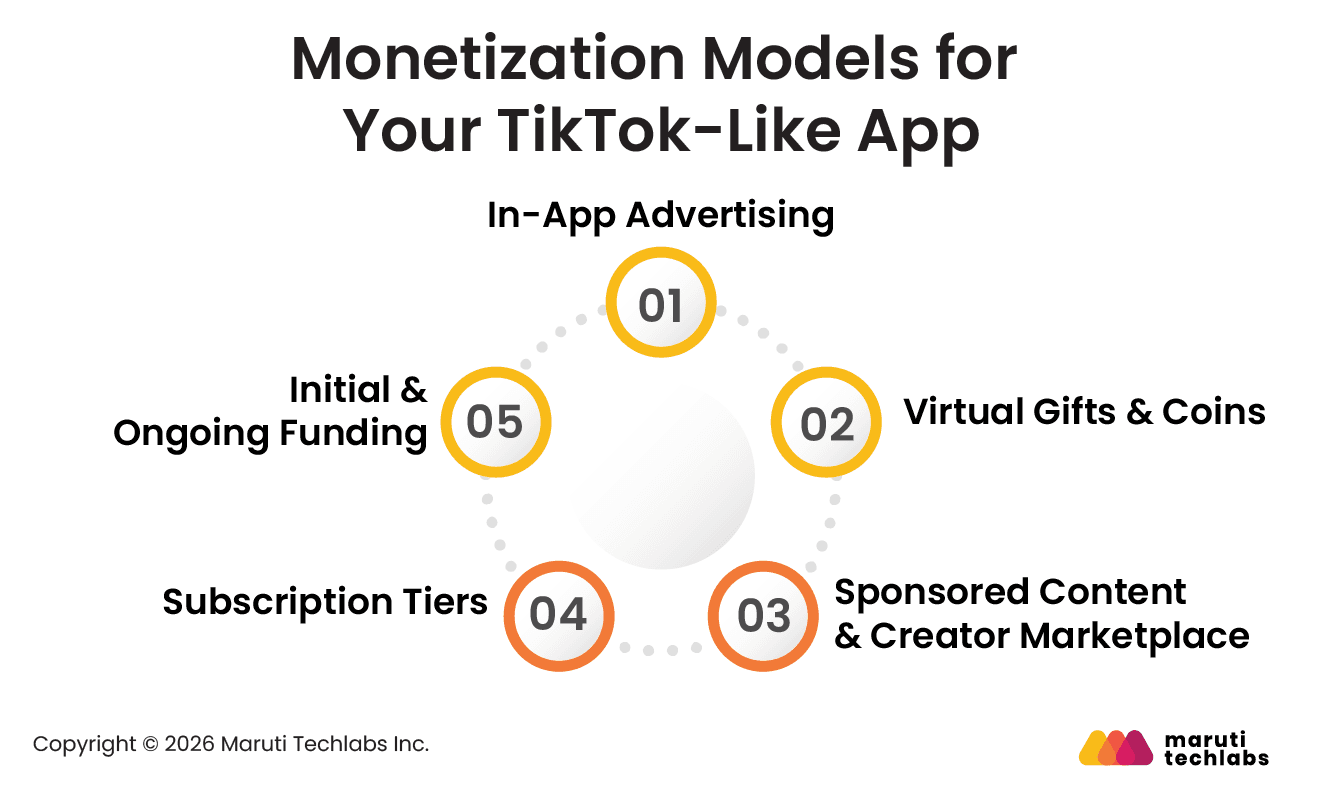
1. In-App Advertising
The highest-volume revenue stream for any scaled platform. Integrate native video ads, branded hashtag challenges, and interstitial placements. Use Google AdMob or Facebook Audience Network for programmatic fill, or build a self-serve ad platform for direct brand deals as you scale.
2. Virtual Gifts & Coins
Users purchase coin bundles with real money and send virtual gifts to creators during live streams and video interactions. The platform takes a percentage cut (typically 30–50%) before paying out creators. This model drives both creator retention and user activity simultaneously.
3. Sponsored Content & Creator Marketplace
Build a brand-creator matching layer directly into the platform. Brands pay to run sponsored challenges, product placements, and creator collaborations. The platform earns a marketplace fee on every deal facilitated. This is notably effective for niche platforms where brands can access highly targeted audiences.
4. Subscription Tiers
Offer a free tier with ads and a premium tier with ad-free viewing, exclusive creator content, early access to features, and higher video upload limits. Subscriptions provide predictable, recurring revenue and reduce dependence on ad market swings.
5. Initial & Ongoing Funding
For early-stage platforms, venture capital and angel investment can provide the runway needed to scale before ad and subscription revenue mature. TikTok itself raised $3 billion after acquiring Musical.ly.
Core Challenges in Building a TikTok-Like App
The core technical and operational problems in building a short-video platform include handling massive concurrent load at scale, automatically moderating content without missing policy violations, and sustaining compliance with data privacy laws across multiple jurisdictions.
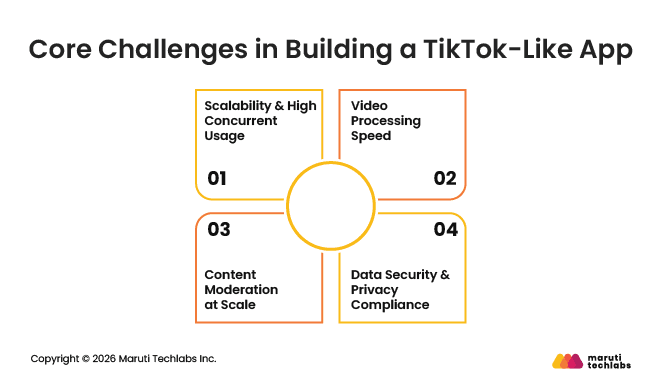
1. Scalability & High Concurrent Usage
When your platform goes viral, you need infrastructure that scales horizontally without affecting performance. This means auto-scaling backend services, load-balanced API gateways, and a CDN that can absorb traffic spikes. Architecture decisions made at the MVP stage have long-term consequences here.
2. Video Processing Speed
Video upload, transcoding, compression, and playback must feel instantaneous. Any interruption during upload or buffering during playback is a direct churn trigger. GPU-accelerated transcoding pipelines are mandatory for a production-grade platform.
3. Content Moderation at Scale
Automated moderation using computer vision and NLP models must catch policy violations before they surface publicly. This needs to be paired with a human review layer for appeals and edge cases. Failure here creates legal exposure and platform reputation risk, especially inside regions with strict digital content laws.
4. Data Security & Privacy Compliance
If your app serves users in different countries, it should follow major privacy and data protection laws like GDPR in Europe, CCPA in California, and India’s DPDP Act. Features like secure messaging, safe login systems, clear data privacy policies, and regular security checks should be treated as essential parts of the platform, not optional add-ons.
Conclusion
The short-form video market in 2026 is simultaneously more competitive and more open than it has ever been. TikTok's regulatory battles haven't weakened demand for this content format. Instead, they've validated it while creating unprecedented openings for well-positioned alternatives.
Building a TikTok-like platform today requires engineering for millions of concurrent video interactions, low-latency content delivery, AI-driven feed ranking, and real-time engagement loops from the start. Success depends on how efficiently your platform processes video uploads, scales recommendation systems, and personalizes user experiences without compromising performance.

FAQs
1. What are the key features of a TikTok-like app?
Basic features include sign-in/onboarding, profile creation, a personalized feed (For You Page), likes/comments/sharing, and push notifications. Advanced features include video recording and editing, geolocation, live streaming, a music library, duet/stitch functionality, and an AI-powered recommendation engine.
2. What programming languages are used to build a TikTok-like app?
Common choices include JavaScript (Node.js, React Native), Python, Java, Flutter, HTML5, and CSS3. For native development, Swift is used for iOS and Kotlin for Android.
3. How does TikTok make money?
TikTok's primary revenue streams are in-app advertising (CPC, CPM, CPA models), virtual gifts and coin purchases during live streams, and brand partnership programs. A TikTok-like app should plan for a similar multi-stream monetization model.
4. How much does it cost to build an app like TikTok in 2026?
Based on 2026 developer hourly rates and published project hour estimates, a cross-platform MVP costs approximately $48,000–$121,000 with an India-based team, or $140,000–$330,000 with a North American team. The difference reflects labor market rates, not output quality. Post-launch maintenance typically runs 15–20% of the initial build cost annually.
5. How long does it take to build a TikTok-like app?
A well-scoped MVP with core features typically takes 16–24 weeks with an experienced team. Full-featured platforms with advanced AI and live streaming can take 9–12 months.
6. What is TikTok's maximum video length in 2026?
TikTok now supports videos from 15 seconds up to 10 minutes for standard creators and up to 60 minutes for eligible accounts.
7. How does TikTok's algorithm work?
TikTok uses an exponential distribution model. New videos are served to a small test audience; strong engagement signals (watch-through rate, shares, replays) trigger increased distribution to progressively larger audiences with similar interest profiles.
How We Build Scalable Video Streaming Platforms
Maruti Techlabs helps businesses build scalable and high-performing digital applications with expertise in product engineering, cloud-native development, DevOps, and AI/ML. From instant engagement platforms to mobile-first applications, we create solutions designed to handle growth, deliver personalized experiences, and provide smooth user journeys.
Our teams have strong experience in building scalable backend systems, optimizing cloud infrastructure, developing recommendation engines, and creating performance-driven applications. This helps businesses launch feature-rich products faster while maintaining stability as user demand grows.
We helped a leading software development company build and enhance a fleet management app and web portal to improve process efficiency, real-time visibility, and platform performance, achieving:
- Minimized operational downtime with a modernized fleet management app and web platform
- Improved cost control through advanced cost-per-mile reporting and optimization features
- Enhanced compliance tracking with integrated DVIR and DOT management capabilities
- Enabled data-informed decision-making with extensive analytics and reporting dashboards
- Developed scalable, future-ready applications optimized for lasting growth and performance
To build a scalable short-video app with intelligent personalization and smooth user experiences, explore our Software Product Engineering Services, Custom AI/ML Development Services, and Cloud Application Development Services.