

How to Build a Production-Ready Predictive Model in Python (Step-by-Step Guide)
Key Takeaways
- Predictive modeling in Python spans four model types: regression, classification, time series, and ensemble methods.
- Choosing the right model starts with understanding your target variable and whether time matters.
- The right library depends on the task: scikit-learn for traditional ML, XGBoost/LightGBM for high-accuracy tabular data, Prophet for seasonal forecasting, and TensorFlow/PyTorch for deep learning.
- Deployment via FastAPI, containerization with Docker, and monitoring with MLflow are what turn a notebook experiment into business value.
- Most model failures trace back to five preventable mistakes: data leakage, skipped EDA, overfitting, ignored class imbalance, and no deployment plan.
- Tools like Optuna, SHAP, and MLflow make pipelines production-grade, explainable, and reproducible.
Introduction
Predictive modeling helps organizations turn historical data into accurate forecasts, enabling them to anticipate customer behavior, detect fraud, forecast demand, and optimize business operations. As data volumes continue to grow, it has become a core capability for organizations looking to make faster, data-driven decisions.
Python has emerged as the preferred language for predictive modeling because it provides a comprehensive ecosystem for data preparation, machine learning, visualization, and deployment. According to Stack Overflow's 2024 Developer Survey, Python was among the top-used programming languages that year. It continued to provide the foundation for data science and machine learning work across industries for the third year in a row.
Organizations across healthcare, retail, finance, and manufacturing increasingly rely on AI Development Services to build predictive models for demand forecasting, fraud detection, predictive maintenance, and customer churn prediction.
Whether you're a data professional, developer, or business leader exploring AI initiatives, this guide walks you through each stage of the process, from exploratory data analysis (EDA) and feature engineering to model training, evaluation, and deployment.

What is a Predictive Model?
A predictive model is a tool that uses analytical and statistical techniques to analyze past data and make predictions about future behavior. It helps in understanding what works and what doesn't, allowing for the development or revision of campaigns based on the model's results.
For example, a predictive model can:
- Predict whether a customer is likely to churn.
- Forecast next month's product demand.
- Estimate the risk of loan default.
- Detect potentially fraudulent transactions in real time.
A predictive model is the end result of the predictive modeling process. After collecting data, preparing features, selecting an algorithm, and training and validating it, the final model is used to generate predictions that support business decision-making.
Python's Rise as the Standard for Predictive Modeling
Python's dominance didn't happen overnight. Before 2015, R was the default choice for statisticians, prized for its academic pedigree and deep statistical package library.
The transition began in earnest with the maturation of scikit-learn around 2015, which gave Python a unified, production-friendly interface for classification, regression, and clustering that R's fragmented ecosystem couldn't match.
By 2020, AutoML tools such as Auto-sklearn, TPOT, and H2O AutoML made Python even more accessible by automating model selection and hyperparameter tuning, helping teams build models faster.
Most recently, from 2024 through 2026, LLM-augmented pipelines have added a new layer. Large language models now assist with feature generation, data cleaning, and exploratory analysis, tasks that used to consume the bulk of a data scientist's week.
At each stage, Python's ecosystem absorbed new capabilities faster than those of competing languages, which is why it remains the default choice for predictive analytics teams in 2026.
How Is Generative AI Changing Predictive Modeling?
Generative AI is making predictive modeling faster and more efficient by automating feature engineering, generating synthetic data to improve model training, and accelerating exploratory data analysis (EDA). These features accelerate development and lessen manual labor while assisting teams in creating more accurate models.
LLMs as Feature Generators
Rather than hand-engineering every feature, teams now prompt LLMs to suggest candidate features from raw text or column descriptions, then validate the outputs against domain knowledge. This reduces the length of a feature engineering cycle from days to hours.
Synthetic Data Generation
Without waiting months for more real data to accrue, generative models can produce realistic synthetic records that improve model accuracy for teams dealing with class imbalance or small datasets, especially in fraud and healthcare.
AI-Assisted EDA
Exploratory data analysis, the step that has traditionally consumed roughly half a data scientist's time, is increasingly handled with LLM-assisted tools that auto-generate summary statistics, flag anomalies, and suggest visualizations.
This is still an early-stage trend. Most teams are working out where AI-assisted steps belong inside a traditional predictive modeling pipeline, which is exactly why getting there first carries a real competitive advantage.
What are the Types of Predictive Models in Python?
Regression, classification, time-series forecasting, and ensemble methods are the main categories of predictive models in Python. These models are built using popular machine learning libraries such as scikit-learn, XGBoost, TensorFlow, and Prophet.
1. Regression Models
Regression models predict a continuous numeric output, a value that can fall anywhere on a scale rather than into a fixed category. House price prediction, revenue forecasting, and demand quantity estimation are all regression problems. Common algorithms that are easily accessible in scikit-learn include Gradient Boosting Regressors, Ridge, Lasso, and Linear Regression.
2. Classification Models
Classification models predict a categorical output, a label from a fixed set of options. Questions like "Will this customer churn?" or "Is this transaction fraudulent?" are classification problems. Support vector machines, random forests, decision trees, and logistic regression are examples of common algorithms.
3. Time-Series Forecasting Models
Time-series models are built for sequential data where order and timing carry information a regular regression model would ignore, such as daily sales, sensor readings, or website traffic. Because each observation depends on what came before it, these models need to account for trend, seasonality, and autocorrelation.
ARIMA and Prophet are the standard statistical choices, while LSTM networks handle more complex, non-linear sequences.
4. Ensemble Methods
Ensemble methods combine multiple models to produce a single, more accurate prediction than any one model could on its own. Random Forest and XGBoost are the most widely used, and stacking, layering different model types together, pushes accuracy further still. Teams use these models when accuracy is more important than simplicity, like in fraud detection or medical risk assessment.
How to Choose Your Model Type
Model selection should not be based on familiarity with a library or algorithm. It should be driven by the nature of the problem and the structure of the data.
Use this decision flow to identify the right model type:
Decision Question | If Yes | If No |
| 1. What is the output you need? | Numeric value → Regression | Category or label → Classification |
| 2. Does time influence the prediction? | Historical sequence matters → Time-series forecasting | Observations are independent → Regression or Classification |
| 3. Is accuracy more critical than interpretability? | Use ensemble methods (XGBoost, Random Forest) | Start with simpler models (Linear Regression, Logistic Regression) |
In practice, teams often begin with a baseline model and then iterate toward more complex approaches based on performance gaps. The goal is not to use the most advanced model, but the one that delivers consistent, explainable results within operational constraints.
Top Use Cases for Predictive Modeling in Python (with Algorithms)
Python predictive modeling is used in a variety of industries to address practical issues including demand planning, fraud detection, sales forecasting, and churn prediction. With libraries like scikit-learn, XGBoost, Prophet, and TensorFlow, developers can build models that analyze historical data and predict future outcomes.
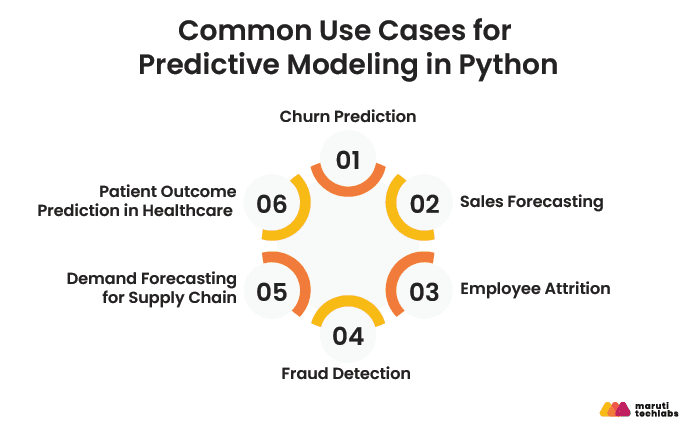
Churn Prediction - Logistic Regression / XGBoost
Financial institutions and subscription businesses use predictive modeling to flag customers at risk of closing accounts or canceling services before they leave. By analyzing historical transactions, demographics, and engagement signals such as login frequency or support tickets, models built with Logistic Regression or XGBoost estimate a churn probability score for each customer.
Teams use that score to prioritize retention campaigns, offer targeted incentives, and route high-risk accounts to customer success teams. Since churn datasets are often imbalanced, XGBoost typically delivers better prediction accuracy than simpler models.
Sales Forecasting - ARIMA / Prophet
Predictive models help companies anticipate future sales by analyzing historical performance, seasonality, and promotional activity. ARIMA works well when the sales pattern is relatively stable and well-behaved, while Prophet, built by Meta, handles irregular seasonality and holiday effects with less manual tuning.
Instead of responding to demand after the fact, firms may synchronize stock levels and campaign timing with anticipated demand by using forecasts from either model directly into inventory planning and marketing calendars. Accurate sales forecasting in Python reduces both overstocking costs and missed-revenue stockouts.
Employee Attrition - Random Forest / Gradient Boosting
HR departments use predictive modeling to identify employees most likely to resign, often months before they submit their notice. Performance ratings, tenure, engagement survey scores, and compensation relative to role benchmarks are the strongest predictors, and Random Forest or Gradient Boosting classifiers handle this mixed, moderately sized dataset well without heavy preprocessing.
In addition to identifying individual flight risks, these models reveal the elements that contribute to team attrition, which HR can utilize to revamp retention initiatives before turnover spikes. Since replacing an employee can cost 50% to 200% of their annual salary, depending on the role, organizations often realize a strong return on investment by using predictive models to improve retention and reduce turnover costs.
Fraud Detection - Isolation Forest / Random Forest
Large amounts of financial transaction data are analyzed by fraud detection models in order to identify irregularities in real time as opposed to after settlement. Isolation Forest is purpose-built for this: it isolates unusual transactions without needing labeled fraud examples, which matters because confirmed fraud cases are always a tiny fraction of total transactions.
Random Forest classifiers gain strength once enough labeled fraud data is available to train on directly. Organizations in the banking, insurance, and e-commerce sectors can score transactions in real time using Python's machine learning stack, reducing financial losses and preventing unnecessary blocking of legitimate transactions due to false positives.
Demand Forecasting for Supply Chain - Prophet / LSTM
Predictive modeling improves supply chain efficiency by forecasting product demand from historical sales, market conditions, and seasonal variation. While LSTM is better suited for complicated, non-linear demand patterns driven by several sources, including promotional surges, Prophet performs well for the majority of demand forecasting applications.
Getting this forecast right lets businesses prevent stockouts, avoid tying up capital in excess inventory, and optimize logistics routing well in advance. Python-based demand models are typically retrained on a rolling basis as new sales data comes in each week or month.
Patient Outcome Prediction in Healthcare - Logistic Regression / Gradient Boosting
Hospitals and health systems use predictive modeling to estimate the likelihood of patient readmission or predict how a patient will respond to a given treatment. Models trained on electronic health records, including vitals, lab results, medication history, and prior admissions, help clinical teams flag high-risk patients for earlier intervention.
Gradient Boosting is used when achieving the highest possible prediction accuracy is more important. When used effectively, these models lower preventable readmissions and provide more individualized treatment planning. However, since they directly affect patient safety, they need to be carefully validated.
Predictive Modeling: Comparison Table for Different Use Cases
This table gives a quick reference for selecting algorithms, libraries, and evaluation metrics across the six use cases above. Accuracy and classification metrics dominate for churn, attrition, fraud, and patient outcomes, while error-based metrics (RMSE, MAE, MAPE) take over for the two time-series cases, sales and demand forecasting.
| Use Case | Best Algorithm(s) | Key Python Libraries | Evaluation Metric |
| Churn Prediction | Logistic Regression, XGBoost | scikit-learn, XGBoost | F1-score, AUC-ROC |
| Sales Forecasting | ARIMA, Prophet | statsmodels, Prophet | RMSE, MAPE |
| Employee Attrition | Random Forest, Gradient Boosting | scikit-learn | Accuracy, F1-score |
| Fraud Detection | Isolation Forest, Random Forest | scikit-learn | Precision, Recall |
| Demand Forecasting | Prophet, LSTM | Prophet, TensorFlow/Keras | RMSE, MAE, MAPE |
| Patient Outcome Prediction | Logistic Regression, Gradient Boosting | scikit-learn, XGBoost | AUC-ROC, Recall |
How to Build a Predictive Model in Python: Step-by-Step (with Code)
Building a predictive model in Python follows a structured workflow, from data preparation and feature engineering to model training, tuning, and evaluation. This step-by-step guide demonstrates how to create and optimize a machine learning model using Python and scikit-learn.
Step 1: Load the Data
Start by importing the required libraries and loading your dataset into a Pandas DataFrame. In production, this data typically comes from a CSV file, database, or cloud storage. Throughout this example, we'll use a representative churn dataset.
import pandas as pd
# Load data into a Pandas DataFrame
df = pd.read_csv("churn.csv")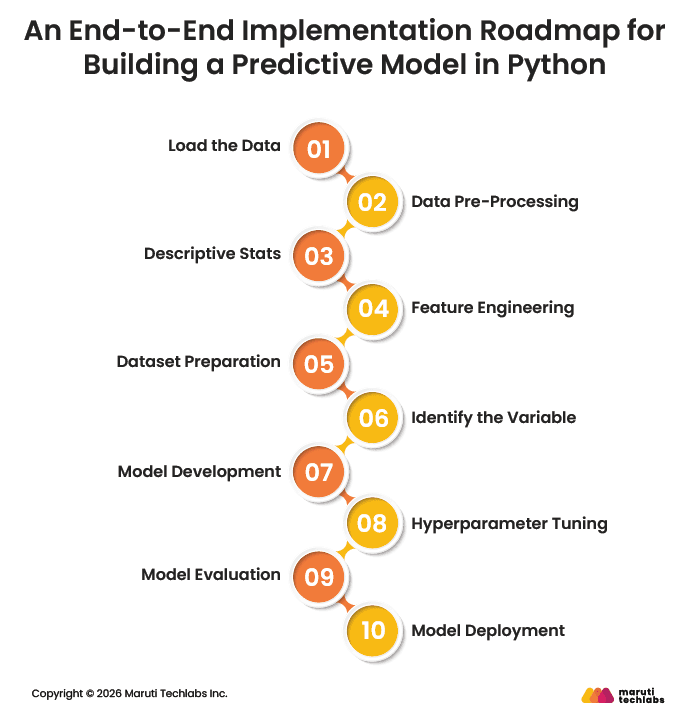
Step 2: Data Pre-Processing
Now that you've loaded the dataset, inspect its structure using df.info() and df.head(). Next, clean the data by handling missing values and converting categorical features (including the target variable, if applicable) into a numeric format suitable for machine learning.
# Inspect the dataset
print(df.info())
print(df.head())
# Handle missing values
df = df.dropna()
# Convert the target variable to numeric if required
# Replace "target" with your dataset's target column
# Example:
# df["target"] = df["target"].map({"Yes": 1, "No": 0})
Step 3: Descriptive Stats
Run summary statistics and check correlations between each feature and the target. Strong correlations provide an early indication of which features are likely to influence the model most.
print(df.describe())
numeric_df = df.select_dtypes(include="number")
# Replace "target" with your dataset's target column
target_column = "target"
print(
   numeric_df.corr()[target_column]
   .sort_values(ascending=False)
)
Step 4: Feature Engineering
When working with Python-based modeling, feature engineering plays an essential role. A poorly designed feature will immediately impact your predictive model, regardless of the data or architecture.
Well-designed features often matter more than the choice of algorithm. Feature engineering can generate new features that simplify and speed up data processing while improving model performance. You may use tools like FeatureTools and TsFresh to make feature engineering easier and more efficient for your predictive model.
Step 5: Dataset Preparation
Split the dataset into training, validation, and testing sets. This ensures the model is trained on one subset, tuned on another, and evaluated on completely unseen data.
from sklearn.model_selection import train_test_split
# Replace "target" with your dataset's target column
X = df.drop("target", axis=1)
y = df["target"]
X_train, X_temp, y_train, y_temp = train_test_split(
   X,
   y,
   test_size=0.30,
   random_state=42,
   stratify=y
)
X_val, X_test, y_val, y_test = train_test_split(
   X_temp,
   y_temp,
   test_size=0.50,
   random_state=42,
   stratify=y_temp
)
Step 6: Feature Selection
Selecting the right features improves model accuracy while reducing unnecessary complexity. Techniques such as chi-square testing, recursive feature elimination, random forest feature importance, and L1 regularization help identify the most relevant variables.
from sklearn.feature_selection import SelectKBest
from sklearn.feature_selection import chi2
selector = SelectKBest(score_func=chi2, k=10)
X_train = selector.fit_transform(X_train, y_train)
X_test = selector.transform(X_test)
X_val = selector.transform(X_val)
Step 7: Model Development
Train the selected machine learning algorithm using the training dataset. Once trained, generate predictions on the test dataset.
from sklearn.ensemble import RandomForestClassifier
model = RandomForestClassifier(random_state=42)
model.fit(X_train, y_train)
y_pred = model.predict(X_test)
Step 8: Hyperparameter Tuning
Hyperparameter tuning helps improve model performance by searching for the best combination of model parameters.
import numpy as np
from sklearn.model_selection import RandomizedSearchCV
from sklearn.ensemble import RandomForestClassifier
n_estimators = [int(x) for x in np.linspace(start=10, stop=500, num=10)]
max_features = ["sqrt", "log2"]
max_depth = [int(x) for x in np.linspace(3, 30, 10)]
max_depth.append(None)
min_samples_split = [2, 5, 10]
min_samples_leaf = [1, 2, 4]
bootstrap = [True, False]
random_grid = {
   "n_estimators": n_estimators,
   "max_features": max_features,
   "max_depth": max_depth,
   "min_samples_split": min_samples_split,
   "min_samples_leaf": min_samples_leaf,
   "bootstrap": bootstrap,
}
rf = RandomForestClassifier(random_state=42)
rf_random = RandomizedSearchCV(
   estimator=rf,
   param_distributions=random_grid,
   n_iter=10,
   cv=5,
   verbose=2,
   random_state=42,
   n_jobs=-1,
)
rf_random.fit(X_train, y_train)
best_model = rf_random.best_estimator_
After testing various predictive analytics models, the one with the best accuracy is selected as the final model.
Step 9: Model Evaluation
Once the model is trained, evaluate its performance using classification metrics. Accuracy measures the overall percentage of correct predictions, while Precision, Recall, and F1-score provide better insight when working with imbalanced datasets such as customer churn. ROC-AUC measures how effectively the model distinguishes between the two classes.
from sklearn.metrics import (
   accuracy_score,
   precision_score,
   recall_score,
   f1_score,
   roc_auc_score,
)
# Generate predictions using the tuned model
y_pred = best_model.predict(X_test)
print("Accuracy:", accuracy_score(y_test, y_pred))
print("Precision:", precision_score(y_test, y_pred))
print("Recall:", recall_score(y_test, y_pred))
print("F1-score:", f1_score(y_test, y_pred))
print(
"ROC-AUC:",
roc_auc_score(
y_test,
best_model.predict_proba(X_test)[:, 1]
)
)Step 10: Model Deployment
A model sitting in a notebook creates little business value. Save the trained model, expose it through an API, and deploy it so applications can make predictions in real time.
Save the model:
import joblib
joblib.dump(best_model, "churn_model.pkl")
Serve it with FastAPI:
from fastapi import FastAPI
import joblib
import pandas as pd
app = FastAPI()
model = joblib.load("churn_model.pkl")
@app.post("/predict")
def predict(features: dict):
   df = pd.DataFrame([features])
   prediction = model.predict(df)[0]
   probability = model.predict_proba(df)[0][1]
   return {
       "prediction": int(prediction),
       "probability": float(probability),
   }
Run the application locally using:
uvicorn main:app --reloadOnce deployed, monitor the model regularly by logging predictions, comparing them with actual outcomes, and retraining the model whenever performance declines because of data drift.
What Are the Best Python Libraries for Predictive Modeling?
The right Python library depends on your predictive modeling task. While some libraries focus on data preparation, others are designed for machine learning, deep learning, visualization, or time-series forecasting.
TensorFlow
TensorFlow is an open-source deep learning library used to build, train, and deploy predictive models efficiently. Its flexible architecture supports CPUs, GPUs, and TPUs for large-scale computations. TensorFlow excels in neural networks, time-series forecasting, and production-ready model deployment, making it ideal for complex predictive modeling in finance, healthcare, and retail.
PyTorch
PyTorch is a dynamic deep learning framework favored for research and production due to its flexible computation graphs and strong GPU support. It simplifies building custom models for tasks such as image recognition, NLP, and time-series prediction, and its smooth integration with Python makes it intuitive for advanced predictive modeling.
Pandas
Pandas is Python’s go-to library for data manipulation and preprocessing in predictive modeling. It uses DataFrames to handle structured data, performing operations such as feature engineering, transformation, and cleaning.
Efficient slicing, grouping, and merging of large datasets simplify the preparation of input features before feeding them into machine learning or deep learning models.
Scikit-learn
Scikit-learn provides an extensive suite of machine learning algorithms for classification, regression, clustering, and dimensionality reduction, and it remains the backbone of traditional predictive modeling in Python.
Its Pipeline object is what makes it genuinely production-ready: it chains preprocessing, model training, and evaluation into a single, reusable object, so the exact transformations applied during training are guaranteed to be applied identically at prediction time.
from sklearn.pipeline import Pipeline
from sklearn.preprocessing import StandardScaler
from sklearn.linear_model import LogisticRegression
from sklearn.metrics import accuracy_score, f1_score
# Preprocessing -> Model -> Evaluation, chained into one object
pipeline = Pipeline([
   ('scaler', StandardScaler()),
   ('model', LogisticRegression())
])
pipeline.fit(X_train, y_train)
preds = pipeline.predict(X_test)
print("Accuracy:", accuracy_score(y_test, preds))
print("F1-score:", f1_score(y_test, preds))
Because the scaler and model are bundled together, you can save this entire pipeline with joblib.dump() and deploy it as a single object, with no risk of applying the wrong scaling logic in production.
Matplotlib
Matplotlib is Python's foundational visualization library for creating static, interactive, and publication-quality charts. In predictive modeling, it visualizes trends, residuals, feature importance, and model performance metrics. When combined with libraries like Seaborn, it provides clear insights into dataset patterns, helping teams validate assumptions and communicate predictions effectively.
XGBoost
XGBoost is a high-performance gradient boosting library known for delivering advanced predictive accuracy and is widely used for structured or tabular data problems such as classification, regression, and ranking. Its efficiency in handling missing values, built-in cross-validation, and parallelized computation make it a top choice in Kaggle competitions and enterprise predictive modeling projects.
LightGBM
LightGBM is a gradient boosting framework built for speed. It uses histogram-based splitting and leaf-wise tree growth instead of the level-wise growth used by most other boosting libraries, which lets it train significantly faster than XGBoost on large datasets without sacrificing accuracy. LightGBM is often preferred for large datasets and low-latency production pipelines because it trains faster than XGBoost without sacrificing accuracy.
Prophet
Prophet is Meta's open-source forecasting library, purpose-built for time-series data with strong seasonal patterns, such as daily sales, web traffic, or demand data with weekly and yearly cycles.
It automatically handles trend changes, holiday effects, and missing data with far less manual tuning than classical statistical models require, making it the most widely adopted library for time-series forecasting tasks in Python.
For time-series forecasting, use statsmodels for ARIMA and SARIMA models when you need detailed statistical analysis, and Prophet when you need fast, scalable forecasts with minimal tuning.
Which Predictive Modeling Library Fits Your Needs? A Comparison Table
Library | Best For | Strengths | When to Use |
TensorFlow | Deep learning, neural networks | GPU/TPU support, production deployment | Complex models, large-scale computation |
PyTorch | Research and custom deep learning | Flexible computation graphs, strong GPU support | Image recognition, NLP, custom architectures |
Pandas | Data manipulation and preprocessing | Fast DataFrame operations, cleaning, merging | Every project, at the preprocessing stage |
Scikit-learn | Traditional ML, pipelines | Simplicity, wide algorithm coverage, Pipeline object | Baseline models, classification, regression |
Matplotlib | Visualization | Publication-quality static and interactive charts | Exploratory analysis, reporting results |
XGBoost | Tabular data, high accuracy | Handles missing values, parallelized, competition-grade | Structured data where accuracy is the priority |
LightGBM | Large-scale tabular data | Faster training than XGBoost, leaf-wise growth | Production pipelines with tight latency needs |
Prophet | Time-series with seasonality | Automatic trend and holiday handling | Sales, demand, and traffic forecasting |
Advanced Tools for Predictive Modeling Pipelines
Advanced predictive modeling tools simplify the entire machine learning workflow. They help with feature engineering, model optimization, experiment tracking, and explainability, making it easier to build and deploy reliable models.
Optuna
Optuna is an advanced hyperparameter optimization framework that intelligently searches for optimal hyperparameters to improve model performance. Unlike traditional grid or random search, Optuna uses Tree-structured Parzen Estimator (TPE) and pruning techniques to converge on optimal configurations quickly.
It works smoothly with libraries like XGBoost, LightGBM, PyTorch, and TensorFlow, making it invaluable for both classical ML and deep learning projects. Automating tuning saves hours of manual experimentation while often delivering superior predictive accuracy.
tsfresh
tsfresh focuses on extracting hundreds of statistical and domain-agnostic features from time-series datasets, such as mean, variance, entropy, and autocorrelation metrics.
This reduces the need for manual feature engineering in forecasting tasks like sales prediction, demand planning, or sensor data analysis, and helps models capture hidden temporal patterns.
Featuretools
Featuretools is designed for relational datasets and automates the creation of new predictive features through its Deep Feature Synthesis (DFS) technique.
Across several linked tables, it can produce insightful aggregates, trends, and transformations. This is critical for projects involving customer analytics, churn prediction, and financial risk modeling.
MLflow
MLflow is an open-source platform for tracking experiments, logging parameters, and managing model versions across the full lifecycle of a predictive modeling project.
As a team runs dozens or hundreds of model variants during tuning, MLflow keeps a record of exactly which parameters, features, and code version produced each result, so the best-performing model is always reproducible rather than lost in someone's notebook history.
This becomes essential the moment a predictive modeling effort moves from a single data scientist's experiment to a production-grade pipeline maintained by a team, since it replaces ad hoc spreadsheets and file-naming conventions with a single source of truth for what was tried and what worked.
Machine learning services frequently rely on MLflow to maintain a consolidated record of experiments, model revisions, and performance metrics as predictive modeling projects become more complex. This makes collaboration and deployment more dependable.
SHAP (SHapley Additive exPlanations)
SHAP, which is based on cooperative game theory rather than a rough approximation, explains individual forecasts by attributing each feature's contribution to a particular outcome.
Rather than merely informing you that a model has a 90% accuracy rate, SHAP explains why it identified this specific customer as high-risk or granted this specific loan application.
That level of explainability has moved from nice-to-have to required in regulated industries: finance and healthcare increasingly mandate that predictive models justify individual decisions, not just report aggregate accuracy. SHAP is how teams meet that bar without abandoning high-performing but harder-to-interpret models like XGBoost or LightGBM.
Common Mistakes When Building Predictive Models (and How to Fix Them)
Most predictive modeling failures aren't algorithm problems; they're process problems. A model that looks excellent in a notebook and then falls apart in production has almost always fallen into one of five traps. 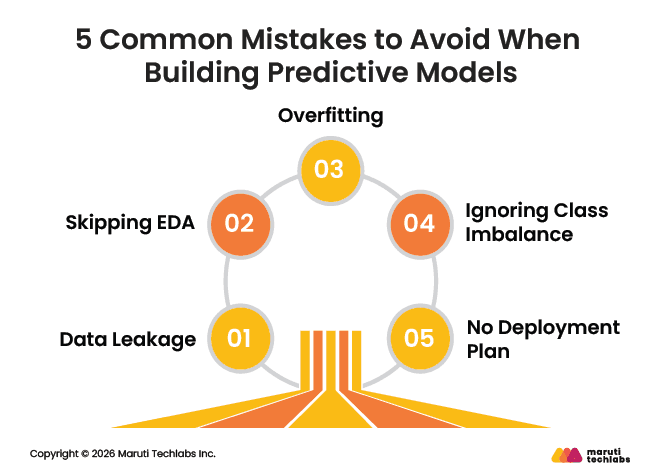
Here's what to watch for, and how to fix each one.
Data Leakage
Data leakage happens when information from the target variable, or from data that wouldn't exist at prediction time, sneaks into your training features. A classic example: including "days since last support ticket resolved" as a feature when the ticket itself was filed because the customer was about to churn.
The model looks highly accurate in testing because it's effectively cheating, then collapses in production once that information isn't available yet.
Fix: Build your preprocessing and feature engineering inside a scikit-learn Pipeline, and always perform your train/test split before any transformation touches the data, not after. Fitting scalers, encoders, or imputers on the full dataset before splitting is one of the most common ways leakage slips in unnoticed.
Skipping EDA
You are modeling on unfamiliar ground if you go straight to model training without first examining the data. Outliers, duplicate rows, mismatched units, and missing values all subtly distort model performance in ways that are difficult to identify after the fact.
Fix: Before training a model, run df.describe() and create a correlation heatmap. These simple checks help identify data quality issues, unusual values, low-variance columns, and highly correlated features before they cause problems later.
Overfitting
An overfit model memorizes the training data rather than learning generalizable patterns, so it performs beautifully on the training set but unpredictably in the real world. This is especially common with high-capacity models like deep decision trees or neural networks on limited data.
Fix: Use cross-validation instead of a single train/test split for more reliable results; apply L1 or L2 regularization to reduce overfitting; and use early stopping to halt training when model performance no longer improves.
Ignoring Class Imbalance
Fraud, churn, and rare-disease datasets are almost always skewed, often 95% or more toward the "normal" class. A model trained without accounting for this can hit 95% accuracy by simply predicting the majority class every time, while being functionally useless at the one thing it was built to catch.
Fix: For imbalanced datasets, use SMOTE to create more minority-class examples, set class_weight='balanced' so the model gives more importance to the minority class, and adjust the prediction threshold instead of always using the default 0.5.
No Deployment Plan
A model that stays in a Jupyter notebook generates zero business value, no matter how accurate it is. This is one of the most common reasons predictive modeling projects stall after the proof-of-concept stage: the team optimized for model performance and never planned for how it would actually reach production.
Fix: Deploy the trained model with FastAPI, package it as a Docker image for consistent deployment, and use MLflow to track predictions and detect model drift before it affects the business.
Conclusion
Predictive modeling in Python is not just about selecting algorithms or improving accuracy scores. The real differentiator lies in how well the model fits into a production environment, how reliably it performs over time, and how clearly its outputs can drive decisions.
Teams that succeed treat modeling as a continuous system. They invest in clean data pipelines, choose models based on business constraints, and prioritize deployment, monitoring, and iteration from the start. That is what turns a working model into a measurable business asset.
How Maruti Techlabs Built a Machine Learning Model That Narrowed Auto Parts Sales Forecasting Errors to ±20%
We recently built a custom machine-learning-based sales-forecasting model for one of the largest manufacturers and distributors of aftermarket auto parts, serving customers across five continents.
The client was relying on a static, formula-driven forecasting process that couldn't adapt to market fluctuations or seasonal demand shifts, leading to a pattern of overstocking on some parts and missed sales on others.
We developed a forecasting model using Long Short-Term Memory (LSTM), selected specifically for its accuracy on sequential, time-dependent sales data. To handle the client's skewed and inconsistent source data, we built custom APIs to extract clean, up-to-date information and extended the model to forecast sales for newly launched parts by matching them to the characteristics of existing comparable products.
The impact
- Prediction errors for high-selling parts narrowed to within ±20%, a sharp improvement over the old formula-based approach.
- Inventory tracking and restocking processes improved significantly, reducing both overstocking and stockouts.
- Throughout the client's warehousing network, storage allocation and operational effectiveness were optimized.
- Following the engagement, the client continued to rely on Maruti Techlabs for scalable, data-driven forecasting as demand grew.

FAQs
1) What is the best Python library for predictive modeling?
It depends on the task.
- Scikit-learn is the best starting point for traditional ML like classification, regression, and clustering.
- XGBoost or LightGBM take over when you need maximum accuracy on tabular data.
- TensorFlow or PyTorch are the right choice once you move into deep learning.
2) How do I evaluate a predictive model in Python?
The right metric depends on the model type: accuracy and F1-score for classification, RMSE and MAE for regression, and MAPE for forecasting models. Use cross_val_score from scikit-learn instead of a single train/test split for a more reliable estimate of real-world performance.
3) What is the difference between predictive modeling and machine learning?
Predictive modeling aims to forecast an outcome, while machine learning is one set of methods used to achieve it. All ML models can be predictive models, but not all predictive models use ML; ARIMA, for example, is a statistical method, not a machine learning one.
4) How long does it take to build a predictive model in Python?
A baseline model can be built in a matter of hours once the data is clean. A production-ready model, including tuning, validation, and deployment, typically takes two to six weeks depending on data quality and complexity.
5) How do you handle imbalanced datasets in predictive modeling?
Pickle or joblib can be used to store the trained model, Flask or FastAPI can be used to deploy it, and Docker may be used to package it. Since accuracy is deceptive when dealing with skewed data, evaluate using F1-score or AUC-ROC instead of accuracy.
6) Can I deploy a predictive model built in Python?
Yes. Pickle or joblib can be used to store the trained model; Flask or FastAPI can be used to deploy it; and Docker can be used to package it. Evidently, AI or MLflow can be used to monitor its performance.
7) What is the difference between predictive modeling and forecasting?
Forecasting is a subset of predictive modeling focused on time-dependent predictions, such as next quarter's revenue. Predictive modeling is the broader category, also covering classification and regression tasks that have nothing to do with time.


