

AI in Software Development: How Maruti Techlabs Accelerates the SDLC
Key Takeaways
- AI supports every stage of the software development lifecycle, not just code generation.
- The best results come from combining AI with engineering expertise and human oversight.
- AI improves planning, development, testing, deployment, and maintenance when it's part of the workflow, not bolted on.
- Successful AI adoption starts with identifying the right use cases, not using AI everywhere.
- Security, governance, and continuous testing are essential to a secure SDLC when building AI-enabled software.
- A structured AI strategy and an experienced technology partner make adoption faster and more scalable.
Introduction
The software development life cycle is undergoing one of its biggest shifts since the adoption of Agile and DevOps. AI now supports every stage of the SDLC, from requirements analysis and code generation to testing, deployment, and production monitoring. According to McKinsey, around 20% of organizations are already scaling AI coding agents, with adoption reaching 31% among larger enterprises.
AI can generate code, but developers are still the ones who turn it into working software. They review what AI produces, make design decisions, and solve problems that require context. That's why AI is now used across the SDLC, helping teams move faster from testing and deployment to monitoring and maintenance.
In this blog, you'll learn how AI fits into every stage of the SDLC process and how agentic AI is reshaping software engineering. We’ll also explore how Maruti Techlabs applies AI across software projects and the best practices for successful AI adoption.
Looking to accelerate software delivery without compromising code quality, security, or engineering standards?
See how our AI-powered SDLC approach helps teams build production-ready software faster.
What Is AI in Software Development?
AI in software development refers to the use of artificial intelligence technologies to assist developers in building, improving, and maintaining software. Instead of relying only on predefined instructions, AI systems can analyze patterns, understand context, and generate recommendations based on the data they process.
From AI-powered coding assistants to intelligent development platforms, these tools help software teams work with greater speed and efficiency. AI is becoming an important part of modern engineering because it can handle complex information, automate repetitive activities, and support better technical decision-making.
Core Technologies Behind AI Software Development
AI software development is powered by a combination of technologies that enable machines to understand, generate, and improve software-related tasks.
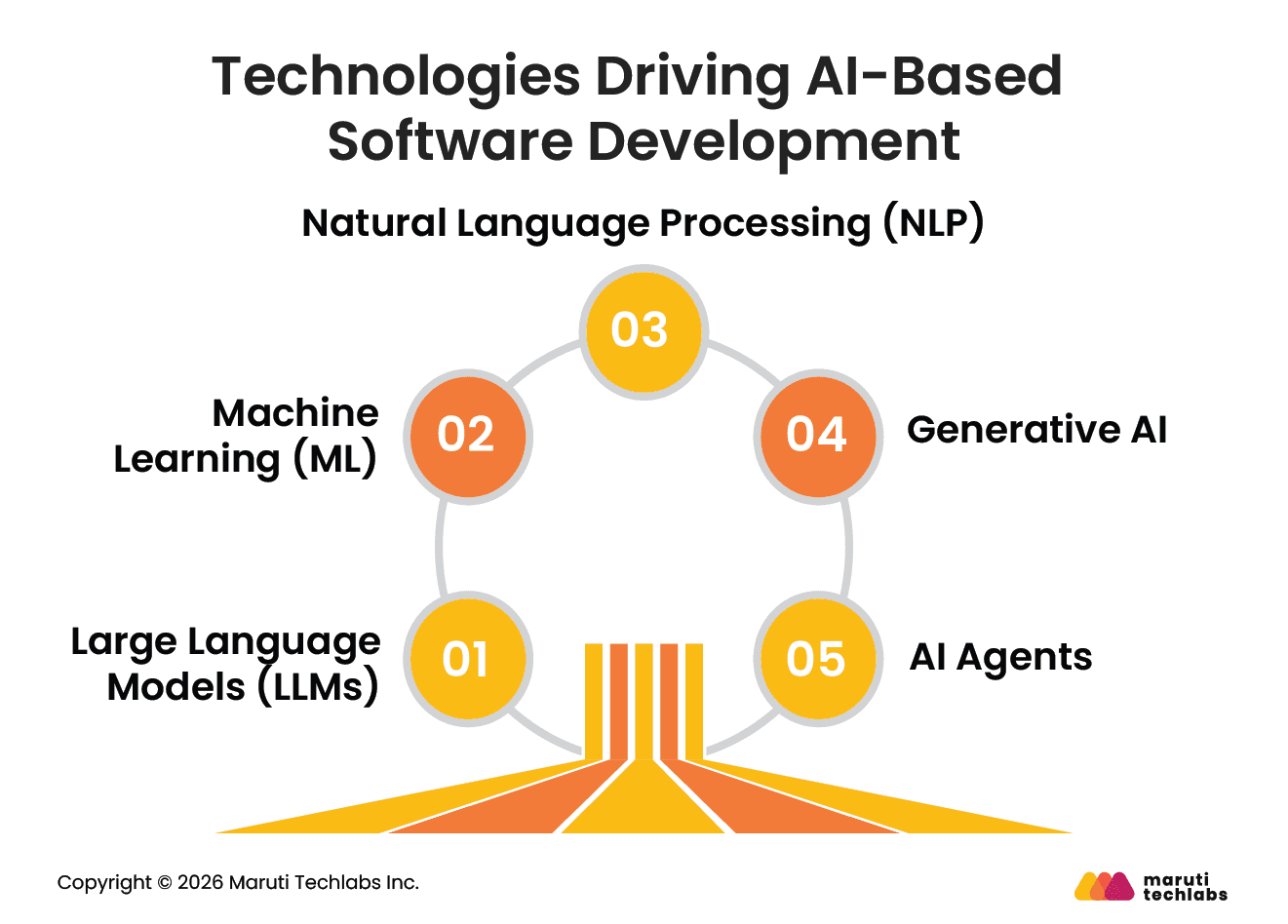
- Large Language Models (LLMs): LLMs enable AI tools to understand natural language instructions and generate human-like responses, including code suggestions, explanations, and technical content.
- Machine Learning (ML): ML models identify patterns from existing data to make predictions, improve recommendations, and detect potential issues.
- Natural Language Processing (NLP): NLP allows AI systems to understand human language, making it possible to interact with development tools using conversational instructions.
- Generative AI: Generative AI creates new content such as code, documentation, and other software assets based on existing patterns and user inputs.
- AI Agents: AI agents combine reasoning and automation capabilities to perform complex tasks by analyzing information, making decisions, and executing predefined actions.
Together, these technologies form the foundation of AI-powered software development and enable tools that can understand, generate, and assist with software-related tasks.
Why AI Is Becoming Essential in Software Engineering
The growing complexity of software systems, shorter delivery timelines, and increasing demand for innovation have made traditional development approaches harder to scale. AI helps engineering teams manage this complexity by reducing repetitive effort and enabling developers to focus on higher-value problem-solving.
As organizations continue adopting AI, its role in software engineering is expanding from a productivity tool to a core capability that supports modern development practices. At Maruti Techlabs, we've seen this shift firsthand while helping businesses integrate AI into software products and engineering workflows.
Understanding the SDLC Process and Where AI Fits
The Software Development Life Cycle (SDLC) covers the different steps teams follow to build and maintain software. It usually begins with gathering requirements and moves through design, development, testing, deployment, and ongoing improvements after release.
Traditional SDLC works well when software behaves as expected and updates are managed through code changes. AI-based systems require a different approach because their performance can change based on data quality, model behavior, and new inputs. Teams need to track components such as model correctness, data changes, and system performance along with standard software maintenance.
As companies move beyond using AI tools only for coding assistance, they need better ways to bring them into existing engineering practices. Well-defined workflows, security checks, and governance help teams use AI consistently across development teams.
Let's look at how AI supports different stages of the SDLC:
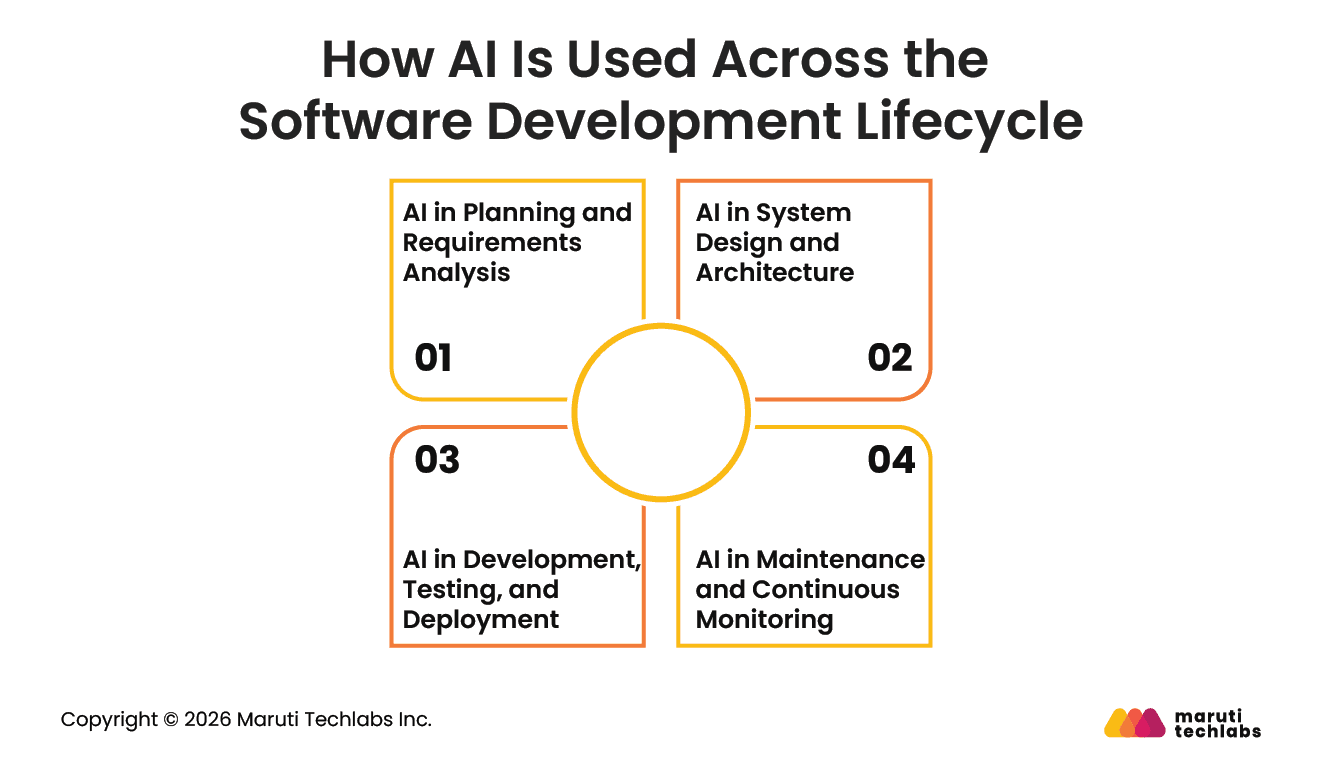
1. AI in Planning and Requirements Analysis
AI helps teams better understand project requirements before development begins. It can assist with:
- Organizing requirements from multiple sources
- Highlighting missing or conflicting information
- Supporting early planning discussions
2. AI in System Design and Architecture
During system design, AI helps teams evaluate technical options before implementation. It can assist with:
- Reviewing possible architecture approaches
- Supporting early design discussions
- Comparing technical alternatives
3. AI in Development, Testing, and Deployment
AI has become an important part of the implementation phase, helping developers improve speed and maintain quality. It supports:
- Generating code suggestions and automating repetitive development tasks
- Creating test scenarios and identifying potential defects
- Improving deployment workflows and detecting operational issues
4. AI in Maintenance and Continuous Monitoring
After deployment, AI continues to support software operations. It can assist with:
- Monitoring application health
- Supporting issue investigation
- Helping teams respond to operational events
By integrating AI across the SDLC, teams can improve collaboration between planning, engineering, testing, and operations while creating more consistent development workflows. This is the approach our engineering teams follow when designing AI-enabled software for enterprise applications.
Knowing where AI fits in the SDLC is important, but how it's applied throughout the development process has an even greater impact on software delivery.
How AI Accelerates and Secures Every Stage of the SDLC Process
Beyond automating individual tasks, AI now supports connected workflows across the SDLC. Engineering teams can use AI to analyze requirements, assist development, improve testing, and support operations, helping reduce manual effort and deliver software more efficiently.
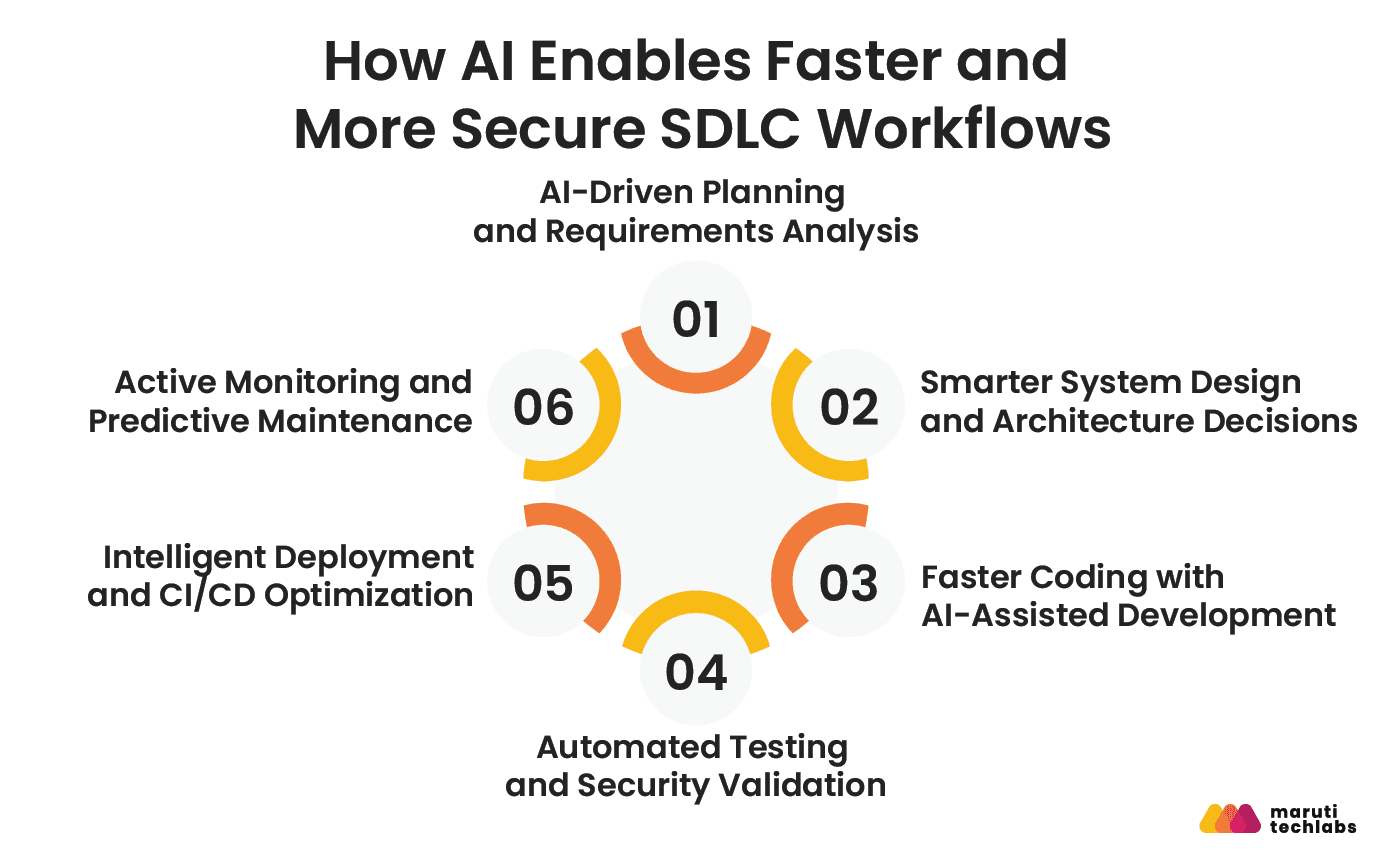
1. AI-Driven Planning and Requirements Analysis
Translating business requirements into clear technical tasks often takes multiple discussions between product and engineering teams. AI tools can help organize information from project documents, user inputs, and existing systems to highlight missing details and bring more clarity to requirements.
As these capabilities become more advanced, AI agents can take on more structured tasks such as drafting user stories, identifying dependencies, and preparing initial development tasks for teams.
2. Smarter System Design and Architecture Decisions
Architecture decisions often involve trade-offs between scalability, performance, security, and cost. AI tools can help architects review existing systems, explore design patterns, and evaluate approaches before implementation.
For larger applications, AI agents can review dependencies, evaluate architectural choices, and help teams identify possible challenges before implementation starts.
3. Faster Coding with AI-Assisted Development
AI coding assistants have become a common part of modern development workflows. Developers use them for generating boilerplate code, creating functions, explaining unfamiliar code, refactoring existing logic, and writing documentation.
Beyond simple autocomplete, AI agents can now handle multi-step development tasks such as analyzing codebases, suggesting changes, and assisting with debugging while developers remain responsible for reviewing and approving changes.
4. Automated Testing and Security Validation
Testing is one area where AI can significantly shorten feedback cycles. AI-powered testing tools can generate test cases, analyze code changes, detect regressions, and identify potential vulnerabilities. Together with CI/CD pipelines, these capabilities help teams identify issues earlier and strengthen secure SDLC practices throughout the development process.
5. Intelligent Deployment and CI/CD Optimization
Deployment workflows generate a lot of operational data across builds, releases, and infrastructure. AI can help teams make sense of this data by identifying failed deployments, recurring issues, and areas where pipelines need improvement.
6. Active Monitoring and Predictive Maintenance
Once software is in production, teams need to keep track of system behavior, performance issues, and unexpected failures. AI can help analyze logs and operational data to find patterns, identify recurring issues, and flag potential problems early. This gives teams more time to investigate and fix issues before they affect users.
Across our software engineering projects, we've found that AI delivers the most value when it supports the entire development lifecycle rather than a single stage of it.
How Maruti Techlabs Accelerates Software Development with AI
Every AI implementation is different. Some projects require document intelligence, while others focus on workflow automation, AI agents, or enterprise search. Our engineering teams work across the entire software development lifecycle, combining AI, cloud, data, and software engineering to build applications that solve specific business problems.
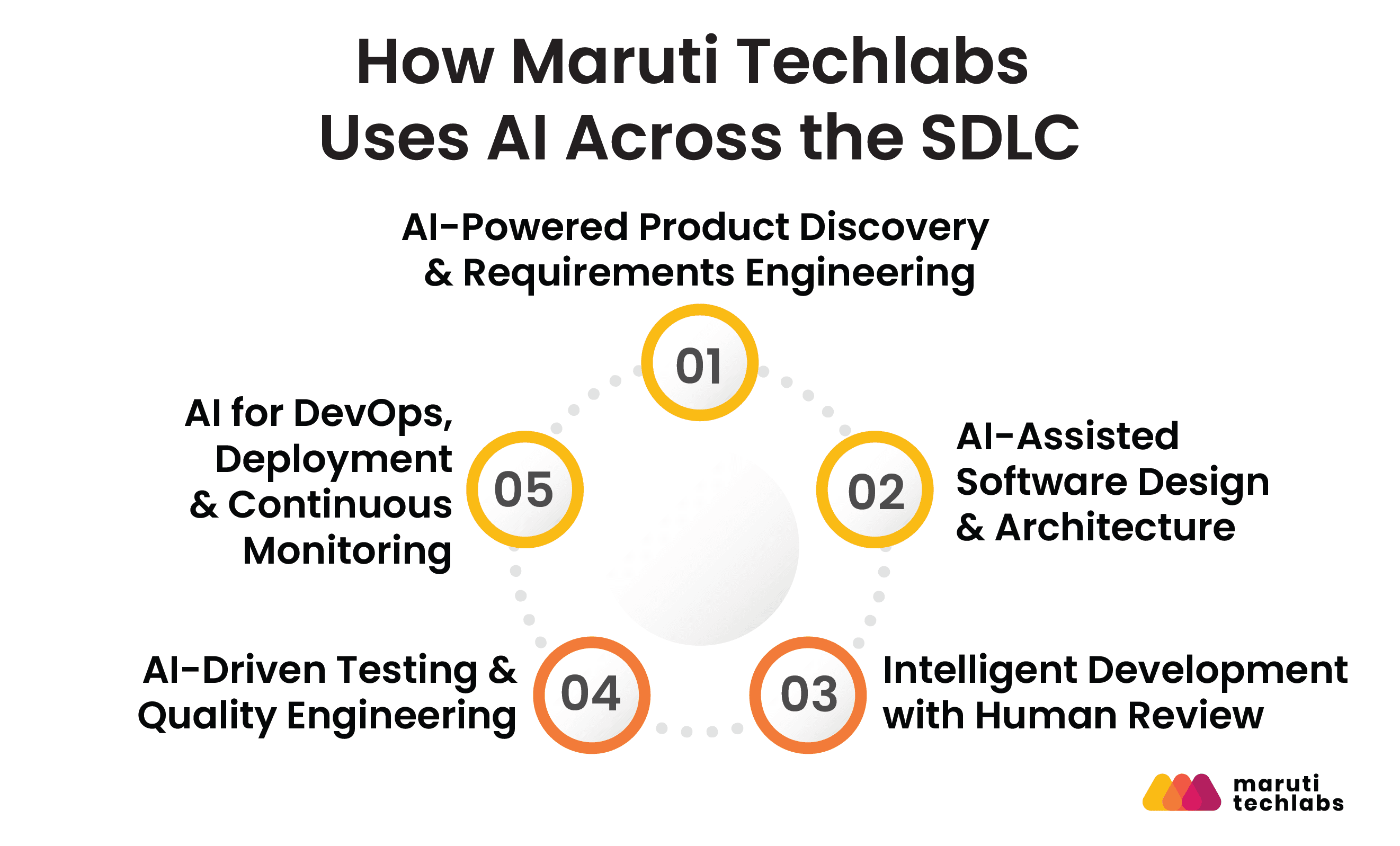
1. AI-Powered Product Discovery & Requirements Engineering
Every project begins with understanding the business problem before selecting the technology. Our teams work with stakeholders to define product requirements, identify opportunities for AI, and shape a roadmap that corresponds to technical and business goals. AI is used to organize information, analyze documents, and speed up early discovery, while architects and engineers validate the final solution design.
One example is a customized deep research platform built for a national U.S. law firm. The platform uses agentic AI to autonomously research complicated legal questions, connect information across multiple sources, and generate structured, citation-backed insights.
Business outcomes:
- 60% reduction in legal research time
- 3× improvement in research accuracy
- 40% increase in team productivity
- Lowered manual checking across research workflows
2. AI-Assisted Software Design & Architecture
The architecture behind an AI application determines how well it performs as data volumes, users, and business requirements grow. Our engineers design scalable cloud architectures, retrieval pipelines, API integrations, and agent orchestration frameworks that support production-scale workloads.
For an Am Law 200 firm, we developed an enterprise LegalTech platform combining conversational search, document intelligence, and task-specific AI agents for legal research, drafting, and due diligence.
Business outcomes:
- Cut document review, research, and drafting time from 7–8 hours to minutes
- Delivered 95%+ accuracy for complex legal reasoning workflows
- Processed large legal documents without manual chunking
- Improved scalability while reducing reliance on individual AI experts
3. Intelligent Development with Human Review
AI has become part of our engineering workflow, but every implementation still goes through architecture reviews, code validation, security checks, and quality assurance before deployment. This allows development teams to move faster while not compromising software quality.
We followed this approach during the building of an AI-powered syndicated loan platform that extracts critical information, compares legal clauses, validates inconsistencies, and automates document generation.
Business outcomes:
- 60–70% reduction in manual review effort
- 3× faster deal processing
- 95%+ extraction accuracy
- 40% reduction in risk exposure
4. AI-Driven Testing & Quality Engineering
Testing goes beyond application functionality. We validate AI outputs, business rules, integrations, and model effectiveness to ensure applications behave consistently in production. Automated testing and continuous validation help identify problems before they affect users.
One example is a compliance engine we built for a U.S.-based real estate platform. Instead of relying on fixed rules, the solution uses AI to understand listing context, detect policy violations more accurately, and reduce manual review.
Business outcomes:
- Better compliance precision from 20% to 90%+
- Decreased manual review effort
- Activated real-time policy validation
- Minimized false positives across property listings
5. AI for DevOps, Deployment & Continuous Monitoring
Launching an application is only one stage of the software lifecycle. Our teams build monitoring, observability, and cloud infrastructure into every implementation so applications remain reliable as usage grows. We also monitor AI performance, optimize deployments, and continuously improve systems based on production data.
Across industries such as legal, healthcare, insurance, financial services, and real estate, we have helped teams build and deploy AI applications that fit their existing workflows and continue to perform as business needs evolve.
Maruti Techlabs' Best Practices for Successful AI Adoption in Software Development
At Maruti Techlabs, we treat AI as part of the engineering workflow, not as a standalone productivity tool. Our teams combine AI capabilities with software engineering practices, technical reviews, and development discipline to ensure faster delivery without compromising code quality, security, or maintainability.
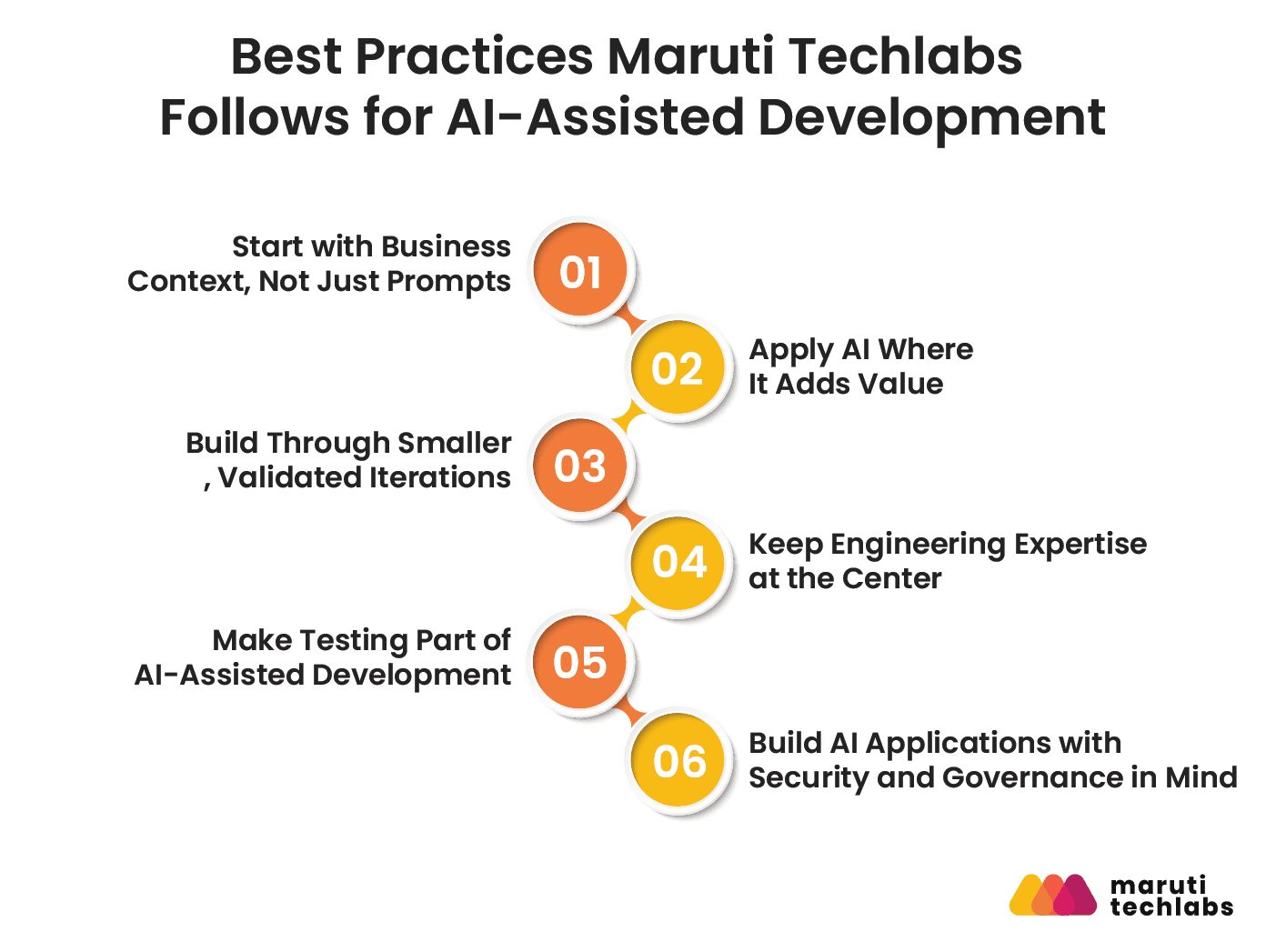
1. Start with Business Context, Not Just Prompts
Before writing code or selecting tools, our teams spend time understanding the product, existing workflows, technical requirements, and business goals. We provide AI systems with the right context through project documentation, technical details, and clear requirements so engineers can make better decisions about implementation.
2. Apply AI Where It Adds Value
Not every workflow needs AI. We look for areas involving repetitive effort, complex information processing, or time-consuming manual tasks where AI can support the development process without adding unnecessary complexity.
3. Build Through Smaller, Validated Iterations
Rather than making large changes all at once, we deliver software in smaller increments. This gives our teams more opportunities to review the implementation, test new functionality, and make improvements as the product evolves.
4. Keep Engineering Expertise at the Center
AI supports our developers, but engineering decisions remain with the team. Developers review generated code, make necessary changes, and ensure every implementation meets application requirements around performance, security, and maintainability.
5. Make Testing Part of AI-Assisted Development
Development doesn't stop once the code is written. We use automated tests, code reviews, and CI/CD pipelines to verify every change before deployment. This helps our teams release software with greater confidence and fewer unexpected issues.
6. Build AI Applications with Security and Governance in Mind
For production AI systems, security, compliance, and governance cannot be treated as final checkpoints. Our teams consider data protection, access controls, model usage, and operational requirements from the beginning to build applications that are ready for enterprise environments.
Conclusion
Using AI for software development will continue to expand, but successful implementation will depend on more than adopting new tools. Teams still need strong engineering practices, clear processes, and the right technical decisions to build software that performs reliably in production.
AI can help developers move faster by reducing repetitive work, improving testing cycles, supporting complex problem-solving, and making development workflows more efficient. However, the value comes from knowing where AI fits, how it should be implemented, and how to maintain quality and security throughout the SDLC.
At Maruti Techlabs, we work with organizations to identify where AI fits into their products and engineering processes. Our teams bring together AI, software engineering, cloud, and data expertise to design and build applications based on specific business and technical requirements. Whether it is developing custom AI solutions through our AI Development Services or building scalable applications through our Software Development Services, we help businesses create software that is practical, reliable, and ready for real-world use.
FAQs
1. How is AI transforming software development?
The biggest change is not just faster coding. AI is helping teams rethink how software moves from an idea to a finished product. Developers can spend less time on repetitive work and more time on architecture, problem-solving, and product decisions. AI is also becoming part of testing, deployment, monitoring, and other engineering activities.
2. How to implement AI in software projects?
Implementing AI in a software project starts with identifying where it can support the development process. Teams can use AI for areas such as coding assistance, testing, documentation, or workflow automation while maintaining proper reviews and security practices. The focus should be on integrating AI into existing engineering processes rather than treating it as a separate tool.
3. Can AI speed up software development and reduce costs?
AI can help teams deliver software faster by reducing the time spent on repetitive work, such as writing boilerplate code, reviewing documentation, preparing test cases, and troubleshooting issues. This often leads to lower development effort and better use of engineering resources. The actual impact depends on the project, development process, and how AI is introduced into the workflow.
4. What are the benefits of using AI throughout the SDLC?
Using AI across the SDLC helps teams improve different parts of the development process, from requirement analysis and coding to testing and maintenance. It can help identify issues earlier, improve collaboration between teams, and provide better visibility into software performance after deployment.
6. How does Maruti Techlabs use AI for software development?
At Maruti Techlabs, we use AI to support the entire software development lifecycle, not just coding. Our teams apply AI to requirements analysis, software design, development, testing, deployment, and monitoring, while engineers remain responsible for architecture, code quality, security, and final implementation. This helps businesses adopt AI in a structured way without disrupting existing engineering workflows.
7. Can Maruti Techlabs help us assess if our software development process is ready for AI adoption?
Yes. Through our AI Readiness Assessment, we help businesses evaluate their current processes, technology landscape, and business goals to identify suitable AI opportunities. We help teams understand where AI can add value and create a practical roadmap for implementation.