

What Are Machine Learning Solutions? A Complete Business Guide
Key Takeaways
- Machine learning helps businesses automate regular work, discover patterns in data, and make faster, more data-driven decisions.
- The right machine learning approach depends on your business goals, the quality of your data, and the problem you're trying to solve.
- Successful machine learning projects require continuous monitoring, model updates, and alignment with evolving business needs.
- While off-the-shelf models work well for common use cases, custom machine learning solutions provide enhanced flexibility for unique business needs.
- Businesses that treat machine learning as a long-term capability are more likely to attain lasting value from their AI investments.
Introduction
What happens when thousands of patient letters need processing every day? One of the UK's largest healthcare providers faced this challenge with slow, manual document classification. We built an OCR and NLP-powered machine learning solution that reduced processing time by 87%, improved accuracy to 93%, and reduced the review team from 12 people to two.
This is one example of how machine learning is solving real business problems across industries. From improving customer experiences to automating repetitive tasks, businesses are finding new ways to create measurable value. Yet building an accurate model is only the first step, because deploying it into production often proves far more challenging.
As adoption grows, investment in machine learning continues to accelerate. The U.S. machine learning market exceeds $21 billion, while the global AI market is expected to reach $1.2 trillion by 2030. Understanding where machine learning fits and how to implement it effectively is becoming a business priority.
This guide explores machine learning solutions, common use cases, implementation best practices, and when custom development delivers the greatest business value.

What Are Machine Learning Solutions?
Machine learning solutions are AI-driven systems that learn from data instead of relying on fixed programming rules. They observe patterns, make predictions, and improve performance as more data becomes available. This helps businesses to automate complex tasks and make faster, analytics-based decisions.
Consider email spam detection. Instead of following a fixed list of rules, a machine learning model acquires knowledge from thousands of labeled emails. It identifies patterns across time and becomes better at distinguishing spam from legitimate messages.
This learning approach powers many everyday applications. It detects fraud, recommends songs, estimates travel times, and forecasts demand. It also helps doctors analyze medical records and manufacturers predict equipment failures.
According to Google, machine learning delivers a new way to solve problems, answer complex questions, and create new content. It can predict the weather, estimate travel times, recommend songs, autocomplete sentences, summarize articles, and even generate images. Such flexibility makes machine learning valuable across industries and business functions.
What are the Various Machine Learning Approaches Used in Modern AI?
Machine learning solutions are built using different learning approaches. Each approach strives to solve a specific type of problem. Here are the four main types of machine learning.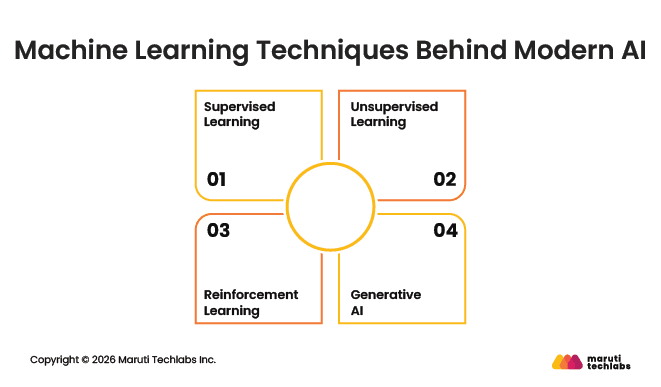
- Supervised learning uses labeled data where the correct outcome is already known. It is commonly used for spam detection, fraud prevention, and sales forecasting.
- Unsupervised learning works with unlabeled data to discover concealed patterns. Businesses use it for customer segmentation, recommendation engines, and anomaly detection.
- Reinforcement learning learns through trial and error. It tries different actions, receives rewards for the right ones, and learns from its mistakes over time. This makes it well-suited for uses such as robotics, self-driving vehicles, and intelligent automation.
- Generative AI learns from existing data to create new content. It can generate text, images, code, audio, and videos. Businesses use it to automate content creation, customer support, and software development.
Each approach solves different business problems. Choosing the right one depends on your data, goals, and the outcomes you want to achieve.
How Different Industries Benefit from Machine Learning?
Machine learning has found its way into almost every industry, but not for the same reasons. A retailer doesn't have the same challenges as a hospital or a bank, so the technology is applied differently in each case. Here are some of the most common examples across industries.
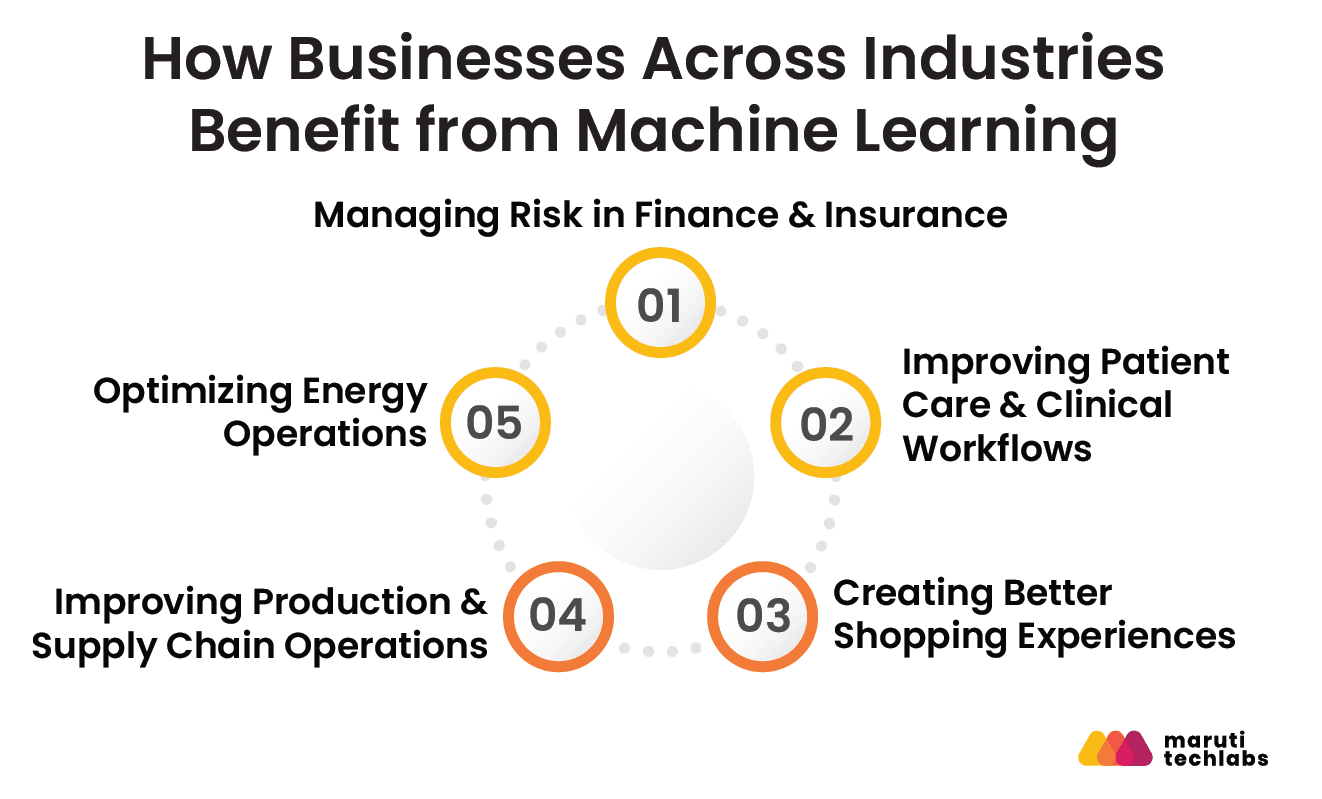
1. Managing Risk in Finance & Insurance
Financial institutions and insurance providers generate enormous amounts of transaction and customer data every day. Machine learning helps them manage financial risk, speed up underwriting and claims processing, strengthen fraud prevention, and support better lending decisions.
2. Improving Patient Care & Clinical Workflows
Healthcare organizations work with large volumes of clinical and patient data every day. Machine learning helps improve diagnosis, supports medical research, speeds up administrative processes, and assists doctors with data-driven decisions.
3. Creating Better Shopping Experiences
Retailers use machine learning to better understand customer behavior, forecast demand, improve inventory planning, personalize shopping experiences, and respond more quickly to changing market trends.
4. Improving Production & Supply Chain Operations
Manufacturers use machine learning to improve production efficiency, reduce equipment downtime, optimize inventory, and make supply chains more responsive.
5. Optimizing Energy Operations
Energy companies use machine learning to balance supply and demand, improve equipment reliability, reduce outages, and support more efficient grid operations.
What are the 10 Common Machine Learning Use Cases?
Machine learning has become part of many products and services people use every day, often without them realizing it. Whether you're making an online payment, checking directions, or asking a voice assistant a question, machine learning is working behind the scenes to analyze data and make decisions in real time. Some of its most common applications include: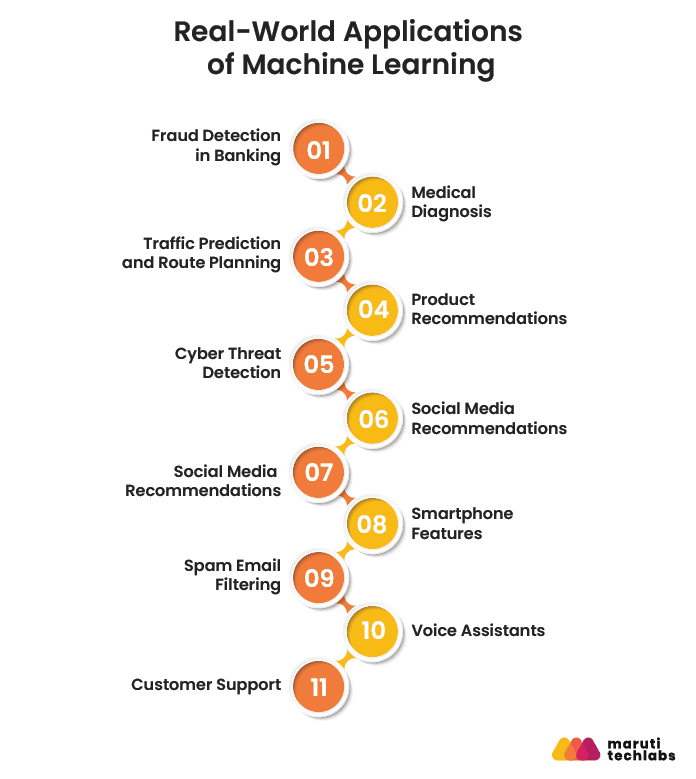
1. Fraud Detection in Banking
Every second, banks process thousands of card payments and online transactions. Looking for suspicious activity manually isn't practical, which is why machine learning is used to flag unusual spending patterns before they turn into fraud.
2. Medical Diagnosis
Doctors often need to review large volumes of medical data before making a diagnosis. Machine learning can analyze medical images, lab reports, and patient records, giving healthcare professionals another source of information during the decision-making process.
3. Traffic Prediction and Route Planning
We've all seen a navigation app suggest a different route halfway through a trip. It does this by factoring in changing traffic conditions, accidents, and road closures to help avoid unnecessary delays.
4. Product Recommendations
The products shown on shopping websites aren't the same for every customer. What you see often depends on what you've browsed, searched for, or purchased in the past.
5. Cyber Threat Detection
Suspicious activity isn't always obvious. Security teams monitor thousands of events every day, and machine learning helps highlight unusual behavior that could point to a potential cyberattack.
6. Social Media Recommendations
The posts that appear in a social media feed are often selected using machine learning. It considers the content people watch, like, share, or ignore to decide what to show next.
7. Smartphone Features
Many of the features we use on our phones every day work quietly in the background. Face unlock, predictive text, voice typing, and even the camera become more accurate the more they're used.
8. Spam Email Filtering
If your inbox isn't filled with spam every morning, machine learning is one of the reasons. Email providers continuously refine their filters to keep unwanted messages out while allowing legitimate emails through.
9. Voice Assistants
When someone asks a voice assistant for directions or the weather, machine learning helps interpret the request and determine the most relevant response. It also improves speech recognition over time.
10. Customer Support
No customer enjoys waiting for answers. Many businesses now use chatbots to handle common questions, while support agents get quick access to the information they need to resolve more complex issues.
When Do You Need Custom Machine Learning Solutions Instead of Off-the-Shelf AI?
There's no single answer to whether a business should choose a custom machine learning solution or an off-the-shelf AI model. It comes down to the problem you're solving. Factors like the quality of your data, expected growth, integration needs, and regulatory requirements all play a role in determining which approach makes the most sense.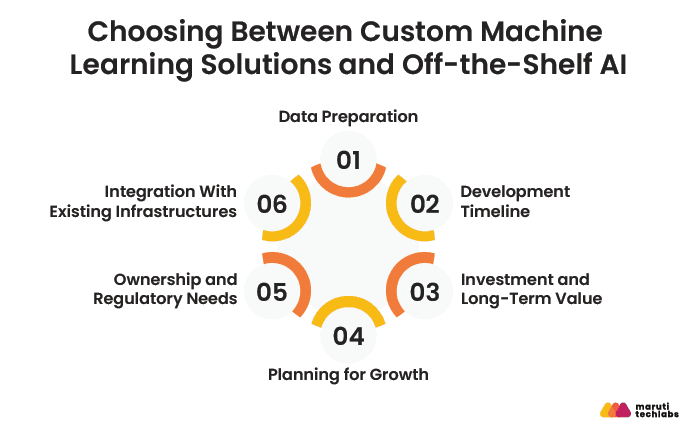
1. Data Preparation
Pre-trained models are a good fit when your data is clean and follows common patterns. But if you're dealing with specialized information, such as medical records or manufacturing sensor data, a custom model is often better equipped to learn from it.
2. Development Timeline
Some projects need results in weeks, while others can afford a longer development cycle. Pre-trained models are well suited for getting an MVP or pilot off the ground quickly, whereas custom models take more time but offer greater precision.
3. Investment and Long-Term Value
A pre-trained model is usually the more affordable option when you're getting started. A custom solution costs more upfront, but it can be a better investment if your business needs AI that's built around your data and processes.
4. Planning for Growth
The AI solution you need today may look very different a year from now. Custom models are easier to adapt as your business grows, whether that means working with more data, supporting new workflows, or expanding into new use cases.
5. Ownership and Regulatory Needs
Businesses operating in regulated industries often need greater control over their AI models and data. Building a custom solution gives organizations more ownership while making it easier to address security, privacy, and compliance requirements.
6. Integration With Existing Infrastructures
Pre-trained tools are generally easier to deploy, but they don't always fit effortlessly into existing workflows. Custom models take longer to integrate, yet they're designed to work with your technology stack from the start.
The right choice depends on how you plan to use AI. If you're solving a common business problem, a pre-trained model may be all you need. But when AI is expected to support a core business process or work with proprietary data, a custom solution is often worth the extra investment.
Applied Machine Learning: From Data Preparation to Production Deployment
Applied machine learning is the process of applying machine learning models to practical business challenges. Building a model is only one part of the process. To deliver reliable results in the real world, businesses need to prepare data, validate the model, deploy it into production, and continue improving it as new data becomes available.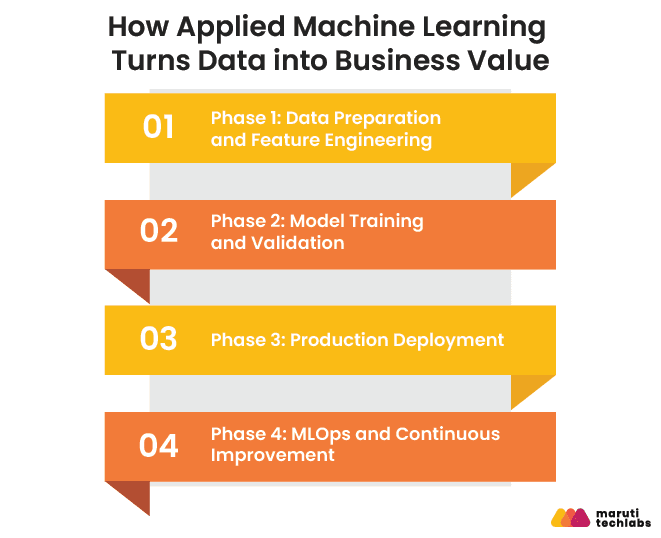
Phase 1: Data Preparation and Feature Engineering
Good data is the foundation of every machine learning model. Before training, the data is cleaned, organized, and prepared for analysis. Feature engineering is also carried out to create inputs that make important patterns easier for the model to recognize.
Phase 2: Model Training and Validation
After the data is prepared, different machine learning models are tested to check which one works best. They are validated using new data to check how well they'll perform outside the training environment. The chosen model is then refined before moving into production.
Phase 3: Production Deployment
After validation, the model is packaged for deployment, often using containerization technologies such as Docker. It is then connected to business applications through APIs and managed using orchestration platforms that support scaling and stable performance. Depending on the use case, predictions can run in real time or in scheduled batches.
Phase 4: MLOps and Continuous Improvement
Deployment isn't the final step. MLOps practices help teams monitor model effectiveness, manage different model versions, and automate updates through CI/CD pipelines. As new data becomes available, models are retrained to sustain accuracy and respond to changing business needs.
Common Machine Learning Challenges and How to Overcome Them
Building a machine learning model is one thing. Making it reliable in everyday business use is another. Most challenges don't come from the algorithm itself. They usually involve data quality, changing business conditions, and keeping models accurate over time.
Common Challenges
Even well-trained models can run into problems after deployment. Understanding these challenges early helps teams build more dependable solutions.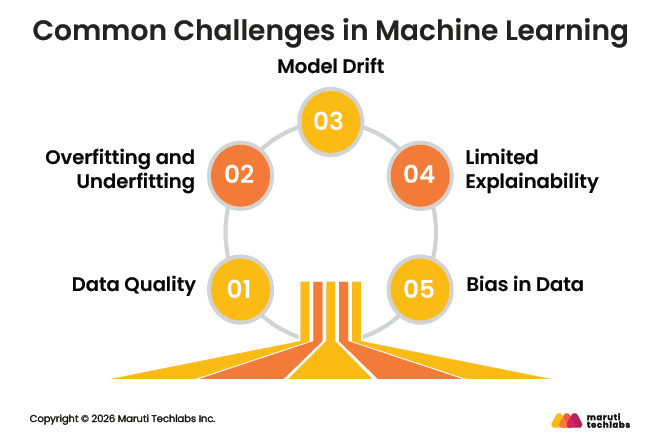
1. Data Quality
A model can only learn from the data it's given. Missing values, duplicate records, or incomplete datasets often lead to unreliable predictions.
2. Overfitting and Underfitting
Some models become too dependent on the training data and struggle with new inputs. Others are too simple to capture important patterns, reducing their accuracy.
3. Model Drift
Business data doesn't stay the same forever. As customer behavior or market conditions change, models can become less accurate if they aren't updated regularly.
4. Limited Explainability
Some machine learning models can produce accurate predictions without clearly explaining how they reached them. This can create challenges in industries where transparency is essential.
5. Bias in Data
Machine learning models learn from historical data. If that data contains bias, the model can unintentionally produce unfair or inconsistent outcomes.
Best Practices
The following practices help improve model performance and make machine learning systems easier to manage over time.
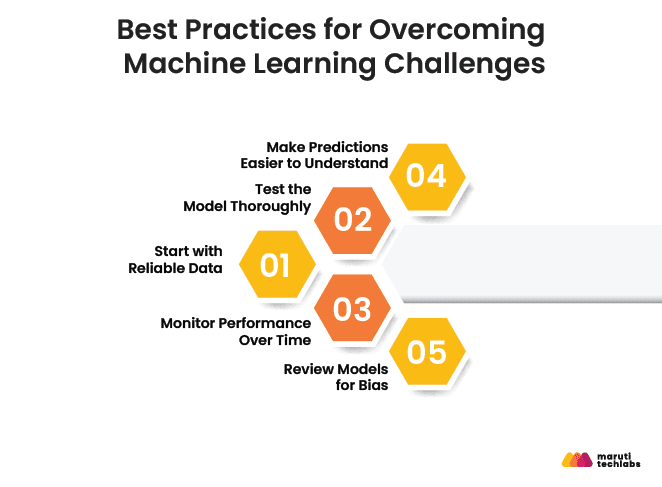
1. Start with Reliable Data
The quality of a machine learning model depends heavily on the data it learns from. Cleaning the data, fixing inconsistencies, and creating useful features help improve model performance from the beginning.
2. Test the Model Thoroughly
Before deployment, the model should be tested on data it hasn't seen before. This helps identify issues such as overfitting and provides a better picture of how the model will perform in practice.
3. Monitor Performance Over Time
A machine learning model shouldn't be left unattended after deployment. MLOps practices make it easier to monitor performance, detect model drift, and retrain models when accuracy starts to decline.
4. Make Predictions Easier to Understand
For many business applications, knowing how a model reached a decision is just as important as the prediction itself. Explainable AI (XAI) helps teams interpret model outputs and supports regulatory compliance where needed.
5. Review Models for Bias
Bias can enter a model through the data used for training. Regularly reviewing datasets and predictions helps identify unfair outcomes and improves the reliability of machine learning systems.
How Machine Learning Automation Improves Efficiency and Decision-Making
Machine learning automation takes repetitive work off people's plates, making everyday processes faster and more efficient. It also analyzes large amounts of data to identify patterns and support faster, more informed business decisions.
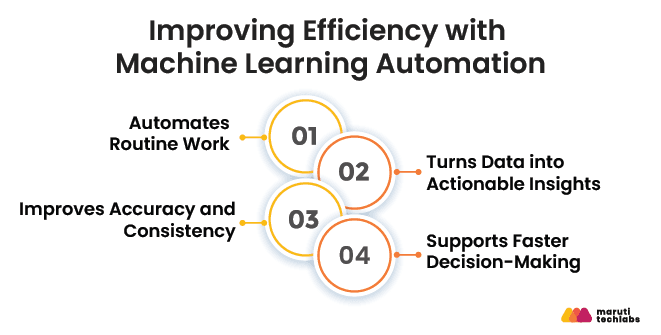
1. Automates Routine Work
Many day-to-day business tasks are repetitive and time-consuming. Machine learning can automate work such as processing documents, entering data, and handling invoices, giving employees more time to focus on work that needs human judgment.
2. Turns Data into Actionable Insights
Businesses collect more data than people can review manually. Machine learning helps make sense of that information by spotting patterns and highlighting changes that deserve attention. This helps teams plan better and make decisions with greater confidence.
3. Improves Accuracy and Consistency
Manual processes are more likely to introduce errors, especially when large datasets are involved. Machine learning follows the same process every time, helping reduce mistakes while delivering more consistent results.
4. Supports Faster Decision-Making
Some business decisions need to be made in seconds. Machine learning can process incoming data in real time, helping businesses detect fraud, optimize delivery routes, adjust prices, or respond to changing customer demand without unnecessary delays.
Conclusion
Machine learning has moved beyond experimentation and become a practical business capability. It helps organizations automate processes, improve predictions, and make better use of their data. The biggest gains come from solving business problems, not simply deploying machine learning models.
Model accuracy isn't determined by training alone. Data preparation, feature engineering, validation, and MLOps all play a role in how well a model performs in production.
Whether you choose a pre-trained model or a custom machine learning solution, the objective remains the same. Build solutions that deliver measurable outcomes and continue improving over time. That's how businesses turn machine learning into a lasting competitive advantage rather than a one-time technology investment.
How Maruti Techlabs Turns Machine Learning into Business Value
One of our U.S.-based insurance broker clients struggled with slow, manual underwriting that delayed document verification and increased errors. We developed a Python-based OCR solution to automate their document processing. It reduced processing time by 40%, improved accuracy, and freed teams to focus on higher-value cases.
At Maruti Techlabs, we build machine learning solutions around business problems, not just algorithms. Our team supports the complete lifecycle, from data preparation and model development to deployment, MLOps, and ongoing optimization, helping organizations put machine learning into everyday operations.
If you're planning a broader AI initiative, explore our AI Development Services to learn how we build intelligent applications that solve real business challenges. For organizations with unique data, workflows, or prediction requirements, our Custom Machine Learning Development Services help develop models tailored to your business.

FAQs
1. What is the difference between machine learning and AI solutions?
Artificial intelligence is the broader concept of building systems that can perform tasks requiring human intelligence. Machine learning is one way of achieving that. Instead of following fixed rules, machine learning models learn from data and improve over time. Most AI solutions combine machine learning with other technologies, depending on the problem they're solving.
2. How can machine learning improve business efficiency?
It's common for employees to spend a large part of their day on repetitive work. Machine learning can handle many of those tasks automatically, from processing documents to forecasting demand. That leaves people free to focus on decisions and problems that benefit from human judgment.
3. What are the benefits of machine learning in business?
The biggest advantage of machine learning is its ability to find useful patterns in data that would otherwise take people much longer to identify. Businesses use it to improve forecasting, personalize customer experiences, detect fraud, optimize operations, and support better decision-making. The exact benefits depend on the business problem being solved.
4. How can machine learning enhance customer service?
Many customer support requests are repetitive. Machine learning can take care of common questions, help customers reach the right team, and surface useful information for agents. That means faster responses for customers and fewer routine tasks for support teams.
5. What is meant by custom machine learning solutions?
Custom machine learning solutions are developed to solve a specific business problem. Instead of relying on a pre-trained model, they're trained on your own data and designed to fit the way your business works. This usually makes them a better choice when off-the-shelf tools don't deliver the results you need.
6. How do machine learning algorithms work?
Instead of relying on fixed rules, machine learning algorithms learn from the data they're given. They look for patterns that help them make predictions or classify new information. As more data becomes available, the model can be retrained to improve its accuracy over time.
7. What are the best machine learning algorithms?
There isn't a single algorithm that's best for every project. The right choice depends on the data, the problem you're trying to solve, and the level of accuracy required. Algorithms such as Decision Trees, Random Forests, XGBoost, Support Vector Machines, and Neural Networks are commonly used for different business applications.