AI Demand Forecasting in Retail: Turning Demand Signals Into Better Inventory Decisions
Key Takeaways
- AI demand forecasting uses machine learning to predict demand for each product and location from sales history plus drivers such as pricing, promotions, weather, and local events.
- Forecast accuracy matters only when it drives business results, so retailers should track WAPE and bias alongside in-stock rate, excess inventory, and carrying cost.
- Better forecasts improve inventory by right-sizing safety stock, setting dynamic reorder points, improving store allocation, and sensing short-term demand.
- Reliable results depend on clean data corrected for stockouts, models matched to each product segment, and forecasts connected directly to replenishment and pricing systems.
- Retailers should start with the categories where forecast error costs the most and run the model alongside the current process before it drives live orders.
Introduction
Peddle, one of the largest manufacturers and distributors of aftermarket car and truck parts across Central and South America, North America, Europe, Asia, Australia, and the Caribbean, manages a catalog of more than 10,000 spare parts. Its forecasting formula was losing accuracy, causing overstocking, understocking, and missed sales. Maruti Techlabs ran a feasibility study and built an LSTM model, then extended it to predict sales for new parts by matching them with similar existing products. Prediction errors for high-selling parts narrowed to within ±20%.
The problem is widespread. Demand forecasting errors are costly in both directions. Underestimate demand and shelves go empty. Overestimate it and capital sits in stock that eventually gets marked down. IHL Group estimates that out-of-stocks and overstocks cost retailers roughly $1.7 trillion a year, about 6.5% of global retail sales.
Traditional methods like spreadsheets, moving averages, and ARIMA typically forecast each SKU from its own history. They struggle when promotions, pricing, weather, and product substitution pull demand in different directions, and they say little about new launches.
This guide explains how AI-driven retail demand forecasting works, which challenges it solves, and how to put it into production.

We help retailers assess data readiness, identify the right forecasting use cases, and build the technology foundation for production AI.
What Is AI-Powered Demand Forecasting in Retail?
AI-powered demand forecasting uses machine learning models to predict how much of each product a retailer will sell at each location and time period by learning from sales history and external drivers such as pricing, promotions, weather, holidays, and local events.
Traditional statistical methods like ARIMA forecast each product from its own past sales. Machine learning models, including gradient boosting, LSTM networks, and newer pretrained time-series models, learn patterns across thousands of products and many demand drivers at once. This gives retailers several capabilities that older methods lack.
- Multiple demand drivers are weighed together, so the effect of a promotion or a heat wave is learned from data instead of estimated by hand.
- It captures relationships between products, including cannibalization when one item takes sales from another and halo effects when one lifts sales of related items.
- New products can be forecast by matching them with existing items that share similar attributes, which addresses the cold start problem.
- Forecasts can be produced at the SKU, store, and day level and return a range of likely outcomes rather than a single number, supporting better safety stock decisions.
- Models can be retrained on fresh data, so forecasts keep pace as buying patterns change, provided accuracy is monitored.
Large language models increasingly sit on top of these forecasts, letting planners ask questions in plain language and understand why a number moved. The forecasting itself, however, still relies on time-series and tabular models.
How Does AI-Powered Demand Forecasting Improve Inventory Management?
AI-powered demand forecasting improves inventory management by giving replenishment and allocation decisions a more accurate and more granular view of future demand.
Safety stock, reorder points, and store allocations all depend on a demand estimate, so a better estimate changes how much stock is held, where it sits, and when it is ordered.
The improvement shows up in several ways.
- Right-sized safety stock - Safety stock depends on forecast error variability, the target service level, and lead time variability. When AI reduces forecast error variability, a retailer can hold a smaller buffer for the same service level, or raise the service level without adding stock.
- Dynamic reorder points - A reorder point equals expected demand during lead time plus safety stock. As forecasts update with new sales data, reorder points update with them instead of staying fixed to a historical average.
- Service-level-based ordering - Models can return a range of likely outcomes rather than a single number. Planners can then order to a chosen service level by product class, with higher targets for high-margin or traffic-driving items and lower targets for slow movers.
- Smarter allocation - Store- and SKU-level forecasts guide how stock splits across distribution centers and stores, reducing cases where one location sells out while another holds excess.
- Short-term demand sensing - Recent sales, weather, and local events can adjust near-term forecasts, so replenishment responds to demand that has already started to move.
- Better promotion, markdown, and launch planning - Forecasts that account for promotional uplift and cannibalization, and that estimate new-item demand from similar products, reduce overbuying ahead of events and leftover stock afterward.
- Exception-based planning - Planners review the items where forecast and inventory position diverge instead of checking every SKU by hand.
Forecasting alone cannot fix every inventory problem. Supplier delays, inaccurate stock records, and slow replenishment cycles still affect results, so forecasts deliver the most value when they feed directly into replenishment systems and are monitored with the metrics described above.
How Does AI for Demand Forecasting Work?
AI demand forecasting works by training machine learning models on historical sales and related data to learn which factors drive demand, then using those models to predict future demand for each product and location. The process runs as a repeating cycle, from data collection through monitoring and retraining.
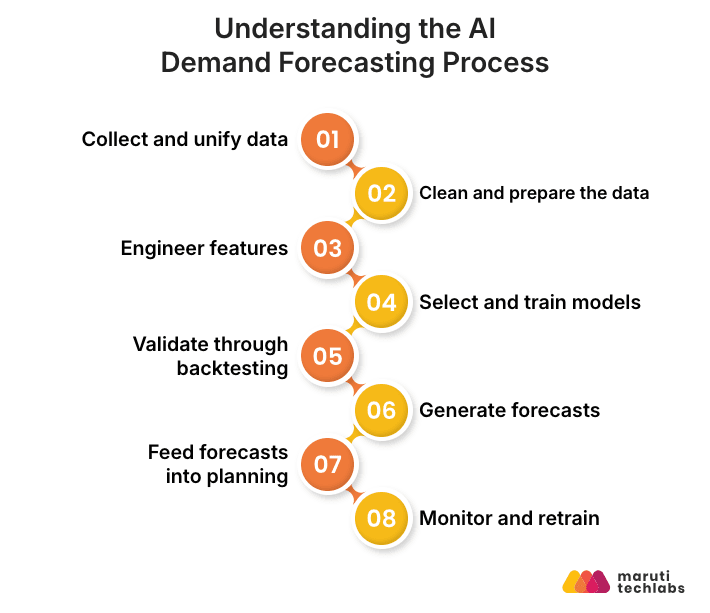
1) Collect and unify data
The model needs transaction history, inventory and stockout records, prices, promotions, calendar events, weather, local events, product attributes, and supplier lead times.
Stockout periods need special care because recorded sales drop to zero when stock runs out, even though customers still want the product. Without an availability flag or a correction, the model learns that demand was low.
2) Clean and prepare the data
Teams handle missing values, returns, outliers, and product hierarchy mapping so that each SKU can be rolled up by category, store, and region.
3) Engineer features
Raw data becomes model inputs such as lagged sales, rolling averages, price changes, promotion flags, holidays, and product attributes.
4) Select and train models
Gradient boosting models such as LightGBM are a common choice for retail data. In the M5 forecasting competition, which used Walmart sales data, tree-based models dominated the leading results. Deep learning models such as LSTM networks and Temporal Fusion Transformers can capture more complex patterns.
Pretrained time-series foundation models, including Chronos, TimesFM, and Moirai, can forecast series they weren't trained on, making them useful for new or data-poor items. Statistical models remain useful as baselines. Many production systems combine several models by product segment.
5) Validate through backtesting
Models are tested on held-out time periods, never random samples, and compared against the current method.
6) Generate forecasts
Outputs are produced at the required granularity and reconciled across levels, so store-level forecasts add up to regional and company totals. Many systems also return a range of likely outcomes.
7) Feed forecasts into planning
Forecasts flow into replenishment, allocation, pricing, and workforce planning systems.
8) Monitor and retrain
Teams track accuracy, detect drift as buying patterns change, and retrain on fresh data. Planner overrides provide feedback on where the model misses.
Large language models increasingly sit on top of this pipeline, helping planners query forecasts in plain language and understand why a number changed. The forecasts themselves still come from time-series and tabular models.
How Can Retailers Measure the Impact of AI Demand Forecasting on Inventory Management?
Retailers measure the impact by tracking forecast accuracy as a leading indicator, then confirming that it translates into better inventory outcomes and financial results.
A more accurate forecast has no value until it appears as fewer stockouts, less excess stock, and lower working capital, so measurement should connect all three layers.
Forecast accuracy metrics show whether the model itself is improving
- WAPE (weighted absolute percentage error) shows overall error weighted by sales volume, and it holds up better than MAPE for low-volume or intermittent items.
- Forecast bias shows whether the model consistently over-forecasts or under-forecasts.
- Forecast value added shows how much the AI forecast improves on the current method or a naive forecast.
Inventory and availability metrics show the direct effect on inventory management
- In-stock rate, fill rate, and stockout rate show how often customers find the product when they want it.
- Inventory turnover and days of supply show how quickly stock converts to sales.
- Excess and obsolete inventory show stock above expected demand, and safety stock levels show whether the business can hold a smaller buffer for the same service level.
Financial metrics translate these gains into money. Carrying cost, markdown rate, and GMROI show the effect on working capital and margin.
To keep results credible, retailers should follow a few practices.
- Set a baseline from the current method, ideally covering a full seasonal cycle.
- Backtest on historical data, then run the model in parallel before it drives live orders.
- Use test and control groups, such as comparable stores or categories, to separate the model's effect from promotions and pricing.
- Segment results by fast sellers, long-tail items, promoted items, and new launches.
- Review on a fixed cadence and retrain when accuracy drifts.
What Are the Key Use Cases of AI Demand Forecasting in Retail?
The key use cases of AI demand forecasting in retail are planning decisions that depend on demand estimates, including replenishment, promotions, pricing, new product launches, allocation, fresh food planning, purchasing, and staffing. Each one turns a more accurate forecast into a specific operational outcome.
- Store and distribution center replenishment - SKU- and location-level forecasts drive what to order and when, so shelves stay stocked without building excess inventory.
- Promotion planning - Models estimate the sales lift from a promotion, including products that lose sales to the discounted item (cannibalization) and products that gain from it (halo effect). This helps retailers set promotional volumes and avoid overbuying or leftover stock.
- Pricing and markdown planning - Forecasts of how demand responds to price changes help retailers decide when and how much to discount, particularly for seasonal and end-of-life items.
- New product launches - For items with no sales history, models estimate demand by matching the new product with existing ones that share similar attributes, such as category, price point, and style.
- Inventory allocation and transfers - Store-level forecasts guide how limited stock is split across stores and online channels, and where inventory should move when demand differs from plan.
- Fresh and perishable goods - Short shelf life leaves little room for error, so accurate daily forecasts reduce spoilage while keeping products available.
- Purchasing and supplier planning - Longer-range forecasts support buying quantities for seasonal merchandise and give buyers a stronger basis for supplier commitments.
- Staffing and logistics planning - Expected demand informs store labor schedules, warehouse capacity, and transportation bookings.
The right starting point depends on where forecast error is most costly. Retailers with large seasonal buys often begin with purchasing and markdowns. Grocers typically begin with replenishment and fresh food, where waste and availability affect results daily.
What Are Some Real-World Examples of AI Demand Forecasting in Retail?
Amazon, Zalando, and Walmart show how large retailers use demand forecasting in different ways, from planning stock across a vast catalog to setting prices on fashion that cannot be reordered and rebalancing stock between stores.
Amazon
Amazon's researchers have described a large-scale platform for training and applying probabilistic demand forecasting models in retail, which produce a range of likely demand outcomes rather than a single estimate.
Amazon Science has also published MQ-Transformer, a neural network architecture for forecasting demand across multiple future time horizons.
The lesson for retailers is that a range of outcomes gives planners what they need to set stock to a target service level.
Zalando
Zalando has described a transformer-based deep learning model for demand forecasting that has run in production, in different versions, since 2019.
A single model forecasts weekly demand for each article across its full assortment and across countries. It also corrects sales history for periods when sizes were out of stock, so the model learns what customers wanted instead of what was available to buy.
This is because much fashion inventory cannot be reordered mid-season; the forecasts mainly feed a pricing optimizer that decides discounts.
The lesson is that a forecast should reflect true demand and be built around the decision it supports, and that Zalando found weekly retraining worked best for keeping accuracy up.
Walmart
Walmart reports that AI and machine learning now support demand prediction and inventory rerouting across its global supply chain.
One example is Self-Healing Inventory, which detects stock imbalances and redirects product to the stores that need it before excess becomes waste, and Walmart says this one system has saved more than $55 million.
Its data science team has also described forecasting with ensembles of machine learning models instead of a single algorithm. The lesson is that forecasting works best alongside systems that act on the forecast.
Across all three, forecasts are built at the product and location level and connected to ordering, allocation, or pricing decisions.
What Are the Key Components of an AI Demand Forecasting Platform for Retail?
An AI demand forecasting platform for retail combines eight components that turn raw sales and operational data into forecasts that planners and systems can act on. Each one is also a useful checkpoint when deciding whether to build or buy.
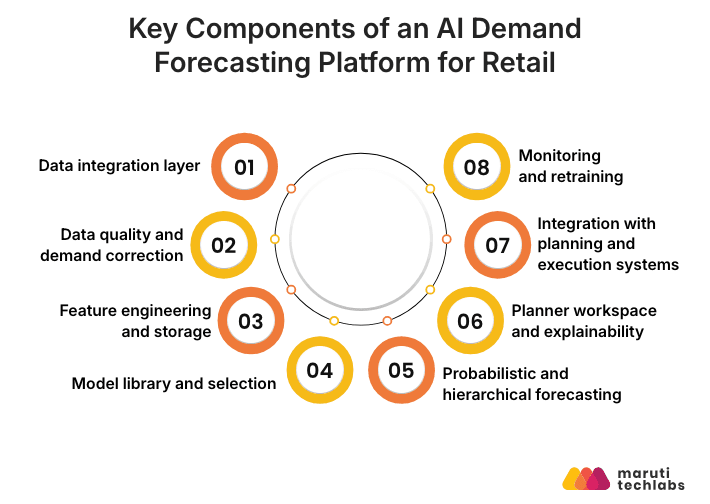
Data integration layer
Connects point-of-sale, e-commerce, inventory, pricing, promotion, and supplier data with external signals such as weather and holidays. Teams should check how easily new sources can be added and how fresh the data is.
Data quality and demand correction
Cleans records, maps the product and location hierarchy, and adjusts sales history for stockouts so the model learns true demand instead of constrained sales.
Feature engineering and storage
Builds and stores model inputs such as lagged sales, price changes, promotion flags, and product attributes, so the same features are used in training and in live forecasting.
Model library and selection
Supports statistical baselines, gradient boosting, deep learning, and pretrained time-series models, and matches the method to each product segment, including new items and the long tail.
Probabilistic and hierarchical forecasting
Produces a range of outcomes alongside a single number, and keeps forecasts consistent across SKU, store, region, and company totals.
Planner workspace and explainability
Lets planners review exceptions, add known events such as promotions or store openings, override forecasts with a recorded reason, and see which drivers moved a number. Natural language assistants can sit in this layer.
Integration with planning and execution systems
Sends forecasts to replenishment, allocation, pricing, and ERP systems through APIs, because a forecast that stays in a dashboard does not change inventory decisions.
Monitoring and retraining
Tracks live accuracy and bias against backtest results, detects data drift, and retrains on a regular schedule. Zalando's team describes monitoring live forecasts against backtests and testing model changes through a deployment pipeline before release.
Access controls, audit trails, and scalable cloud infrastructure underpin all eight, especially for retailers operating across multiple markets.
What Are the Challenges of AI Demand Forecasting in Retail and How Can Retailers Overcome Them?
The main challenges are unreliable data, sparse history for new and slow-selling products, promotion and pricing effects, volatile external conditions, low planner trust, and difficulty connecting forecasts to operations. These obstacles appear across AI in retail initiatives, and each one has a practical fix.
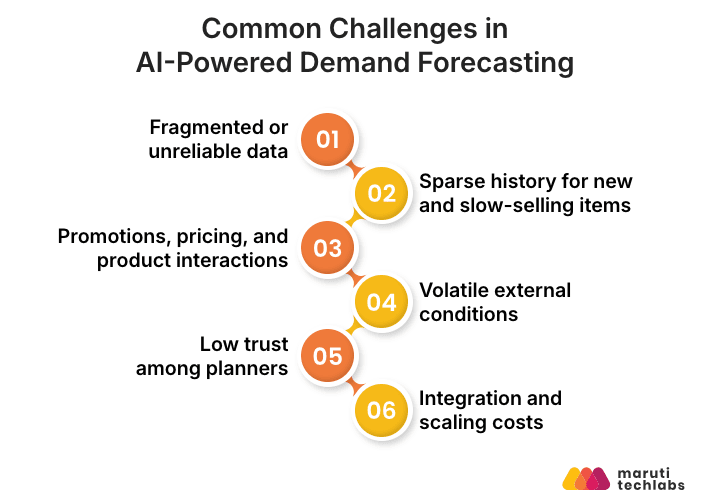
1. Fragmented or unreliable data
Sales, inventory, pricing, and promotion data often sit in separate systems. Recorded sales also understate demand when an item is out of stock, so a model can learn low demand when the shelf was simply empty.
How to overcome it.
- Unify sources into one reliable data pipeline.
- Add automated data quality checks before data reaches the model.
- Correct sales history for stockout periods so the model learns true demand.
Pipeline reliability matters as much as the model. A US used car selling company we worked with ran its data jobs on manual scheduling, which led to skipped runs, failed initializations, and slow bug tracing. Maruti Techlabs moved the workflows to Apache Airflow with a CI/CD pipeline and AWS hosting, and system availability rose from 90% to 99.95%.
2. Sparse history for new and slow-selling items
New products have no sales history, and most items in a large catalog sell rarely, leaving little for a model to learn from. Zalando describes cold start and sparse demand as prominent problems in its catalog.
How to overcome it.
- Forecast new items by matching them with similar products on category, price point, and style.
- Use pretrained time-series models that can forecast series they were not trained on.
- Produce ranges instead of single numbers for slow movers.
3. Promotions, pricing, and product interactions
A promotion lifts the promoted item and can pull sales from substitutes or raise sales of related items. A model that ignores these effects will overbuy or underbuy around events.
How to overcome it.
- Feed promotion calendars, price changes, and product relationships into the model as inputs.
- Validate uplift estimates with test and control stores before relying on them.
4. Volatile external conditions
Weather, supply disruptions, tariffs, and sudden trends can break patterns learned from history.
How to overcome it.
- Add short-term demand sensing, so forecasts react to recent signals.
- Monitor accuracy and bias continuously and retrain on a regular schedule.
- Run what-if scenarios so planners can prepare for a range of outcomes.
5. Low trust among planners
Planners will not use a forecast they cannot understand or correct, and an unused forecast delivers no value.
How to overcome it.
- Show which drivers moved a number.
- Allow overrides with a recorded reason, and review by exception.
- Run the model in parallel with the current process first.
- Track forecast value added to show where the model beats the baseline.
6. Integration and scaling costs
A forecast that stays outside replenishment and allocation systems changes nothing, and running models across millions of product-location combinations can be expensive.
How to overcome it.
- Start with categories where forecast error costs the most.
- Connect forecasts to ordering systems through APIs.
- Monitor compute spend as coverage grows.
Making Inventory Decisions More Predictive and Precise
AI demand forecasting delivers value when the forecast changes what a retailer buys, stocks, and prices, not when it only improves an accuracy score.
Retailers that get results start with reliable data that reflects true demand, choose methods that fit each product segment, and connect forecasts directly to replenishment, allocation, and pricing.
They then measure outcomes through stockouts, excess stock, and working capital, and keep models accurate by monitoring and retraining regularly.
The challenges above, from fragmented data to low planner trust, are solvable when teams treat forecasting as an operating capability, not a one-time model build.
For most retailers, the practical next step is a clear view of data readiness and the one or two categories where forecast error costs the most. Starting there keeps the first deployment focused and measurable.
Build Scalable Demand Forecasting Systems with Maruti Techlabs
Retail demand forecasting delivers results when models, data, and operations work together, and that takes engineering across all three. Maruti Techlabs is a product engineering partner that works across the full lifecycle, from strategy and architecture to development, deployment, and continuous optimization. The capabilities below map directly to the challenges covered in this guide.
- Data foundation. Our data analytics and engineering teams unify sales, inventory, pricing, and promotion data into reliable pipelines, addressing the data-quality problems that hold back most forecasting projects.
- Custom AI and ML development. We build forecasting models that fit each product segment, including new items and slow movers, and we stay neutral on platforms and tools so every recommendation follows business need.
- AI strategy and readiness. Our AI strategy and readiness service helps teams judge readiness and choose the right first use case before any model is built, so the first deployment targets the categories where forecast error costs the most.
- Integration and product engineering. Our software product engineering and cloud application development teams connect forecasts to replenishment, allocation, and pricing systems through APIs, since a forecast that stays in a dashboard changes nothing.
- Cloud and DevOps. As an AWS partner, we build the deployment and monitoring pipelines that keep models accurate as demand changes, and our cloud cost optimization practice helps control compute spend as forecast coverage grows.
The outcome is a forecasting capability the business can run, measure, and improve continuously as demand patterns change.
Our custom AI and ML development team helps retailers build and deploy forecasting models that plug into their planning systems.
FAQs
1. How is AI demand forecasting different from traditional forecasting?
Traditional methods such as spreadsheets, moving averages, and ARIMA typically forecast each product from its own sales history.
AI models learn patterns across thousands of products and many demand drivers at once, which helps with promotions, product interactions, and new launches. Classical methods still work well as baselines and for simple, stable items.
2. How is AI demand forecasting different from traditional forecasting?
Traditional methods such as spreadsheets, moving averages, and ARIMA typically forecast each product from its own sales history. Machine learning approaches, part of the wider family of predictive analytics models and algorithms, learn patterns across thousands of products and many demand drivers at once.
This helps with promotions, product interactions, and new launches. Classical methods still work well as baselines and for simple, stable items.
3. How accurate is AI demand forecasting?
No single accuracy figure exists because results depend on data quality, product mix, and forecast horizon. Items with steady demand are generally easier to forecast than items with sparse, intermittent demand.
Retailers should measure WAPE and forecast bias, then compare against their current method using forecast value added.
4. What data is needed for AI demand forecasting in retail?
The core inputs are listed below.
- Sales history at the product and location level
- Inventory levels and stockout records
- Prices, promotions, and markdowns
- Product attributes such as category, brand, and style
- Calendar events and, where relevant, weather and local events
- Supplier lead times
Sales history should cover enough time to include seasonal cycles, and stockout periods should be flagged so the model learns true demand. Bringing these sources into one dependable flow is the job of well-designed retail data pipelines.
5. Can AI forecast demand for new products with no sales history?
Yes, with limits. Models can estimate demand by matching a new product with similar existing items on attributes such as category, price point, and style. Pretrained time-series models can also forecast series they were not trained on. Early forecasts carry more uncertainty, so they should be reviewed and updated as real sales arrive.
6. Does AI replace demand planners?
No. AI handles routine forecasting at scale, while planners focus on exceptions, known events, and judgment calls. Good platforms let planners review flagged items, add context such as promotions or store openings, and override forecasts with a recorded reason.