

AI Agents for Legal Teams: A Guide to Use Cases, Workflows, and Choosing the Right Solution
Key Takeaways
- AI agents in legal tech plan and execute multi-step workflows end to end. AI assistants just respond to a single legal prompt.
- Agents work best on high-volume, document-heavy tasks, contract review, research, e-discovery, compliance monitoring. Negotiation, strategy, and final calls stay with the lawyer.
- Leading legal AI research tools hallucinate 17-33% of the time. Governance, human-in-the-loop review, data isolation, audit trails, isn't optional.
- Choosing the right agent comes down to seven criteria: task fit, security, human oversight, integration, citation transparency, vendor track record, and build vs. buy vs. integrate. No vendor wins on all seven.
- Rollout matters as much as the agent. Pilot with one practice group, measure in lawyer terms, build internal champions, then expand.
Introduction
Legal teams don't usually struggle because they can't find information. They struggle because there's too much of it, spread across contracts, case files, regulations, emails, knowledge bases, and internal systems.
A lawyer may get an AI assistant to summarize a contract or find a relevant clause in seconds. Helpful, sure. But someone still has to decide what to do next, pull information from another system, apply the right legal playbook, prepare the deliverable, and review the result.
That's where AI agents change the conversation.
An AI assistant responds to a request. An AI agent can take a defined outcome and work through the steps needed to achieve it. It can plan a task, retrieve relevant information, use connected tools, execute actions, and route the result for human review.
For legal leaders, that distinction matters. The opportunity isn't simply to give lawyers a faster way to ask questions. It's to reduce the manual coordination sitting between the first request and the finished piece of legal work.
This blog thoroughly looks at where AI agents fit into legal workflows, how they operate, what risks need to be controlled, and what legal teams should evaluate before putting them into production.
If you're exploring how these systems can be built for real-world legal workflows, see Maruti Techlabs' AI Agent Development Services for more on designing and integrating AI agents into enterprise applications.

How Are AI Agents Different From Legal AI Tools?
AI agents can plan, execute, and adapt across multiple steps, while traditional legal AI tools typically perform a specific task based on a user’s input.
For example, an agent can review a contract, identify risks, research relevant clauses, and generate a summary, whereas a legal AI tool may only handle one of these tasks.
The easiest way to understand the difference is to line up four stages of legal technology side by side:
| Technology | What It Does | Example |
| Traditional legal software | Stores and retrieves information on request | Document management systems, case law databases |
| AI-powered tools | Generates an answer or summary from existing data | AI-assisted search, clause extraction tools |
| AI assistants | Performs one task per prompt, with a human directing each step | Drafting a single clause, summarizing one document |
| AI agents | Plans and executes an end-to-end workflow across multiple steps with minimal prompting | Reviewing a full contract, flagging deviations, and producing a redline summary unprompted after each step |
Each layer builds on the one before it. Legal teams already run on the first two, and most have started experimenting with the third. Agents are the layer that's new, and the one this guide focuses on.
What Are the Five Stages of a Legal AI Agent's Workflow?
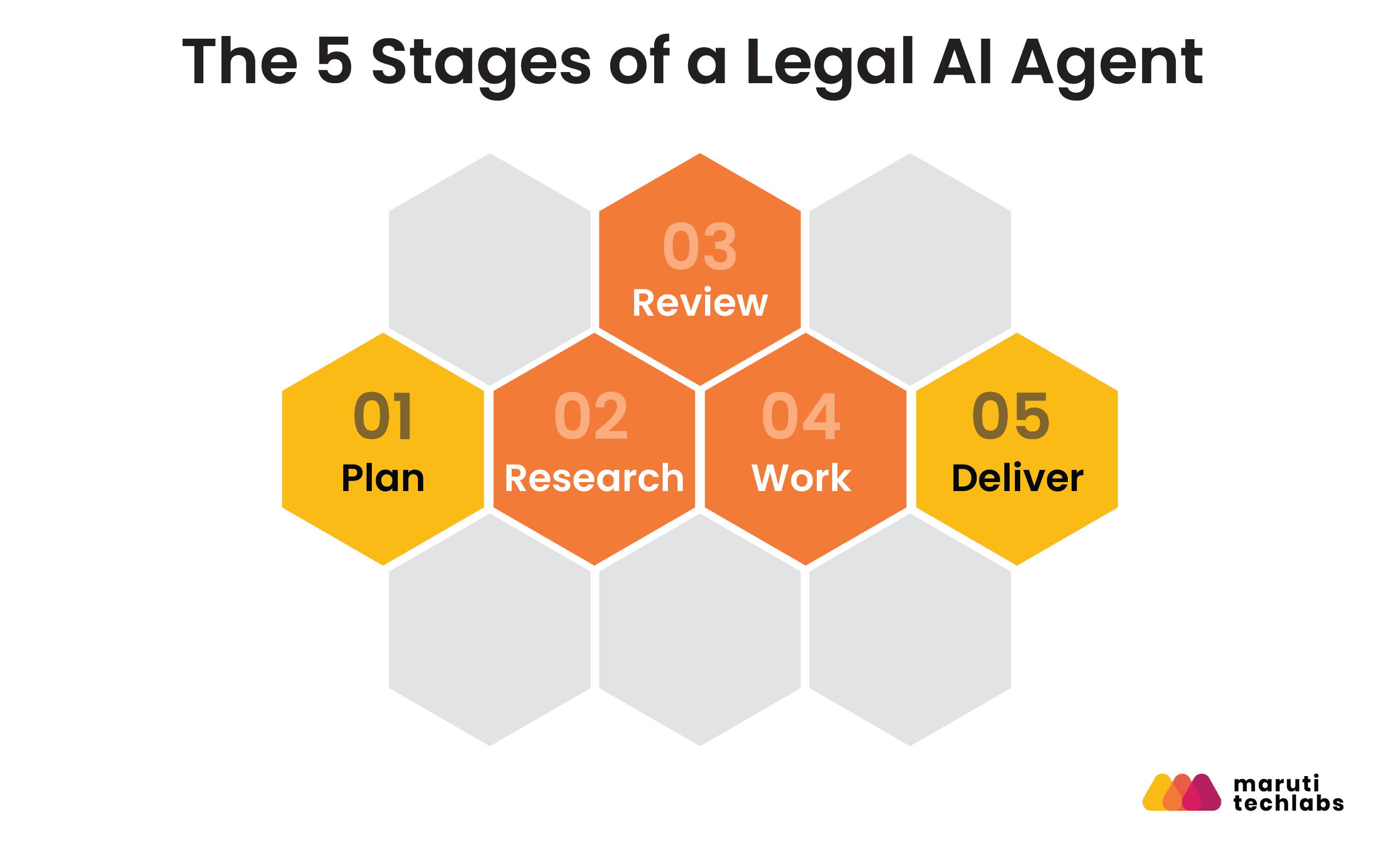
A legal AI agent moves through five stages to complete a task: Plan, Research, Work, Deliver, and Review. Each stage hands off to the next with little to no prompting in between, which is what separates an agent from a single-prompt assistant.
Plan
The agent breaks the task down into steps. Given "review this vendor contract against our standard playbook," it maps out what needs to happen: pull the playbook, compare clause by clause, flag deviations, draft a summary.
Research
It retrieves what it needs to complete the task, the relevant playbook, prior contract versions, applicable case law, or firm precedent, pulling from connected document systems rather than relying on what it already knows.
Work
It carries out the task itself. For a contract markup, this means reading the agreement clause by clause, comparing each one against the playbook, and marking where the vendor's language departs from the standard.
Deliver
It produces a finished output, not a list of observations. In the contract example, that's a redlined document with a summary of every deviation and why it matters, ready for a lawyer to review rather than a lawyer starting from scratch.
Review
The output goes back to a human before anything is finalized, sent, or filed. This stage is what keeps an agent inside the bounds of supervised legal work rather than acting as an unchecked decision-maker.
Walking through a contract markup end to end shows why this matters in practice. A lawyer who once spent two to three hours reading a vendor contract line by line now spends that time reviewing an agent's redline and summary instead, checking the agent's judgment rather than doing the first read themselves.
What Are the Best AI Agent Use Cases by Legal Practice Area?
The best AI agent use cases in legal practice are legal research, contract review, litigation support, and compliance, where agents can handle repetitive, multi-step workflows while lawyers retain control over judgment-intensive decisions.
The most effective deployments focus on tasks where AI agents can improve speed and consistency without replacing legal oversight.
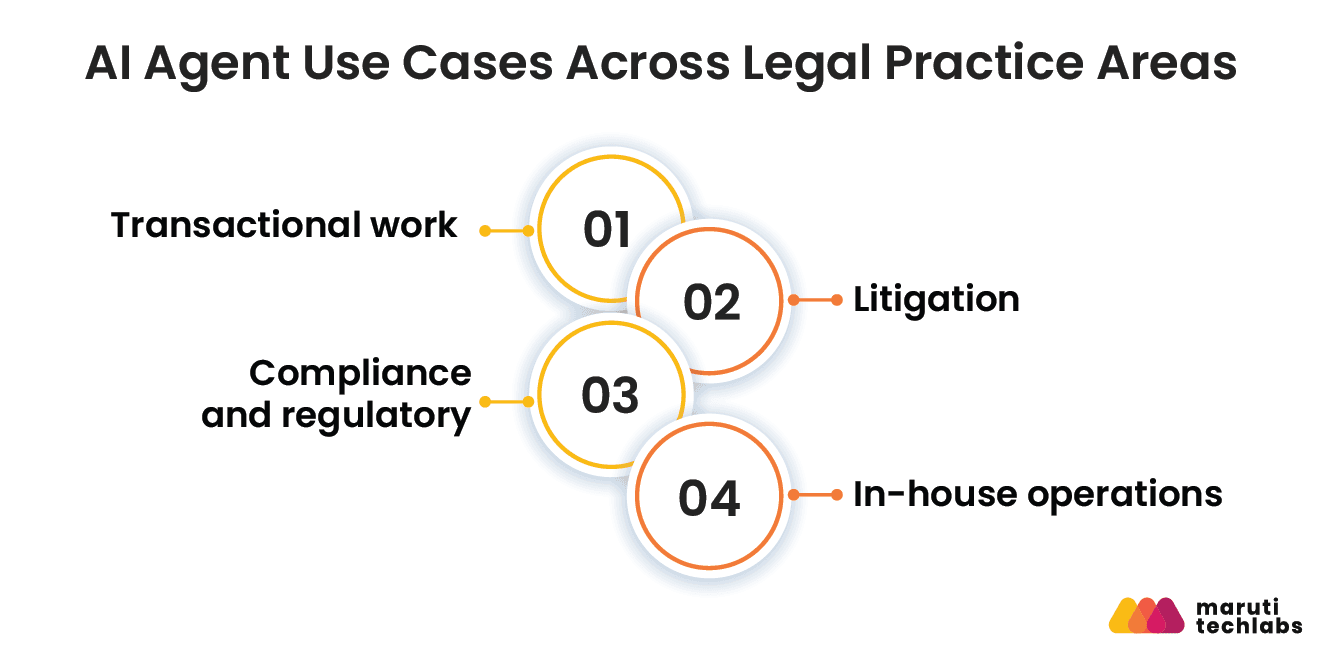
Transactional work
This is where agents have found the most traction, and it's not hard to see why. Contract review is repetitive, high volume, and rules-based enough for an agent to handle the first pass reliably.
An agent can read an incoming vendor contract and compare it clause by clause against a firm's standard playbook. It flags every deviation and hands back a redline with a summary of what changed and why it matters.
It can pull relevant precedent from a firm's own document history instead of starting from a blank template. It can track obligations and renewal dates across a contract portfolio so nothing slips through because someone forgot to check a calendar.
What stays human: The actual negotiation, any judgment call about whether a deviation is acceptable given the specific deal, and final sign-off before anything goes out the door. The agent gets a lawyer to that decision faster. It doesn't make the decision.
Litigation
Litigation generates enormous volumes of documents, and that volume is exactly where agents earn their keep. An agent can run e-discovery, sorting through thousands of documents to surface the ones that are relevant to a matter, instead of a team doing that sort manually.
It can build a first-pass chronology of events from case files. It can pull related case law and prior filings to support a research memo, cutting down the hours a junior associate would otherwise spend searching.
What stays human: Legal strategy, how a case gets argued, and any output that goes in front of a judge. An agent can shrink the haystack. Finding the needle that wins the case is still a lawyer's job.
Compliance and regulatory
Regulatory requirements shift often enough that keeping up with them manually is a real drain on a legal team's time. An agent can monitor regulatory changes across jurisdictions and flag which ones affect the business, instead of a compliance officer scanning updates one by one.
It can check internal policies and contracts against current requirements and surface where something's fallen out of alignment. It can maintain audit trails automatically, so when a regulator asks for documentation, it's already there.
What stays human: Interpreting how a new regulation applies to the business's specific situation, and any decision about how to respond to a compliance gap once it's flagged.
In-house operations
In-house legal teams deal with a steady stream of requests from across the business, and most of those requests are routine. An agent can triage incoming legal questions from other departments.
It routes simple ones, like a standard NDA request or a basic policy question, toward fast resolution and escalates anything that needs a lawyer's attention.
It can draft first versions of routine correspondence and standard agreements. It can pull together reporting on legal team workload and turnaround times, giving legal ops leaders visibility they'd otherwise have to compile by hand.
What stays human: Anything with real legal or business risk attached, and the relationship-building that comes from a lawyer talking to the business teams they support.
Across all four areas, the pattern holds. Agents take on the volume and the repetition. Lawyers keep the judgment calls, the negotiation, and the final say.
What Are the Benefits of AI Agents for Legal Teams?
AI agents can help legal teams reduce manual work, accelerate legal workflows, improve consistency, increase productivity, and scale routine tasks without proportionally increasing headcount. These benefits become more significant when agents are integrated into recurring, multi-step legal workflows rather than used as standalone assistants.
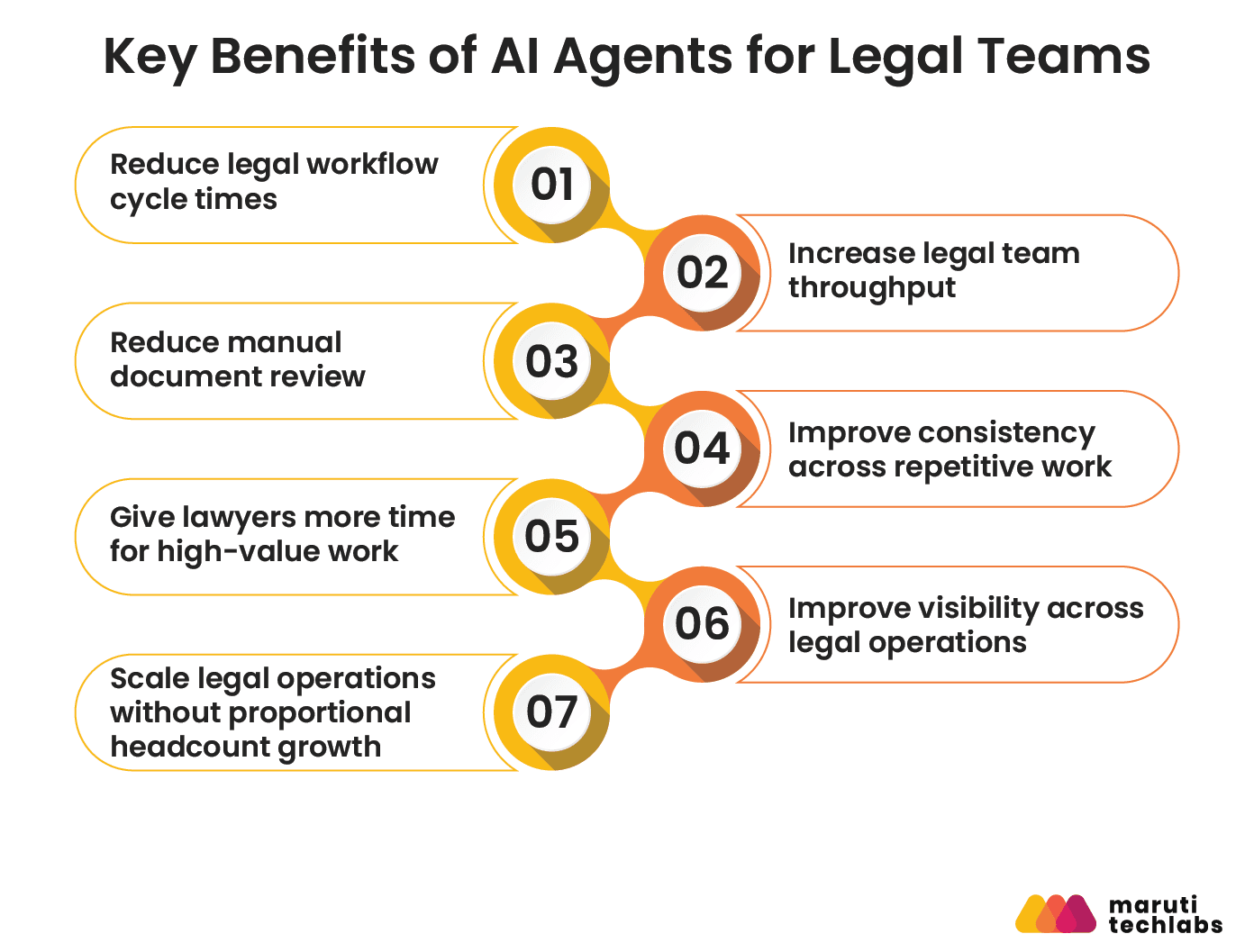
Reduce legal workflow cycle times
A contract review that used to take a few hours now starts with a redline already done. Research that used to eat up an afternoon starts with the relevant sources already pulled. That first-pass time doesn't disappear, it just moves from a lawyer's desk to an agent's, and what's left for the lawyer is the part that needs their judgment.
Increase legal team throughput
Because agents handle the repetitive first pass, the same team can move through more matters without adding headcount. A legal ops lead isn't choosing between "hire more people" and "let turnaround times slip." There's a third option now.
Reduce manual document review
Contract review, e-discovery, due diligence, these all involve reading a lot of documents to find the handful of things that matter. An agent doing that first read means fewer billable or in-house hours spent on the parts of document review that don't require a law degree, just attention and consistency.
Improve consistency across repetitive work
A tired associate at 9 p.m. and a fresh one at 9 a.m. don't always catch the same things in a contract. An agent applies the same playbook, the same checklist, the same standard every time, regardless of the hour or how many contracts it's already been through that day.
Give lawyers more time for high-value work
This is really the point of everything above. Time that used to go into first-pass review and manual research is time that can go into negotiation, strategy, client relationships, the parts of legal work that need a lawyer's experience and judgment.
Improve visibility across legal operations
Agents leave a trail. Every contract reviewed, every research task completed, every compliance check run gets logged. That gives legal ops leaders a clearer picture of where the team's time is going, instead of relying on anecdotal sense of what's taking too long.
Scale legal operations without proportional headcount growth
As deal volume or matter load grows, legal teams have historically had one lever: hire more people. Agents give teams a second lever, handling more of the repetitive volume so headcount doesn't have to grow at the same rate the business does.
What Are the Risks and Challenges of Using AI Agents in Legal Work?
The main risks of using AI agents in legal work include hallucinations and inaccurate outputs, data privacy and confidentiality issues, weak explainability, unauthorized actions, regulatory and ethical concerns, integration failures, and insufficient human oversight.
AI agents can make decisions and execute multi-step tasks with less direct supervision, legal teams need stronger controls than they would for a conventional AI chatbot.
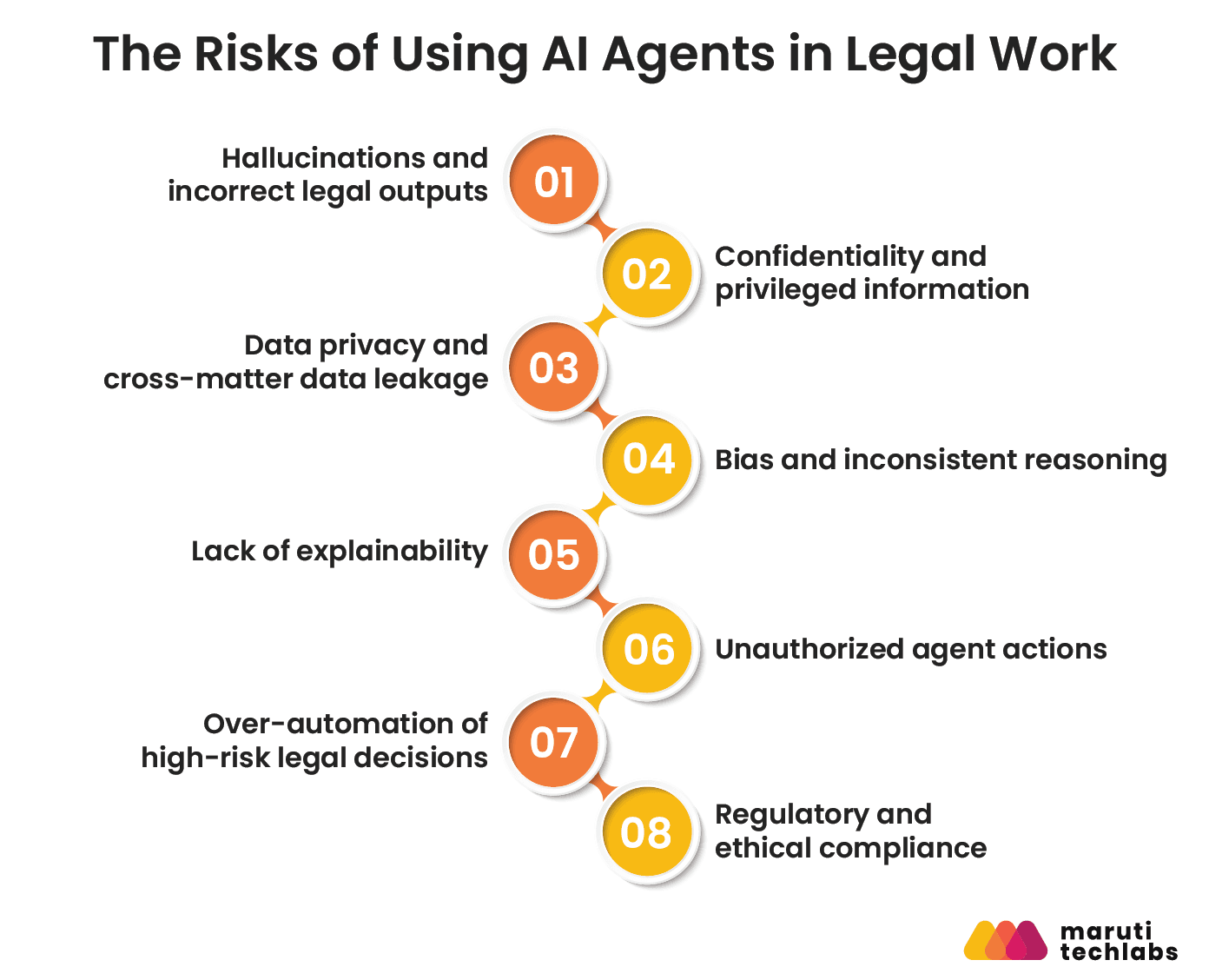
Hallucinations
An agent can generate a citation, a clause interpretation, or a summary that sounds confident and is wrong. In legal work, that's not a minor inconvenience, it can mean a brief filed with a case that doesn't exist or a redline that misses a real deviation.
AI hallucinations can produce incorrect legal outputs, fabricated citations, inaccurate case summaries, or flawed clause interpretations that appear credible but are factually wrong.
In legal workflows, these errors can lead to unreliable research, missed contractual risks, or incorrect filings if they are not caught through human review.
Confidentiality and privileged information
Legal work runs on privilege, and an agent that isn't built with that in mind can expose privileged material to the wrong system, the wrong prompt log, or the wrong training pipeline.
Data privacy and cross-matter data leakage
An agent working across multiple matters needs hard boundaries between them. Without that, information from one client's matter can bleed into another's, which is a conflict-of-interest problem as much as a data problem.
Bias and inconsistent reasoning
An agent trained on historical legal data can pick up the same biases baked into that data, and it can reach different conclusions on similar fact patterns depending on how a task is framed.
Lack of explainability
When an AI agent flags a clause or recommends an action, lawyers need to understand the basis for that output. Explainable AI helps legal teams trace how an AI system arrives at its recommendations, making outputs easier to verify, challenge, and defend.
Unauthorized agent actions
An agent with too much autonomy can take an action, sending a document, filing something, updating a record, that a human never approved.
Over-automation of high-risk legal decisions
Some decisions shouldn't be automated at all, regardless of how good the agent is. Handing off a judgment call that carries real legal or financial consequence removes the human accountability the legal profession depends on.
Regulatory and ethical compliance
Bar rules on competence and supervision, unauthorized practice of law statutes, and client confidentiality obligations don't pause for new technology. An agent has to operate inside those boundaries, not around them.
How Does Maruti Techlabs Address These Risks in AI Agent Development?
These risks are exactly why agent development can't stop at "does it work." It has to be built to fail safely. Here's how that shows up in practice.
- For hallucination risk, validation pipelines and hallucination controls sit inside the execution layer itself, not bolted on after the fact, so an agent's output gets checked before it ever reaches a lawyer.
- Confidentiality and cross-matter leakage are handled through role-based access controls, secure deployment environments (cloud, hybrid, private cloud, or on-premise depending on what a firm needs), and audit logging, keeping access to privileged or matter-specific data scoped to who's authorized to see it.
- For explainability and unauthorized actions, human-in-the-loop controls, approval checkpoints, and escalation paths sit directly inside the workflow, so an agent routes anything above its authority to a human instead of acting on its own.
- Inconsistent reasoning and over-automation are kept in check through structured planning frameworks that break a task into clear, step-by-step execution, paired with runtime monitoring that tracks execution quality and flags behavior drifting from expected patterns after deployment.
- Regulatory compliance runs through governance built in from the start, permission controls, response limits, and SOC 2-aligned development practices, so an agent operates inside a firm's compliance obligations instead of creating new exposure.
The goal isn't about building an agent that never makes a mistake. It's about building an agent so mistakes get caught before they reach a client, a filing, or a decision that can't be undone.
How Should Legal Teams Govern AI Agents Before Deploying Them?
Legal teams should govern AI agents by establishing clear usage policies, human oversight requirements, data access controls, security and compliance safeguards, audit trails, approval workflows, and ongoing performance monitoring before deployment.
These controls define what an agent can access, decide, and execute, while ensuring lawyers remain accountable for high-impact legal decisions.
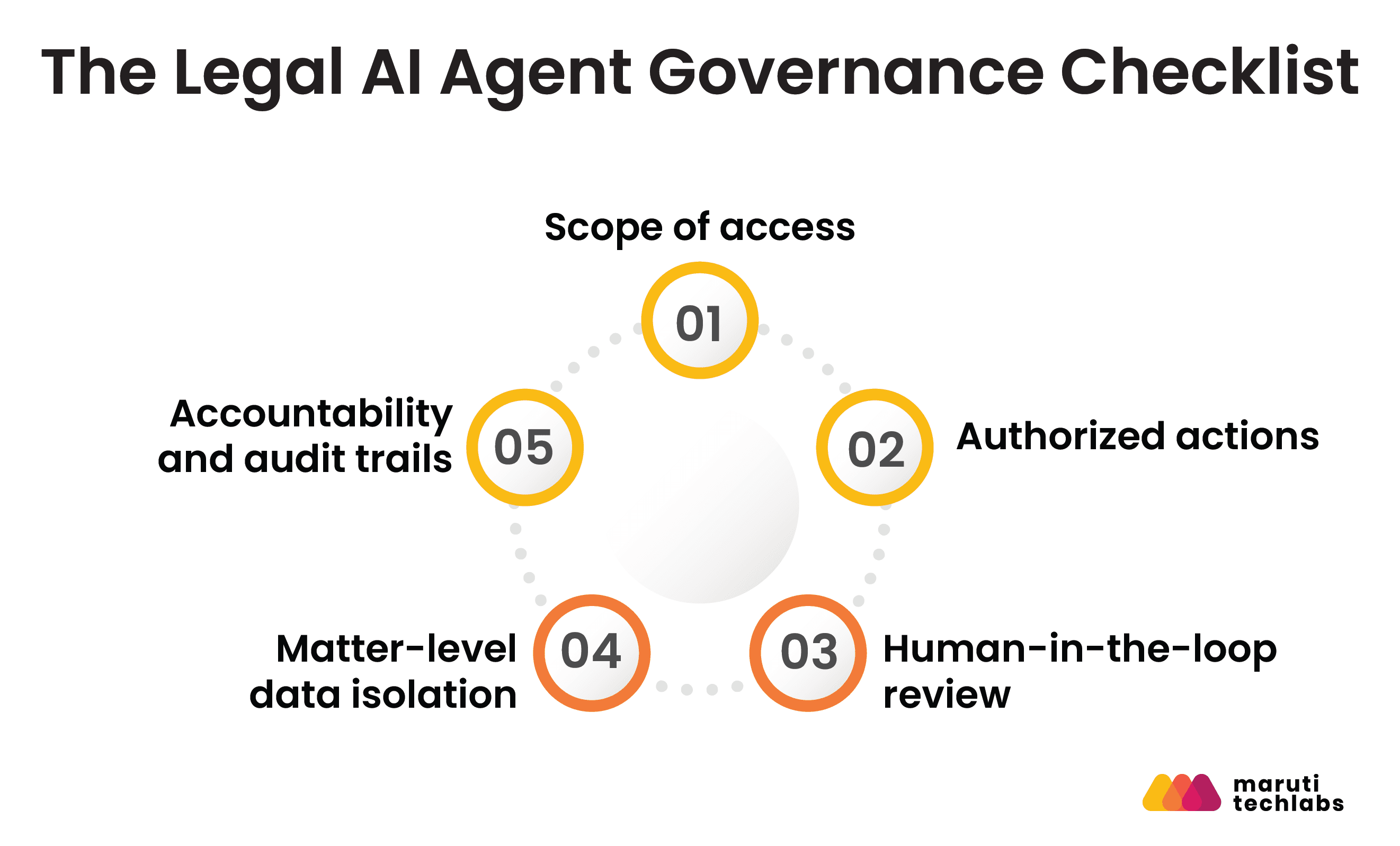
Scope of access
What data can the agent actually see?
An agent working on a single matter shouldn't have standing access to every other client's files. Access should be scoped tightly to what a given task requires, and nothing more.
Authorized actions
What is the agent allowed to do on its own, and what does it need sign-off for?
Drafting a redline is different from sending one. A team needs to draw that line explicitly before the agent is live, not figure it out after something goes out that shouldn't have.
Human-in-the-loop review
Where does a person have to check the agent's work before it moves forward?
For most legal tasks, that checkpoint belongs right before anything gets filed, sent, or relied on, not as an optional step someone can skip when they're busy.
Matter-level data isolation
Can the agent guarantee that information from one matter never bleeds into another? This isn't just a technical configuration, it's a conflict-of-interest question, and it needs to hold up under scrutiny.
Accountability and audit trails
If something goes wrong, can the team trace exactly what the agent did, when, and why? A clear audit trail is what turns "the AI made a mistake" into an answerable, defensible explanation.
Get these five right before deployment, and an agent becomes a tool a legal team can trust with real work. Skip them, and even a technically capable agent becomes a liability waiting to surface.
How Do You Choose the Right AI Agent for Your Legal Team? (Evaluation Criteria)
workflow, accuracy and reliability, integration capabilities, data security, compliance controls, explainability, scalability, and total cost of ownership. A structured evaluation helps distinguish agents that can deliver measurable value from those that simply offer impressive demonstrations.
The market for legal AI is getting crowded fast. The global legal AI software market is projected to grow from USD 3.11 billion in 2024 to USD 10.82 billion by 2030, a 28.3% CAGR, according to MarketsandMarkets. That's a lot of vendors making similar promises, which is exactly why a structured way to evaluate them matters more now than it did two years ago.
Here's what to check before signing anything.
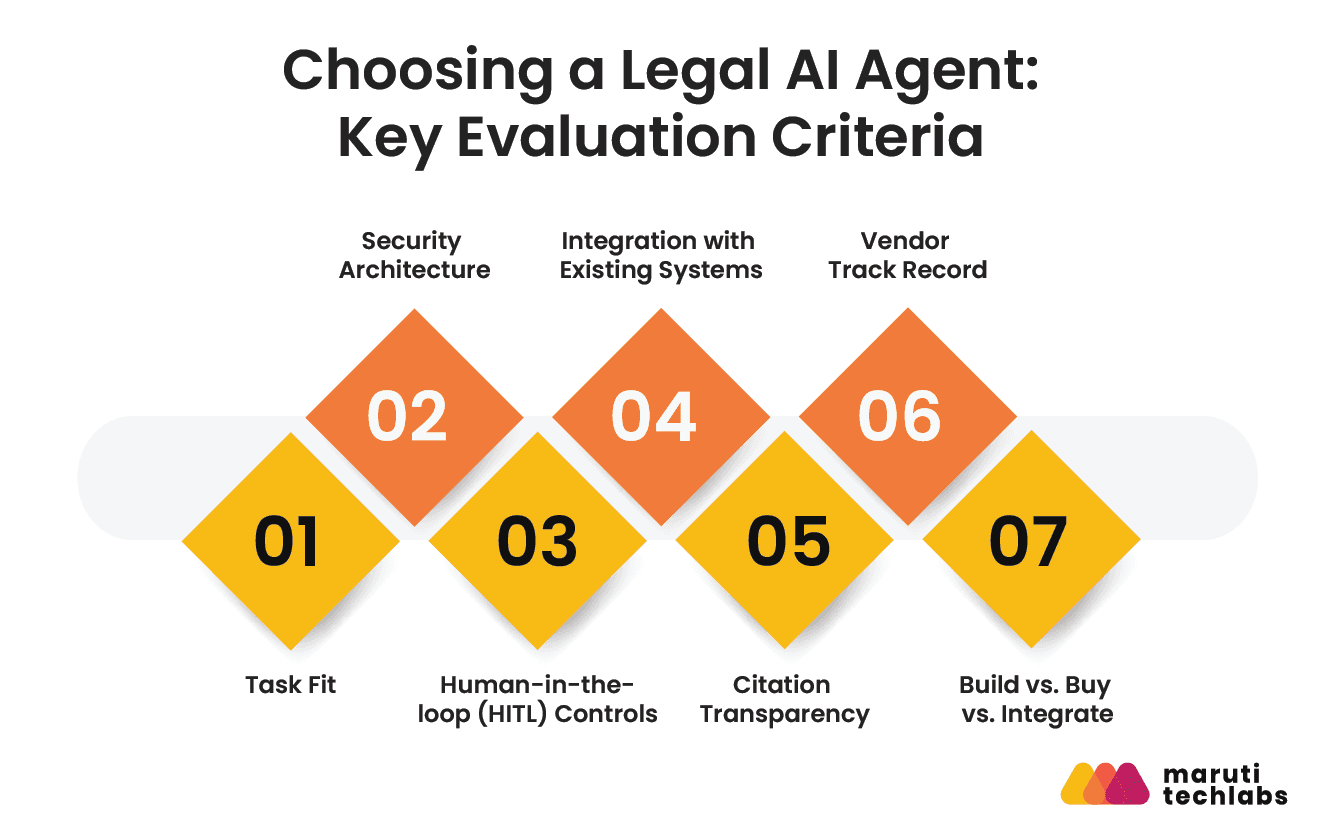
Task Fit
Does the agent do the specific job a team needs, contract review, research, compliance monitoring, or is it a general-purpose tool stretched to cover legal use cases? A narrow agent that's genuinely good at one task usually beats a broad one that's mediocre at five.
Security Architecture
Where does client data live while the agent is working with it? A team needs a straight answer on deployment options (cloud, hybrid, private cloud, on-premise), role-based access controls, and audit logging, not a vague assurance that the platform is "secure."
Human-in-the-loop (HITL) Controls
Can a firm set its own checkpoints, or does the agent expect to run end to end with no review built in? The right answer depends on the task, but the option to add a human checkpoint needs to exist.
Integration with Existing Systems
Does the agent connect to the document management system, case management platform, and other tools a team already uses, or does it require working in a separate silo? An agent that doesn't fit into existing workflows adds friction instead of removing it.
Citation Transparency
Can the agent show where an answer or a flagged issue came from? Given how often legal AI tools have been shown to hallucinate, a vendor that can't explain its sourcing is a vendor to be cautious about.
Vendor Track Record
Has this vendor deployed in legal environments before, and can they point to real outcomes, not just feature lists? A vendor with production experience in regulated industries has already worked through problems a newer vendor hasn't hit yet.
Build vs. Buy vs. Integrate
This is the decision that shapes everything else. Buying an off-the-shelf agent is fastest but least flexible to a firm's specific workflows. Building custom means more control and a better fit, but it takes longer and needs the right development partner.
If you're weighing this trade-off for your broader legal tech stack and not just agents specifically, it's worth understanding how custom and off-the-shelf legal software compare before deciding.
Integrating an existing agent framework into a firm's own systems sits in between, faster than building from scratch, more tailored than buying as-is. The right call depends on how specific a team's workflows are and how much control they need over the agent's behavior.
None of these criteria works in isolation. A vendor can pass on security and still fail on task fit. The point isn't finding a perfect answer to all seven, it's knowing exactly where a given vendor is strong, where they're weak, and whether that trade-off works for the specific matters a team is putting the agent in front of.
How Did Maruti Techlabs Build an Agentic AI System for an Am Law 200 Firm?
A leading Am Law 200 firm needed to cut down the hours its legal teams spent working through dense, document-heavy tasks, contracts and filings that regularly ran 300 to 1,000+ pages.
Maruti Techlabs built an agentic AI system with task-specific automation modules, including document review and due diligence workflows, that took work previously taking 7 to 8 hours down to a matter of minutes, while holding accuracy above 95%.
This is the same build-vs-buy question covered above, worked out in practice. A general-purpose tool wasn't going to hit that accuracy bar on documents that dense. A custom-built agent, engineered around the firm's actual workflows and document types, could.
What Does a Successful AI Agent Rollout Look Like in the First Six Months?
A successful AI agent rollout starts with a focused pilot, clearly defined use cases and success metrics, controlled deployment, user training, human oversight, and continuous monitoring and improvement.
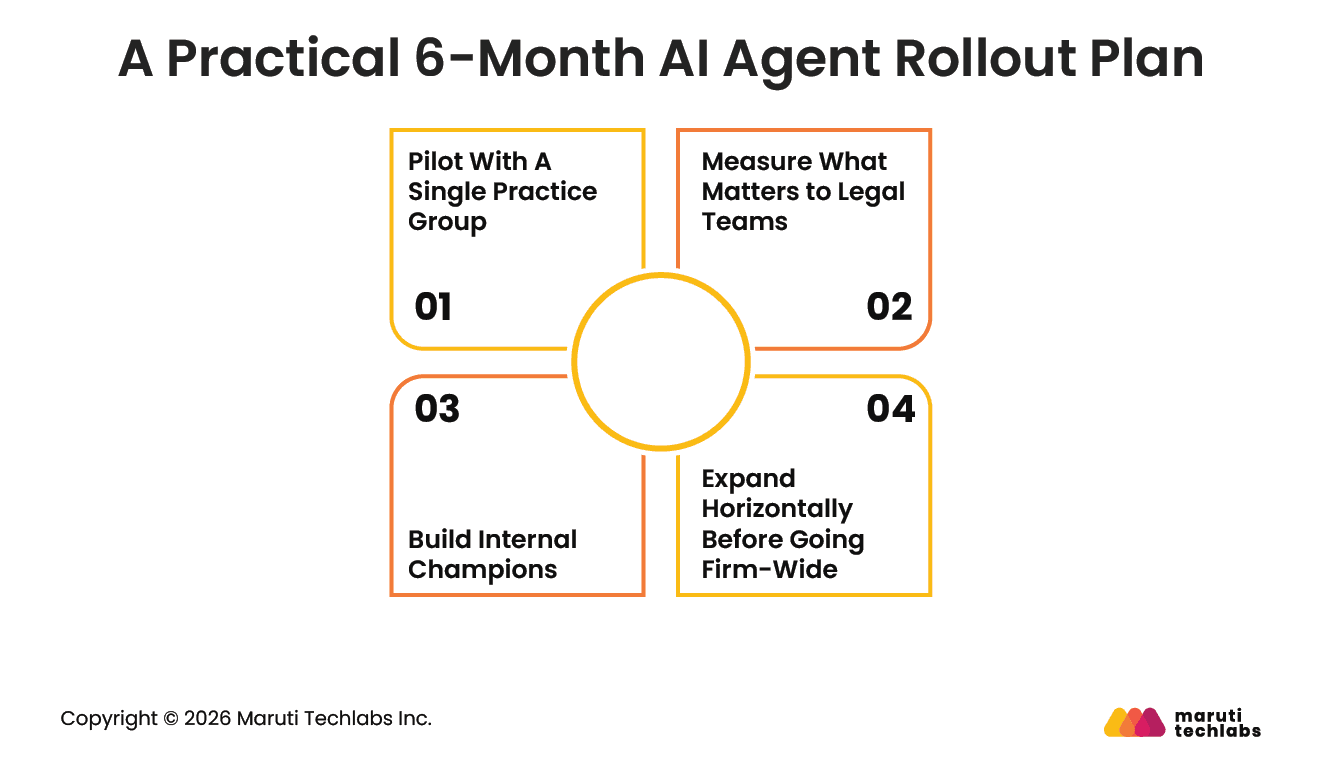
Over the first six months, legal teams should expand adoption gradually based on measurable performance, reliability, user feedback, and business impact rather than deploying agents broadly from the start.
Pilot With A Single Practice Group
Don't roll an agent out firm-wide on day one. Pick one practice area, contract review is a common starting point, and run the pilot there first. A narrow pilot surfaces problems while they're still small and easy to fix, instead of after the agent's already touching every matter in the building.
Measure In Lawyer Terms, Not Platform Terms
A dashboard full of uptime and API response times doesn't tell a managing partner anything useful. What matters is whether contract review takes less time, whether the redlines hold up under a lawyer's review, whether the team trusts what the agent hands back.
Track the outcomes lawyers care about, not the metrics that are easiest to pull from a platform. If you're building out this scorecard, here's how to measure ROI on legal AI in terms that hold up with leadership.
Build Internal Champions
Every successful rollout has a handful of lawyers who like using the tool and can show colleagues how it fits into their day.
Skepticism is the default reaction to new legal tech, and it doesn't get overcome by a mandate from leadership, it gets overcome by a peer saying "this actually saved me two hours yesterday."
Expand Horizontally Before Going Firm-Wide
Once the pilot group is getting real value, move to adjacent practice areas or teams with similar workflows before pushing the agent to every corner of the firm.
Horizontal expansion lets a team apply what it learned in the pilot instead of repeating the same early mistakes at a much bigger scale.
Six months is enough time to know whether an agent earns its place in a team's workflow. If it's still fighting for adoption by then, the problem usually isn't the technology, it's that one of these four steps got skipped.
The Legal Team That Waits Won't Be Ahead
AI agents in legal work aren't a future consideration anymore. They're already reviewing contracts, running research, monitoring compliance, and handing lawyers finished work instead of a blank page to start from.
The teams getting real value out of them aren't the ones who adopted everything at once. They're the ones who picked one workflow, understood exactly where the agent's judgment stops and a lawyer's has to start, and built in the governance to make it trustworthy before scaling it.
The risks are real, hallucinations, confidentiality exposure, over-automation of decisions that shouldn't be automated. None of that is a reason to sit this out. It's a reason to be deliberate about how a team gets in.
The firms figuring this out now, with a real evaluation framework and a real rollout plan, aren't just saving time. They're building the operational muscle everyone else will be scrambling to catch up on in two years.
FAQs
1. What can AI agents do for legal teams?
AI agents can review contracts against a firm's playbook and flag deviations, run legal research and pull relevant case law, sort through documents for e-discovery, monitor regulatory changes, track compliance obligations, and triage routine legal requests from other departments. They handle the multi-step, document-heavy work. Negotiation, strategy, and final decisions stay with the lawyer.
2. What is the technology stack behind a legal AI agent?
A legal AI agent typically runs on a large language model for reasoning, a retrieval layer (often a vector database) that pulls relevant documents and case law, an orchestration framework that manages multi-step task execution, and integrations into a firm's existing systems like document management or case management platforms. Human-in-the-loop checkpoints and monitoring layers sit on top to keep execution controlled.
3. Are AI agents safe for confidential legal data?
They can be, if they're built with that requirement from the start. Safety depends on role-based access controls, matter-level data isolation, secure deployment (cloud, hybrid, private cloud, or on-premise), and audit logging, not on the underlying AI model alone. A poorly configured agent can expose privileged information. A properly governed one keeps that risk close to what a firm already manages with its existing systems.
4. How much does it cost to build a legal AI agent?
Cost depends on scope, whether a firm is building a narrow, single-task agent or a broader system connected across multiple platforms, and on the deployment approach, buy, build, or integrate. A narrow pilot for one workflow costs far less than a firm-wide, multi-agent system with deep integrations. Most firms start with a scoped pilot to prove value before committing to a larger build.
5. Can AI agents integrate with existing legal software?
Yes. AI agents can connect with document management systems, case management platforms, CRMs, and other tools a legal team already uses through APIs and secure integrations. Integration depth is one of the most important things to check before choosing an agent, since a tool that doesn't fit into existing workflows adds friction instead of removing it.
6. What is the difference between legal AI tools and AI agents?
Legal AI tools generally answer a question or complete a single task per prompt, summarizing a document or extracting a clause. AI agents plan and carry out a multi-step task end to end with limited prompting, reviewing a full contract, flagging every deviation, and producing a finished redline without a human directing each individual step.
How Maruti Techlabs Cut Deposition Review Time by 95% for a National Law Firm?
A full-service US law firm with 500+ attorneys and government relations professionals, serving over 40 percent of Fortune 500 companies, was running deposition review through a slow, manual process that couldn't keep pace with case volume.
Attorneys were spending hours working through
- 00 to 600 page transcripts by hand, cognitive fatigue increased the risk of missing critical details and inconsistencies,
- Finding a specific statement meant repeatedly scanning entire documents
- Summaries lacked precise citations that made validation time-consuming, and
- Multiple team members often reviewed the same content without realizing it, creating duplicated effort across the case team.
Maruti Techlabs built an AI-powered platform that automates transcript processing and delivers structured, citation-backed outputs instead of raw manual notes.
The platform converts transcripts into structured, speaker-wise data, identifies key topics, events, and legal elements instantly, generates chronological narrative summaries mapped to exact page-line references, and gives teams a natural language search layer so they can query a transcript directly and get an instant, cited answer instead of scanning the whole document again.
The impact:
- 95 percent faster reviews, cutting review time from 6-8 hours to under 2.5 hours
- 95%+ citation accuracy, delivering highly reliable, reference-backed summaries
- 3x faster retrieval of specific testimony and objections
- No duplicate work, with a single source of truth across legal teams
- Faster case turnaround, accelerating motion drafting and overall case preparation




![[GetPaidStock.com]-65b9d3432ecc1.webp](https://cdn.marutitech.com/small_Get_Paid_Stock_com_65b9d3432ecc1_c1b16b05fb.webp)