

What Is Explainable AI? A Complete Guide for Businesses
Key Takeaways
- Explainable AI helps people understand the reasoning behind AI decisions instead of relying only on the final result.
- It builds trust by making AI predictions easier to review, validate, and improve.
- Industries such as healthcare, finance, and insurance use Explainable AI to support responsible decision-making and compliance.
- Tools such as SHAP, LIME, and InterpretML help teams explain complex AI models without changing how they work.
- Building explainability into your AI strategy from the beginning makes enterprise AI easier to govern, scale, and trust.
Introduction
Whether AI is approving a loan, screening job applications, detecting fraud, reviewing insurance claims, or supporting patient care, one question always remains: Why did it make that decision? The answer is often just as important as the prediction itself.
That is where Explainable AI (XAI) comes in. It helps people interpret AI decisions, identify potential issues, and build greater confidence in the results.
The Explainable AI market is projected to grow from USD 6.2 billion in 2023 to USD 16.2 billion by 2028, at a CAGR of 20.9%. Companies such as Microsoft, IBM, and Temenos are expanding their Explainable AI offerings as enterprise adoption grows.
Getting started with Explainable AI doesn't have to be complicated. This guide explains what it is, how it works, where it's used, the XAI tools, and best practices for successful implementation.

What Is Explainable AI?
Explainable AI (XAI) is a set of methods that helps people understand how an AI model reaches its decisions. Instead of only showing the final prediction, it explains the reasoning behind it. This makes AI outputs easier to interpret, validate, and trust.
Many AI models behave like a black box. They produce an answer, but they don't show how they arrived at it. In some cases, even the developers who built the model cannot fully explain its reasoning.
Explainable AI brings that missing context into the picture. It helps users understand why a model reached a specific conclusion, making AI outputs easier to evaluate.
With Explainable AI, teams can:
- See which inputs had the biggest impact on a prediction.
- Spot unexpected patterns or potential bias in the model.
- Check whether the model is working as expected.
- Explain AI-driven decisions to customers, auditors, or regulators.
- Improve models using clear evidence instead of trial and error.
This is why Explainable AI matters beyond model effectiveness. When people understand how AI reaches a decision, they are more confident using it in real business situations.
How Does Explainable AI Work?
Explainable AI works by breaking down the steps behind an AI prediction. It looks at the data used to train the model, the features affecting a decision, and how those inputs produce the final result.
To achieve this, Explainable AI focuses on three key areas:
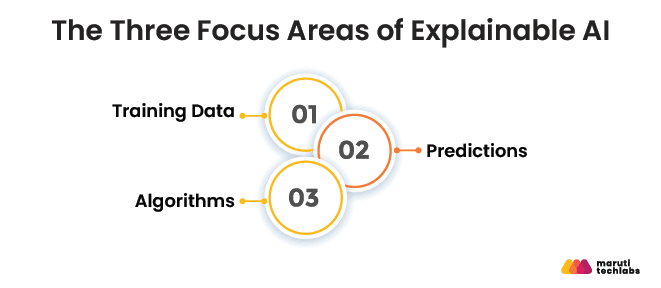
- Training Data: It explains which data trained the model, why it was selected, and how bias was reduced.
- Predictions: It identifies the inputs and features that influenced a specific decision.
- Algorithms: It shows how different parts of the model work together to produce the final output.
There are two common ways to make AI models more explainable:
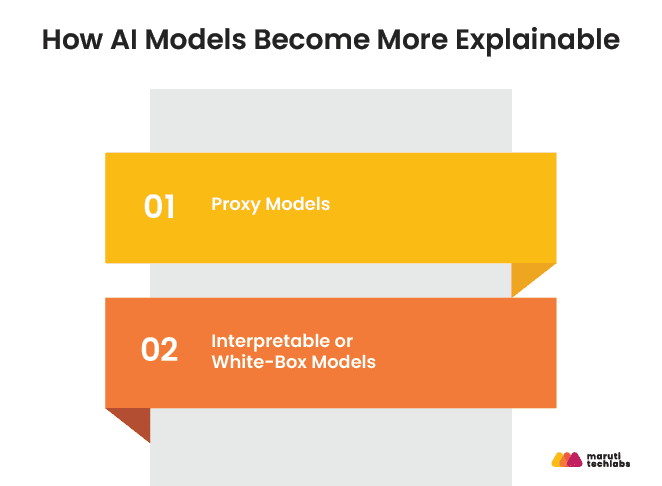
- Proxy Models: Simpler models, such as decision trees, approximate complex AI models to make their predictions easier to interpret. Since they simplify the original model, the explanation may not always match every prediction.
- Interpretable or White-Box Models: These models are designed to be understandable from the beginning. Decision trees, sparse linear models, and Bayesian networks are common examples.
Because deep learning models process large amounts of data across multiple layers, their decision-making can be difficult to follow. Explainable AI uses specialized techniques to convert that internal logic into information people can understand.
Some commonly used techniques include:
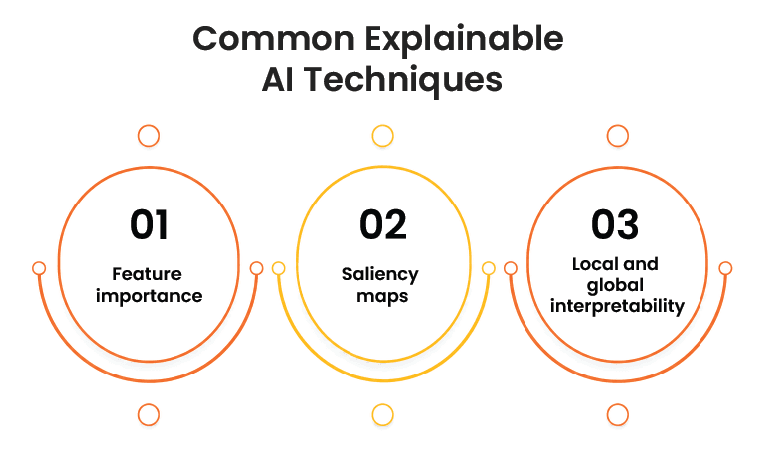
- Feature Importance: Measures how much each input influenced the final prediction.
- Saliency Maps: Highlight the image regions an AI model relied on during image classification.
- Local and Global Interpretability: Explain either an individual prediction or the overall behavior of a model.
Researchers are also improving ways to explain black-box AI without replacing it. Techniques such as LIME and DeepLIFT reveal which features or model components influenced a prediction. This helps teams review complex AI systems while maintaining much of their predictive accuracy.
What are the Benefits of Explainable AI for Enterprises?
Explainable AI supports every stage of the AI lifecycle, from development to business adoption. Its benefits spread beyond technical teams and create value across the enterprise. These include:
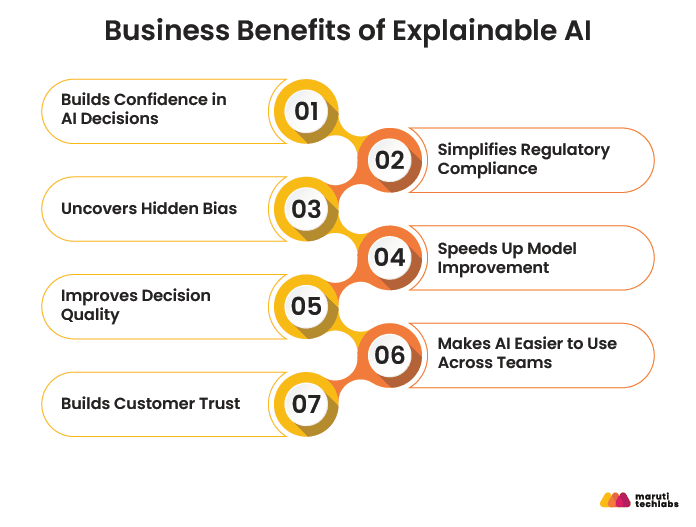
1. Builds Confidence in AI Decisions
Few organizations rely on AI without human monitoring. Explaining the factors behind a prediction gives reviewers ample context to validate the result before moving forward.
2. Simplifies Regulatory Compliance
Meeting compliance requirements is easier when AI decisions can be traced back to their source. Explainable AI helps organizations show what influenced a prediction instead of relying on an unexplained outcome.
3. Uncovers Hidden Bias
Bias can find its way into AI through the data used for training. Seeing which factors influenced a prediction makes it easier to spot patterns that shouldn't be there. Teams can then refine the model before those issues affect real users.
4. Speeds Up Model Improvement
Fixing an AI model is much easier when the source of the problem is clear. Understanding what influenced a prediction helps developers focus on the right areas instead of investigating every possibility.
5. Improves Decision Quality
AI can highlight patterns, but people still make the final decision. Knowing what influenced a recommendation helps teams weigh the outcome alongside their business knowledge.
6. Makes AI Easier to Use Across Teams
Business teams shouldn't have to interpret complex model outputs on their own. Clear explanations make AI results easier to review and discuss across different functions. This encourages broader adoption across the organization.
7. Builds Customer Trust
For many customers, the explanation matters as much as the decision itself. Providing that context makes AI-driven interactions easier to understand and helps build lasting confidence in your business.
6 Explainable AI Use Cases Across Industries
Explainable AI is already being used across industries where decisions need to be accurate, transparent, and easy to justify. Here are some of the most common enterprise applications.
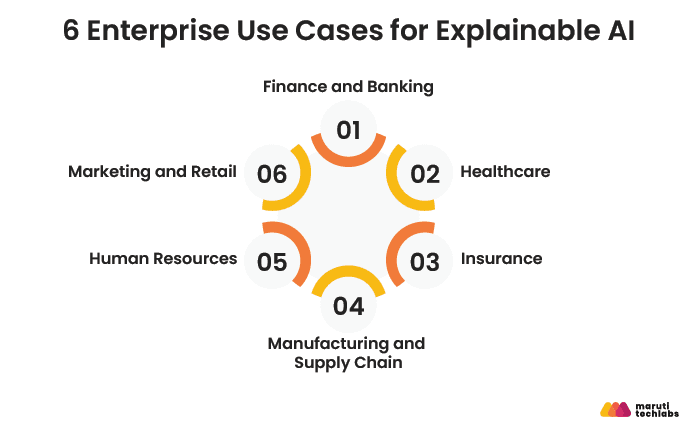
1. Finance and Banking
Loan approvals and fraud alerts usually go through multiple levels of review. Understanding what influenced an AI recommendation helps risk and compliance teams validate the outcome before moving ahead.
2. Healthcare
Medical teams need more than a prediction when diagnosing a patient or planning treatment. Seeing the findings behind an AI recommendation makes it easier to review and validate the result.
3. Insurance
Claims and underwriting decisions aren't always straightforward. Showing the factors behind a decision helps insurers answer customer questions and resolve disputes more effectively.
4. Manufacturing and Supply Chain
Production teams deal with machine alerts every day. Knowing whether an alert was linked to vibration, temperature, or another operating condition makes it easier to identify the root cause.
5. Human Resources
Hiring decisions are rarely based on a shortlist alone. Recruiters usually want to know why one candidate was recommended over another. Explainable AI makes those recommendations easier to review.
6. Marketing and Retail
AI can identify buying patterns and recommend products, but the recommendation alone isn't always enough. Understanding what influenced it helps marketing teams make better campaign and merchandising decisions.
What are the Popular Explainable AI Tools and Techniques?
Several techniques and tools help data science teams understand, validate, and troubleshoot AI models. Some explain individual predictions, while others evaluate how an entire model behaves. The right choice depends on the model architecture and the level of explanation required.
Explainable AI Techniques
- SHAP (SHapley Additive Explanations): SHAP is based on game theory and measures how each feature contributed to a prediction. It is widely used for interpreting complex machine learning models.
- LIME (Local Interpretable Model-Agnostic Explanations): LIME explains an individual prediction by creating a simpler model around it. This allows teams to understand black-box models without modifying the original model.
- Counterfactual Explanations: Counterfactual explanations show the smallest input changes needed to produce a different outcome. They are useful when teams need to explain why a decision changed.
- Surrogate Models: A surrogate model is a simpler version of a complex machine learning model. It approximates the original model to make its behavior easier to interpret.
- Partial Dependence Plots (PDPs): PDPs visualize how changes in a single feature influence model predictions. They help teams understand the relationship between features and outcomes.
Explainable AI Tools
- IBM AI Explainability 360 (AIX360): IBM AI Explainability 360 is an open-source Python toolkit developed for model interpretability. It includes algorithms for explaining predictions, measuring bias, and evaluating fairness across different machine learning workflows.
- Microsoft InterpretML: InterpretML is an open-source framework developed by Microsoft. It supports both interpretable models and post-hoc explainability methods, including SHAP and LIME.
- Google What-If Tool: Google's What-If Tool is a visual interface for exploring machine learning models. It allows teams to compare predictions, test hypothetical scenarios, and examine feature behavior without writing extensive code.
What Are the Challenges of Implementing Explainable AI?
Putting Explainable AI into practice involves technical as well as business considerations. From selecting the right model to meeting compliance requirements, every stage of implementation brings its own challenges. The following are some of the most common ones, along with the practices organizations commonly adopt.
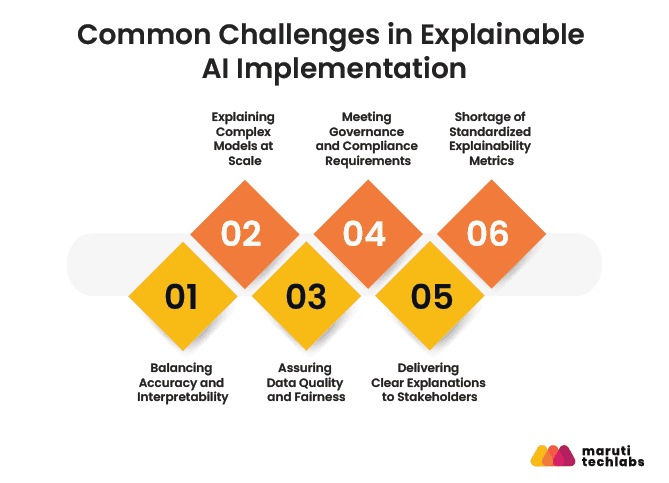
Challenge 1: Balancing Accuracy and Interpretability
Every AI project has different priorities. Some require the highest possible accuracy, while others place greater importance on understanding how each prediction was made. Finding the right balance is part of the model selection process.
Best Practice: The right approach depends on how the model will be used. For decisions that need clear justification, organizations usually favor models that are easier to interpret. When more complex models are necessary, explainability techniques help make their predictions easier to understand.
Challenge 2: Explaining Complex Models at Scale
Once a complex model is in production, explaining thousands of predictions becomes a different challenge altogether. Reviewing every decision manually isn't practical, especially when models process large volumes of data every day.
Best Practice: Techniques such as SHAP and LIME help teams understand why individual predictions were made. They add an explainability layer without changing how the underlying model works.
Challenge 3: Ensuring Data Quality and Fairness
The quality of a model is closely tied to the quality of the data behind it. If the training data contains bias or inconsistencies, those patterns can carry into future predictions. Explainable AI helps uncover them during model evaluation.
Best Practice: Reviewing the model once before deployment is rarely enough. As new data comes in, teams continue checking prediction quality, looking for signs of bias, and making sure the model still performs as expected.
Challenge 4: Meeting Governance and Compliance Requirements
Governance becomes more challenging as AI is adopted across different teams and business functions. Without clear processes, it is difficult to show how models are developed, evaluated, approved, and monitored throughout their lifecycle.
Best Practice: Good governance starts with good record-keeping. Teams often document training data, model updates, and evaluation results so they can explain how a model was developed and reviewed whenever required.
Challenge 5: Delivering Clear Explanations to Stakeholders
People use AI outputs for different reasons. A data scientist may want to understand the technical details, while a business leader is usually interested in the reasoning behind the decision. Explaining AI in the same way to everyone rarely works.
Best Practice: Successful implementations present explanations in different formats for different audiences. Technical teams may need feature-level insights, while business users often prefer a clear business rationale.
Challenge 6: Shortage of Standardized Explainability Metrics
Different organizations measure explainability in different ways. What works for a healthcare model may not be enough for a banking application. That makes it difficult to evaluate explainability using a single standard.
Best Practice: Many organizations define their own guidelines for evaluating explainability. Using the same approach across AI projects makes it easier to review models and compare results over time.
Conclusion
Explainable AI answers a question that every business eventually asks: Why did the model make this decision? Without that answer, it becomes difficult to rely on AI for decisions that affect customers, employees, finances, or operations.
That is why explainability is moving beyond a technical discussion. It has become an important part of how organizations build, govern, and scale AI responsibly. The models, tools, and techniques covered in this guide help teams understand AI decisions without giving up the performance modern applications require.
As enterprise AI adoption continues to grow, explainability is likely to become a standard part of every AI project rather than an optional feature. Building it into your AI strategy from the start can make future deployments easier to manage, easier to validate, and easier for people to trust.
FAQs
1. What is explainable AI?
Explainable AI (XAI) is AI that can explain why it made a particular prediction or recommendation. Instead of simply producing a result, it gives people enough information to understand what influenced the decision. That makes it easier to review AI outputs before acting on them.
2. What are the most common explainable AI methods?
SHAP and LIME are the two most widely used Explainable AI techniques. Other common methods include counterfactual explanations, surrogate models, and partial dependence plots (PDPs). Each method gives a different way to understand why a model made a particular prediction.
3. What are the best explainable AI tools available today?
Some of the most popular Explainable AI tools include IBM AI Explainability 360 (AIX360), Microsoft InterpretML, and Google's What-If Tool. These tools help data science teams understand model predictions, uncover bias, and review AI results before they are put into production.
4. What are examples of explainable AI models?
Models such as decision trees, Bayesian networks, and linear regression make it easier to follow how a prediction was reached. That's one reason they're widely used in regulated industries, where teams often need to explain or validate AI-driven decisions.
5. What are the main benefits of explainable AI for enterprises?
Explainable AI helps organizations understand how AI models reach their decisions. It supports regulatory compliance, improves trust, makes bias easier to detect, and simplifies model monitoring. It also gives business teams greater confidence when using AI to support important decisions.
6. Is explainable AI a legal requirement?
Not in every case. However, businesses using AI in regulated industries are under increasing pressure to explain how important decisions are made. That's why many organizations are investing in Explainable AI now instead of waiting for regulations to catch up.
7. How is explainable AI different from traditional black-box AI?
Black-box AI tells you what the answer is but not why it reached that conclusion. Explainable AI fills that gap by showing what influenced the prediction. That makes it easier to review important decisions before acting on them.
How Maruti Techlabs Helped a Healthcare Provider Build More Reliable AI
Managing thousands of patient letters every day had become a time-consuming manual process for a leading UK healthcare provider. (optical character recognition) and NLP (natural language processing) solution that automatically extracted and classified patient records. The solution reduced processing time by 87%, improved accuracy to 93%, and reduced review teams from 12 people to 2.
Projects like this show that enterprise AI must fit existing workflows and deliver dependable results. Success depends on more than model accuracy alone. Organizations also need AI solutions that teams can confidently use every day.
Our AI Development Services help organizations build, deploy, and scale enterprise AI solutions for complex business problems. Our Custom AI & Machine Learning Development services create tailored models for automation, document intelligence, computer vision, and predictive analytics. Every solution is designed around your business goals, existing systems, and operational requirements.