
Why Enterprise AI Projects Fail: Root Causes and Fixes for CTOs and CIOs
Key Takeaways
- Most AI implementation failures trace back to a small set of avoidable causes, not the underlying technology itself.
- 42% of enterprises abandoned most of their AI initiatives in 2025, and only 5% of generative AI pilots reach production with measurable business impact.
- The 7 root causes range from unclear ROI and poor data governance to weak change management and missing post-deployment monitoring.
- Hidden costs of a failed AI implementation include sunk investment, lost opportunity, eroded internal trust, and growing regulatory exposure under GDPR and the EU AI Act.
- A 5-dimension readiness check across data, infrastructure, team, strategy, and governance helps catch failure risks before a project starts.
- Tracking business KPIs, model performance, adoption, and a fixed monitoring cadence together, not any single metric alone, is what separates AI implementations that scale from those that stall.
Introduction
When Core Nova needed a fraud detection model to flag suspicious insurance calls, Maruti Techlabs did not start with the model. The engagement opened with a four-week AI readiness audit, followed by cleaning and labeling the client's audio training data before any classification model was built.
The result was a Python-based model that classified calls as human-answered or non-human-answered within 500 milliseconds, saving agents 30 minutes per day and cutting operating costs by $110,000 per month. The client renewed the partnership for further phases.
Most AI implementations do not get to tell that story. According to S&P Global Market Intelligence's 2025 survey of more than 1,000 enterprises across North America and Europe, around 42% of companies abandoned most of their AI initiatives this year, up from just 17% in 2024.
Cisco's 2025 AI Readiness Index tells a similar story on readiness. Across more than 8,000 senior IT and business leaders surveyed in 30 markets, out of which only 13% of organizations qualify as "Pacesetters," consistently able to move AI pilots into production.
The gap between Core Nova and S&P Global’s 42% is not a difference in budget or ambition. It comes down to a small, repeatable set of mistakes, made early and rarely revisited.
This guide diagnoses the root causes behind corporate AI implementation failure with real enterprise examples, and gives you a practical framework to fix them, without starting the project over.

What are the Root Causes Behind Failed AI Projects
Failed AI projects rarely stem from a single technical problem. They are typically the result of unclear business goals, poor data governance, adoption challenges, weak AI governance, and the inability to scale successful pilots into production.
The seven causes below account for the majority of documented AI implementation failures across enterprise deployments, each with a specific fix rather than a general warning.
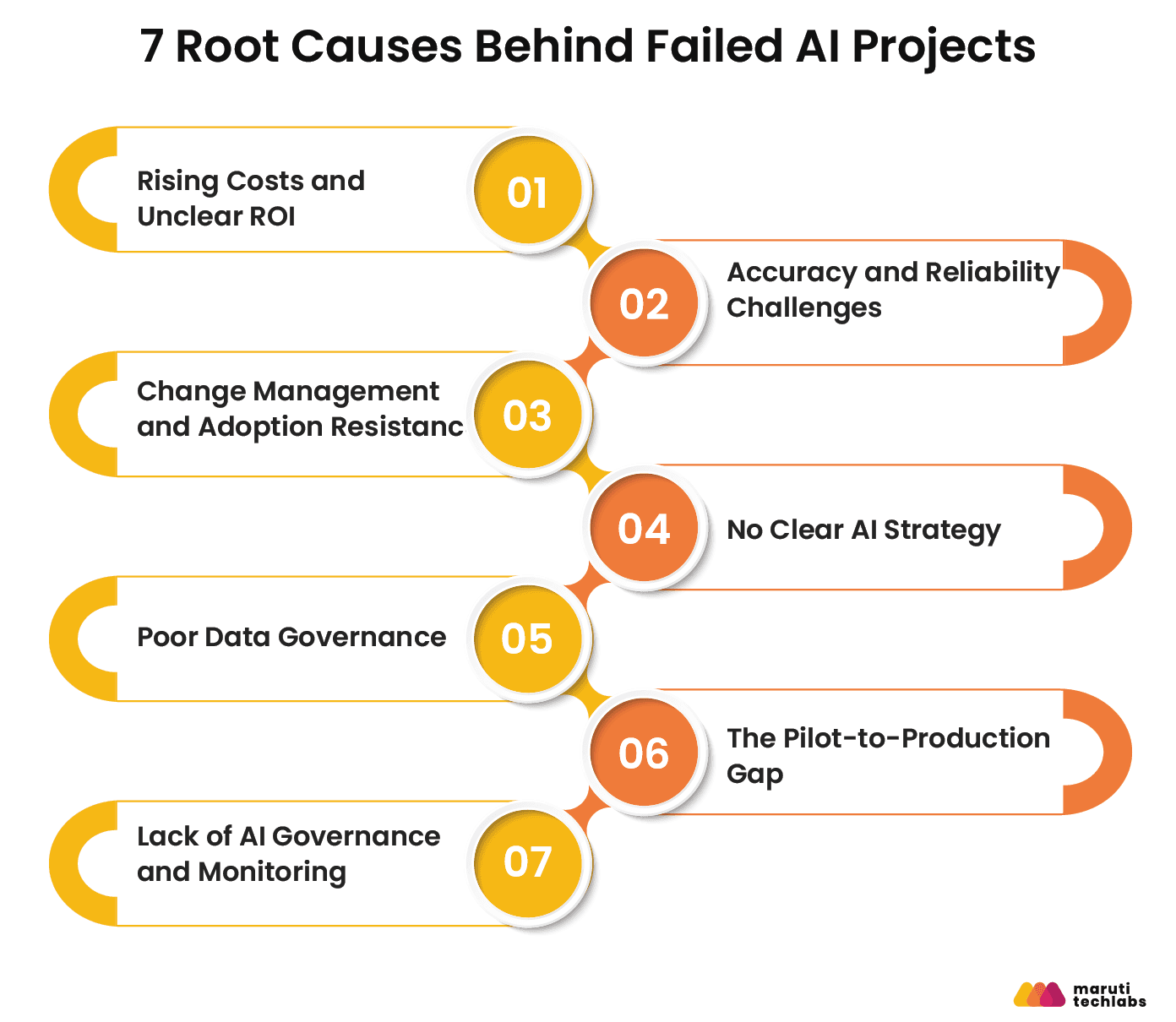
1. Rising Costs and Unclear ROI
Enterprise spending on generative AI reached an estimated $30-40 billion in 2025, yet MIT's Project NANDA found that 95% of organizations deploying generative AI saw zero measurable financial return on that investment.
Costs compound quietly across licensing, compute, integration, and retraining, none of which typically appear in the original business case.
How to fix it:
Tie every AI initiative to one pre-defined business metric before funding is approved, not after the pilot ships.
2. Accuracy and Reliability Challenges
Purpose-built AI tools are not immune to this problem. Stanford's RegLab found that leading legal AI research tools from LexisNexis and Thomson Reuters each hallucinated between 17% and 33% of the time in a controlled evaluation, despite vendor claims of being "hallucination-free".
In high-stakes domains like legal, insurance, and healthcare, an unverified answer is often worse than no answer.
How to fix it:
Require a human review step for any AI output feeding a client-facing or compliance-sensitive decision, with the review step built into the workflow, not treated as optional.
3. Change Management and Adoption Resistance
Deploying a tool is not the same as changing how people work. BCG's 2025 AI at Work survey of over 10,600 employees across 11 countries found that only 51% of frontline employees are regular AI users, a figure that has stagnated, and just 25% say their leaders provide enough guidance on AI.
How to fix it:
Assign a named workflow owner responsible for adoption, not just deployment, and measure their success by usage, not by go-live date.
4. No Clear AI Strategy
Without a stated plan, employees fill the gap with guesswork.
Gallup's most recent workplace survey found that while 44% of employees say their organization has begun integrating AI, only 22% say their organization has communicated a clear plan or strategy for doing so.
How to fix it:
Publish a one-page AI strategy naming the specific business problems AI is meant to solve this year, before greenlighting any new pilot.
5. Poor Data Governance
Data quality decides the model's fate before training even begins. When Maruti Techlabs built a sales forecasting model for A20 Motors, the historical sales data was skewed toward top-selling parts, which would have made the model unreliable for the long tail of inventory.
Correcting for that skew before training, rather than after, kept prediction error on high-selling parts within plus or minus 20%.
How to fix it:
Audit training data for skew, gaps, and labeling quality as a distinct, signed-off milestone before model development starts.
6. The Pilot-to-Production Gap
Getting a model to work in a demo is not the hard part. MIT's Project NANDA, drawing on more than 300 enterprise deployments, found that only 5% of generative AI pilots reach production and generate measurable business impact, while the remaining 95% stall indefinitely as internal demos.
How to fix it:
Design for production constraints, including latency, integration, and monitoring, from the first prototype rather than treating them as a later phase.
7. Lack of AI Governance and Monitoring
Models degrade after launch, and few organizations are watching for it. Gartner's November 2025 survey of 360 organizations found that companies conducting regular AI system assessments were three times more likely to report high generative AI business value than those that did not.
How to fix it:
Assign a named owner for post-deployment monitoring before launch, with a defined cadence for reviewing drift and bias, not a reactive response to the first incident.
What is the Business Cost of a Failed AI Implementation?
A failed AI implementation costs far more than the project budget. The real damage shows up in five distinct places, and one of them, regulatory exposure, barely existed as a risk category three years ago.
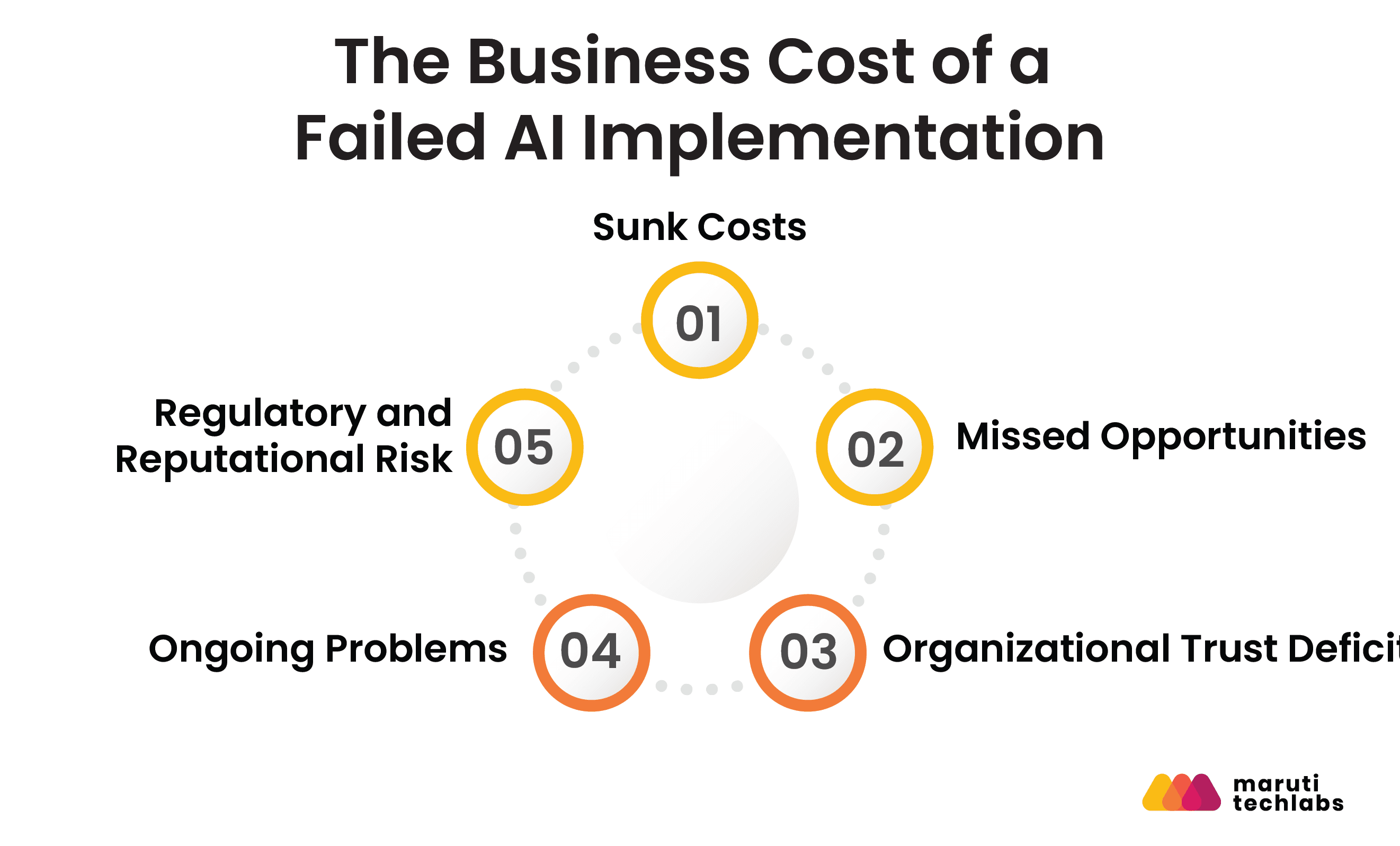
1. Sunk Costs
Enterprise-wide AI initiatives generate an average ROI of just 5.9%, well below the typical 10% cost of capital, according to IBM's Institute for Business Value survey of 2,500 global executives.
Best-in-class companies reach 13% ROI on the same investment, more than double the average, which means the gap is not the technology, it's the execution.
2. Missed Opportunities
The cost of a failed initiative is not just what was spent, but what a working one would have returned.
IBM's CEO study found that only about 25% of AI initiatives deliver their expected ROI, and just 16% have reached enterprise-wide scale, leaving the majority of intended value uncaptured (IBM, 2025).
3. Organizational Trust Deficit (consolidating Stakeholder Doubt and Loss of Trust)
Every visible AI failure makes the next initiative harder to fund and adopt. Deloitte's TrustID Index recorded a 31% drop in employee trust toward company-provided generative AI tools between May and July 2025 alone, and an 89% drop in trust toward agentic AI systems over the same period. Rebuilding that trust takes longer than building the model did.
4. Ongoing Problems
A failed implementation rarely disappears quietly.
Without the monitoring practices covered under Cause 7 above, a stalled or degraded AI system keeps consuming support time, generating bad outputs, or sitting half-integrated into a workflow, all while leadership assumes the problem was closed out with the project.
5. Regulatory and Reputational Risk
This risk is newer than the other four, and it is growing. Under the EU AI Act, non-compliant high-risk AI systems can draw fines of up to €15 million or 3% of global annual turnover, and prohibited practices up to €35 million or 7%, whichever is higher.
Separately, GDPR Article 22 gives individuals the right not to be subject to a decision based solely on automated processing, which creates direct exposure for insurance, healthcare, and legal clients using AI in claims, diagnosis, or case-related decisions without a human-in-the-loop step.
Real-World AI Implementation Failures: Enterprise Case Studies
Consumer-facing AI mishaps make headlines, but they rarely resemble what goes wrong inside an enterprise software rollout. The three examples below are enterprise deployments, and each maps directly to a root cause covered above.
1. IBM Watson for Oncology
IBM spent roughly $4-5 billion acquiring health data companies (including a $2.6 billion purchase of Truven alone) to feed its Watson for Oncology product, which was meant to recommend cancer treatments to physicians.
An internal document review by STAT News found the system had produced ‘multiple examples of unsafe and incorrect treatment recommendations,’ and MD Anderson Cancer Center ended its collaboration in 2015 after spending $62 million on the project.
IBM ultimately sold the Watson Health assets in 2022 for roughly $1 billion, a fraction of what was invested.
This illustrates Accuracy and Reliability Challenges and Change Management and Adoption Resistance: physicians would not act on recommendations they could not trust or verify.
2. Amazon's AI Recruiting Tool
Amazon built an experimental hiring tool starting in 2014 that scored resumes on a five-star scale.
By 2015, the company discovered the model had taught itself to penalize resumes containing the word "women's" and downgrade graduates of women's colleges, because it had been trained on ten years of resumes submitted mostly by men. Amazon scrapped the project in 2017.
This is a direct illustration of Poor Data Governance: the training data itself encoded a historical bias that the model then amplified at scale.
3. Zillow
Zillow's "Zestimate" algorithm was used to make automated cash offers on homes for its iBuying business.
When the housing market shifted after 2020, the model kept bidding as if prices would keep rising, and Zillow ended up paying more for homes than it could resell them for. The company shut the business down in November 2021, took write-downs exceeding $500 million, and laid off 25% of its workforce.
This is the clearest illustration of the Pilot-to-Production Gap and Lack of AI Governance and Monitoring: the model worked in a stable market and had no monitoring in place to catch it failing as conditions changed.
Are You Ready for AI? A 5-Dimension AI Readiness Self-Assessment
Before choosing a strategy to fix a failing AI implementation, it helps to know exactly where the gap is. The five dimensions below cover the areas that most commonly separate AI initiatives that scale from the ones that stall.
1. Data Readiness
Not ready: Training data is scattered across disconnected systems, has no documented lineage, or contains known gaps and skew that no one has corrected for.
Ready: Data is centralized or accessible through a governed pipeline, quality and completeness have been audited, and known biases have been identified and addressed before model training begins.
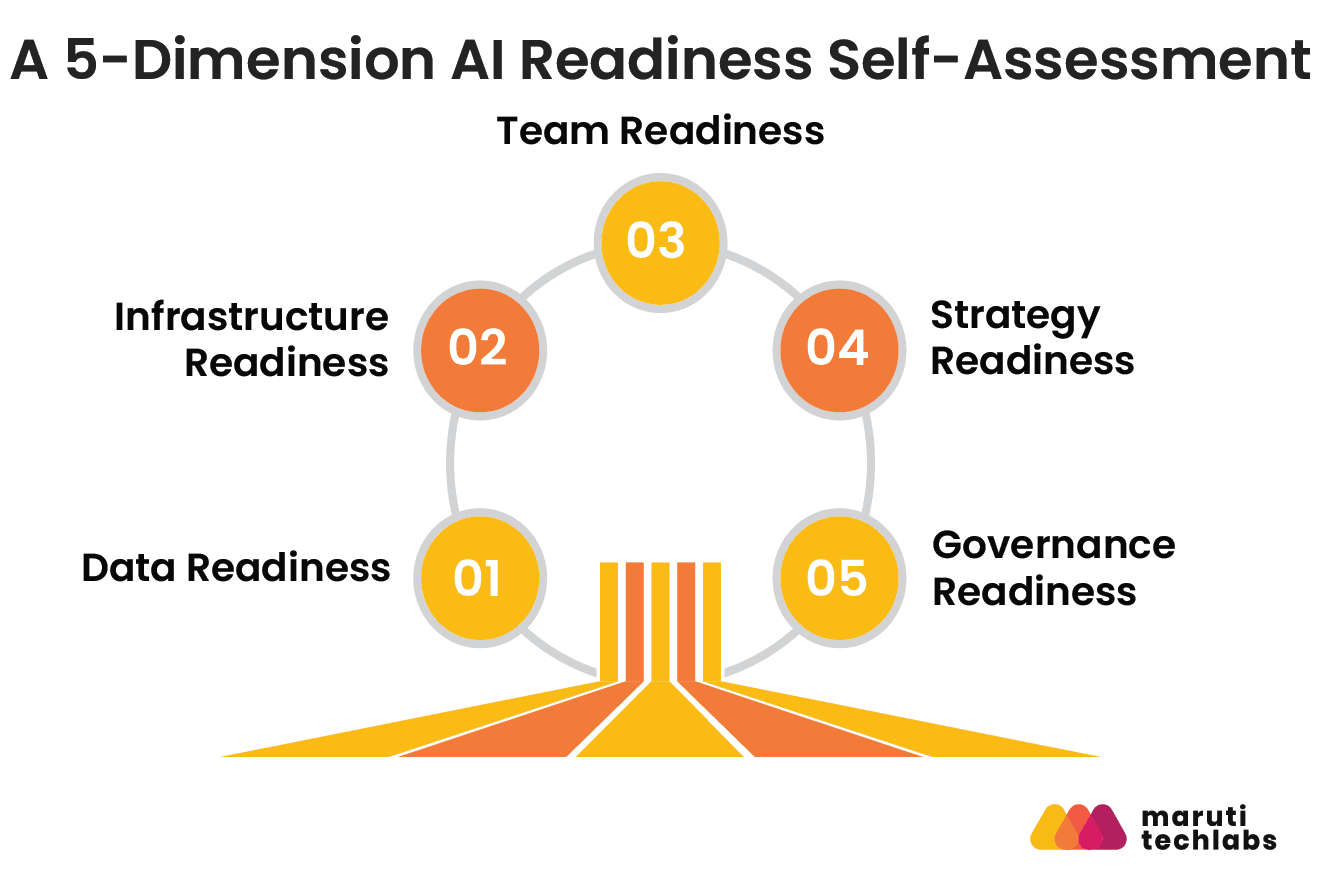
2. Infrastructure Readiness
Not ready: The AI model was built and tested in a sandbox with no plan for how it will handle production data volume, latency requirements, or integration with existing systems.
Ready: The target production environment, its latency and throughput requirements, and its integration points with existing systems were mapped out before development started.
3. Team Readiness
Not ready: The project depends on one or two specialists with no documented process, and the broader team has not been trained on how the AI tool changes their workflow.
Ready: There is a named team with defined roles for building, deploying, and maintaining the system, and end users have been trained on the new workflow, not just the tool.
4. Strategy Readiness
Not ready: The project began with a technology ("let's use AI") rather than a business problem, and no one can name the specific metric it is meant to move.
Ready: The initiative is tied to one named business KPI with a target and a timeframe, agreed before any model was selected.
5. Governance Readiness
Not ready: There is no owner for post-deployment monitoring, no plan for detecting model drift or bias, and no defined escalation path if the model starts producing bad outputs.
Ready: A named owner monitors the model on a set cadence, with clear thresholds for when a human reviews or overrides its output.
Scoring Your Readiness
Count how many of the five dimensions land on the green flag side:
- 0-1 green flags: Not ready. Starting a build now is likely to repeat the failure patterns covered earlier in this guide.
- 2-3 green flags: Partially ready. You can proceed, but close the remaining gaps before scaling past a pilot.
- 4-5 green flags: Ready to scale. Your foundation is strong enough to move from proof of concept to production with manageable risk.
Want a full, structured assessment instead of a self-check? Our AI Readiness Audit tool walks through all five dimensions in detail and gives you a concrete action plan for the gaps it finds.
How to Implement AI Successfully: 8 Proven Strategies for Enterprise Teams
Each strategy below is a direct countermeasure to one of the failure patterns covered earlier in this guide. Building against these fixes early costs far less than trying to retrofit them into a stalled project later.
1. Anchor Every Initiative to One Business Metric
Skip the general "AI strategy" workshop. Before any funding is approved, name the single business KPI the initiative is meant to move (churn, cost-per-claim, cycle time) and set a target and timeframe.
This directly counters the ROI ambiguity behind the industry's 5.9% average return on enterprise AI investment.
2. Build Human Review Into High-Stakes Outputs
Route any AI output that touches a compliance-sensitive or client-facing decision through a mandatory human review step, built into the workflow rather than offered as an optional check.
This is non-negotiable for legal, insurance, and healthcare use cases, where the Stanford RegLab findings on legal AI hallucination rates make the stakes clear.
3. Name a Workflow Owner, Not Just a Project Owner
Assign someone accountable for adoption, separate from whoever is accountable for deployment. Their success metric should be usage and workflow change, not go-live date. This is the single biggest lever against the adoption stall reflected in BCG's 51% frontline usage figure.
4. Publish a One-Page AI Roadmap
Write down, in one page, which specific business problems AI is meant to solve this year and which are explicitly out of scope. Distribute it to every team touching AI work. This closes the strategy communication gap Gallup found at only 22% of organizations.
5. Put Data Governance Tooling in Place Before Training
Use a data cataloging and lineage tool such as Apache Atlas or Collibra to track where training data comes from, and a validation tool such as Great Expectations to catch schema drift, missing values, and skew before they reach a model. This is what would have caught the training data problem behind Amazon's recruiting tool.
6. Design for Production From the First Prototype
Involve the team that owns integration, latency requirements, and security review from the earliest prototype stage, not after the model works in a notebook.
Standard MLOps practice treats the production environment as a design constraint, not as a post-deployment afterthought. This directly targets the gap where 95% of pilots never reach production.
7. Monitor Continuously After Deployment
Assign a named owner to track model drift, data drift, and output quality on a defined cadence using a monitoring platform such as Evidently AI, WhyLabs, or Amazon SageMaker Model Monitor. Set explicit thresholds for when a human reviews or overrides the model's output. This is what Zillow's Zestimate algorithm lacked when the housing market shifted underneath it.
8. Build Compliance Checkpoints Into the Workflow, Not After It
Map any AI system touching EU users or high-risk decisions (claims, hiring, credit, healthcare) against GDPR Article 22 and EU AI Act risk tiers before launch, not during an audit.
Include a documented human-in-the-loop step wherever a decision could otherwise be "solely automated." This closes the regulatory and reputational exposure covered earlier.
How Do You Measure the Success of an AI Implementation? Key Metrics and KPIs
Most AI failures are diagnosed months after the damage is done, because no one defined what "working" would actually look like before launch. The four categories below cover what to track, starting on day one, not after the first complaint.
1. Business KPIs
These tie the AI system back to the one metric named in Strategy 1 above. Examples: cost per transaction processed, cycle time reduction, error rate versus the previous manual process, or revenue influenced.
The target and baseline should be set before launch, using the pre-AI process as the comparison point, not a hypothetical best case.
This is the metric IBM's Institute for Business Value found missing in the majority of enterprise AI initiatives that failed to clear even a 10% cost-of-capital hurdle.
2. Model Performance Metrics
These are the technical health checks: accuracy, precision and recall (or their equivalents for the task), latency under real production load, and the rate of flagged or overridden outputs.
For any system touching a regulated or high-stakes decision, track the hallucination or error rate specifically, the way Stanford RegLab did for legal AI tools, rather than relying on a vendor's stated benchmark.
3. Adoption Metrics
A model that performs well in testing but sits unused has failed regardless of its technical scores. Track active usage rate among the intended users, not just licenses issued or logins in week one.
BCG's finding that only 51% of frontline employees are regular AI users, despite widespread deployment, is exactly the gap this metric is meant to catch early rather than discover a year later.
4. Monitoring Cadence
Set a fixed schedule, weekly or monthly depending on how fast the underlying data changes, for reviewing model drift, data drift, and output quality against the original benchmarks.
Define in advance the threshold that triggers a human review or a full model retrain, rather than deciding reactively after something goes visibly wrong. Gartner's finding that regular assessments triple the odds of high AI value is the direct evidence behind this practice.
Putting It All Together
A genuinely healthy AI implementation shows movement on its business KPI, stable or improving model performance, sustained (not just initial) adoption, and a monitoring cadence that has actually caught and corrected at least one drift event. Missing any one of the four is an early warning sign, not a minor gap.
From One-Off Fixes to Repeatable AI Risk Management
The organizations that get AI right are not the ones with bigger budgets or better models. They are the ones that treat each of the 7 root causes covered in this guide as a checklist item to close before launch, not a lesson to learn after a failed rollout.
Before your next AI initiative moves past the whiteboard, run it through this 3-point check:
- Can you name the one business metric this initiative is meant to move, with a target and a timeframe? If not, revisit Strategy 1 before writing any code.
- Has your training data been audited for gaps, skew, and quality, with a named owner for that audit? If not, revisit Poor Data Governance and the Data Readiness dimension.
- Is there a named owner for post-deployment monitoring, with a defined cadence and escalation threshold? If not, revisit Lack of AI Governance and the Governance Readiness dimension.
If any of the three is unclear, that is exactly the gap our AI Readiness Audit is built to find, with a concrete action plan attached rather than just a diagnosis.
For teams still deciding whether to build in-house or bring in a partner, our build vs. buy framework and AI data readiness framework are useful next steps before committing resources.
FAQs
1. What percentage of AI projects fail?
Estimates vary by scope, but S&P Global Market Intelligence found 42% of enterprises abandoned most of their AI initiatives in 2025, and MIT's Project NANDA found only 5% of generative AI pilots reach production with measurable business impact.
2. What is the difference between AI implementation and AI deployment?
AI implementation covers the full lifecycle: strategy, data preparation, model development, integration, and change management. AI deployment refers specifically to the technical step of releasing a model into a live environment.
A project can be successfully deployed and still fail at implementation if adoption, governance, or ROI never materialize.
3. Why do most AI pilots never reach production?
Most pilots are built and tested without accounting for production constraints such as latency, system integration, monitoring, and user adoption. Because these are treated as later-phase concerns rather than early design constraints, a working prototype often cannot survive contact with real production conditions.
4. How long does it take to see ROI from an AI implementation?
This depends heavily on scope, but enterprises that tie AI initiatives to one named, measurable business metric from the start tend to see returns faster than those that treat AI as a general capability investment.
IBM's Institute for Business Value found that only best-in-class implementations exceed the 10% cost-of-capital threshold, at 13% average ROI.
5. What is AI governance and why does it matter?
AI governance is the set of policies, ownership structures, and monitoring practices that oversee an AI system after it launches, including drift detection, bias monitoring, and escalation paths.
Gartner found that organizations conducting regular AI system assessments were three times more likely to report high AI business value.
6. How do you know if your organization is ready for AI?
Readiness spans five dimensions: data quality and governance, production infrastructure, team skills and training, a clearly defined strategy, and post-deployment governance. An organization scoring well on most of these is in a strong position to scale past a pilot; gaps in any dimension predict where failure is most likely to originate.
7. What industries are most at risk from AI implementation failure?
Regulated, high-stakes industries such as healthcare, insurance, and legal face the highest exposure, both because model errors carry direct consequences for patients or clients and because of specific regulatory frameworks like GDPR Article 22 and the EU AI Act governing automated decision-making.
How Did Maruti Techlabs Turn a Failing Computer Vision Model Into a 23% Precision Gain?
PhotoStat, a platform that helps photographers and artists detect unauthorized use of their images online, had already built and deployed a computer vision model to power its image similarity search. It wasn't working. The existing logistic regression model had less than 65% precision, producing a high rate of false positives and false negatives that confused users and undermined trust in the platform.
Rather than patch the existing model, Maruti Techlabs rebuilt the detection approach from the ground up, designing a computer vision-based search engine that matched user-submitted images against a similarity index and returned ranked, explainable results instead of a binary right-or-wrong output.
The impact:
- 23% greater precision in image similarity detection compared to the original model
- Reduced manual review effort and lower long-term operating costs for the platform
- Improved end-user trust and experience through more reliable match results
- PhotoStat retained Maruti Techlabs as its ongoing product development partner, with both teams now working jointly on PhotoStat's product roadmap