

8 Best Explainable AI Tools for Enterprise Teams (Compared Across Features, Capabilities, and Use Cases)
Key Takeaways
- Explainable AI tools show which inputs drove a model's prediction, helping teams debug models, answer auditors, and explain decisions to affected people.
- This comparison covers eight tools, with six open source (SHAP, LIME, InterpretML, Captum, DALEX and H2O-3), one cloud-native (the Azure Responsible AI dashboard) and one enterprise platform (Fiddler AI).
- SHAP and LIME explain individual predictions, Captum targets PyTorch models, and InterpretML builds models that are readable by design.
- The open-source libraries have no built-in audit logging, so regulated teams need a platform such as Fiddler AI or their own pipeline to keep decision records.
- Google deprecated Vertex Explainable AI in March 2026, and AWS closed SageMaker Clarify to new customers, so check the availability of managed services.
- The best choice depends on model type, the explanation needed, and audit requirements, so test shortlisted tools on representative models and real decision scenarios before committing.
Introduction
A bank uses a machine learning model to evaluate loan applications. An applicant with a strong credit history and stable income gets rejected. When the applicant asks why, the bank can only point to the model's decision; its internal team cannot clearly identify which factors contributed to the rejection or consistently explain the outcome.
This creates a problem beyond a single rejected application. The bank needs to justify automated decisions, investigate potential model bias, and provide evidence during regulatory reviews.
Explainable AI(XAI) tools close that gap. They help ML teams understand how models arrive at predictions, identify influential features, and generate explanations that business stakeholders, auditors, and compliance teams can interpret.
From open-source libraries such as SHAP and LIME to enterprise platforms with built-in explainability capabilities, organizations have several options. However, choosing the right tool depends on the models they use, the explanations they need, and the level of AI auditability their operations require.
In this comparison, we examine eight explainable AI tools, their capabilities, supported methods, pricing, and suitability for enterprise use.

From integrating explainability methods to building model monitoring and audit workflows, Maruti Techlabs helps enterprises develop custom AI solutions aligned with their technical and governance requirements.
How We Evaluated These Tools
We assessed each tool against six criteria that matter in an enterprise buying decision, using official documentation, licensing terms, and published pricing checked in November 2026.
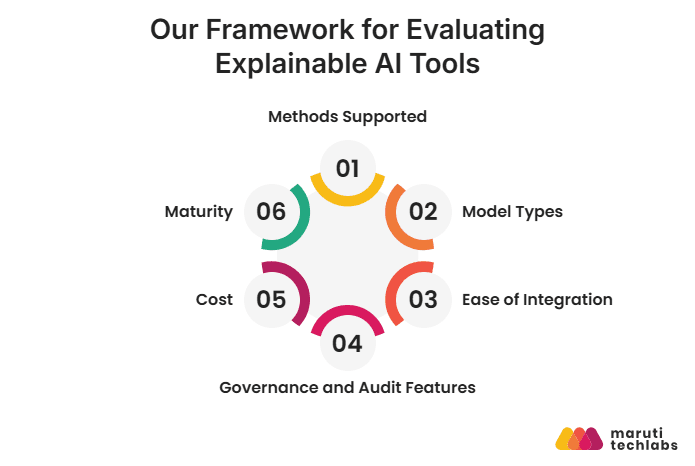
- Methods supported: The techniques the tool offers, such as feature attribution, counterfactuals, or example-based explanations.
- Model types: Whether it works with tabular, image, text, and deep learning models, and whether it needs access to model internals.
- Ease of integration: How well it fits common ML frameworks, cloud platforms, and existing MLOps pipelines.
- Governance and audit features: Whether it logs explanations, supports reason codes, and produces documentation a reviewer can use.
- Cost: The license type, pricing model, and what a team pays to run it at scale.
- Maturity: Release activity, maintenance history, documentation quality, and enterprise adoption.
Where a vendor doesn't publish a detail, the comparison table marks it as not disclosed or (NA)
What Features Should You Look for in Explainable AI Tools?
Strong explainable AI tools offer six things. They give local and global explanations, support more than one method, cover your models and data, keep an audit trail, monitor models in production, and fit your existing stack. Here’s what each one means in practice.
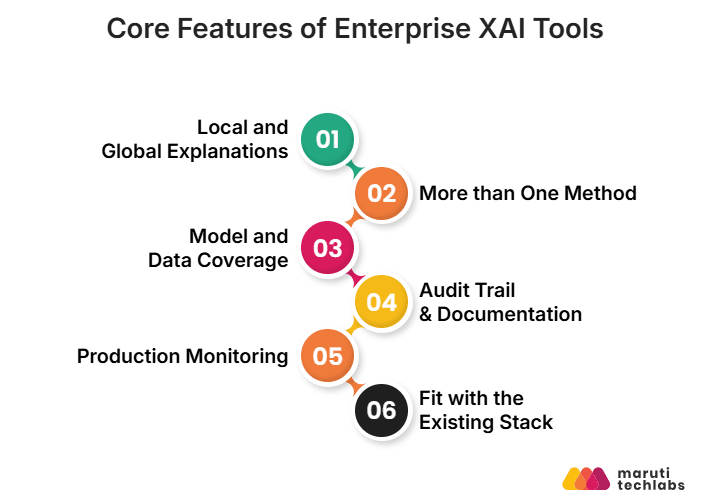
Local and global explanations
Local views explain a single prediction, and global views show which inputs drive the model overall. Teams need both, one for individual decisions and one for model review.
More than one method
Different methods can disagree on the same prediction. A tool that offers SHAP, LIME, permutation importance, or counterfactuals lets teams cross-check explanations before relying on them.
Model and data coverage
Check whether the tool handles tabular, text, and image data, and whether it works with the frameworks the team already uses. Some tools only support PyTorch, and others only tabular models.
Audit trail and documentation
Regulated teams need explanations they can store, such as logs, reason codes, and model documentation. Most open-source libraries produce explanations but leave record-keeping to the team.
Production monitoring
Explanations on live data show when a model starts leaning on different inputs. Enterprise platforms tend to cover this, while libraries mostly run on batches and in notebooks.
Fit with the existing stack
Look at MLOps pipelines, the cloud platform, and deployment options, including SaaS, self-hosted, and on-premises.
Explainable AI Tools Compared by Method, Model Support, and Audit Features
The table below compares all 8 tools on type and cost, methods, model support, and audit features. Details were checked on November 17, 2026.
Tool | Type and cost | Methods | Model support | Audit features |
SHAP | Open source, free (MIT license) | Shapley value feature attribution | Tree ensembles, deep learning and any model through KernelExplainer | None built in |
LIME | Open source, free (BSD-2-Clause) | Local surrogate explanations for single predictions | Any model, with tabular, text and image support | None built in |
InterpretML | Open source, free (MIT license) | Explainable Boosting Machines (glass-box) plus black-box explainers | Tabular models | None built in |
Captum | Open source, free (BSD-3-Clause) | Attribution methods such as integrated gradients and saliency maps | PyTorch models | None built in |
DALEX | Open source, free (GPL license) | Model-agnostic methods for variable impact on single predictions and whole datasets | Any black-box model, including boosted, bagged and stacked | None built in |
H2O-3 | Open source, free (Apache 2.0 license) | Variable importance, SHAP summary and row-level SHAP, partial dependence, ICE and residual analysis | H2O models, with local SHAP for tree-based models only | None documented |
Azure Responsible AI dashboard | Cloud, pricing not disclosed on the docs page | Feature importance, error analysis, counterfactual what-if, causal analysis and fairness | Tabular classification and regression models | Responsible AI PDF scorecard for compliance stakeholders |
Fiddler AI | Enterprise, commercial license, pricing not disclosed | FiddlerSHAP, Tree SHAP, permutation, integrated gradients and custom explainers | Tabular, NLP and computer vision models | AI registry, decision traceability and audit evidence aligned with GDPR, HIPAA, NAIC and bank model risk management expectations (vendor claim) |
The 8 Best AI Explainability Tools
The right explainability tool depends on the machine learning models an organization deploys, the level of interpretability it needs, and how explanations fit into its existing ML workflows.
Some tools focus on explaining individual predictions, while others help teams interpret model behavior across datasets, investigate bias, or monitor models in production. The following eight options cover open-source libraries, cloud-native services, and enterprise platforms.
1. SHAP
Open-source library | MIT License | Free
Best for: Explaining tabular model predictions with a widely accepted method
SHAP (SHapley Additive exPlanations) shows how much each input feature pushed a prediction above or below the average. It applies Shapley values from game theory, so every feature receives a fair share of the credit for the result.
It includes fast exact algorithms for tree ensembles, supports deep learning models, and can explain any model through KernelExplainer. Version 0.54.1 was released on October 16, 2026, and it requires Python 3.12 or later. SHAP produces values and plots but has no built-in audit logging, so teams need to store and document the output themselves.
For example, a team reviewing a declined insurance claim can use SHAP to see which inputs weighed most in that case, then aggregate the values to see which features drive the model overall. However, model-agnostic explanations can run slowly on large datasets, and they describe the model's logic rather than real-world causes.
Official resource: SHAP documentation
2. LIME
Open-source library | BSD License | Free
Best for: Explaining individual model predictions
LIME (Local Interpretable Model-Agnostic Explanations) helps teams understand why a machine learning model produced a particular prediction. Instead of analyzing the entire model, it focuses on an individual prediction and approximates the model's behavior around that specific data point.
It works by perturbing the input data, observing how the black-box model responds, and fitting a simpler interpretable model to those observations. This makes LIME useful for explaining predictions from tabular, text, and image classifiers. The last PyPI release, 0.2.0.1, dates to June 2020, so teams should plan to maintain it themselves.
For example, a team investigating a rejected loan application can use LIME to identify which input features most influenced that particular prediction. However, explanations can vary depending on the perturbation process and may not represent the model's overall behavior.
Official resource: LIME GitHub repository
3. InterpretML
Open-source library | MIT License | Free
Best for: Building inherently interpretable models for regulated decisions
InterpretML is a toolkit that began at Microsoft Research and takes two routes to explainability. Glass-box models such as Explainable Boosting Machines are readable by design, and black-box explainers describe other models after training.
An Explainable Boosting Machine learns how each feature contributes to the result, so a reviewer can read the logic directly instead of reverse-engineering it. Version 0.7.8 was released on March 17, 2026, and the 0.7.7 release before it sped up Explainable Boosting Machine predictions.
For example, a lender can train an Explainable Boosting Machine for credit risk and show auditors exactly how income or credit utilization moves the score. However, glass-box models may trail the accuracy of larger ensembles on some problems, and the toolkit centers on tabular data.
Official resource: InterpretML GitHub repository
4. Captum
Open-source library | BSD 3-Clause License | Free
Best for: Explaining PyTorch deep learning models
Captum is the model interpretability library for PyTorch. It traces a neural network's output back to its input features using attribution methods such as integrated gradients and saliency maps.
Integrated gradients, for example, accumulate gradients along a path from a neutral baseline to the actual input, which shows how much each feature contributed. Version 0.9.0 was released on April 17, 2026, requires Python 3.10 or later and PyTorch 2.3 or later, and is maintained by the PyTorch team.
For example, a team running a PyTorch classifier on medical images can use Captum to highlight the regions that drove a prediction. However, Captum works only with PyTorch; it has no audit layer of its own, and gradient-based attributions can be noisy.
Official resource: Captum on GitHub
5. DALEX
Open-source library | GPL License | Free
Best for: Exploring and comparing models in R and Python
DALEX (moDel Agnostic Language for Exploration and eXplanation) treats a model as a black box and explains how input variables affect its predictions, for single cases and for whole datasets. It is the core package of the DrWhy.AI ecosystem for visual model exploration.
It works with boosted, bagged, and stacked models alike. The R package, version 2.5.4, was published on July 15, 2026 under a GPL-2 or GPL-3 license, and a Python version called dalex is also available.
For example, a data science team comparing several candidate models can wrap each one in a DALEX explainer and view variable importance side by side. However, the GPL license matters for teams that embed it in commercial software, so a legal review is worth doing first.
Official resource: DALEX on CRAN
6. H2O-3
Open-source machine learning platform | Apache 2.0 License | Free
Best for: Teams that already train models in H2O and want built-in explanations
H2O-3 is an open-source machine learning platform with a built-in explainability module. In R and Python, h2o.explain() produces global explanations for a model, an AutoML run, or a list of models, and h2o.explain_row() explains a single row.
The plots include variable importance, SHAP summary and row-level SHAP, partial dependence, individual conditional expectation (ICE), and residual analysis for regression, plus leaderboard and heatmap views for comparing models from AutoML. H2O says Apache 2.0 will remain the license for upcoming open-source releases. Some deployment pieces, including the MOJO (Model Object, Optimized) and Kubernetes support, move to the commercial H2O-3 Secure edition starting with release 3.46.0.12.
For example, a data science team that built a gradient boosting credit risk model in H2O can run explain() to see variable importance and a SHAP summary, then use explain_row() to examine one declined applicant. However, local SHAP works only for tree-based models, variable importance excludes Stacked Ensembles, and H2O labels the explainability interface as experimental, so its API may change.
Official resource: H2O-3 model explainability documentation
7. Azure Responsible AI Dashboard
Cloud-native dashboard | Part of Azure Machine Learning | Pricing not disclosed on the docs page
Best for: Azure teams that need explanations, error analysis, and fairness checks in one view
The Responsible AI dashboard brings model interpretability, error analysis, counterfactual what-if analysis, causal analysis, and fairness assessment into a single view. It draws on open-source packages including InterpretML, Fairlearn, DiCE, and EconML.
It supports tabular classification and regression models, including scikit-learn models registered through MLflow in Azure Machine Learning. A Responsible AI PDF scorecard lets teams share insights offline with product and compliance stakeholders. The dashboard visualizes up to 5,000 data points, so larger datasets need downsampling.
For example, a team validating a claims model can use error analysis to find which customer segments it misjudges, then use counterfactuals to see which feature changes would flip a decision. However, AutoML MLflow models aren't supported, and dataset inputs must be pandas DataFrames in Parquet format.
Official resource: Responsible AI dashboard documentation
8. Fiddler AI
Enterprise platform | Commercial license | Pricing not disclosed
Best for: Regulated enterprises that monitor and explain models in production
Fiddler AI combines explainability with production monitoring so that teams can explain predictions on live traffic as well as on baseline data. Its methods include FiddlerSHAP, Tree SHAP, permutation, integrated gradients, and a vision-focused variant called Super Integrated Gradients, and teams can add custom explainers.
It covers tabular, NLP, and computer vision models, with word-level impact scores for text. For governance, Fiddler describes an AI registry and decision traceability, and it says its audit evidence aligns with GDPR, HIPAA, NAIC, and SR 11-7. That is a vendor claim rather than a certification. It runs as single-tenant SaaS or inside a customer's own AWS, GCP, or Azure account.
For example, an insurer can use Fiddler to see why a pricing model scored one customer segment higher and keep a traceable record of that decision. However, pricing isn't published, and the compliance claims should be validated during a pilot.
Official resource: Fiddler explainability documentation
Explainable AI Methods These Tools Use
Explainable AI methods are the techniques that turn a model's output into something a person can check. Some explain a single prediction, others describe how a model behaves overall, and glass-box models make the model readable from the start. Most of the eight tools above combine several of them.
Method | Scope | What it shows | Tools in this list that use it |
SHAP | Single prediction and whole model | How much each feature added to or subtracted from the result | SHAP, H2O-3 (tree-based models), Fiddler AI |
LIME | Single prediction | Which features mattered most around one data point | LIME |
Integrated gradients | Single prediction | How each input contributed, traced from a neutral baseline | Captum, Fiddler AI |
Counterfactuals | Single prediction | What would need to change for the model to decide differently | Azure Responsible AI dashboard |
Feature importance | Whole model | Which inputs matter most overall | DALEX, InterpretML, H2O-3, Azure Responsible AI dashboard, Fiddler AI |
Partial dependence and ICE | Whole model and single row | How the prediction changes as one feature varies | H2O-3 |
Glass-box models | Whole model and single prediction | A model whose logic can be read directly | InterpretML |
Attention maps | Single prediction | Which parts of an input a transformer weighed most | Closest match is Captum for PyTorch models |
Explainability Tools for Regulated Industries and Audits
Regulated teams need explanations they can keep, not just see. When an auditor, regulator, or customer asks why a model made a decision, the team must produce evidence from that time. That evidence usually takes three forms.
- Reason codes that turn a model's explanation into plain-language reasons for one decision.
- Audit logs that record which model version ran, on which data, and what it returned.
- Model documentation that describes how the model was built, validated, and where it falls short.
What counts as enough depends on the sector.
Banking and lending
Regulation B requires lenders to give applicants specific reasons for an adverse decision, so a score alone isn't enough, even with a complex model. On the model governance side, the OCC, Federal Reserve, and FDIC issued revised model risk management guidance (SR 26-2) on April 17, 2026, replacing SR 11-7. It keeps the core validation steps of conceptual soundness, outcomes analysis, and ongoing monitoring, along with documentation expectations.
It names interpretability measures as one way to assess the conceptual soundness of some models, and it says the same principles apply to vendor models even when the vendor won't share code, data, or methodology. It leaves generative and agentic AI out of its scope, and the Federal Reserve's cover letter says it's expected to be most relevant to organizations with over $30 billion in assets.
Insurance
The NAIC Model Bulletin asks insurers to maintain a written AI program covering governance, risk management, and internal audit. Insurers may have to produce documents about their AI development and use during an investigation or market conduct action.
The bulletin lists transparency and explainability of outcomes to affected consumers as a factor when setting controls, and it expects consumers to be told when AI is in use. Contracts with AI vendors should include audit rights, so a vendor's model has to be explainable enough to review.
Healthcare
FDA's revised clinical decision support guidance, issued January 6, 2026, makes it a condition of staying outside device regulation that software lets a clinician independently review the basis for its recommendations.
The recommendations also need to rest on well-understood and accepted sources. The guidance doesn't say how AI-based tools should meet that test, and it doesn't address tools built on proprietary algorithms.
What the tools cover and where they stop
- Explanation engines. SHAP, LIME, DALEX, H2O-3, Captum, and InterpretML produce the attributions that feed reason codes and model documentation. None of them is documented as logging those explanations for audit.
- Records and review. Fiddler AI adds an AI registry and decision traceability, and the Azure Responsible AI dashboard exports a PDF scorecard that reviewers can read offline.
- The gap. A library explains a decision, but it doesn't keep the record. A regulated team should store each explanation alongside the model version, the data version, and the decision outcome, either in a platform like Fiddler or in its own pipeline.
How to Choose an Explainable AI Tool
The right explainable AI tool depends on the models you run, the decisions they influence, and who needs to read the explanations. A library like SHAP or Captum may be enough for an ML team investigating model behavior.
A regulated enterprise usually needs more, including explanation records, governance workflows, and a fit with its existing ML infrastructure. Evaluate shortlisted tools against six criteria before you choose one.
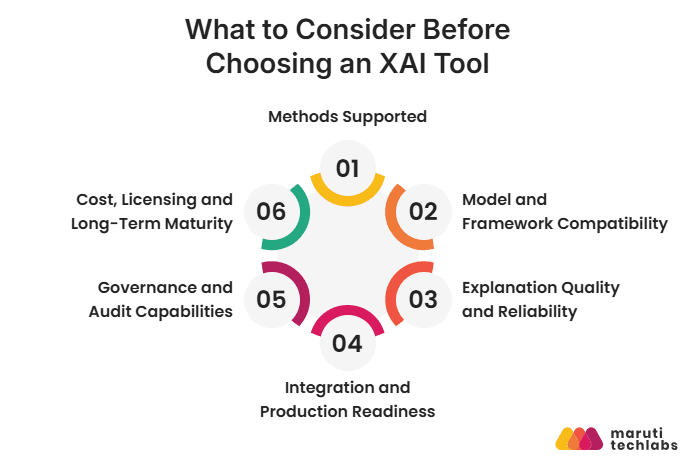
1. Methods Supported
Start with the question your use case needs answered. SHAP and LIME explain individual predictions, integrated gradients trace a neural network's output back to its inputs, counterfactuals show what would have to change for a different outcome, and glass-box models such as InterpretML's Explainable Boosting Machines make the logic readable by design.
Check that the tool offers the method your team will actually use, rather than counting the techniques it lists. Also confirm whether it gives local explanations, global insight into the whole model, or both.
2. Model and Framework Compatibility
Match the tool to your model families, frameworks, and data types. Captum works only with PyTorch, H2O-3 explains H2O models, and the Azure Responsible AI dashboard covers tabular classification and regression models. SHAP can explain any model through KernelExplainer, and Fiddler AI covers tabular, NLP, and computer vision models.
Think about where your stack is heading too. If teams plan to add new architectures or mix frameworks, compatibility can become the main constraint, and a tool tied to one platform may need replacing.
3. Explanation Quality and Reliability
An explanation should reflect how the model actually produced its output. A clean feature-importance chart isn't enough if it misdescribes the model.
Test explanations on representative data. Check fidelity to the model, consistency across similar inputs, and stability under small changes, since sampling-based methods such as LIME can vary between runs. Also confirm that the people who read them, whether ML engineers, risk teams, or auditors, can follow them.
4. Integration and Production Readiness
Assess how well the tool fits the ML lifecycle, including training and deployment pipelines, cloud infrastructure, data platforms, and monitoring systems. Fiddler AI runs as single-tenant SaaS or inside your own AWS, GCP, or Azure account, while the open-source libraries run wherever you put them.
Consider overhead and speed as well. Exact Shapley values need exponentially many model evaluations, so approximations matter at scale, and a tool that works well in a notebook may need extra engineering before it can explain thousands of production decisions. The Azure dashboard visualizes up to 5,000 data points, and H2O labels its H2O-3 explainability interface experimental.
5. Governance and Audit Capabilities
For high-impact and regulated use cases, look at what evidence the tool can produce, export, and retain, such as documentation, explanation reports, decision traceability, and version tracking. Fiddler AI adds an AI registry and decision traceability, and the Azure dashboard exports a PDF scorecard.
Separate tools that generate explanations from platforms that keep decision records. The open-source libraries in this list have no built-in audit logging, and H2O-3 documents none, so your team would have to build evidence retention into its own data and ML pipelines.
6. Cost, Licensing and Long-Term Maturity
Compare more than the license price. Libraries are free, but implementation, infrastructure, and engineering time still count, and licenses differ. DALEX uses a GPL license that deserves a legal review before it goes into a product. Fiddler's pricing isn't published, and Azure's isn't on its docs page, so ask for quotes early.
Review release activity, documentation, support, and roadmap. LIME's last release dates to 2020, while SHAP, Captum, and InterpretML all shipped releases in 2026. For managed services, check availability and support commitments, because Google deprecated Vertex Explainable AI in March 2026 and AWS closed SageMaker Clarify to new customers.
The final test
Test shortlisted tools on representative models and real decision scenarios before committing. Check whether the explanations are accurate, understandable to the intended audience, and useful for the decisions your teams make. NIST's four principles of explainable AI point in the same direction, calling for explanations that are meaningful, accurate, and aware of a system's knowledge limits.
How Maruti Techlabs Helps You Choose and Implement the Right Explainability Stack
Choosing a tool is one decision, and making it work in your ML systems and audit process is another. Our AI consulting team supports each of the six criteria above.
- Methods supported - We match methods and tools to the decisions your models influence, without vendor bias.
- Model and framework compatibility - We test shortlisted platforms against your architectures, frameworks, and data types.
- Explanation quality and reliability - We run a proof of concept on your own models and decisions to check fidelity and readability.
- Integration and production readiness - We connect the tooling to your pipelines, APIs, and cloud environments.
- Governance and audit capabilities - We design model validation, audit trails, and human oversight around the regulations you face.
- Cost, licensing, and long-term maturity - We compare licensing, maintenance, and total cost, and flag risks early.
Turn Model Explainability Into an Enterprise Capability
Explainable AI tools turn a model's output into evidence that engineers, auditors, and customers can check. The eight tools in this comparison do that job in different ways. Open-source libraries such as SHAP, LIME, InterpretML, Captum, DALEX and H2O-3 produce the explanations.
The Azure Responsible AI dashboard bundles several checks into one view for Azure teams, and Fiddler AI adds monitoring and decision records for production use.
The right choice comes down to three questions.
Which models do you run, what do you need explained, and what evidence will a reviewer ask for?
The libraries answer the first two at no license cost, but they don't keep records, so regulated teams should plan for audit logging from the start. Whichever tools make your shortlist, test them on representative models and real decision scenarios before you commit.
FAQs
1. Who are the top vendors for AI explainability tools?
The most established options include open-source libraries such as SHAP, LIME, InterpretML, and Captum; the Azure Responsible AI dashboard for cloud teams; and Fiddler AI for enterprise production use. The best fit depends on your model type, the explanations you need, and your audit requirements.
2. Which tools help ensure explainability in AI decision-making?
SHAP and LIME explain individual decisions, InterpretML's Explainable Boosting Machines make a model's logic readable by design, and counterfactual views such as the Azure Responsible AI dashboard's what-if analysis show what would change an outcome. For decision records, Fiddler AI adds traceability.
3. Are there free explainable AI tools?
Yes. SHAP, LIME, InterpretML, Captum, DALEX, and H2O-3 are all free open-source libraries. Check each license before commercial use, since DALEX uses a GPL license. Fiddler AI doesn't publish pricing, and the Azure dashboard's cost isn't listed on its docs page.
4. Is SHAP or LIME better for explaining model predictions?
SHAP is usually the better default for tabular models, since it has fast exact algorithms for tree ensembles and can summarize a whole model. LIME explains one prediction at a time, and its results can vary with its perturbation process. LIME's last release was in 2020, so plan to maintain it yourself.
5. Which tools support explainable AI in audit analytics?
Fiddler AI offers an AI registry and decision traceability, and the Azure Responsible AI dashboard exports a PDF scorecard for reviewers. Open-source libraries produce explanations but lack built-in audit logging, so teams must store explanations with the model version, data version, and decision outcome.
6. Can explainable AI tools explain large language models?
Partly. Captum's LLM attribution gives token-level scores showing which parts of a prompt influenced an output. These methods can't reliably show why a model reasoned the way it did, so treat LLM explanations as supporting evidence and log prompts, sources, and outputs for important decisions.
How Maruti Techlabs Cut Legal Research Time by 60% With Source-Backed AI Outputs?
A national law firm with 475 attorneys and government relations professionals across 17 offices, serving more than 40% of the Fortune 500, needed a faster and more dependable way to answer complex legal questions.
Its research was spread across search engines, internal documents, research tools, and personal notes, and each complex question meant reviewing many sources, comparing perspectives, and connecting findings by hand.
The firm's pain points included search engines that returned links rather than answers, general AI tools that lacked the depth legal research demands, AI answers without clear citations that attorneys could not verify, research depth and quality that varied by person, and rising query volume that strained speed and consistency unless more manual effort was added.
Maruti Techlabs built an agentic deep-research platform that breaks complex questions into research tasks, investigates multiple sources, and assembles a verifiable report. The pipeline clarifies the query, plans targeted sub-questions, gathers current information from live sources, analyzes findings across sources, synthesizes the analysis, and links every insight to its supporting evidence.
The platform was designed so that every output can be checked. Each insight carries inline citations to its supporting sources, a process view shows how the research progressed, and research parameters such as source requirements, analysis depth, and report structure can be customized for each query.
This is the same principle behind the explainability tools in this guide, since results that cannot be traced back to evidence are hard to trust or audit.
The impact
- 60% less research time, with a single workflow replacing hours of manual work.
- 3x greater research depth and coverage.
- 90% source-backed outputs, so attorneys can verify the basis for what the platform reports.
- Greater decision confidence and more consistent research quality across users and offices.
- The firm continues to expand platform adoption across its offices.
Integrate explainability, model monitoring, and governance practices into your AI systems with custom engineering from Maruti Techlabs.