

The Ultimate Guide to Agentic AI: Enterprise Use Cases & Examples
Key Takeaways
- Agentic AI goes beyond traditional automation by completing tasks and making decisions across business workflows.
- Enterprise AI agents deliver the best results when they're built around clear business goals and existing systems.
- Strong governance, security, and human oversight are essential for deploying AI agents responsibly.
- Starting with a focused use case makes it easier to measure results before expanding AI across the organization.
- The right technology partner can help build AI agents that fit your business, integrate smoothly, and scale over time.
Introduction
Reviewing hundreds of pages of legal documents, finding relevant information, and drafting accurate responses can take hours. For many enterprises, these repetitive tasks slow decisions and limit productivity. That's exactly the challenge one of our legal clients faced before adopting Agentic AI.
The firm partnered with us to simplify these workflows using Agentic AI. Routine legal tasks like research, document review, and drafting that once took 7-8 hours were completed in minutes, with 95%+ accuracy. This helped the team work faster while creating a practical roadmap for adopting AI across the firm.
This is why Agentic AI is gaining momentum across industries. 55% of organizations are already adopting it, while 60% plan to automate workflows across finance, HR, and supply chain.
In this guide, you'll learn what Agentic AI is, how it works, its top enterprise use cases and examples, popular frameworks, governance best practices, and how to build enterprise AI agents successfully.

What Is Agentic AI?
Agentic AI is a new generation of artificial intelligence that can work toward a goal with minimal human involvement. Instead of only responding to prompts, it can understand what needs to be done, break complex tasks into smaller steps, make decisions, and take action to complete them. It can also adapt as new information becomes available and makes it suitable for dynamic business environments.
| Google explains Agentic AI as AI that goes beyond responding to instructions. Instead of waiting for every prompt, it can understand a goal, decide the best way to achieve it, and carry out the required tasks with minimal human input. |
These capabilities are made possible by AI agents. Each agent is built to perform a specific task, like retrieving information, analyzing data, interacting with enterprise applications, or generating responses. When multiple AI agents work together, they can coordinate and complete end-to-end business workflows that would otherwise require continuous human oversight.
Although the terms Agentic AI and AI agents are often used interchangeably, they are not the same.
- AI agents are individual software entities built to perform specific tasks or solve defined problems.
- Agentic AI is the system that coordinates multiple AI agents, enabling them to work together toward a shared business goal.
Think of it as a project team. An AI agent is a team member with a specific responsibility, while Agentic AI coordinates their work to complete an entire workflow, not just individual tasks.
How Does Agentic AI Work? Understanding Agentic AI Architecture
Agentic AI is built on a layered architecture where each component has a specific responsibility. Some layers understand business goals, while others plan, execute, and monitor tasks. Together, these layers enable AI agents to automate complex enterprise workflows by reasoning, planning, executing, and continuously improving decisions.
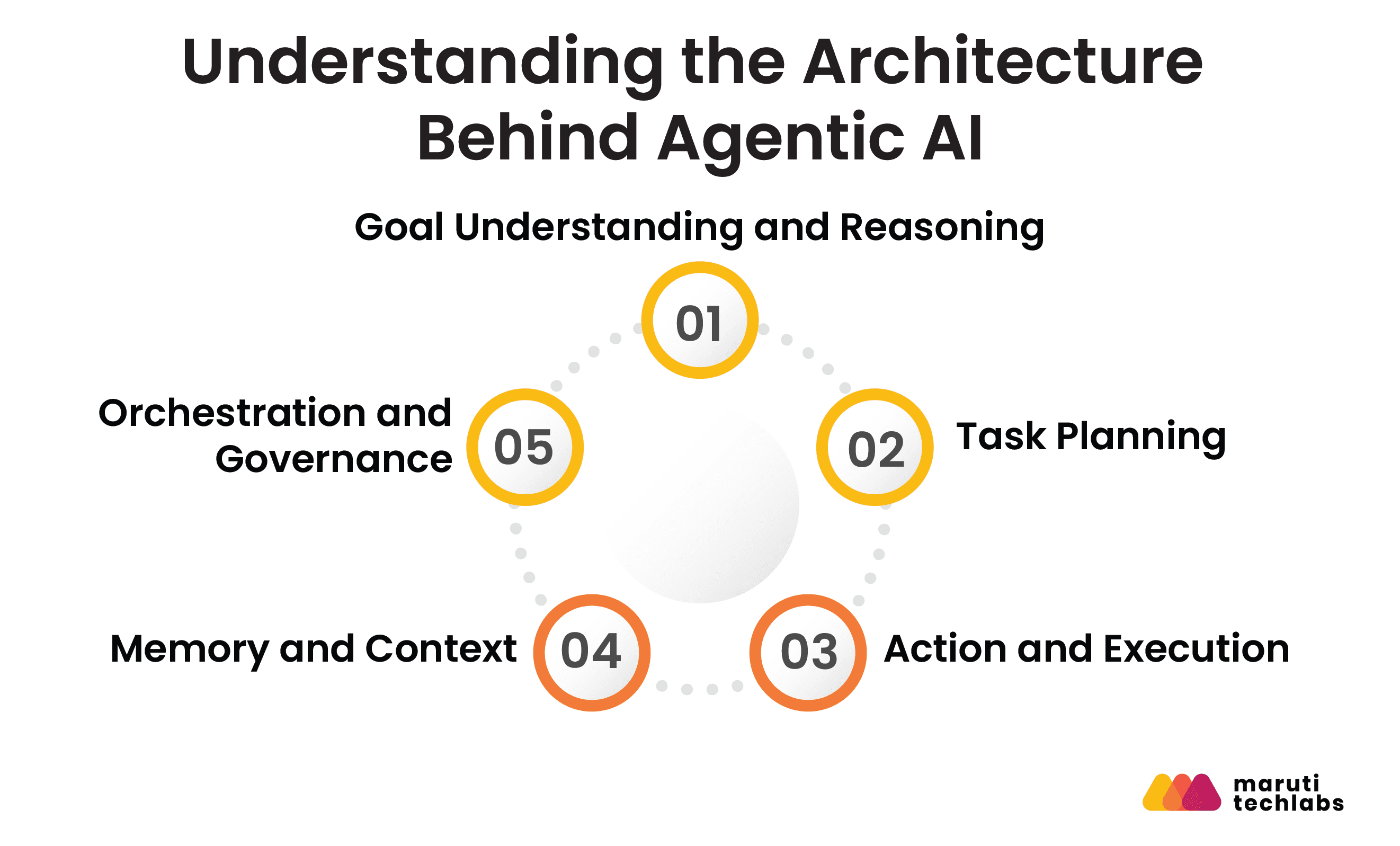
1. Goal Understanding and Reasoning
An AI agent doesn't treat every request as a single prompt. It gathers context from enterprise systems, business rules, previous interactions, and available data before deciding what needs to happen. This gives it enough context to turn a business request into a structured objective.
2. Task Planning
Once the objective is defined, the workflow needs to be organized. Agentic AI maps the sequence of tasks, identifies dependencies, and accounts for approvals and business rules before execution begins. If priorities or inputs change, the workflow adjusts automatically.
3. Action and Execution
After planning, the agent connects with enterprise systems to perform the needed actions. It uses APIs, databases, CRM, ERP, and automation tools to execute workflows. This allows repetitive and time-consuming tasks to run with minimal manual effort.
4. Memory and Context
Most enterprise tasks aren't completed in one go. Agentic AI remembers where the workflow left off, along with the relevant business context, so the next step doesn't require starting over.
5. Orchestration and Governance
Large business processes often involve multiple AI agents working together. The orchestration layer coordinates their activities, while governance enforces business policies, monitors risks, and routes high-impact decisions for human review.
How the Architecture Works Together
The architecture is designed as a connected system rather than a collection of independent components. Each layer builds on the previous one to keep workflows moving from planning to execution and governance. This allows enterprises to automate complex operations while maintaining visibility and control.
Top Agentic AI Use Cases and Examples Across Enterprises
Agentic AI is helping enterprises automate more than repetitive tasks. By connecting with enterprise systems and making decisions in real time, AI agents can complete end-to-end workflows with minimal human involvement. Here are some of the most common Agentic AI use cases across industries.
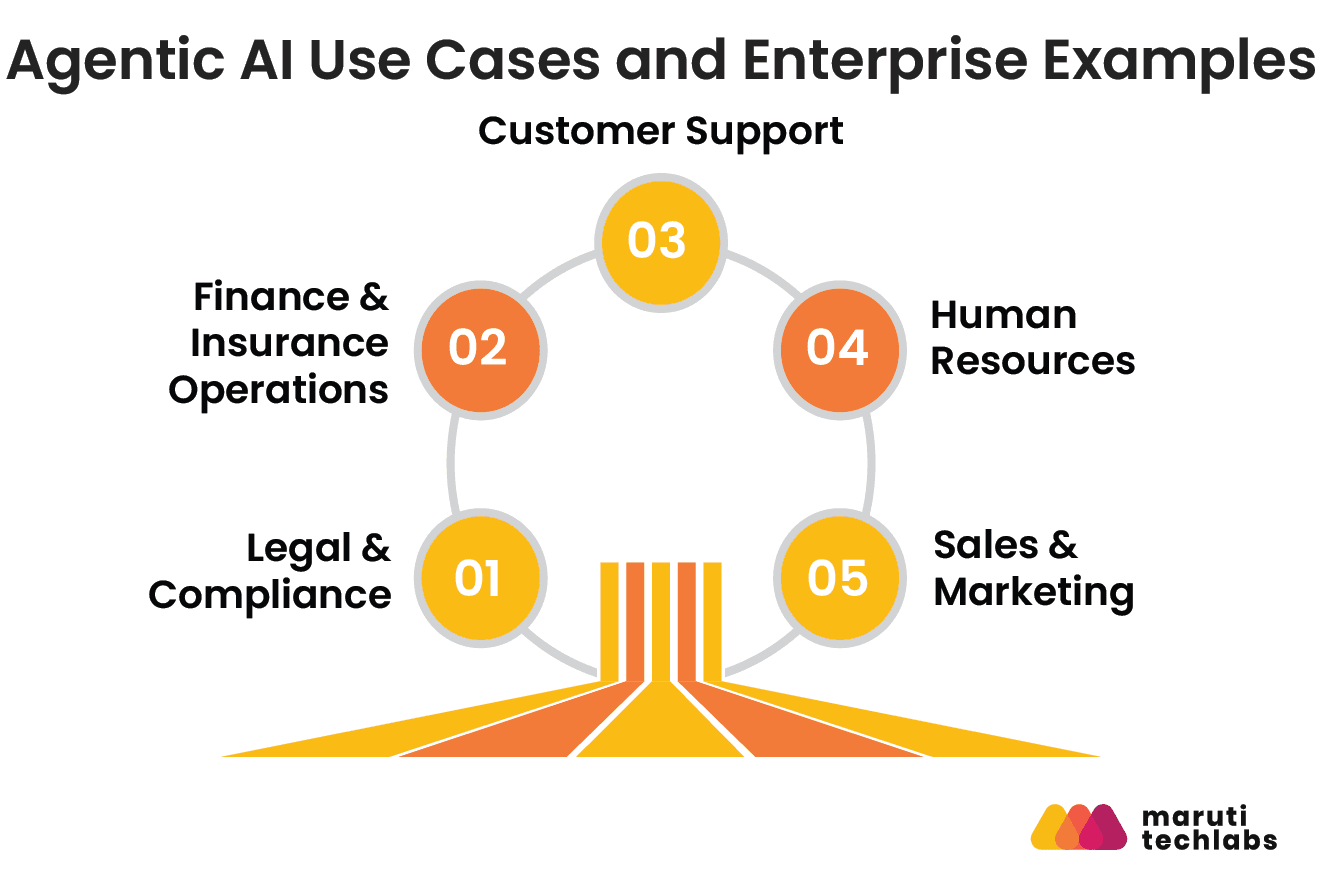
1. Legal & Compliance
Contracts, vendor agreements, and compliance documents need careful review before they move forward. Agentic AI helps with these day-to-day reviews by checking documents against company policies and highlighting anything that looks unusual.
Example: An AI agent reviews vendor agreements, highlights non-standard clauses, and routes high-risk contracts to legal teams for review.
Business value: Legal teams spend less time reviewing standard contracts and more time on negotiations and strategic advice.
2. Finance & Insurance Operations
Finance & insurance teams process thousands of invoices, payments, and claims every day. Agentic AI helps move these requests through validation and approval by checking records, applying business rules, and routing them to the right teams.
Example: A health insurer can use an AI agent to review incoming claims, compare them with policy coverage, and flag missing documents before the claim reaches a claims examiner.
Business value: Claims move through the review process faster, while specialists spend more time handling exceptions instead of routine checks.
3. Customer Support
Customer support teams spend a significant amount of time switching between systems to resolve a single request. Agentic AI brings these steps together by retrieving customer history, checking order details, and taking the required actions without waiting for manual intervention.
Example: If an order is delayed, the AI agent can notify the customer, update the delivery status, and process a refund or replacement when required.
Business value: Customers stay informed throughout the process, and support teams receive fewer repetitive queries.
4. Human Resources
HR teams manage several repetitive processes that follow predefined business rules. Agentic AI can automate these workflows while giving employees quick access to company policies and information.
Example: After an offer is accepted, the AI agent provisions system access, assigns onboarding tasks, and answers common HR policy questions.
Business value: Onboarding becomes faster and more consistent, reducing the workload for HR teams.
5. Sales & Marketing
Sales teams spend a significant part of their day qualifying leads, following up with prospects, and updating CRM records. Agentic AI takes care of these routine tasks, allowing sales representatives to focus on customer conversations.
Example: The AI agent identifies qualified leads, sends personalized follow-up emails, updates the CRM based on prospect responses, and schedules meetings for the sales team.
Business value: Sales teams spend more time building customer relationships and less time on administrative work.
Popular Agentic AI Frameworks for Enterprise Development
Agentic AI frameworks simplify the development of independent AI agents by providing reusable components for planning, memory, reasoning, and integrations. Instead of building every capability from scratch, developers can use these frameworks to accelerate development and deploy enterprise-ready AI solutions faster.
Some of the most widely used agentic AI frameworks include:
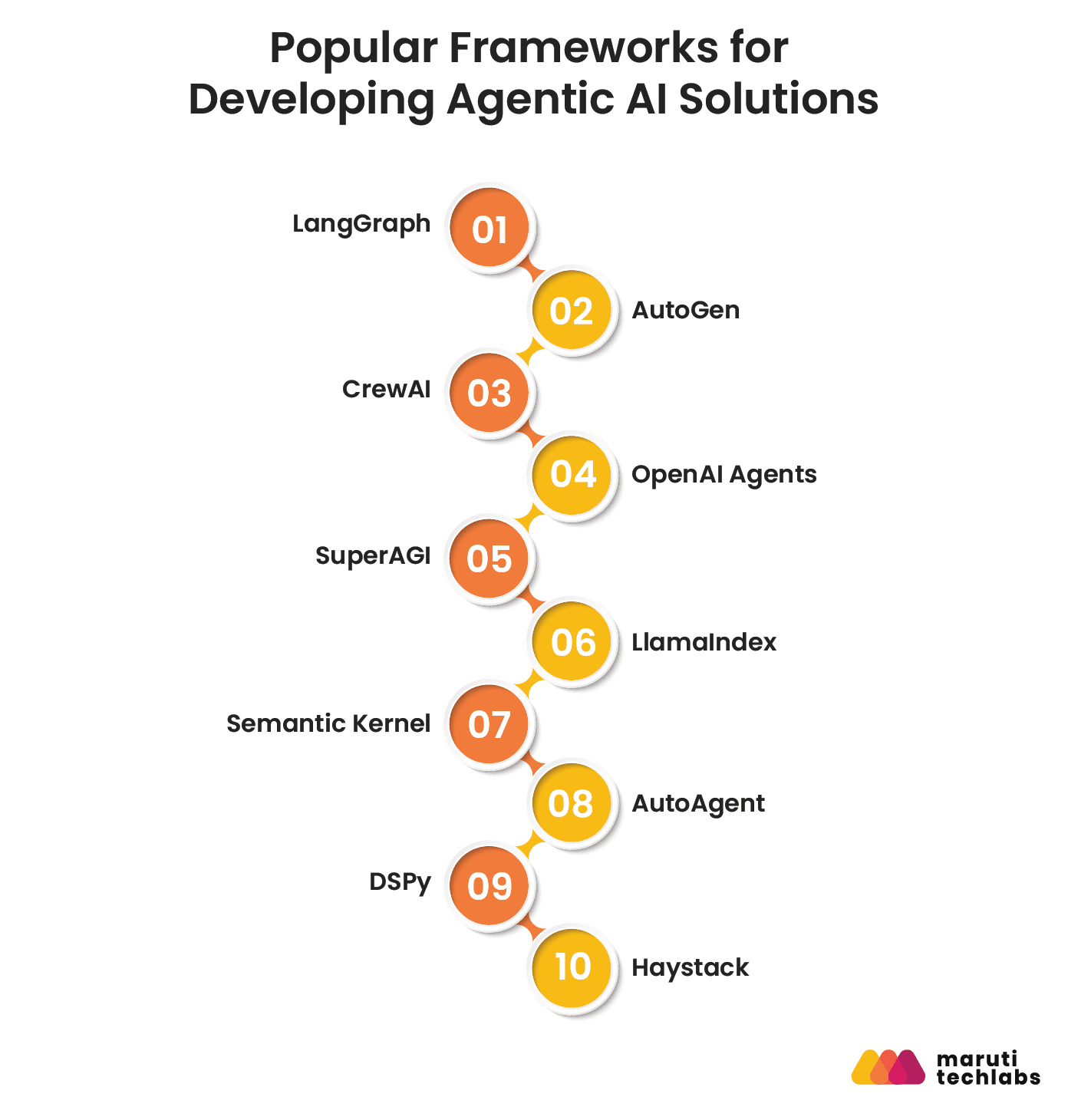
- LangGraph: Builds stateful AI workflows with memory, human monitoring, and multi-agent orchestration.
- AutoGen: Creates conversational AI agents that collaborate to complete complex tasks over various workflows.
- CrewAI: Coordinates multiple AI agents with defined roles, joint objectives, and enterprise tool integrations.
- OpenAI Agents: Develops AI agents using OpenAI models, tools, memory, and structured workflow logic.
- SuperAGI: Automates business functions across sales, marketing, customer support, and business workflows.
- LlamaIndex: Connects AI agents with enterprise documents and knowledge using Retrieval-Augmented Generation (RAG).
- Semantic Kernel: Integrates AI capabilities into existing business applications and enterprise systems.
- AutoAgent: Simplifies the creation of AI agents and multi-agent workflows with minimal development effort.
- DSPy: Builds modular AI applications using structured programming instead of manual prompt engineering.
- Haystack: Develops production-ready AI agents with flexible retrieval pipelines and enterprise integrations.
Different frameworks are built for different use cases. Compare their scalability, security, integration capabilities, governance features, and support for multi-agent workflows before choosing one.
Agentic AI Governance: Managing Risk, Security, and Compliance
As AI agents become part of business operations, governance provides the controls needed to manage security, accountability, and regulatory compliance.
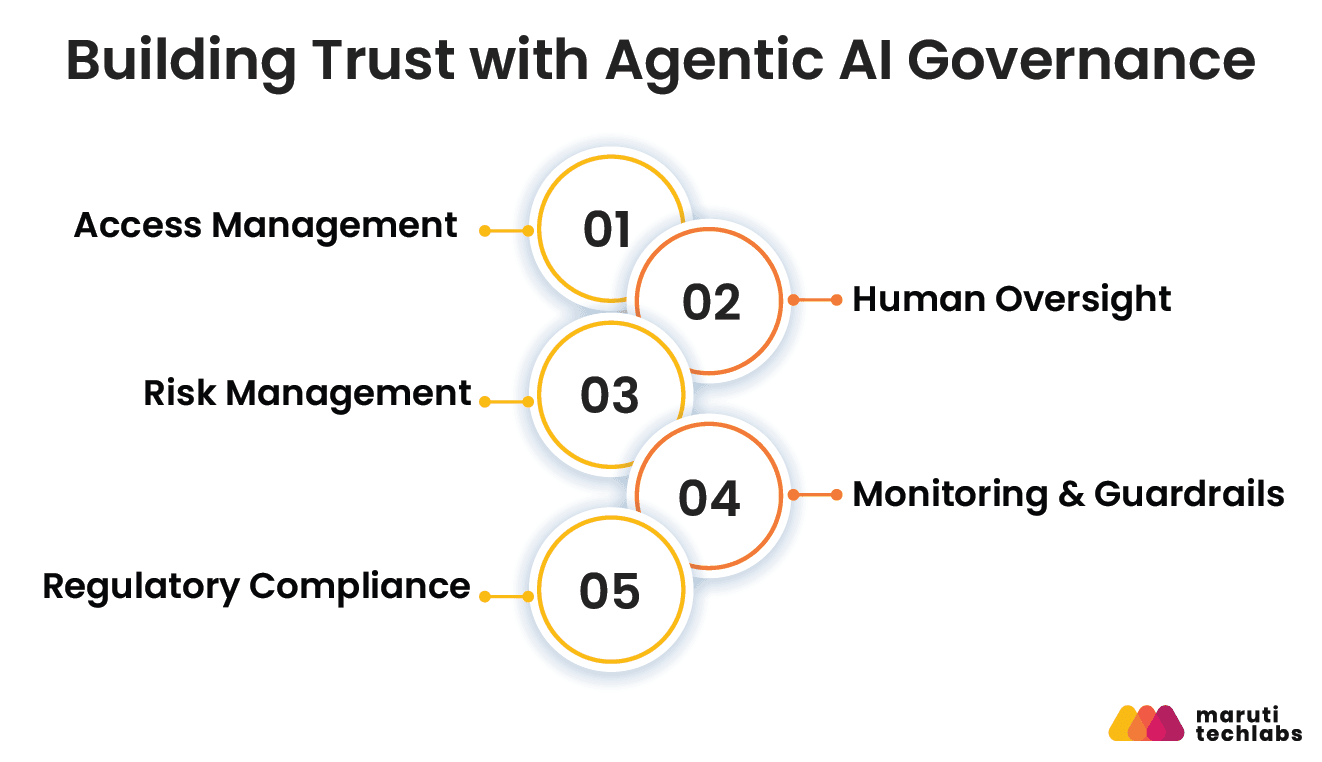
1. Access Management
AI agents should only access the systems and information needed to perform their assigned tasks. Role-based permissions and least-privilege access help reduce security risks and protect sensitive business data.
2. Human Oversight
Some business decisions still require human judgment. Financial approvals, external communications, and changes to sensitive data are best reviewed before an AI agent takes action.
3. Risk Management
AI agents require ongoing monitoring to maintain reliable performance and detect operational or security risks. Clearly defined ownership supports accountability throughout the deployment lifecycle.
4. Monitoring & Guardrails
Runtime monitoring and audit logs make it easier to understand how AI agents interact with systems and data. Policy guardrails and kill switches provide additional control when unexpected behavior is detected.
5. Regulatory Compliance
Enterprise AI governance is often aligned with established frameworks such as NIST AI RMF, ISO/IEC 42001, GDPR, and the EU AI Act. This helps organizations strengthen compliance while promoting responsible AI adoption.
How to Build Enterprise AI Agents Successfully
Successful enterprise Agentic AI implementations are built around clear business objectives, reliable integrations, strong governance, and continuous evaluation.
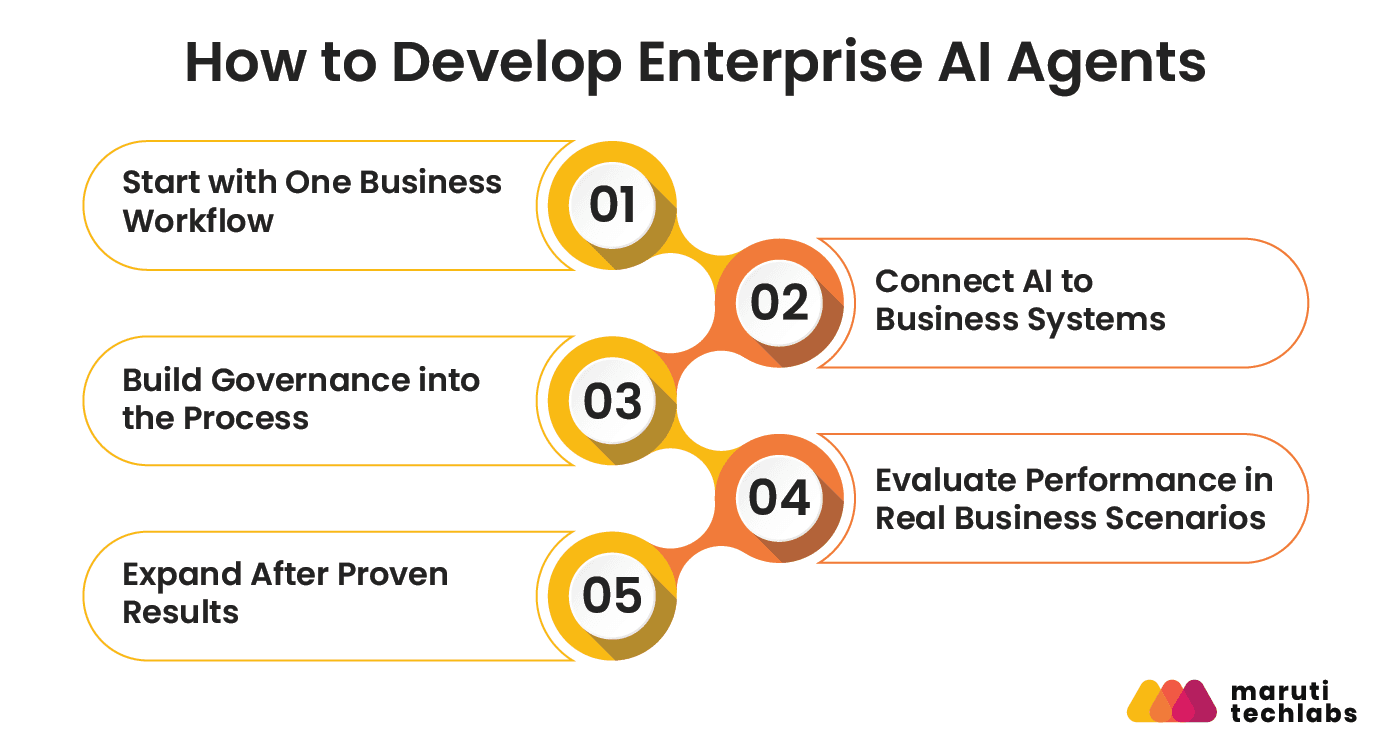
1. Start with One Business Workflow
Many successful AI projects begin with a focused business use case. Once the workflow and expected outcomes are clear, measuring progress and refining the solution becomes much more straightforward.
2. Connect AI to Business Systems
An AI agent becomes far more useful when it can work with the tools employees already use. Secure connections to APIs, CRMs, ERPs, databases, and enterprise knowledge sources allow agents to access information and complete tasks within existing business processes.
3. Build Governance into the Process
Many governance issues can be avoided by addressing them early in the project. Planning security controls, role-based access, human approvals, and compliance requirements alongside development leads to a more reliable implementation.
4. Evaluate Performance in Real Business Scenarios
Initial testing is only part of the evaluation process. Once AI agents are used in day-to-day operations, teams gain a much clearer picture of their reasoning quality and response accuracy. Performance metrics such as latency and business outcomes can then be refined over time.
5. Expand After Proven Results
Early deployments provide practical insights into performance, operating costs, and reliability. Those learnings make it easier to plan the next phase of AI adoption across the organization.
Conclusion
For many organizations, AI agents have moved beyond experimentation. They are being introduced into everyday business operations to manage workflows, assist with decision-making, and reduce repetitive manual work.
Enterprise AI adoption is rarely a one-time rollout. Teams learn from early implementations, improve the solution over time, and gradually introduce AI agents into additional business functions. Governance and security continue to guide every stage of that journey.
Building enterprise AI agents also requires experience with architecture, integrations, and deployment at scale. Working with the right AI agent development company can help organizations build AI solutions that fit their business today and continue to support future growth. Our AI agent development services help businesses design, develop, and deploy intelligent agents that integrate seamlessly with existing systems while supporting long-term scalability and performance.
How We Improved Real Estate Listing Compliance with AI
One of our US-based real estate clients needed a faster and more accurate way to validate property listings at scale. Their rule-based system struggled with contextual understanding, increasing manual reviews and creating compliance gaps. The growing review effort also affected operational efficiency and user experience.
We helped the client replace rigid rule-based validation with an AI-powered compliance engine built for real-world listing content. The solution raised compliance precision from 20% to over 90% while cutting manual review effort. It also made policy validation faster and more consistent across high listing volumes.
The same engineering expertise supports our enterprise AI and Agentic AI engagements across industries. Whether you're exploring enterprise automation or autonomous AI workflows, our AI Development Services help organizations build solutions aligned with their business goals.
For organizations looking to develop AI applications around proprietary data, existing systems, or specialized workflows, our Custom AI Development Services provide the flexibility to build solutions tailored to your requirements.
FAQs
1. How can Agentic AI benefit enterprises?
Enterprise teams often spend a lot of time moving work between people and systems. Agentic AI can take over many of those routine steps, complete tasks independently, and keep workflows moving. This gives employees more time for work that needs experience, judgment, or customer interaction.
2. What are some examples of Agentic AI in enterprises?
Agentic AI is being used across industries for contract review, claims processing, customer support, inventory management, compliance monitoring, and healthcare administration. Unlike traditional chatbots, AI agents can complete multi-step tasks, interact with business systems, and coordinate actions across different workflows.
3. Can Agentic AI improve decision-making in enterprises?
Yes. AI agents can collect information from different business systems, analyze it, and present useful recommendations. This gives employees better visibility when making decisions. For important financial, legal, or operational decisions, human review remains an important part of the process.
4. Is Agentic AI scalable for enterprise applications?
Yes. Many organizations introduce AI agents within a single business process before expanding them to other teams. This approach permits them to evaluate performance, control costs, and refine workflows prior to scaling AI across the organization using the same enterprise infrastructure.
5. What are the ethical concerns with Agentic AI?
AI agents often work with business data and enterprise systems, so organizations need to understand how their actions are monitored and controlled. Clear governance, human review for critical decisions, and security controls help reduce potential risks.
6. How do businesses get started with Agentic AI?
Many organizations begin with a single business process where repetitive work consumes significant time. After validating the results, AI agents are gradually introduced into other workflows, allowing teams to improve adoption while managing costs and operational risks.
7. Why should businesses work with an AI agent development company?
Building AI agents involves much more than choosing an LLM. A development partner helps define the right use cases, integrate enterprise systems, establish governance, and deploy AI agents that fit existing business processes. This reduces implementation risks and helps organizations move from pilot projects to production faster.