

AI Governance Best Practices: A Practical Guide for Enterprise Teams
Key Takeaways
- AI governance guarantees compliance, accountability, and transparency while assisting enterprises in managing AI risks.
- The EU AI Act, ISO/IEC 42001, and NIST AI RMF frameworks offer organized methods for regulating AI systems.
- Good governance necessitates clear ownership, documented policies, model oversight, and continuous supervision.
- Updating model documentation, audit records, risk assessments, and incident records is critical for compliance and trust.
- Organizations that treat AI governance as a strategic function can reduce risk, improve AI adoption, and stay ahead of evolving regulations.
Introduction
Businesses are speeding up to integrate AI into every aspect of their operations. However, the numbers present a concerning picture. Only approximately 25% of firms have put in place a robust governance framework to go along with the over 83% of organizations that already employ AI products. That gap is now a board-level liability rather than just a compliance risk.
Without AI governance, even the most well-intentioned AI initiative can produce biased outcomes, breach data privacy regulations, trigger regulatory penalties, and damage the trust customers have in ways that take years to repair.
This is crucial due to the regulatory wave of 2025–2026. High-risk AI requirements are being phased in under the EU AI Act. Federal agency standards have been increased by the US AI Executive Order. In January 2026, South Korea became the second country in the world with a legally binding AI law. Businesses that operate in many markets now have to deal with overlapping compliance deadlines.
This guide walks enterprise teams through the components, frameworks, best practices, and a 90-day implementation roadmap to build AI governance that works.

What Is AI Governance?
AI governance is the combination of policies, standards, processes, roles, and accountability systems that ensure AI systems are developed, deployed, and monitored in ways that are ethical, safe, transparent, and compliant with applicable regulations throughout the full AI lifecycle.
Understanding how AI governance differs from related concepts is critical for enterprise teams:
| Concept | Definition | Primary Focus |
| AI Governance | The organizational systems, policies, and controls that ensure AI operates within defined ethical, legal, and business boundaries. | Establishing accountability, risk management, compliance, and oversight for AI systems. |
| AI Ethics | The philosophical principles, such as fairness, transparency, non-maleficence, and autonomy, that guide the responsible development and use of AI. | Defining the values and principles that governance translates into policies and practices. |
| AI Management | The operational discipline of planning, deploying, monitoring, and measuring AI initiatives across the organization | Executing AI projects and operations within the governance-established guardrails. |
Core Components of an AI Governance Framework
- Accountability, Oversight, Roles, and Responsibilities: Defining who owns AI outcomes at each stage.
- Governance Structures: The organizational bodies (committees, boards, working groups) that set direction.
- People, Skills, Values, and Culture: Cultivating the technical expertise and ethical mindset required.
- Principles and Policies: The overarching objectives and particular regulations that direct creation and application.
- Practices, Processes, and Controls: Methodical approaches that put ideas into practice.
- Supporting Infrastructure: The tools, technology, and data that underpin governance.
- Monitoring, Reporting, and Evaluation: Constant observation of compliance, hazards, and performance.
- Involving impacted parties throughout the AI lifecycle through stakeholder engagement, co-design, and impact assessment.
Why AI Governance is Now a Board-Level Priority
AI governance has become a board-level priority as organizations now face regulatory, operational, and reputational risks.
- Stanford HAI's 2026 AI Index Report recorded 362 AI-related incidents in 2025, a 55% increase from the 233 incidents logged in 2024.
- IBM research shows that companies investing more than 10% of AI budgets in responsible AI practices see approximately 30% higher operating profit growth, 22% higher customer satisfaction, and 19% higher AI adoption rates.
- The EU AI Act carries fines of up to €35 million or 7% of worldwide annual turnover for violations of prohibited practices.
- Gartner projects spending on dedicated AI governance platforms will reach $492 million in 2026, with 72% of organizations expecting GRC technology budgets to increase, with AI governance as the top investment priority.
Key AI Governance Frameworks: NIST, ISO 42001, and EU AI Act Compared
AI governance relies on 4 primary frameworks: NIST, ISO 42001, EU AI Act, and White House AI EO. Choosing the right frameworks proves the first structural decision your governance program must make.
| Framework | Applies To | Geographic Scope | Key Requirements |
| NIST AI RMF | All sectors (voluntary) | US-focused, global use | Map, Measure, Manage, Govern |
| ISO/IEC 42001:2023 | Any organization deploying AI | Global | AI management system, risk treatment, continuous review |
| EU AI Act | Businesses operating AI in the EU | EU + extraterritorial | Risk-tiered compliance; Aug 2026 & Dec 2027 deadlines |
| White House AI EO | Federal agencies + contractors | US | Safety testing, bias audits, transparency disclosures |
1. NIST AI Risk Management Framework (AI RMF)
Published by the US National Institute of Standards and Technology, the NIST AI RMF is voluntary but widely adopted as a best-practice baseline. It organizes AI risk management around four functions:
- Map: Identify and classify AI systems and their contexts of use.
- Measure: Assess risks for likelihood, severity, and breadth of impact.
- Manage: Apply controls, document decisions, and track performance.
- Govern: Embed accountability for AI safety at the leadership level.
2. ISO/IEC 42001:2023
ISO/IEC 42001, the first worldwide standard for AI management systems, offers a certified framework appropriate for any size or industry. Its process framework includes risk identification, evaluation, treatment, monitoring, and documenting, resulting in a governance audit trail that meets the needs of enterprise clients and regulators alike.
3. EU AI Act
The EU AI Act is the world's first comprehensive AI law with binding legal force. It classifies AI systems into four risk tiers:
- Unacceptable Risk: Completely forbidden (e.g., subconscious manipulation, social scoring).
- High Risk: Strictly regulated in areas such as employment, healthcare, education, credit, and law enforcement.
- Limited Risk: There are transparency rules such as those pertaining to chatbot disclosure.
- Low Risk: There are no responsibilities for low-impact products like spam filters.
On May 7, 2026, EU lawmakers reached a political agreement to revise key compliance deadlines, including extending high-risk obligations for newly placed systems to December 2027, while programs should proceed as if August 2026 remains in effect until formal adoption. Penalties remain up to €35 million or 7% of global turnover.
4. White House AI Executive Order
For AI systems in high-impact domains, the US AI Executive Order mandates that government agencies and their contractors carry out safety testing, bias audits, and transparency disclosures. It establishes compliance requirements for government-facing businesses and indicates the direction of US federal AI regulation, even though it is not yet as prescriptive as the EU AI Act.
Enterprise AI Governance Best Practices
Enterprise AI governance best practices deliver an organized approach to managing AI risk, upholding compliance, and securing accountability across the AI lifecycle. The best practices below help organizations build a scalable and effective AI governance program.
1. Build a Cross-Functional AI Governance Committee
Governance cannot live in a single department. Effective programs draw on compliance, legal, technical, product, ethics, and business leadership and have a formal mandate from the board.
- Create a permanent AI governance committee with a specified membership, regular meeting schedule, and escalation power.
- Designate a Chief AI Governance Officer (CAGO) or a comparable position with reporting lines at the board level.
- Determine who is Responsible, Accountable, Consulted, and Informed for each AI system and decision using RACI matrices.
- Plan quarterly cross-functional reviews to identify misalignment before it poses a danger.
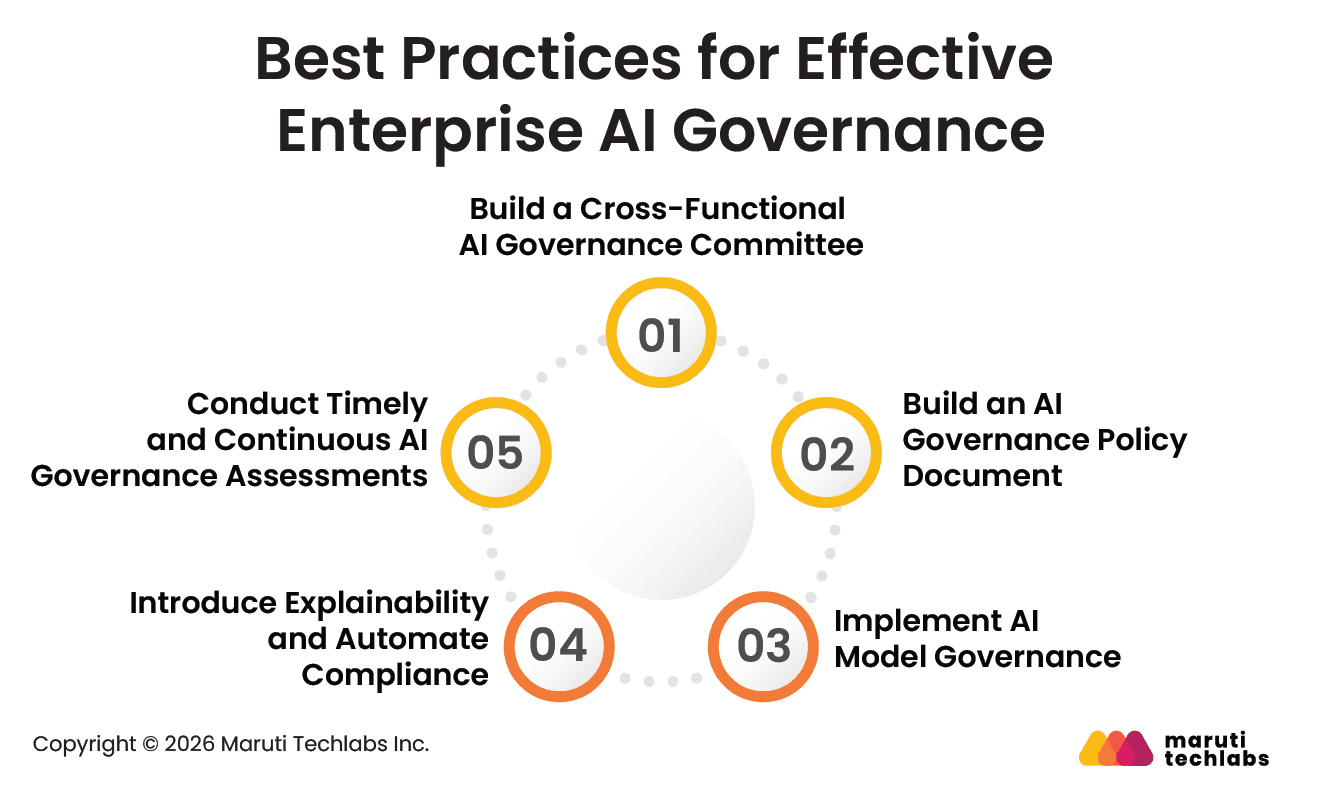
2. Build an AI Governance Policy Document
A governance policy document is the core artifact that defines how your organization treats AI across its lifecycle. It should cover:
- Scope: Which AI systems, data types, and business processes the policy governs.
- Data governance rules: Consent management, data lineage requirements, retention and deletion obligations.
- Model approval process: Gates required before a model moves from development to production.
- Incident response: Defined procedures for detecting, escalating, and remediating AI-related failures.
- Third-party AI vendor standards: Baseline governance requirements for AI tools procured externally.
3. Implement AI Model Governance
Model governance addresses the specific risks that emerge during the AI development and deployment lifecycle, such as bias, drift, version control, and explainability.
- Conduct pre-deployment bias audits using tools such as IBM AI Fairness 360 or internal audit protocols.
- Implement drift monitoring post-deployment using platforms such as Fiddler AI or Arthur AI.
- Maintain structured documentation of each model's purpose, training data, known limitations, and performance benchmarks.
- Establish version control for models with change approval processes equivalent to software release management.
- For regulated industries, comply with Model Risk Management (MRM) frameworks such as SR 11-7.
4. Introduce Explainability and Automate Compliance
Manual governance doesn't scale. Automation of compliance checks and explainability tooling are essential for enterprise programs.
- Leverage explainability tools like LIME and SHAP to generate human-readable explanations for model choices.
- Embed automated compliance checks into your deployment pipeline. No model goes to production without passing governance gates.
- Automate report generation for regulatory reviews and internal audits.
- Provide jargon-free decision explanations for non-expert stakeholders and regulators.
5. Conduct Timely and Continuous AI Governance Assessments
Risk is not static. As models are updated, data sets shift, and regulations change, your governance posture has to adapt.
- Run security, bias, and performance reviews on all production models on a defined cycle (quarterly minimum for high-risk systems).
- Monitor for model drift and vulnerability using automated tooling.
- Keep governance policies updated to reflect regulatory changes. Assign ownership for tracking regulatory calendars.
- Use the KPI framework in the monitoring section below to measure governance maturity over time.
How to Build an AI Governance Policy: What to Include
Building an AI governance policy requires a well-defined framework that defines accountability and risk controls across the AI lifecycle. Below is a practical checklist of what every enterprise policy document should contain.
Policy Components Checklist
- Policy scope along with the applicability statement
- AI system inventory and classification criteria (risk tiers)
- Data governance rules: lineage, consent, retention, deletion
- Model development standards: documentation, testing, validation requirements
- Model approval and deployment gates
- Monitoring and review cadence
- Incident detection, escalation, and remediation procedures
- Third-party AI vendor assessment criteria
- Employee training and awareness requirements
- Policy review cycle and version control process
AI Accountability Frameworks: Assigning Ownership Across the Organization
An AI accountability framework defines clear ownership as well as decision-making roles throughout the AI lifecycle. It makes certain that every AI system has designated individuals or teams responsible for its performance, risk management, regulatory compliance, and overall outcomes.
1. Accountability vs. Responsibility in AI
Responsibility refers to the team or individual who does the work, develops the model, runs the bias audit, and writes the policy. Accountability refers to the individual who owns the outcome and answers for it when something goes wrong. Every AI system should have exactly one accountable owner.
2. RACI Model for AI Decisions
Apply RACI across the key AI lifecycle stages:
- Model Development: Data Science team (Responsible), CTO (Accountable), Legal/Compliance (Consulted), Business stakeholders (Informed).
- Pre-deployment Bias Audit: Compliance team (Responsible), CAGO (Accountable), Legal (Consulted), Product (Informed).
- Production Monitoring: MLOps team (Responsible), Product Owner (Accountable), Compliance (Consulted), Board (Informed quarterly).
3. Regulatory Accountability Requirements
The EU AI Act requires suppliers of high-risk AI systems to maintain technical documentation, appoint an authorized representative within the EU, and make sure human monitoring procedures are in place.
The NIST AI RMF Govern function similarly requires documented leadership accountability for AI safety. As regulators move toward active enforcement, 'accountability' will shift from an internal concept to an externally auditable obligation.
AI Governance Documentation You Need to Maintain
- Model Register: A central database of all AI systems, including their ownership, status, and risk classification.
- Model Cards: Documentation specific to each model that includes performance benchmarks, known constraints, training data, and purpose.
- Audit Records: Timestamped documentation of governance choices, deployment approvals, and model modifications.
- Data Lineage Records: Information about the source, processing method, and consent status of training and inference data.
- Incident Reports: Documentation of AI-related mishaps, their underlying causes, corrective actions, and lessons discovered.
- Version of the Policy History: A dated change log for each governance policy update.
- Risk Assessment Records: Recorded results of regular and pre-deployment risk assessments.
How to Implement AI Governance: A 90-Day Enterprise Roadmap
Implementing enterprise AI governance requires a phased approach that focuses on establishing ownership, assessing AI risks, defining policies, and implementing controls to monitor and govern AI systems as they scale across the organization.
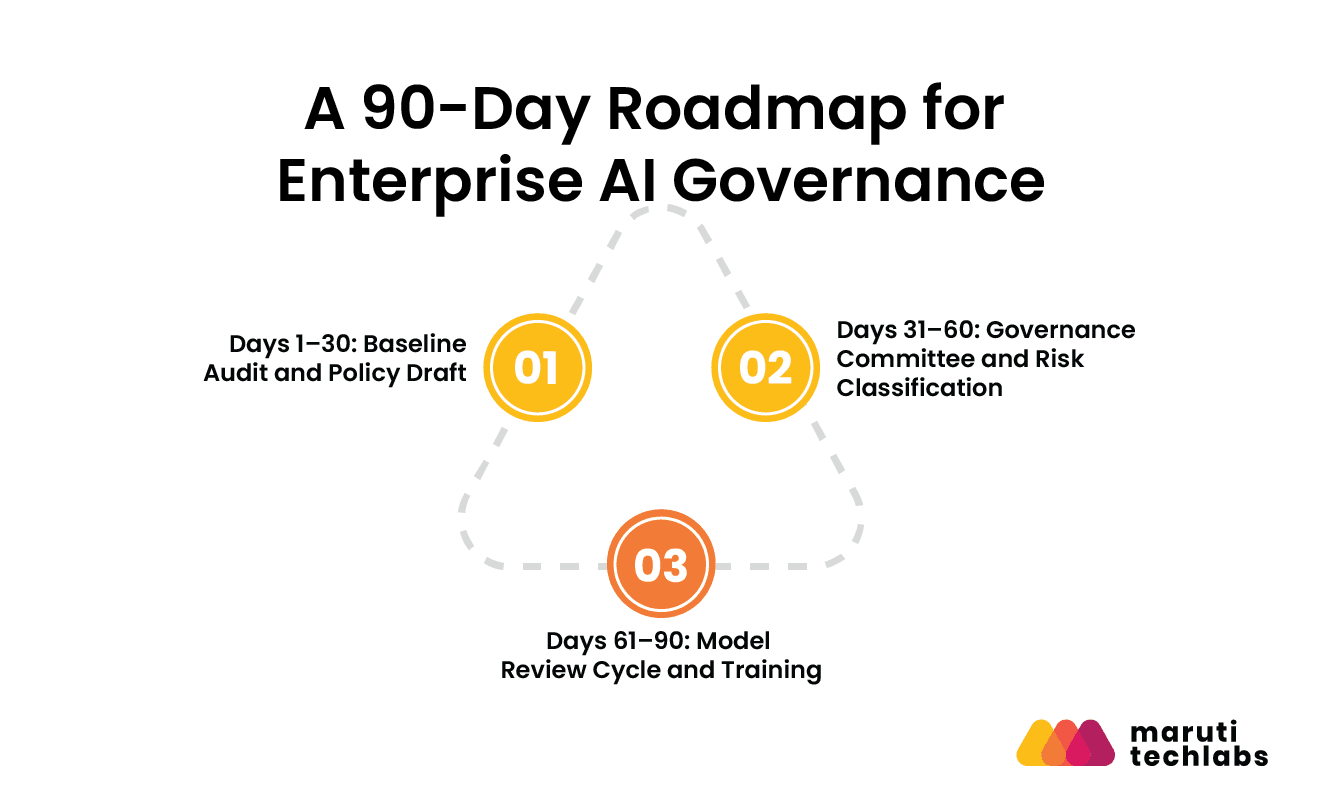
Days 1–30: Baseline Audit and Policy Draft
- Perform a thorough inventory of AI systems. List all of the AI models, tools, and features that are currently in use, including shadow AI.
- Use the EU AI Act and NIST AI RMF criteria to categorize each system by risk level.
- Determine any current governance deficiencies, such as incomplete paperwork, unclear ownership, and a lack of oversight.
- Create a preliminary AI governance strategy that addresses incident response, data rules, and scope.
- Determine important parties and obtain executive sponsorship.
Days 31–60: Governance Committee and Risk Classification
- Formally establish the AI governance committee with defined roles, RACI assignments, and meeting cadence.
- Assign accountable owners (CAGO or equivalent) for the overall program and for each high-risk AI system.
- Complete risk assessments for all systems classified as high-risk.
- Finalize and formally adopt the AI governance policy.
- Start model card documentation for priority systems.
Days 61–90: Model Review Cycle and Training
- Begin the first complete cycle of model reviews for all high-risk systems.
- Implement drift monitoring and bias auditing tools for production models.
- Set up the infrastructure for the model registration and audit log.
- Provide training on AI governance to any employee that uses AI technologies.
- Use the metrics framework below to create the KPI tracking dashboard.
- Set a time for the upcoming quarterly governance review.
AI Governance Monitoring and Reporting: Metrics That Matter
Key AI governance monitoring and reporting metrics regularly track governance maturity over time.
| KPI | What It Measures |
| Governance Maturity Score | Overall program maturity on a 1–5 scale |
| Model Incident Rate | Frequency of model-related issues per quarter |
| Policy Compliance Rate | % of AI deployments following governance policy |
| Model Review Velocity | Avg. days to complete a full model audit |
| Bias Incident Rate | Bias flags raised during pre-deployment audits |
Tooling recommendations: IBM OpenScale for model fairness and drift monitoring; Fiddler AI for explainability and performance tracking; Arthur AI for production model observability; Microsoft Purview for data governance and compliance documentation.
5 Common AI Governance Mistakes Enterprises Make (and How to Avoid Them)
Common AI governance mistakes emerge from treating compliance as a one-time checklist, ignoring Shadow AI, slow policies, and stakeholder misalignment.
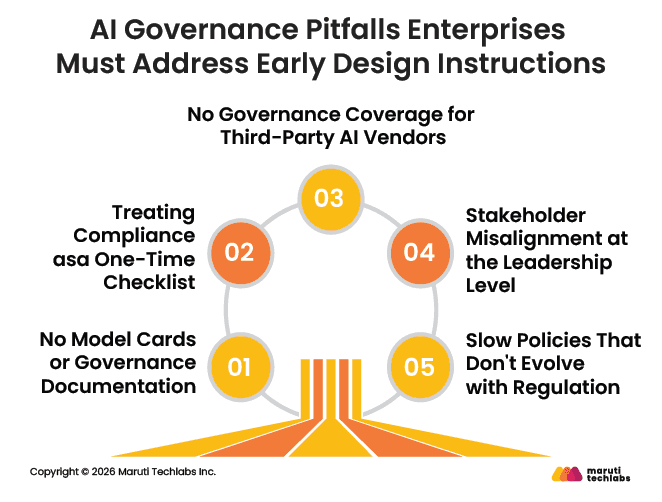
1. No Model Cards or Governance Documentation
How to fix it: Require model cards as a deployment gate. No card, no deployment. Build templates and automate as much documentation as possible through your MLOps pipeline.
2. Treating Compliance as a One-Time Checklist
How to fix it: The cycle of governance never ends. Incorporate automated monitoring and quarterly review cycles into your program right away. Model incidence rate and policy compliance rate ought to be standard measures.
3. No Governance Coverage for Third-Party AI Vendors
How to fix it: Add vendor assessment criteria to your governance policy. Before being deployed, any third-party AI tools used by your company should pass a written governance assessment and be continuously monitored.
4. Stakeholder Misalignment at the Leadership Level
How to fix it: Without executive sponsorship, governance stalls. Board-level visibility and authority are essential for the CAGO and AI governance committee. Before an actual incident happens, escalation channels must be established and tested.
5. Slow Policies That Don't Evolve with Regulation
How to fix it: Assign the regulatory calendar to a member of your legal or compliance team. Your policy must be updated within a specified window if the deadline for the EU AI Act changes or if NIST publishes new guidelines. Use mandatory review cycles to maintain version control over your policy papers.
Stakeholder Engagement and Impact Assessment
Numerous stakeholders are impacted by AI systems, including consumers, workers, authorities, and communities. Instead of considering impact as an afterthought, good governance integrates its viewpoints through structured interaction.
- Co-design sessions with end users and affected communities during model development.
- Pre-deployment impact assessments that evaluate outcomes for different demographic groups.
- Ongoing feedback channels for internal and external stakeholders to report concerns.
- Board-level reporting on stakeholder engagement outcomes.
For enterprise AI programs, stakeholder engagement is also a regulatory expectation. The EU AI Act requirements and the NIST AI RMF's sociotechnical framing both assume that affected parties are meaningfully involved in AI development and deployment decisions.
Real-World AI Governance Success Stories
AI governance success stories show how organizations leverage AI services to comply with regulatory requirements and avoid risks at all levels.
Governance Success Stories
Infosys' Enterprise-Wide AI Governance Program
In compliance with ISO 42001, NIST, and the EU AI Act, Infosys established a centralized AI Management System. Over 7,000 AI use cases were subject to routine oversight, governance workflows, AI review boards, and automated risk assessments.
As a result, Infosys maintained compliance and transparency at scale while reporting a 150% improvement in operational performance. This shows that rather than slowing down the adoption of AI, formal governance might speed it up.
Key Lesson: Governance works best when embedded throughout the AI lifecycle instead of being treated as a final compliance checkpoint.
IBM's Responsible AI Governance Framework
IBM established a formal governance structure that includes its Responsible Technology Board, AI ethics reviews, privacy oversight, and continuous risk monitoring. The company operationalized AI principles through a Privacy and AI Management System (PIMS), helping ensure accountability, transparency, and compliance with regulations across AI initiatives.
Key Lesson: AI concepts are not enough on their own. Dedicated governance teams, procedures, and accountability systems are necessary for organizations.
Conclusion
In 2026, AI governance will not be a matter of compliance. It is a tactical and competitive necessity. Businesses are better able to lower risk, fulfill compliance requirements, and confidently scale AI programs when they view governance as an essential component of the AI lifecycle.
By leveraging established frameworks such as NIST AI RMF, ISO/IEC 42001, and the EU AI Act, enterprises can create a governance foundation that integrates innovation with responsibility and long-term business value.
Why Maruti Techlabs for AI Governance
AI governance is only as effective as the expertise and infrastructure behind it. Maruti Techlabs brings end-to-end AI governance capabilities built for enterprise scale, from strategy and policy design through compliance monitoring and ongoing optimization.
What We Deliver
- AI Strategy and Governance Readiness: We assess your current AI maturity, identify governance gaps, and design a program roadmap aligned to your regulatory environment.
- Policy and Framework Design: We build AI governance policy documents, RACI structures, and model approval processes designed for your industry and risk profile.
- Model Governance and Monitoring: We implement bias auditing, drift monitoring, and model lifecycle management using the leading tooling ecosystem.
- Continuous Improvement Programs: We design governance KPI frameworks, monitoring dashboards, and quarterly review cycles that keep your program effective as AI and regulation evolve.
Whether you're building your first AI governance program or maturing an existing one, our AI governance and compliance services give you the expertise and execution support to do it right. When you're ready to put that governance framework into practice, our AI development services help you build and deploy scalable AI solutions with governance, security, and compliance considered from the start.

FAQs
1. How do you implement AI governance in an organization?
Implement AI governance in three phases:
- First (Days 1–30), conduct a baseline audit: inventory all AI systems, classify them by risk, identify governance gaps, and draft an initial policy.
- Second (Days 31–60), establish your governance committee, assign accountability owners, complete risk assessments for high-risk systems, and finalize your policy.
- Third (Days 61–90), launch model reviews, deploy monitoring tooling, complete documentation, train employees, and stand up KPI tracking.
2. What is the NIST AI Risk Management Framework?
The NIST AI Risk Management Framework (AI RMF), published by the US National Institute of Standards and Technology, is a voluntary framework for managing AI risk across sectors.
It organizes risk management into four functions:
- Map (identify AI systems and their contexts),
- Measure (assess risks for likelihood and impact),
- Manage (apply controls and track performance),
- Govern (establish leadership accountability for AI safety).
3. Does the EU AI Act apply to US companies?
Yes, if your company operates AI systems that are placed on the EU market or whose outputs are used in the EU. The EU AI Act applies based on where AI is deployed and its effects, not where the company is headquartered. US companies operating high-risk AI systems in areas such as hiring, credit, healthcare, or law enforcement may face compliance obligations under the Act.
The high-risk provisions have been revised to extend the deadlines for newly placed systems to December 2027, but compliance programs should begin now, given the operational complexity involved.
4. What documentation is required for AI governance compliance?
A model register (an inventory of all AI systems with risk classifications and ownership), model cards (per-model documentation of purpose, training data, limitations, and performance), audit records of governance decisions and approvals, data lineage records, incident reports, policy version histories, and risk assessment records are examples of core AI governance documentation.
For EU AI Act high-risk systems, technical documentation (Article 11) and automated logging (Article 12) are legally mandatory. See the documentation section above for a full checklist.
5. Who is responsible for AI governance in an organization?
A designated accountable owner, usually a Chief AI Governance Officer (CAGO) or an equivalent with board-level reporting, must serve as the focal point of the organization's distributed AI governance responsibilities. Compliance, legal, data science, product, and IT departments collaborate on daily governance.
6. How do you conduct an AI governance assessment?
An AI governance assessment evaluates the maturity of your governance program against a defined framework (NIST AI RMF, ISO 42001, or an internal standard). It covers the completeness of the AI system inventory, the quality and currency of governance documentation, the effectiveness of monitoring and incident response, the policy compliance rate across AI systems, and compliance with applicable regulations.
7. What is responsible AI governance?
Responsible AI governance is the practice of ensuring AI systems are not simply legally compliant but also ethical, fair, and beneficial to the people they affect. It goes beyond minimum regulatory requirements to embed values such as human dignity, non-discrimination, privacy, and accountability into the governance program itself.
IBM research shows that organizations with mature responsible AI practices see measurable returns, approximately 30% higher operating profit growth.
8. What tools are used for AI governance?
The leading AI governance tools in 2026 include:
- IBM OpenScale (model fairness and drift monitoring),
- Fiddler AI (explainability and performance tracking),
- Arthur AI (production model observability),
- Microsoft Purview (data governance and compliance documentation),
- IBM AI Fairness 360 (open-source bias detection and mitigation).
9. What is shadow AI and why does it matter for governance?
Shadow AI refers to AI tools adopted by employees or teams outside of centralized IT and governance review processes. Shadow AI creates governance blind spots: models in use that have never been inventoried, risk-assessed, or monitored. Addressing it requires both technical controls (SaaS visibility tooling) and policy requirements that define the approval process for any new AI tool adoption.