

How to Measure ROI from Legal AI Document Tools
Key Takeaways
- Legal AI ROI comes from faster legal work, lower costs, and better use of attorney time.
- Contract review, legal research, document analysis, and other high-volume tasks can deliver faster returns.
- Productivity gains often appear within months, while financial returns usually build over six to twelve months.
- Adoption, workflow integration, data quality, and output quality directly affect the return from legal AI.
- Human oversight remains essential for legal judgment, client advice, court filings, and other high-risk work.
Introduction
Case preparation doesn't always start with legal strategy. It often starts with reviewing lengthy legal documents, searching for critical information, and piecing together evidence from multiple sources. One of our clients, a U.S. law firm with over 500 attorneys, faced the same situation while reviewing lengthy deposition transcripts.
We built an AI-powered platform for them that automated transcript analysis and generated citation-backed summaries. This reduced review time by 95%, achieved 95%+ citation accuracy, and made finding relevant testimony significantly faster.
This isn't just one firm's experience. As legal AI becomes part of everyday document review and legal research, firms are reporting measurable business gains. A Forrester Total Economic Impact™ study found that AI can deliver up to 400% ROI over three years while increasing attorney matter capacity by 25%.
This guide explains how to measure the ROI of legal AI, where it delivers the fastest returns, realistic implementation timelines, and the challenges that can delay measurable results.

What Does ROI Mean for Legal AI Document Tools, and How Do You Measure It?
The return on investment (ROI) of legal AI document tools means the business value gained compared to the time, cost, and effort invested in the software. That investment includes licensing, implementation, workflow integration, user training, and ongoing maintenance. The return is measured by how those investments improve day-to-day legal work.
Contract review, legal research, document drafting, and discovery account for a significant share of a legal team's workload. Completing these tasks faster gives lawyers more time to handle additional matters without expanding the team. For many firms, that additional capacity becomes one of the biggest contributors to ROI.
ROI also depends on how firms use the time they save. If lawyers use those hours to handle more matters without adding staff, that's known as capacity savings. If the same time reduces outside counsel fees or other operating costs, it becomes cash savings.
How Do You Measure Legal AI ROI?
The way legal AI ROI is measured usually depends on the workflow being automated. A contract review platform is evaluated differently from a legal research assistant because the expected outcomes are not the same. Looking at workflow-specific metrics gives a more reliable picture of business impact.
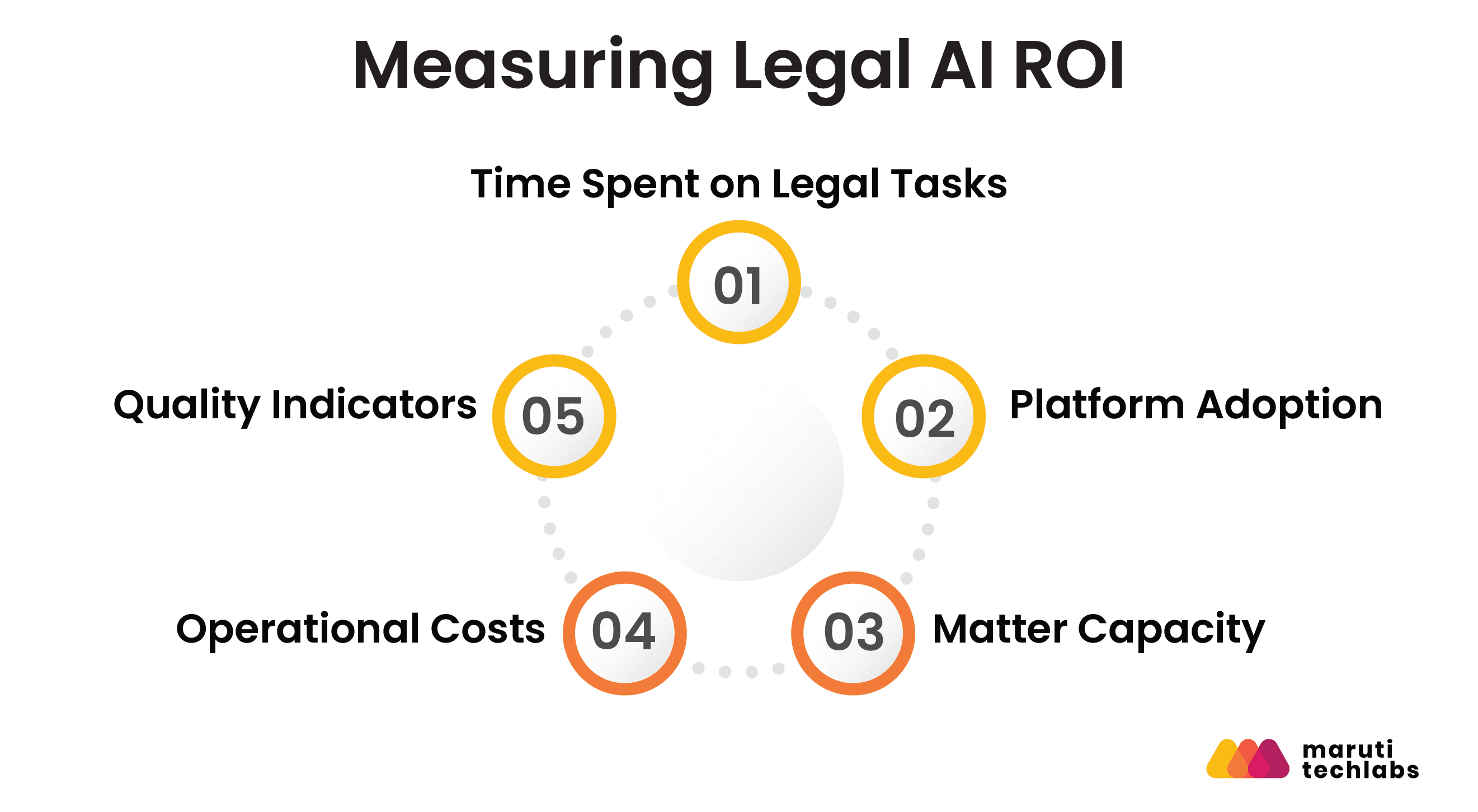
- Time Spent on Legal Tasks: Hours required for contract review, legal research, document drafting, discovery, or document analysis before and after implementation.
- Platform Adoption: How frequently lawyers use AI features as part of their day-to-day legal work.
- Matter Capacity: The number of contracts, documents, or legal matters completed within the same reporting period.
- Operational Costs: Changes in internal review costs, outside counsel spending, and administrative effort.
- Quality Indicators: Missed clauses, drafting revisions, compliance exceptions, document turnaround time, and rework.
Where Legal AI Delivers the Fastest ROI: Top Use Cases
The strongest early returns from legal AI usually come from the work legal teams handle every day. Repetitive, document-heavy tasks are often the first to be automated because they offer clear opportunities to save time without changing legal judgment. Thomson Reuters' 2025 report found that 28% of law firms already use Generative AI.
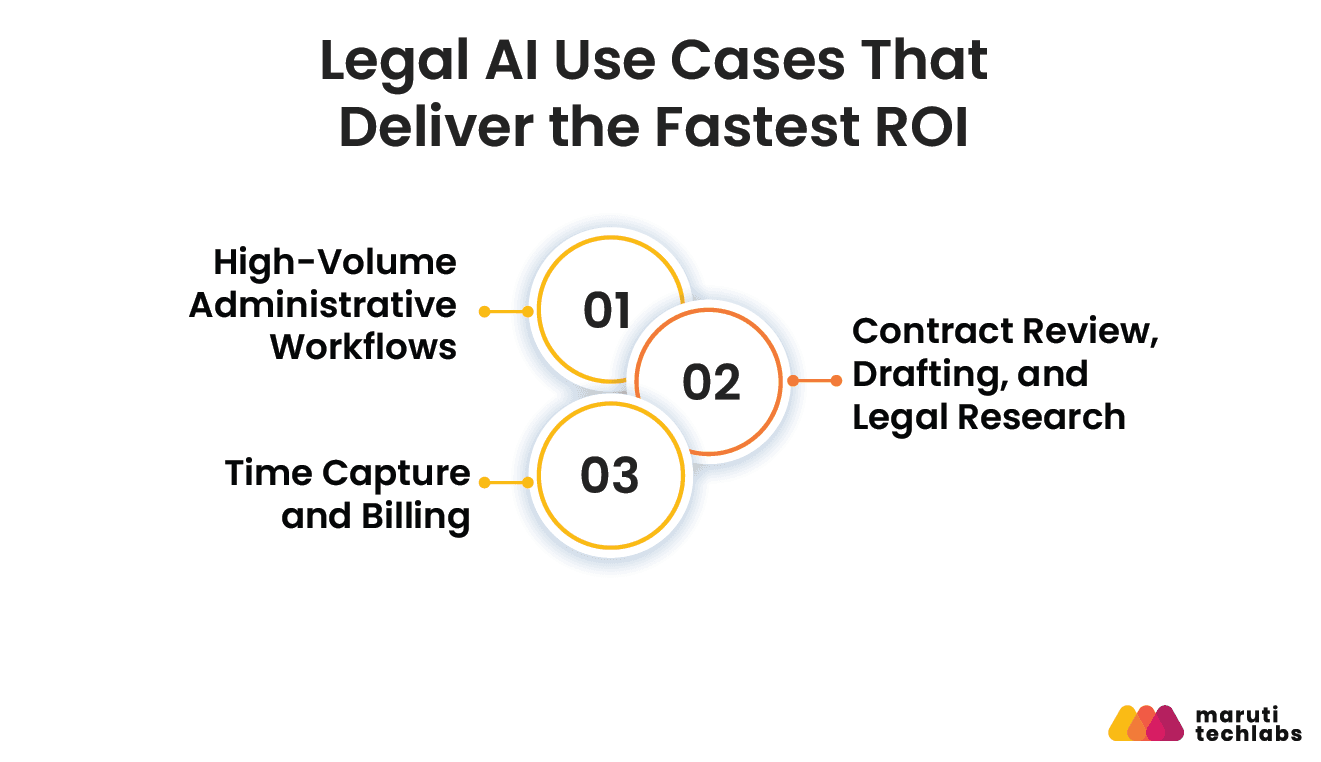
1. High-Volume Administrative Workflows
Before a lawyer reviews a contract or prepares legal advice, several administrative checks have already taken place. Client intake, conflict searches, KYC, AML screening, and matter routing all happen at the beginning of a matter and often follow the same process within a legal document management workflow. Improving these processes removes delays long before legal work reaches an attorney.
2. Contract Review, Drafting, and Legal Research
Much of a lawyer's day is spent reviewing contracts, researching precedents, drafting documents, or working through discovery material. AI contract review and AI document analysis compare contracts against approved playbooks, identify unusual clauses, and retrieve relevant case law.
Lawyers still review every recommendation before anything is shared with a client or filed in court, making AI legal document review an assistant rather than a replacement.
3. Time Capture and Billing
By the end of the day, it's not always easy to remember every billable task. A quick client call, a few contract revisions, or time spent researching a legal issue can easily be overlooked. Bringing those activities together before time is submitted helps firms capture more billable work without asking lawyers to change how they already work.
Human Review Stays Essential
Legal work doesn't end when the first draft is ready. Every filing, opinion, client communication, and conflict decision still needs a lawyer's review before it moves forward, regardless of how much legal document review has already been completed by AI. AI shortens the preparation, but legal judgment remains exactly where it has always been.
What is a Realistic ROI Timeline for Legal AI Document Tools?
Legal AI usually delivers productivity gains before financial returns. As lawyers use the platform more consistently, the time saved across routine legal work gradually translates into measurable business value.
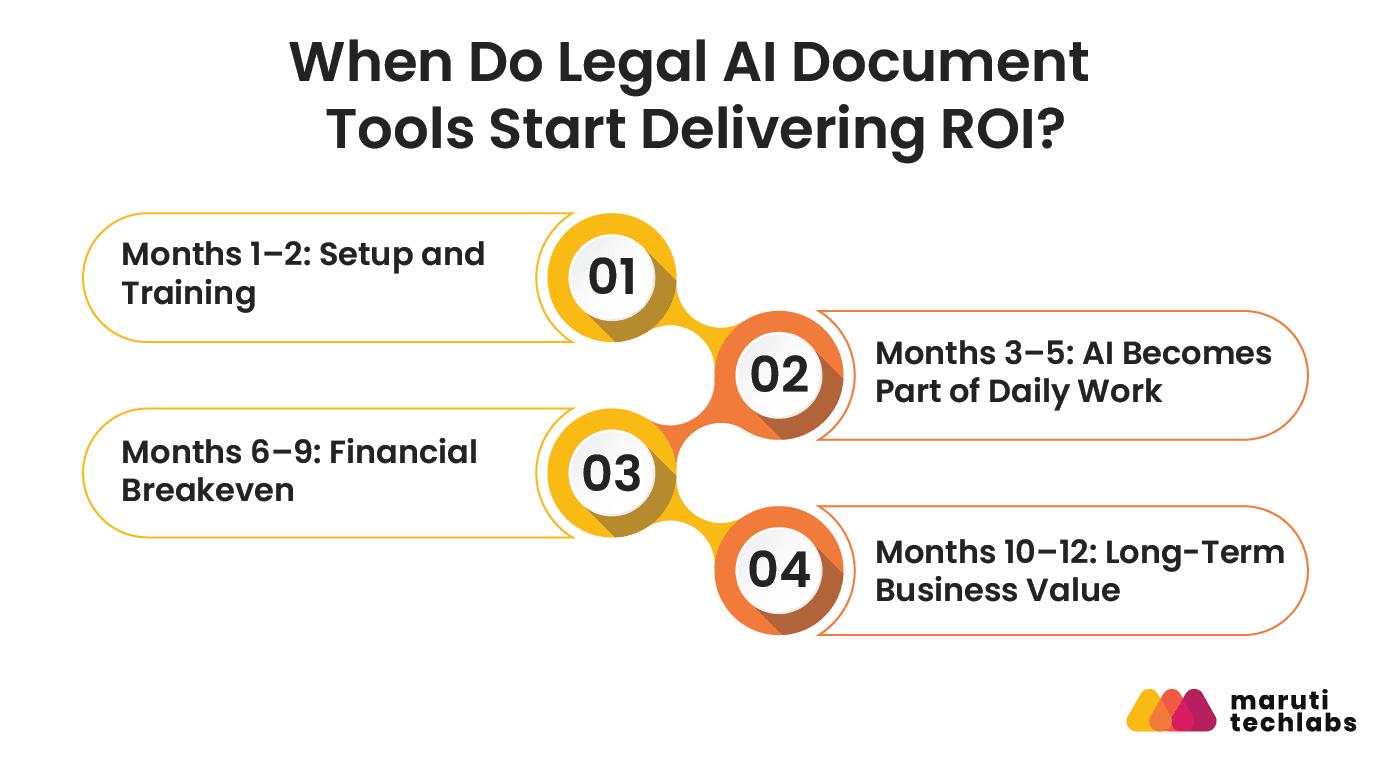
Months 1–2: Setup and Training
The first few weeks are usually spent getting the platform ready for day-to-day legal work. Clause playbooks, templates, document repositories, and user permissions are configured to match the firm's existing review process. Since lawyers are still getting comfortable with the platform, reviewing documents may take a little longer than usual.
Months 3–5: AI Becomes Part of Daily Work
By this point, the platform becomes part of the legal team's daily routine. Routine contract reviews, document drafting, and legal research take less time because much of the initial work is already done. Lawyers still review every output, but they can focus more on negotiation strategy, legal reasoning, and advising clients.
Months 6–9: Financial Breakeven
This is usually when firms start seeing a financial return. The time saved on routine legal work begins covering the cost of the platform and its implementation. Legal teams also find they can manage more matters without expanding the team or sending additional work to outside counsel.
Months 10–12: Long-Term Business Value
The longer legal AI stays in regular use, the more value it tends to deliver. Teams spend less time reworking documents, drafting becomes more consistent, and routine reviews move much faster. Some firms have reported first-year ROI exceeding 500%, although the actual return depends on document volumes and how widely the platform is used.
What Common Challenges Delay Legal AI ROI, and How Do You Fix Them?
Many legal AI projects begin with the right expectations but struggle during day-to-day execution. Small issues, such as poor adoption, disconnected systems, or unclear goals, can delay ROI even when the technology performs well. Addressing them early makes a measurable difference.
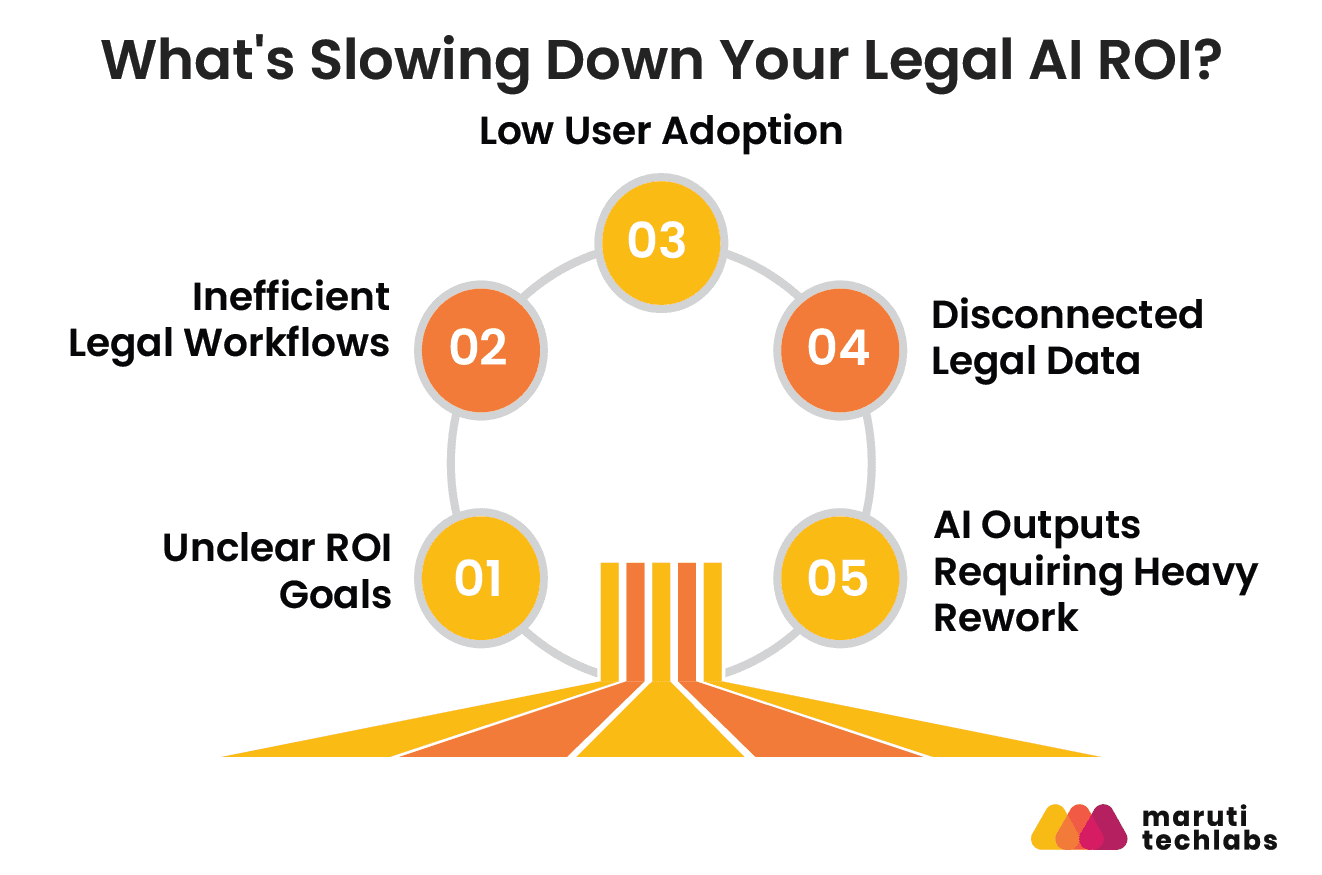
1. Unclear ROI Goals
Challenge: Many firms buy legal AI tools expecting them to save time, but stop there. Months later, it's difficult to answer a simple question: What has actually improved? Without measuring review time, turnaround time, or cost per matter before rollout, proving ROI becomes much harder.
Solution: The firms that see the strongest returns know what they're measuring from the beginning. They compare the same numbers before and after adoption, making it much easier to show where AI is saving time or reducing costs.
2. Inefficient Legal Workflows
Challenge: AI for law firms can't fix a process that's already slowing people down. If contracts are still shared over email, redlines are tracked in spreadsheets, and approvals happen across different systems, AI simply moves that same process along faster.
Solution: Firms usually see better results when they first bring some consistency to the way contracts are reviewed and approved. Once document review workflows, clause playbooks, and approval steps are in place, AI has a much stronger foundation to build on.
3. Low User Adoption
Challenge: It's common that a handful of lawyers embrace a new platform while everyone else sticks to familiar ways of working. When that happens, the benefits stay limited to a few individuals instead of the firm as a whole.
Solution: Adoption improves when lawyers learn the platform through real client work rather than one-time demonstrations. Ongoing training, leadership support, and regular use help turn legal AI tools into part of the team's daily workflow.
4. Disconnected Legal Data
Challenge: Lawyers naturally pull information from several places before making a decision. If AI for law firms can't access the same contracts, matter files, and knowledge repositories, its responses lack the full context.
Solution: Integrating document management, matter management, and knowledge systems gives AI access to more complete information, improving the accuracy of legal document analysis and document review.
5. AI Outputs Requiring Heavy Rework
Challenge: AI isn't saving much time if lawyers have to rewrite most of the first draft. That usually happens when the system is working without enough context or when templates and drafting standards aren't consistent across the firm.
Solution: The quality of the output improves when AI works from approved templates, clause libraries, and well-structured legal documents. Over time, lawyers spend less time making the same edits and more time reviewing the legal issues that actually need their attention.
Conclusion
The conversation around legal AI is gradually shifting. Firms are no longer asking whether AI can review documents or draft contracts. They're asking whether it improves the way legal work moves through the business and whether that improvement justifies the investment.
That's why ROI matters. It shows whether legal AI is actually making everyday work easier instead of simply adding another piece of software to the firm's technology stack. The firms seeing the best results are usually the ones that keep improving how the technology fits into their work instead of treating implementation as a one-time project.
At its best, legal AI doesn't change the role of a lawyer. It simply removes some of the repetitive work that gets in the way. When that happens, the return is reflected not only in the numbers but also in how smoothly legal teams can support the business.
How Can Maruti Techlabs Help You Maximize Legal AI ROI?
One of our legal clients wanted to reduce the time spent reviewing syndicated loan documents while improving accuracy across complex agreements. Maruti Techlabs built an AI-powered platform that extracted key deal information, compared clauses, validated documents, and automated document analysis. The solution reduced manual review effort by 60–70%, improved accuracy by 95%+, and helped legal teams process deals three times faster.
At Maruti Techlabs, we build practical AI systems that fit naturally into legal workflows instead of disrupting the way legal teams work. Our AI development services help organizations build custom AI platforms that solve document-heavy legal processes with measurable business outcomes. For LLM-powered legal assistants, document intelligence, and workflow automation, our Generative AI services help enterprises move confidently from pilots to production.

FAQs
1. How long does it take to see ROI from legal AI?
Most firms begin seeing productivity gains within the first few months as routine legal work becomes faster. Financial ROI usually takes longer because software, implementation, and training costs need to be recovered first. The timeline varies based on document volume, user adoption, workflow integration, and how widely legal AI is used across the firm.
2. What affects the ROI of legal AI the most?
The biggest factors are the workflows you automate, how consistently lawyers use the platform, and the quality of your legal data. AI usually delivers stronger returns in high-volume, document-intensive work where repetitive tasks can be reduced without compromising legal judgment. Poor adoption and disconnected systems often delay measurable business value.
3. What is the best legal AI tool?
The best legal AI tool is the one that handles your firm's actual workload well, not simply the one with the longest feature list. For contract-heavy work, look for reliable clause extraction, playbook comparison, and citation-backed analysis. For broader document work, strong search, document intelligence, integrations, and lawyer-controlled review matter more.
4. How does AI work for legal document analysis?
AI reads and processes large volumes of legal documents to find specific information, clauses, dates, parties, and other details. It can also compare documents, flag differences, summarize content, and answer questions based on the information it finds. More advanced systems use retrieval-augmented generation (RAG) to ground responses in the firm's documents and supporting sources.
5. How do legal teams use AI for document management?
Legal teams use AI to make large collections of documents easier to organize and search. It can classify files, pull out useful metadata, find related documents, and help lawyers locate information across different matters. When documents are spread across multiple repositories, AI can also make it easier to bring relevant information together without searching each system separately.

![[GetPaidStock.com]-65b9d3432ecc1.webp](https://cdn.marutitech.com/small_Get_Paid_Stock_com_65b9d3432ecc1_c1b16b05fb.webp)


