

12 Best Legal AI Tools in 2026 for Research, Drafting & Document Review (+3 Bonus Tools)
Key Takeaways
- Listed Legal AI tools in five distinct categories, including document review, case research, contract drafting, litigation analytics, and practice management.
- Harvey AI and CoCounsel lead among large firms for AI research grounded in verified legal databases like Westlaw and Practical Law.
- Free tools like ChatGPT and NotebookLM offer a legitimate starting point for firms not ready to commit to a paid platform.
- Bar association AI disclosure requirements are becoming a standard evaluation criterion alongside pricing and accuracy.
- Firms with specialized workflows or large proprietary document sets often get more value from a custom-built AI platform than from an off-the-shelf tool.
Introduction
Legal AI tools have moved from novelty to infrastructure in the space of two years. The global legal AI market was valued at $1.45 billion in 2024 and is projected to reach $3.90 billion by 2030, growing at a 17.3% CAGR, according to Grand View Research. That growth is being driven by firm-wide adoption of tools like Harvey AI, CoCounsel, and Lexis+ AI across research, contract review, and litigation analytics.
The pace of change inside individual firms tells the same story. Thomson Reuters' Future of Professionals Report 2025 found that legal professionals expect AI to free up nearly 240 hours per year, up from 200 hours in 2024, adding an average of $19,000 in annual value per professional and a combined $32 billion impact across the US legal and tax-accounting sectors.
We shortlisted 12 legal AI tools based on product maturity, workflow coverage, integrations, target users, and publicly available product information. The 12 in this guide are the best-performing, actively maintained tools available to law firms as of mid-2026.
This guide covers four things for each tool.
- Who it's actually built for (solo practitioner, mid-size firm, or enterprise)
- Pricing tier (free, mid-tier, or enterprise)
- What the tool does, separated from how it's marketed
- A side-by-side comparison table so you can shortlist in a few minutes
Not every legal AI tool is built on ChatGPT. For a closer look at using general-purpose AI in legal practice specifically, see our guide on ChatGPT for lawyers.
If you are looking for purpose-built legal AI tools, with verified citations, real-time case law access, and confidentiality controls that general-purpose AI tools don't offer by default this article is for you.
We have thoroughly covered both categories, general-purpose tools adapted for legal work and legal-specific platforms built from the ground up.


We helped a national law firm cut legal research time by 60% with a purpose-built deep research tool, and we can do the same for your team's specific workflow
5 Proven Benefits of Legal AI Tools (With Real Data)
Legal AI tools can reduce legal review time, increase professional productivity, improve accuracy on structured tasks, lower document-processing costs, and accelerate contract cycles. Research and our evaluation of these tools show how these benefits translate into measurable improvements for legal teams.
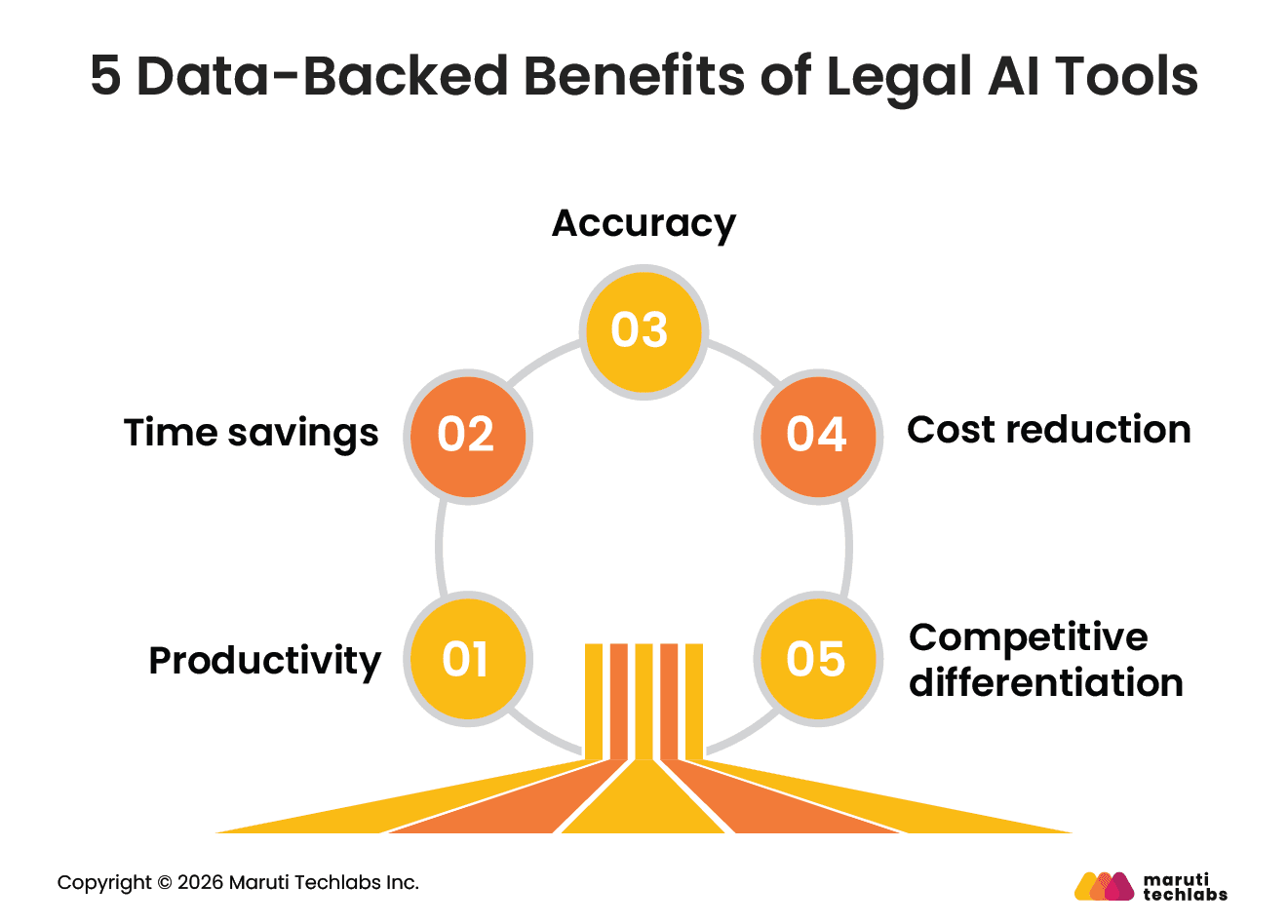
1. Productivity: Faster contract review
Bloomberg Law's 2024 Contract Workflow Analysis timed lawyers reviewing standard commercial contracts with and without AI assistance.
Manual review averaged 92 minutes per contract. With AI handling first-pass clause extraction and flagging, the same contracts averaged 22 minutes, a reduction of about 76%.
This clearly shows a drastic improvement in overall productivity, faster outcomes and efficient results.
2. Time savings: Hours back in the week
Thomson Reuters' Future of Professionals Report 2025 found that legal professionals expect AI to free up nearly 240 hours per year, up from 200 hours in 2024.
That works out to an average of $19,000 in annual value per professional, and a combined $32 billion impact across the US legal and tax-accounting sectors.
3. Accuracy: AI outperforming manual review on structured tasks
A 2024 Stanford RegLab and Institute for Human-Centered AI study (published in the Journal of Empirical Legal Studies, 2025) tested leading AI legal research tools head-to-head against general-purpose models.
Lexis+ AI hallucinated on 17% of queries and Westlaw AI-Assisted Research on 33%, compared to 43% for GPT-4 used without legal-specific grounding, and between 58% and 88% for general-purpose models tested on open legal queries in an earlier companion study.
The takeaway for firms evaluating tools is that retrieval-augmented, legal-specific platforms meaningfully outperform general AI on accuracy, but none of them are error-free.
Every AI output in a legal context still requires verification by a licensed attorney before filing or advising.
4. Cost reduction: Lower cost per contract cycle
Deloitte's 2026 agreement management research found that organizations using automated workflows and AI in contract management report average efficiency gains of 36%, cost avoidance of 36%, direct cost savings of 29%, and agreement accuracy improvements of 72%.
Separately, McKinsey's analysis of legal operations automation puts total legal cost reductions at 15% to 50% for targeted contract workflows once tool costs are factored in.
5. Competitive differentiation: Clients are starting to expect it
Bloomberg Law's first State of Practice report of 2026, based on responses from 760 law practitioners across law firms and corporate legal departments, found that 83% of lawyers now use AI at work, up from under 20% in 2023.
The same survey found competition, not just internal efficiency, is a primary driver behind adoption, with 62% of respondents saying AI tools are now "integral" to their daily workflows.
Bloomberg Law's separate Leading Law Firms survey reinforces the same trend at the top of the market. All 40 law firms with 500 or more attorneys that reported their technology usage said they used legal-specific AI tools in 2025, up slightly from the year before, reflecting how AI has become as standard as other core attorney software at large firms.
Firms that adopt early aren't just working faster internally, they're positioning themselves ahead of a market where AI use is quickly becoming the norm rather than the exception.
For a deeper breakdown of AI's impact on legal work, see our guide on AI in Predictive Analytics for Legal Firms.
Which Legal AI Use Cases Matter Most for Legal Teams?
Legal AI tools can review contracts, conduct legal research, draft documents, analyze litigation data, support e-discovery, and streamline practice management.
The table below maps these seven core use cases to the tools in this guide, based on their actual product capabilities rather than their marketing categories.
| Use Case | Best Tools Covered in This Blog |
| Contract Review | Litera Kira, Luminance, LegalOn |
| Contract Lifecycle Management | Ironclad |
| Legal Research | CoCounsel, Lexis+ AI, Harvey AI |
| Document Drafting | Harvey AI, Spellbook |
| Litigation Analytics | Lex Machina, Judicata |
| E-Discovery | Relativity |
| Practice Management | Litify, Clio Duo |
A few tools appear in more than one row, and that's accurate, not an error.
Harvey AI spans research, drafting, and document review rather than fitting a single category, since it's built as a general enterprise legal AI platform rather than a point solution.
Judicata sits under litigation analytics specifically because its core function, verifying quotations and citations in briefs against the underlying case text, supports litigation work rather than general case research.
Legal AI tools generally fall into three categories.
- Tools built on general-purpose LLMs adapted for legal work, such as Harvey AI
- Tools integrated with legal databases for verified citations, such as CoCounsel and Lexis+ AI
- Purpose-built platforms for specific legal workflows, such as Relativity for e-discovery and Lex Machina for litigation analytics
The best choice depends on your primary use case. This guide is organized by the tool category below, so you can find the tools relevant to your firm's specific workflow first.
Legal AI Tools Comparison: Quick Reference Table
This comparison highlights the best legal AI tools by use case, firm size, pricing model, AI capabilities, citation support, and trial availability, so legal teams can quickly narrow down the options that fit their workflow and buying requirements.
Tool | Best For | Pricing Tier | Key AI Feature | Verified Citations? | Free Trial? |
| Litera Kira | Am Law 100 M&A due diligence | $100 to $500/user/month, or $12,000 to $60,000+/year for 10 users | 1,400+ clause extraction, Grid Chat | N/A (extraction tool) | No |
| Relativity (aiR) | Large-scale e-discovery & litigation | Processing $25 to $75/GB one-time; hosting/licensing adds $75 to $250/user/month | Predictive coding, continuous active learning | N/A (document review) | No |
| LegalOn | In-house contract review | Individual plan $550/month ($6,600/year); Teams plan custom-quoted | AI benchmarked across 21 clause categories | N/A (contract review) | Demo only |
| Ironclad | In-house CLM (200+ contracts/year) | $30,000 to $250,000+/year, median buyer pays ~$39,700/year | Jurist AI (drafting, redlining) | N/A (contract lifecycle) | No |
| Luminance | High-volume transactional (M&A, PE) | Quote-only; mid-size deployments typically land in the five-to-six-figure range per year | Autonomous Negotiation (agent-to-agent) | N/A (contract review) | No |
| Harvey AI | Am Law 100 & large corporate legal | Quote-only; median contract reported at $175,000/year | 25,000+ custom AI agents | Yes, source-linked | No |
| CoCounsel | Firms on Westlaw/Practical Law | $104 to $639/user/month depending on tier and Westlaw bundle | Agentic Deep Research | Yes, Westlaw-grounded | No |
| Lex Machina | Litigation analytics & judge insights | Fully custom, quote-only. No third-party source publishes even an estimated figure | Protégé data extraction | N/A (analytics, not citations) | Demo only |
| Clio (vLex/Fastcase) | Research bundled with practice mgmt | From ~$49/user/month (Clio base); Fastcase often bundled free via bar associations | Vincent AI, 1B+ documents | Partial (source-linked) | Yes (Clio) |
| Spellbook | Word-native contract drafting | $99/user/month (Starter) to $199 to $350/user/month (Enterprise) | Clause benchmarking (2,300+ types) | N/A (drafting tool) | Yes (14-day) |
| Lexis+ AI | Firms on Lexis/Lex Machina | Base research seat ~$171/user/month; AI layer adds $75 to $200+/user/month | Unified LexisNexis AI layer | Yes, Lexis-grounded | No |
| Litify | Plaintiff-side CRM & case mgmt | $100 to $200+/user/month including required Salesforce licensing | Salesforce-powered analytics | N/A (practice mgmt) | No |
| Clio Duo | Small/mid firms already on Clio | Bundled into Clio Manage Suite/Complete tiers, roughly $49 to $149/user/month | Matter-grounded AI assistant | N/A (practice mgmt) | Yes (Clio) |
| MyCase (8am IQ) | Small/mid firms wanting lower-cost AI | Basic $39/user/month; Pro (includes 8am IQ) $89 to $100/user/month, billed annually | Document summarization, AI drafting | N/A (practice mgmt) | Yes (10-day) |
| Filevine (LOIS) | High-volume PI & mass tort litigation | $49 to $150+/user/month depending on modules; median buyer reported at $7,500/year | Deposition AI, medical record review | N/A (practice mgmt) | No |
Decision Guide: Which Legal AI Tool Is Right for Your Firm?
- Solo practitioner or small firm (1–10 attorneys): MyCase (8am IQ) or Clio Duo depending on which practice management platform fits your budget, or Spellbook's free trial if contract drafting is your main volume. (For no-cost options while you evaluate, see the Free Legal AI Tools section.)
- Mid-size firm (10–50 attorneys): Spellbook or Clio Duo for day-to-day drafting and admin; Lexis+ AI or CoCounsel if you're already paying for Westlaw, Practical Law, or Lexis.
- Large law firm (Am Law 100 / BigLaw): Harvey AI or CoCounsel for firm-wide research and drafting; Litera Kira or Luminance for due diligence at scale; Relativity for active litigation and e-discovery.
- In-house legal department: LegalOn or Ironclad for contract review and CLM; Clio (vLex) if you also need case law research bundled with practice management.
- Plaintiff-side / high-volume litigation practice: Filevine for personal injury, mass tort, and complex litigation with 500+ active cases; Lex Machina for judge and case analytics; Litify for CRM and matter management at enterprise scale; Relativity if you handle high-volume discovery.
Legal AI Tools for Document and Contract Review
Legal AI tools for document and contract review can automate clause extraction, identify risks and inconsistencies, accelerate due diligence and e-discovery, and streamline contract workflows from drafting through renewal.
The five tools below cover the major use cases across transactional due diligence, litigation document review, and contract lifecycle management.
1. Litera Kira
Kira Systems was acquired by Litera in 2021 and is now marketed as Litera Kira. It remains one of the most widely deployed contract analysis platforms, used by more than 50 Am Law 100 firms alongside four of the five UK Magic Circle firms.
Kira's core strength is clause extraction from unstructured documents. It identifies over 1,400 predefined clauses and data points across 40+ substantive areas including M&A, real estate, banking and finance, and employment.
In 2026, Litera added generative AI capabilities on top of Kira's existing machine learning models, including Grid Chat, a natural language interface for querying entire document sets with source citations, and Generative Smart Fields.
This lets users describe a clause in plain English instead of training an extraction model from examples.
Pricing is enterprise-only and custom-quoted. Third-party estimates put per-user costs between $100 and $500 per month, with a 10-user deployment typically running $12,000 to $60,000 or more annually depending on modules selected.
Best Suited To: M&A due diligence, cross-border contract review, and large-volume document analysis at Am Law 100 firms. |
2. Relativity (RelativityOne aiR)
Relativity is the e-discovery industry standard, used by 198 of 200 AmLaw firms. It's worth framing accurately here. Relativity is a comprehensive e-discovery platform with AI features, not a standalone AI research tool.

Relativity aiR uses predictive coding and continuous active learning to prioritize documents for review, cutting the volume attorneys need to manually review on large litigation matters.
In June 2026, Relativity released aiR Assist for early case intelligence and added no-code custom analyses to aiR for Review, letting legal teams define their own AI-driven review criteria through natural language prompts instead of writing code.
Pricing is usage-based. Processing runs $25 to $75 per GB as a one-time cost, with hosting and user licensing adding $75 to $250 per user per month depending on deployment size and tier.
Best Suited To: Large law firms and litigation departments handling high-volume document review in complex commercial disputes, regulatory investigations, or class actions. |
3. LegalOn
LegalOn is an independent AI contract review platform for in-house legal teams. It's backed by $200 million from investors including Goldman Sachs and SoftBank, and serves more than 7,500 organizations globally.

LegalOn's own 2026 benchmark tested its contract review against 11 general-purpose AI models, including Claude, ChatGPT for lawyers, and Gemini, across 3,282 contracts and 21 legal provision categories, and reported outperforming all of them on accuracy.
LegalOn integrates with CLM systems like Salesforce and DocuSign, and is built around 50+ attorney-drafted playbooks covering common contract types.
It's positioned for in-house legal departments handling high volumes of vendor contracts, NDAs, and standard commercial agreements, not law firms.
The Individual plan is published at $550 per month, or $6,600 annually. The Team's plan is fully custom-quoted and requires a sales demo.
Best Suited To: In-house legal departments handling high volumes of vendor contracts, NDAs, and standard commercial agreements. Law firms looking for a standalone contract review tool should evaluate Litera Kira or Luminance instead, since LegalOn is built for in-house legal operations, not law firm due diligence work. |
Note for Law Firms: Firms looking for a standalone contract review tool should evaluate Litera Kira or Luminance instead. LegalOn is built for in-house legal operations.
4. Ironclad
Ironclad is the leading AI-powered contract lifecycle management (CLM) platform, used by legal teams at Dropbox, L'Oréal, Cisco, Asana, and OpenAI.
It was named a Forrester Wave CLM Leader in 2025. Ironclad's AI module, called Jurist, handles drafting, redlining, and clause analysis.

Unlike point solutions such as Kira for due diligence or Relativity for e-discovery, Ironclad manages the full contract lifecycle, from first draft through execution, storage, and renewal tracking.
This makes it the default choice for in-house legal teams that need workflow automation, not just contract analysis.
Pricing is fully custom and enterprise-scaled. Vendr's transaction data puts typical annual contract values between $30,000 and $250,000+, with mid-market buyers commonly landing between $50,000 and $120,000 a year. Ironclad does not offer a free trial; prospective buyers need a sales demo.
Best Suited To: In-house legal teams at growth-stage and enterprise companies managing 200+ contracts per year. |
5. Luminance
Luminance is an active, well-regarded platform for document review, due diligence, and contract negotiation.
It's built by mathematicians from Cambridge University on a proprietary legal LLM. Luminance says its proprietary legal AI was trained on more than 150 million legal documents
Since 2023, Luminance has offered an autonomous contract negotiation feature (originally called Autopilot, now Autonomous Negotiation) that can handle a full negotiation cycle for standard agreements like NDAs, including analyzing risk, sending redlines to a counterparty, and tracking responses, without a lawyer driving each turn.
In 2026, Luminance extended this capability enterprise-wide (not just to legal teams) and added visibility into the reasoning behind each AI decision.
Pricing is enterprise-tier and quote-only. Mid-size deployments typically fall in the five to six figure range annually based on user count, document volume, and modules purchased.
Luminance is built for large legal departments running high-volume transactional work, not solo GCs or small teams that want fast, self-serve pricing.
Best Suited To: Large law firms and enterprises handling high-volume transactional work (M&A, private equity, banking) where speed of document review and negotiation is a competitive differentiator. |
Legal AI Tools for Research & Case Prediction
Legal AI tools for research and case prediction can accelerate case law discovery, summarize legal authorities, surface relevant precedents, analyze litigation data, and provide insights into judges, courts, and case outcomes.
The tools below represent the current research AI landscape across legal research platforms, litigation analytics, and integrated legal technology suites.
1. Harvey AI
Harvey is the best-funded legal AI company in the market, valued at $11 billion after a $200 million round in March 2026 led by GIC and Sequoia, up from $8 billion just three months earlier.
It's used by more than 100,000 lawyers across 1,300+ organizations in 60+ countries, including a majority of the Am Law 100.

Harvey handles document analysis, legal research, drafting, and multi-language translation, and runs more than 25,000 custom AI agents built for individual firm workflows.
In 2026, it added a Microsoft 365 Copilot integration for in-app research and agreement analysis, a DocuSign partnership connecting it to contract lifecycle management, and an Intapp partnership for ethical wall enforcement, syncing AI access controls with a firm's existing conflict management systems.
Pricing is enterprise-only and custom-quoted. Third-party buyer data puts the median annual contract at approximately $175,000.
Best Suited To: Am Law 100 firms and large corporate legal departments that need a customizable AI platform across research, drafting, and workflow automation, not a single-purpose tool. |
2. CoCounsel
CoCounsel Legal is Thomson Reuters' AI legal assistant, built on the Casetext platform Thomson Reuters acquired for $650 million in 2023.
It has since been fully integrated into the Thomson Reuters ecosystem and rebranded as CoCounsel Legal.
Its core differentiator is that every research answer is grounded in Westlaw and Practical Law content rather than open-web generation, which sharply reduces the risk of hallucinated case citations.
In August 2026, Thomson Reuters released a next-generation version described as fully agentic:
- It builds a research plan,
- Retrieves authority from Westlaw and Practical Law,
- Verifies citations, and drafts a first-pass work product within a single workflow.
It surpassed 1 million users by February 2026. CoCounsel Legal makes the most sense for firms already invested in the Westlaw and Practical Law ecosystem, since the AI layer sits on top of that existing subscription rather than replacing it.
Pricing runs $104 to $639 per user per month depending on tier and whether Westlaw research access is bundled in, based on Thomson Reuters' own configurator.
Best Suited To: Firms and legal departments already on Westlaw or Practical Law that want AI research with verified, source-linked citations. |
3. Lex Machina
Lex Machina is a litigation analytics platform, not a case law search tool, and it's worth being precise about that distinction.
Originally developed at Stanford Law School and Stanford's Computer Science department, it now operates as part of LexisNexis.
Rather than searching case law, Lex Machina analyzes litigation data, judge behavior, attorney performance, case outcomes, and timing, covering all 94 federal district courts, 13 appeals courts, the Patent Trial and Appeal Board, and expanded state court coverage across more than 45 million documents and 10 million cases.
Its AI extraction layer, Protégé, converts raw court filings into structured, searchable data. It connects into the broader LexisNexis ecosystem, including Lexis+ AI.
Pricing is fully custom and quote-only. No published or third-party estimate exists; firms need to contact LexisNexis sales directly for a quote.
Best Suited To: Litigation teams that need predictive insight into how a specific judge, court, or opposing counsel is likely to behave, particularly in IP, employment, and antitrust matters. |
4. Clio (vLex / Fastcase)
Clio, best known as the leading legal practice management platform, acquired the global legal research company vLex for $1 billion in 2025, and vLex itself was built around Fastcase and Vincent AI.

Fastcase had earlier acquired the Judicata research and analytics technology in 2020. That lineage puts Judicata's original California case law and analytics capability inside this stack today.
vLex's research platform draws on more than 1 billion legal documents across 100+ countries and includes Vincent AI, a generative research and litigation-support tool.
Fastcase, the U.S.-focused layer within vLex, is offered free or at a discount through many state bar association memberships, including partnerships with all 50 U.S. state-level bar associations.
Clio now serves more than 400,000 legal professionals and reports $400 million in annual recurring revenue.
Pricing starts around $49 per user per month at Clio's base tier. Fastcase, the U.S. research layer within vLex, is often included free or discounted through state bar association memberships.
Best Suited To: Firms that want case law research bundled with practice management, or that already access Fastcase through a bar association membership and want AI research layered on top at no extra cost. |
5. Spellbook
Spellbook is a Word-native AI contract drafting and review assistant, used by transactional lawyers who want AI suggestions without leaving Microsoft Word.
It raised more than $70 million in equity plus a $40 million debt facility as of March 2026, and in March 2026 became the exclusive AI contract partner of the Canadian Bar Association, reaching roughly 40,000 members.
Spellbook flags missing clauses, suggests redline language, and benchmarks contract terms against a library of 2,300+ contract types.
In June 2026, it released Autonomous Contract Management to early-access customers, an end-to-end system that intakes new contracts, reviews incoming redlines against a team's playbook, and monitors signed agreements for renewal deadlines and risk.
Pricing is tiered but not officially published; third-party estimates put it around $99 to $199 per user per month depending on plan, billed annually, with a free trial available on entry tiers.
Best Suited To: Transactional lawyers and small-to-mid-size firms doing high-volume contract drafting who want AI embedded directly in their Word workflow. |
6. Lexis+ with Protégé (Formerly known as Lexis+ AI)
Lexis+ with Protégé is LexisNexis's generative AI research layer, sold as an add-on to existing Lexis subscriptions rather than as a standalone product.
It connects to the broader LexisNexis ecosystem, including Lex Machina for litigation analytics and Practical Guidance for how-to content, giving subscribers a single AI entry point across tools that previously required separate searches.
Lexis+ with Protégé Pricing isn't published, but firms report add-on costs in the range of $75 to $200 per user per month, layered on top of an existing Lexis subscription that itself ranges from roughly $150/month for small firms to enterprise-negotiated rates for larger ones.
Best Suited To: Firms already subscribed to Lexis or Lex Machina that want AI-assisted research without switching research platforms, particularly for appellate and citation-heavy work. |
Top AI-Powered Legal Tools for Practice Management
AI-powered legal practice management tools help firms automate intake, billing, matter tracking, scheduling, client communication, and other administrative workflows.
They are particularly valuable for solo and small-to-mid-size firms looking to reduce operational overhead and spend more time on billable legal work.
1. Litify
Litify is a legal operations platform built natively on Salesforce.
It functions primarily as a CRM and case management system for plaintiff-side and insurance defense firms, helping legal teams manage client relationships, cases, workflows, and operations from a unified platform.
It offers standardized matter workflows, customizable intake questionnaires, document generation from matter data, and Salesforce-powered analytics for tracking team productivity and case profitability.
Because Litify is built on Salesforce, its overall cost and implementation requirements reflect the underlying platform.
Total cost of ownership, including Salesforce licensing, typically ranges from $100 to $300+ per user per month. Implementation can add $50,000 to $200,000+ in upfront costs, with deployments typically taking three to nine months.
Best Suited To: Large plaintiff firms (25+ attorneys) handling mass tort, personal injury, or workers' compensation matters that want enterprise-grade CRM capabilities and already have, or are willing to build, in-house Salesforce expertise. |
2. Clio Manage
Manage AI is the AI assistant built into Clio Manage, the market-leading cloud practice management platform.
Unlike standalone research tools, Manage AI works exclusively from a firm's own Clio data:
- It summarizes matters, drafts emails and letters from case context, and
- Its Document Analyzer generates instant summaries and clause identification for uploaded documents.
Pricing is bundled into Clio's higher subscription tiers rather than sold as a fully separate product.
As of 2026, Clio Manage runs from roughly $49/user/month (EasyStart) up to $149/user/month (Complete), and Manage AI access is included at the Suite/Complete tier or added for roughly $49 to $59/user/month on lower tiers.
Best Suited To: Small and mid-size firms already running on Clio that want AI for day-to-day admin, billing narratives, matter summaries, and client emails, without adopting a separate legal AI tool. |
3. MyCase (8am IQ)
MyCase is a cloud-based practice management platform built for small and mid-size firms, positioned as a lower-cost, simpler alternative to Clio.
Its AI assistant, 8am IQ, launched in 2024 and is available on the Pro plan, offering document summarization, AI-assisted drafting, and editing across notes, messages, tasks, and client portal communications.
MyCase's Basic plan starts at $39/user/month (annual billing), roughly $10 to $30 cheaper per user than Clio's equivalent tiers, with 8am IQ unlocked on the Pro plan at $89/user/month. A 10-day free trial is available with no credit card required.
Best Suited To: Small and mid-size firms that want AI-assisted practice management at a lower price point than Clio, particularly firms switching from paper or spreadsheet-based systems. |
4. Filevine (LOIS AI)
Filevine is a case management platform purpose-built for high-volume litigation, particularly personal injury, mass tort, and complex litigation firms managing hundreds or thousands of active matters at once.
Unlike general practice management tools with legal templates bolted on, Filevine was designed from the ground up around litigation-specific workflows.
Its AI suite, LOIS, goes deeper than administrative assistance: it includes deposition AI, automated medical record review and timeline generation, and contract intelligence, features aimed squarely at the document-heavy bottlenecks of PI and mass tort practice.
Filevine serves more than 60,000 legal professionals across roughly 2,000+ firms.
Pricing is custom-quoted and modular, generally running $49 to $150 or more per user per month depending on which AI add-ons are included. Third-party buyer data puts a median annual contract around $7,500.
Best Suited To: Personal injury, mass tort, and complex litigation firms with high case volume (typically 10+ attorneys or 500+ active matters) that need AI-assisted medical record review and deposition analysis, not just general case tracking. |
Which Free Legal AI Tools Support Research, Drafting, and Document Review?
Free legal AI tools can support legal research, document drafting, contract analysis, summarization, and basic document review, making them useful for solo practitioners and small firms evaluating AI before investing in enterprise platforms.
However, free options typically come with limitations on usage, features, data handling, or access to authoritative legal sources.
1. ChatGPT (Free tier)
As of August 2026, OpenAI made ChatGPT's free tier unlimited for text chat, though it runs on a smaller model (GPT-5.6 Luna) than paid tiers, and image generation and file uploads carry separate, smaller limits.
It's a reasonable entry point for legal drafting practice, brainstorming, and general research, but it lacks legal-specific citation verification, so any case law or statute it references needs independent confirmation before use in actual filings.
2. Clio Duo (via Clio's paid plans)
Clio Duo isn't free outright, but firms already on a qualifying Clio Manage subscription get AI-assisted matter summaries and drafting bundled into the platform they're already paying for, without buying a separate AI product (see the Practice Management section above for tier details).
3. Perplexity

Perplexity's free tier provides web-grounded, cited answers to legal research questions, useful for quick statutory lookups or background research on unfamiliar areas of law.
Like ChatGPT, it isn't built on verified legal databases like Westlaw or Lexis, so citations still need independent verification before filing.
4. Google Notebook/NotebookLM
Google's document-grounded AI tool was renamed Gemini Notebook on July 16, 2026, though it remains free at the standard tier.
It works differently from a general chatbot: it only answers from documents you upload (up to 50 sources per notebook, 500,000 words per source), with every answer citing the exact passage it came from.
That makes it well suited to synthesizing a large set of case documents, depositions, or discovery materials without the hallucination risk of open-web AI tools.
Its Audio Overview feature converts uploaded documents into a podcast-style summary, useful for reviewing a long brief during a commute.
How to Choose the Right Legal AI Tool: A 7-Point Framework
The right legal AI tool should fit your firm's workflows, practice areas, existing technology stack, security requirements, budget, and expected return on investment. Use these seven criteria to evaluate each tool consistently before committing to a platform.
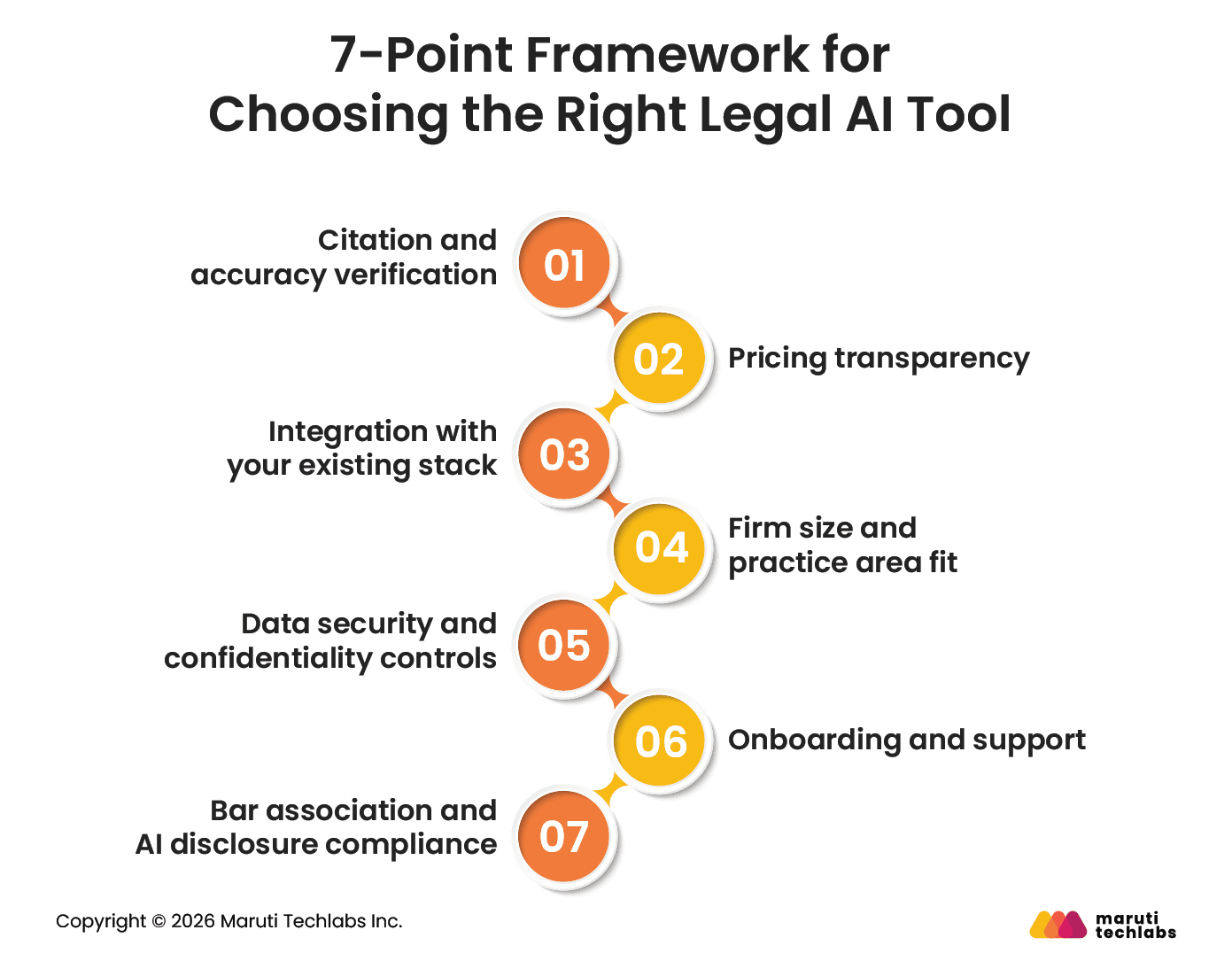
1. Citation and accuracy verification
Does the tool ground its answers in a licensed legal database (Westlaw, Practical Law, Lexis), or does it generate from general training data? Tools like Harvey AI, CoCounsel, and Lexis+ AI link every claim to a verifiable source.
General-purpose tools require independent citation checking before any output goes into a filing.
2. Pricing transparency
Most enterprise legal AI tools (Harvey, Kira, Luminance, Ironclad) are quote-only, which makes budgeting difficult without a sales call.
Tools with published or estimable pricing (MyCase, Clio Duo, Spellbook) are easier to evaluate against a fixed budget, particularly for solo and small firm buyers.
3. Integration with your existing stack
A tool that doesn't connect to your practice management system, document storage, or billing software adds friction instead of removing it.
Check whether the tool integrates natively with what your firm already runs (Clio, Microsoft 365, Salesforce) before adding a new platform.
4. Firm size and practice area fit
An enterprise CLM built for Fortune 500 legal departments (Ironclad) will overwhelm a five-person firm, and a lightweight practice management assistant (MyCase) won't handle Am Law 100 due diligence volume. Match the tool's target customer profile to your actual firm size and case volume, not your ambitions.
5. Data security and confidentiality controls
Legal work involves privileged and confidential client information. Confirm where a tool processes and stores data, whether it trains on your firm's inputs, and what certifications (SOC 2, encryption standards) it holds before uploading client documents.
6. Onboarding and support
Enterprise tools like Litera Kira and Relativity often require weeks of implementation and dedicated administrators.
Self-serve tools like Spellbook and MyCase are usable within days. Weigh the implementation timeline against how quickly your firm actually needs results.
7. Bar association and AI disclosure compliance
An increasing number of state bar associations require disclosure of AI use in court filings and impose independent verification duties on attorneys using AI-generated content.
Before deploying any tool, confirm your jurisdiction's current AI disclosure rules and your bar's guidance on client confidentiality when using third-party AI platforms.\
Warning Signs to Keep Your Eye On:
- No published information on where client data is processed or stored
- Vendors that claim "100% accurate" citations without independent verification available
- No free trial or demo before requiring a signed annual contract
- Pricing that scales unpredictably after the first year (check renewal terms before signing)
The Verdict: Building Your Legal AI Stack
Legal AI tools have moved past the pilot stage. The right choice depends on where your actual bottleneck sits: document review, contract drafting, litigation analytics, or day-to-day practice management, not on picking whichever tool has the most funding behind it.
Three steps to start:
- Identify your single biggest time drain (research, contracts, or admin) and shortlist 2-3 tools from that category using the comparison table above.
- Run a free trial or demo before committing. Most enterprise tools require a sales call, but Spellbook, Clio, and MyCase all offer self-serve trials.
- Confirm your bar association's AI disclosure and confidentiality requirements before deploying any tool with client data.
For firms not ready to commit to a paid platform, the free stack covered above (ChatGPT, NotebookLM) is a legitimate way to start.
FAQs
1. What is the best AI tool for legal research in 2026?
Harvey AI and CoCounsel lead for large firms needing verified, citation-backed research grounded in legal databases.
Solo practitioners and small firms get strong value from Lexis+ AI (if already on Lexis) or the free tier of NotebookLM for document synthesis.
2. Is legal AI software worth the cost for a small firm?
For most small firms, yes, if the tool matches an actual bottleneck. Practice management AI like Clio Duo or MyCase's 8am IQ costs $39 to $149 per user per month and reduces administrative time.
Enterprise research and contract platforms (Harvey, Kira, Luminance) are usually not cost-effective below 10+ attorneys.
3. Can AI legal tools replace a paralegal or associate?
No. Every tool covered in this guide is designed to accelerate research, drafting, or document review, not to replace attorney judgment or provide legal advice.
Bar associations increasingly require disclosure of AI use and independent verification of AI-generated citations before filing.
4. Which legal AI tools verify their own citations?
Harvey AI, CoCounsel, and Lexis+ AI all ground their outputs in licensed legal databases (Westlaw, Practical Law, or Lexis) and link to source citations.
General-purpose tools like ChatGPT and Perplexity do not verify legal citations against a licensed database, so outputs need independent confirmation before use in filings.
5. How much does legal AI software typically cost?
Pricing varies widely by category. Free tools (ChatGPT, NotebookLM) cost nothing. Practice management AI runs $39 to $199 per user per month.
Enterprise research and contract review platforms (Harvey, Kira, Luminance, Ironclad) are quote-only and typically start in the tens of thousands of dollars annually.
Building Custom Legal AI for Workflows Off-the-Shelf Tools Can’t Handle
Every tool covered in this guide solves a general problem well. But firms with specialized workflows, proprietary document types, or a need to keep everything inside their own infrastructure often outgrow what an off-the-shelf platform can offer.
That's where a custom-built AI layer, designed specifically around a firm's own processes, makes the difference between a tool the team tolerates and one that actually changes how work gets done.
Why an Am Law 200 Firm Left Harvey AI to Build Its Own Legal AI Platform
An Am Law 200 firm with more than 1,000 attorneys across multiple cities approached Maruti Techlabs after previously using Harvey AI.
As the firm expanded its use of AI, Harvey’s per-seat pricing became increasingly difficult to justify, particularly as new capabilities were added, including 25,000+ custom AI agents, multilingual translation, and integrations such as Microsoft 365 Copilot.
But the firm's core challenge was more specific. Its legal teams regularly handled large documents ranging from 300 to 1,000+ pages across corporate law, litigation, and intellectual property work.
What they needed was not another broad AI platform, but a focused solution for processing these documents efficiently, backed by a clear and scalable AI roadmap.
Maruti Techlabs developed a custom AI-powered LegalTech platform built around three core capabilities:
- Conversational legal AI: A unified interface for legal research, contract review, drafting, and case analysis.
- Source-grounded search: A fast retrieval layer that enables attorneys to search the firm's internal documents and knowledge base while grounding responses in firm-specific sources.
- Task-specific AI agents: Specialized agents for high-volume workflows such as document drafting, due diligence, and data extraction, built using our specialized AI agent development services tailored to specific legal workflows.
The impact:
- Work that took 7 to 8 hours (document review, research, drafting) compressed to minutes
- Over 95% accuracy on complex legal reasoning tasks
- Reduced dependency on any single person for AI-related decisions
- A clear, execution-ready AI roadmap replacing fragmented experimentation
- The firm continues to expand adoption of the platform across additional practice groups
If your firm is paying enterprise rates for features it rarely uses, or watching costs climb every time you add a capability, a custom-built platform may be the more practical path forward, one priced around your actual workflow instead of a vendor's broadest use case.



![[GetPaidStock.com]-65b9d3432ecc1.webp](https://cdn.marutitech.com/small_Get_Paid_Stock_com_65b9d3432ecc1_c1b16b05fb.webp)


