

Custom vs Off-the-Shelf Legal Software: Which One Actually De-Risks Your Firm Long Term?
Key Takeaways
- Off-the-shelf platforms reduce deployment and cost risk but leave vendor, compliance, and lock-in risk with the firm.
- Custom-built software cuts vendor and switching cost risk sharply, at the price of upfront cost and partner dependency.
- Confidentiality and technology-competence duties sit with the firm, not a vendor's terms of service.
- Vendor lock-in is a contract mechanics problem, checkable through export formats, fees, and termination clauses before signing.
- A 1 to 5 risk score across vendors, compliance, data, and switching cost turns this decision into something a firm can act on.
- Many firms are best served by a hybrid stack, buying commoditized functions and building only where their workflow is the differentiator.
When law firm leaders compare off-the-shelf and custom legal software, the conversation almost always starts with price. A software decision like this carries compliance and confidentiality stakes a subscription fee doesn't capture.
A software decision in a law firm carries compliance obligations, client confidentiality duties, and years of matter data behind it, so the real question is not what a platform costs today.
The real question is which option exposes the firm to less risk over the next five years.
Maruti Techlabs saw this play out directly with an Am Law 200 firm that has more than 1,000 attorneys. The firm's legal workflows were manual and hard to scale, and no off-the-shelf tool could process its 300- to 1,000-page documents the way its teams needed. Maruti Techlabs built a custom AI-powered legal platform instead, combining legal research, document review, and drafting into one system. The outcomes are exceptional:
- Work that took 7 to 8 hours now takes minutes, and
- The platform reaches more than 95% accuracy in complex legal reasoning
A generic platform could not have closed that gap, because the firm's workflow, document scale, and internal knowledge base were too specific to fit a standard product.
That is the real test behind this decision. It is not which platform costs less to license today, but which one holds up over time against your firm's actual risk profile across compliance, data ownership, and long-term flexibility.
This article breaks down where that risk actually sits, and it gives you a framework to score that risk before you sign anything.

Why Cost Alone Isn't Enough When Choosing Legal Software
Most law firms frame this decision as a budget line. They compare a subscription fee against a development quote, and they pick whichever number looks smaller this year.
This kind of comparison hides the real cost, because a subscription that looks cheaper today can force an expensive migration three years from now if the vendor raises prices, changes its product direction, or gets acquired.
A custom build that looks expensive upfront can also avoid years of compounding risk, because it removes the firm's dependence on someone else's roadmap and someone else's compliance posture.
To make this comparison useful, this article scores both options against four risk categories instead of price alone.
- Vendor risk covers what happens when a platform's pricing, ownership, or roadmap changes after your firm has already committed to it.
- Compliance risk covers whether a platform can meet your firm's confidentiality and regulatory obligations, not just generic data protection standards.
- Data and privilege risk covers what happens to matter data and privileged communications inside a platform's architecture, especially once AI features are involved.
- Switching cost risk covers what it actually takes to leave a platform once years of matter data live inside it.
Each of these categories gets its own section below, and the framework later in this article pulls them together into a single score you can apply to your own firm.
Where Long-Term Risk Actually Hides in a Legal Software Decision
Most firms only price a legal software decision against its subscription fee, but the real risk sits in four places most contracts never spell out:
- What happens when the vendor's pricing or roadmap changes,
- Whether the platform actually meets a firm's confidentiality duties,
- Where privileged data physically lives, and what it costs to leave once matter data is embedded inside the system.
The sections below define each of these before applying them directly to off-the-shelf and custom platforms.
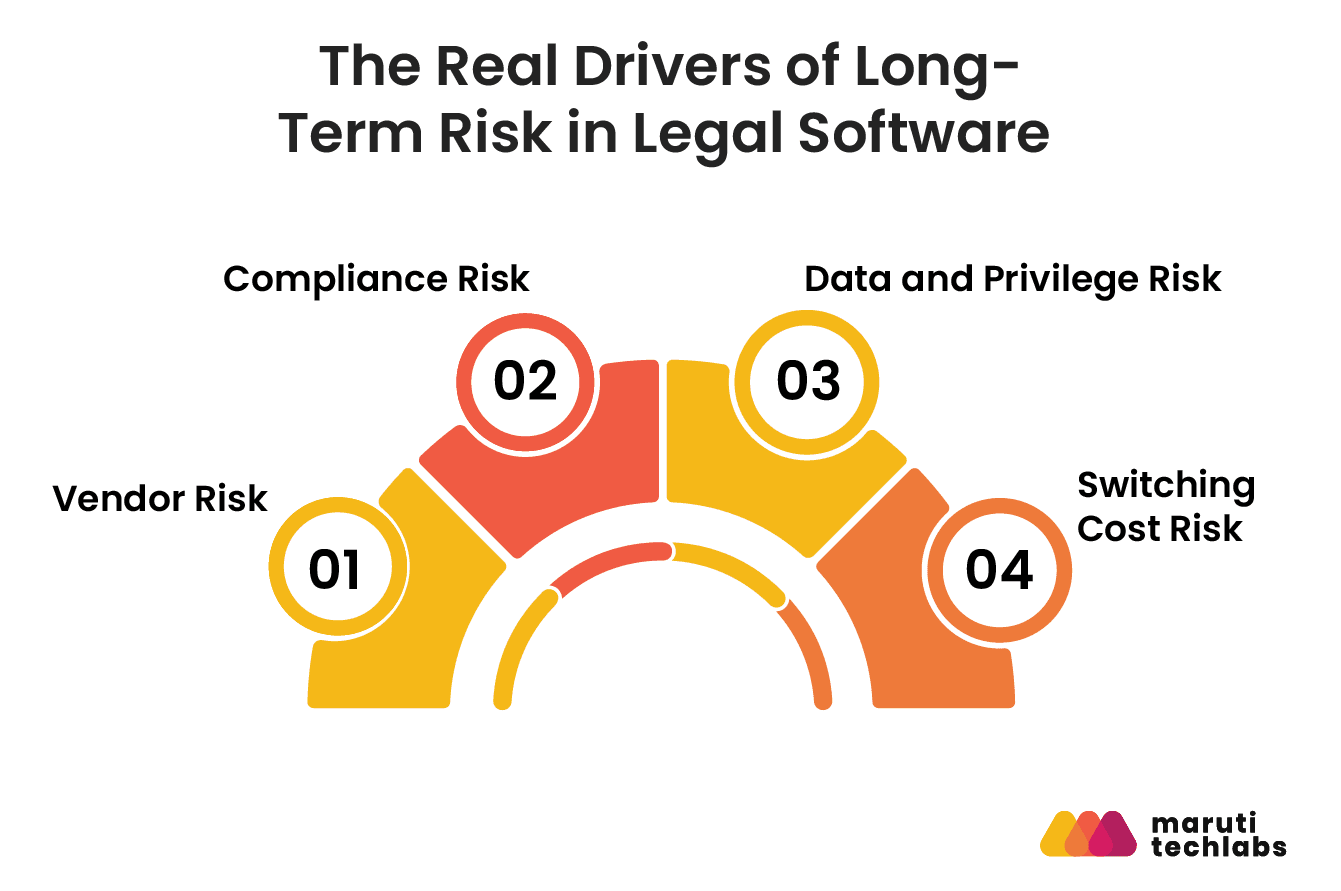
Vendor Risk
A platform can raise its subscription price at renewal, shift its product roadmap away from features your firm depends on, or get acquired by a company with different priorities. None of these events are hypothetical, and none of them show up in a feature comparison chart before you sign.
Compliance Risk
Compliance risk is the risk that a platform's compliance posture stops at general data protection standards and does not address the specific duties a law firm carries. Attorneys have confidentiality obligations to their clients, and many bar associations now expect firms to understand the technology they use well enough to protect that confidentiality.
A platform built for general business use was not designed with those specific duties in mind, and a firm cannot outsource its regulatory exposure to a vendor's terms of service.
Data and Privilege Risk
This risk lives inside the platform's architecture rather than its contract terms. Many off-the-shelf platforms run on shared, multi-tenant infrastructure, and a growing number now route content through third-party AI providers to power search or drafting features.
Every one of those integration points is a place where privileged communication could pass through a system the firm does not fully control.
Switching Cost Risk
This risk only becomes visible once a firm tries to leave. Years of matter data, client records, and firm workflows end up embedded inside a platform, and exporting all of that cleanly depends on contract terms most firms never scrutinize closely when signing.
A firm that skips this question at signing often ends up paying for it at renewal, when leaving costs more than staying.
These four categories give the rest of this article a shared vocabulary. The next two sections apply them directly, first to off-the-shelf platforms and then to custom-built software, so you can see where each option reduces risk and where it simply moves it elsewhere.
What Risks Off-the-Shelf Legal Platforms Can Reduce, and What They Can’t
Off-the-shelf legal platforms earn their place in this comparison honestly, and they reduce some categories of risk.
A leading practice-management platform has already been tested across thousands of firms, so the software itself carries less operational risk than a first version of anything custom-built.
For a solo practice or a small firm with standard workflows, this is often the right trade, because the remaining risk is smaller than the risk a custom build would introduce.
Off-the-shelf platforms reduce risk in a few concrete ways.
- Pricing is predictable and published upfront, so there is no surprise development overrun to budget against.
- Deployment takes weeks rather than months, since the software is already built and tested.
- The firm does not need to manage a development team just to keep the platform running.
- Thousands of other firms have already surfaced and fixed the platform's bugs before your firm ever touches it.
The risk that off-the-shelf platforms do not remove is the risk they transfer to the firm instead.
A firm using a shared platform is bound by whatever compliance posture that vendor has chosen to build, and the firm has limited ability to verify or change that posture beyond what the vendor discloses. That transferred risk shows up in a few specific places.
- Compliance posture is set entirely by the vendor, and the firm cannot independently verify it beyond what the vendor discloses.
- Configuration stops at whatever the vendor has decided to expose, so a firm with an unusual workflow ends up working around the software rather than through it.
- Roadmap control belongs to the vendor, so a feature the firm depends on can be deprioritized, changed, or discontinued at the vendor's discretion.
This trade plays out differently depending on firm size and structure. A solo practice with a single jurisdiction and standard workflows is unlikely to hit the limits of a well-built platform, so the remaining risk stays manageable.
A firm operating across multiple jurisdictions, or handling matters with heightened confidentiality requirements, is far more likely to find that a generic platform's compliance posture was never built with its specific obligations in mind.
The next section applies the same test to custom-built software, so the comparison stays balanced rather than favoring either option by default.
What Ownership Buys You With Custom-Built Software, And What It Costs
Custom software shifts the balance of risk in the opposite direction from an off-the-shelf platform. Instead of trusting a vendor's compliance posture, contract terms, and roadmap decisions, the firm owns the code, the data, and the infrastructure outright.
This ownership is not just a preference for control. It is a direct reduction in three of the four risk categories, because vendor risk and switching cost risk both shrink sharply when there is no vendor relationship to manage in the first place.
Ownership reduces risk in a few concrete ways.
- The firm controls its own data and infrastructure, so there is no vendor contract governing export rights, retention, or access.
- The firm sets its own roadmap, so a feature the firm depends on cannot be deprioritized or discontinued by someone else's business decision.
- The firm can build compliance controls directly into the platform's architecture, rather than relying on a vendor's disclosed posture.
- There is no per-seat subscription ceiling, so cost does not scale linearly as the firm grows.
Custom software also introduces its own risk, and a fair comparison has to name it with the same rigor as the vendor-side risk above.
- The upfront investment is higher than a subscription, and the firm carries that cost before the platform delivers any value.
- Ongoing maintenance is an active, recurring cost the firm has to plan for, not a bundled subscription fee.
- The firm becomes dependent on a single development partner, so that relationship needs the same scrutiny a firm would normally apply to a vendor contract.
- The software is unproven at launch, unlike a platform that thousands of other firms have already tested and hardened.
How does Maruti Techlabs reduce custom development risk?
|
This is why the choice is not simply build versus buy in the abstract. It is a question of which category of risk your firm is better equipped to manage, and the framework that we are going to discuss later on in this article gives you a way to score that instead of choosing with assumptions.
Can Off-the-Shelf Legal Software Fully Protect Confidentiality, Privilege, and Compliance?
Every attorney carries a duty of confidentiality toward client information, and ABA Model Rule 1.6 sets the baseline for that duty across the profession.
Many state bars have gone further and adopted a duty of technology competence, which expects attorneys to understand the technology they use well enough to protect client confidentiality, not just to use whatever tool is convenient.
A firm cannot hand that duty off to a vendor's terms of service, because the obligation sits with the attorney and the firm, not with the platform.
This duty runs into a real architectural problem once AI features enter the picture. A growing number of off-the-shelf legal platforms now route search, drafting, or summarization features through third-party AI model providers, and most of those platforms also run on shared, multi-tenant infrastructure. That combination creates two separate points of exposure.
- Multi-tenant infrastructure means privileged matter data sits on shared systems the firm does not fully control, alongside data from other firms using the same platform.
- Third-party AI providers processing that data introduce another party that touches privileged content, often without the firm having direct visibility into that provider's own data-handling practices.
Cross-jurisdiction firms face a related version of the same problem. A platform built for general use is built around one regulatory baseline, and it rarely accounts for the fact that a firm operating across multiple states or countries carries different confidentiality and compliance obligations in each one.
The platform's compliance posture stays fixed while the firm's actual obligations keep shifting underneath it. This is where custom development closes a gap off-the-shelf platforms structurally cannot.
What Vendor Lock-In Risks Should Law Firms Check Before Signing A Legal Software Contract?
Vendor lock-in rarely announces itself at signing. It shows up later, once years of matter data and firm workflows are already embedded inside a platform and leaving would mean rebuilding all of it somewhere else.
Maruti Techlabs saw this firsthand with an Am Law 200 firm, where one reason the firm's CIO and Director of Technology sought a new technology partner was limited transparency and strategic direction from their existing vendor.
The firm needed a unified platform it could actually direct, not one where roadmap decisions and support quality were entirely out of its hands.
Lock-in is built into a handful of specific contract mechanics, and each one is checkable before a firm signs anything.
- Data export formats determine whether the firm can actually move its data out in a usable form, or only in a format that needs significant rework to use elsewhere.
- Export fees can turn a routine data pull into an expensive one, especially for firms with large document archives.
- Notice periods and termination clauses determine how much runway a firm has to plan an exit, versus how much a vendor can force a rushed one.
- Vendor acquisition or discontinuation is a real event, not a hypothetical one, and a firm's contract should specify what happens to its data if the vendor is bought or shuts down mid-contract.
Custom-built software sidesteps most of this risk by design, because there is no vendor relationship governing export rights in the first place. The firm already owns its data and infrastructure, so there is no contract clause to negotiate and no renewal cycle to feel pressured by.
A Risk Scoring Framework For The Off-The-Shelf Versus Custom Decision
Every risk category from Section 2 can be scored on the same simple scale, from 1 to 5, where 1 means the option barely exposes the firm to that risk and 5 means it exposes the firm heavily. Scoring both options side by side turns four abstract concerns into a single comparison a firm's leadership can actually act on.
Score each option against the same four categories.
- Vendor risk - How exposed the firm is to a vendor's pricing changes, roadmap decisions, or acquisition.
- Compliance risk - How well the option's architecture supports the firm's specific confidentiality and jurisdictional obligations.
- Data and privilege risk - How much control the firm has over where matter data lives and who else can access it.
- Switching cost risk - How expensive and disruptive it would be to leave the platform once the firm depends on it.
Three factors should adjust how heavily each category gets weighted for a given firm.
- Firm size changes how much switching cost risk matters, since a larger firm with more matter data has more to lose in a forced migration.
- Jurisdiction count raises the weight on compliance risk, since a firm operating across several jurisdictions carries more regulatory variation than a single-jurisdiction practice.
- Practice area sensitivity raises the weight on data and privilege risk, since litigation and highly confidential corporate work carry more exposure than routine transactional matters.
Here is how this plays out for a mid-size firm operating across three states, handling a mix of corporate and litigation work.
- Vendor risk on a leading off-the-shelf platform might score a 2, since established vendors are unlikely to shut down but still control the roadmap.
- Compliance risk might score a 4, since a generic platform was not built around the firm's specific multi-jurisdiction obligations.
- Data and privilege risk might score a 3, reflecting shared infrastructure and possible AI integrations.
- Switching cost risk might score a 4, given how much matter data would need to move in a forced exit.
A custom build, by contrast, might score a 3 on vendor risk, since the firm now depends on its development partner rather than a software vendor, but drop to a 1 on compliance risk, a 1 on data and privilege risk, and a 1 on switching cost risk, since the firm owns its data and architecture outright.
Totals like these rarely land on a clean, obvious winner, and that is the point. A firm whose combined off-the-shelf score sits meaningfully higher than its custom score has a clear signal to move toward a custom build or a serious vendor renegotiation.
A firm whose scores land close together, often because its practice areas are routine and its jurisdiction footprint is simple, is a strong candidate for the hybrid approach covered in the upcoming sections of this article.
How Do Law Firms Decide What to Buy vs Build in a Hybrid Architecture?
The framework in Section 7 rarely produces a clean, all-or-nothing answer, and firms often serve their risk profile best by not treating this as a binary choice at all. The pattern that works well in practice is to buy the parts of the technology stack that are commoditized and build only where the firm's own workflow is the differentiator that generic software cannot serve.
A useful way to see this is by mapping it onto a typical law firm stack.
- Practice management, billing, and time tracking are commoditized functions most firms handle the same way, so an established off-the-shelf platform like Clio or a similar tool fits well here with low risk.
- A custom intake workflow or compliance layer is worth building when the firm's process for qualifying, routing, or documenting matters is specific to its practice areas or jurisdictional obligations.
- Document review and drafting for high-volume, high-complexity matters is where a custom platform pays off most clearly.
Deciding which layer belongs on which side of that split comes down to one question for each function, asked separately rather than answered once for the whole stack.
- Is this function something every firm needs handled the same way, or does the firm's own process make it different from a generic implementation?
- Would a generic tool force the firm to change how it works, or does the firm's actual workflow already fit what a standard platform offers?
A firm that answers this function by function ends up with a stack that is lower risk overall than either a fully off-the-shelf setup or a fully custom one, because it is only carrying custom-build risk where that risk is actually worth taking on.
Making The Call: A Decision Checklist For Firm Leadership And Legal Ops
The right choice between off-the-shelf and custom legal software is not about which option costs less today; it is about which one your firm's own risk profile can absorb, and the scoring framework is the tool that turns that judgment into something concrete rather than a gut call.
Before signing anything, whichever direction the score points, work through a short set of actions first.
- Score your firm against the four risk categories (Mentioned above), weighted by your own size, jurisdiction count, and practice area sensitivity.
- If leaning toward an off-the-shelf platform, get specific answers on data export formats, export fees, notice periods, and what happens to your data if the vendor is acquired.
- If leaning toward a custom build, vet your development partner with the same scrutiny you would apply to a vendor contract, including their track record, their transparency about roadmap and cost, and whether they design for compliance from the architecture up.
- If your scores land close together, work through the hybrid mapping function by function instead of forcing a single answer across your whole stack.
The firms that get this right are the ones that treat it as a risk decision from the start, not a budget line they revisit once something goes wrong.
If your firm's workflow, document scale, or compliance obligations are specific enough that no off-the-shelf platform has fit them well, that is usually the clearest signal that a custom build, built by a partner who understands both the technology and the legal obligations behind it, is worth the investment.
How Did Maruti Techlabs Cut Legal Deposition Review Time by 95% for a US Law Firm?
A 500-plus attorney U.S. law firm serving over 40% of Fortune 500 companies needed a faster way to review deposition transcripts without losing accuracy.
Its attorneys were spending 6 to 8 hours manually reading transcripts running 300 to 600 pages; long reviews increased the risk of missing a critical detail, and multiple team members often reviewed the same transcript because there was no single source of truth to work from.
Rather than layer automation on top of that manual process, Maruti Techlabs built an AI-powered platform that converted transcripts into structured, citation-backed summaries, with instant search and page-line references attorneys could verify directly against the source document.
Here is what the platform delivered.
- 95% faster reviews, cutting review time from 6 to 8 hours down to under 2.5 hours
- More than 95% citation accuracy on every summary produced
- Three times faster retrieval of specific testimony and objections
- A single source of truth that eliminated duplicate review work across teams
For firms weighing the same decision this article covers, our Custom AI Development Services enable platforms built around your firm’s data, workflows, and regulatory constraints, not retrofitted into generic systems.
Our Software Product Engineering Services help turn those requirements into scalable, production-ready platforms designed for your firm’s specific operational needs. The focus is control, adaptability, and long-term alignment with how your firm operates.

FAQs
1) Is custom legal software always less risky than off-the-shelf platforms?
No, custom software removes vendor and switching cost risk but introduces its own upfront cost and single-partner dependency. The right choice depends on your firm's size, jurisdiction count, and how sensitive your practice areas are.
2) What compliance obligations do off-the-shelf legal platforms often miss?
Many platforms meet general data protection standards but stop short of the confidentiality and technology-competence duties attorneys carry under bar association rules. Those duties sit with the firm, not the vendor's terms of service.
3) How do I know if my firm is locked into a legal software vendor?
Check your contract for data export formats, export fees, notice periods, and what happens to your data if the vendor is acquired or shuts down. These terms determine how expensive and disruptive leaving would actually be.
4) Should a small law firm still consider custom legal software?
Usually not on its own. A single-jurisdiction firm with standard workflows is often better served by an established platform, while custom development pays off once document scale, compliance obligations, or workflow complexity outgrow what generic software supports.
5) Is AI-powered legal research or contract review riskier than traditional legal software?
It can be, if the AI features route content through third-party model providers on shared infrastructure. The privilege exposure covered earlier in this article applies directly to AI legal research and AI contract review tools, so firms should score that risk separately rather than assuming a platform is safe just because the base software is familiar.
6) What types of legal software should a law firm run through this risk framework?
Any category where matter data or privileged content passes through the system, including case management, litigation tracking, document management, and AI-assisted contract review or drafting tools.
The same four-category score from this article applies function by function, which is also why the hybrid approach in this article works well across a mixed technology stack rather than a single all-or-nothing platform choice.




![[GetPaidStock.com]-65b9d3432ecc1.webp](https://cdn.marutitech.com/small_Get_Paid_Stock_com_65b9d3432ecc1_c1b16b05fb.webp)


