

What Are the Top Generative AI Use Cases Across Industries?
Key Takeaways
- Generative AI creates new content, code, and insights instead of only classifying existing data.
- The generative AI market is projected to grow from USD 16.9 billion in 2024 to USD 109.4 billion by 2030.
- Healthcare, finance, insurance, marketing, retail, manufacturing, and automotive are already running generative AI in production.
- Tools such as ChatGPT, Gemini, Copilot, and Midjourney make generative AI accessible without deep technical expertise.
- Businesses that identify high-value use cases early scale generative AI adoption faster and with less risk.
Introduction
Whether it's a marketing team generating multiple ad variations in minutes or a hospital summarizing a patient's history in seconds, generative AI is increasingly the technology making it possible.
Unlike traditional AI, which mostly predicts or classifies, generative AI produces something new. It writes, designs, codes, and simulates.
The shift is happening fast. The global generative AI market was valued at USD 22.2 billion in 2025 and is expected to grow to USD 324.7 billion by 2033. That pace reflects how quickly enterprises across healthcare, finance, retail, manufacturing, and automotive have moved from experimentation to real deployment.
This growth is not limited to one function. Generative AI services now touch product design, customer service, fraud detection, marketing content, and clinical documentation, often at the same time within a single organization. Companies that pick focused, high-value use cases tend to see returns faster than those chasing every possible application at once.
This guide breaks down what generative AI is, how it works, its enterprise benefits, and the use cases across industries that are already delivering measurable results.
What Is Generative AI?
| Generative artificial intelligence (generative AI) is a type of AI that can create new content and ideas, including conversations, stories, images, videos, and music. It can learn human language, programming languages, art, chemistry, biology, or any complex subject matter. It reuses what it knows to solve new problems. |
Traditional predictive AI answers questions like "Will this customer churn?" Generative AI instead produces something new: a product description, a synthetic dataset, a piece of working code, or a realistic image.
Models trained on big datasets, such as generative adversarial networks (GANs), diffusion models, and large language models (LLMs), are responsible for this capability. These models pick up statistical patterns from structured data, pictures, or language during training. After being trained, they are able to produce outputs that exhibit the same patterns but have never been seen in that particular form.
This is important for businesses because generative AI creates a deliverable rather than merely automating a task. A generative model can draft a contract clause, propose a new drug molecule, generate a marketing image, or write functioning software. That makes it useful across almost every business function, not just data science or engineering.
With generative AI, teams can:
- Produce first drafts of content, code, or designs in minutes instead of hours.
- Personalize messaging and product recommendations at an individual level.
- Simulate scenarios, such as rare failure conditions, that are hard to capture in real-world data.
- Free up skilled employees from repetitive drafting and documentation work.
- Explore many creative or technical variations before committing resources to one.
How Does Generative AI Work Across Business Functions?
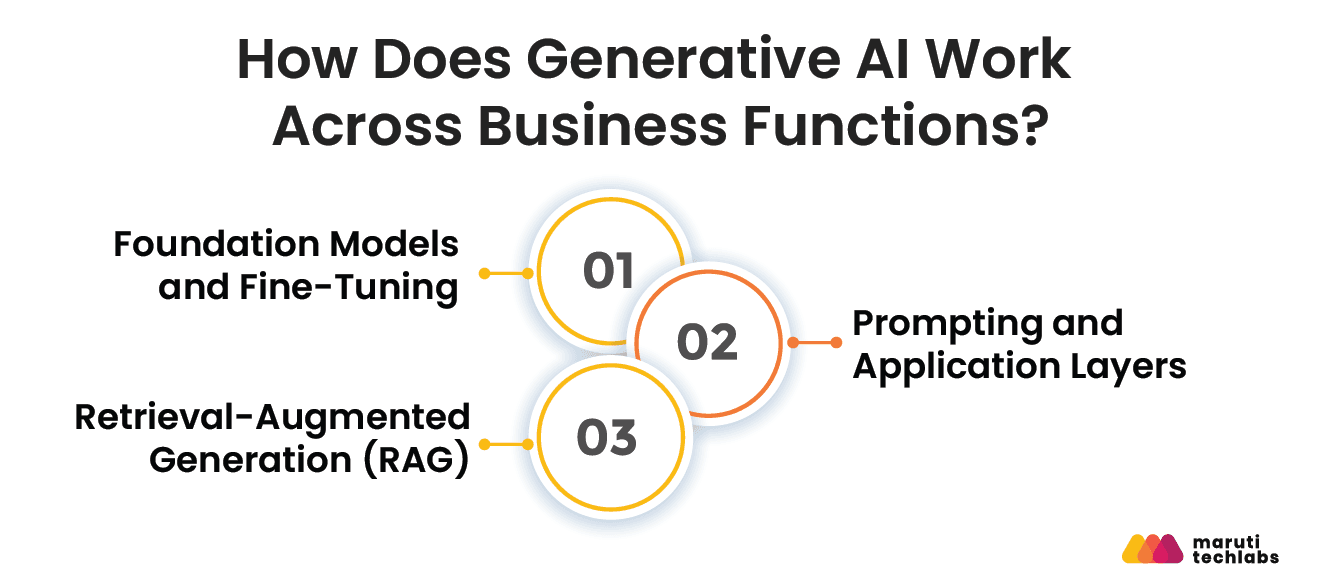
Generative AI models train on large volumes of structured and unstructured data, learning the underlying patterns before generating new outputs. Once trained, these foundation models can be adapted for specific business functions in a few common ways.
Foundation Models and Fine-Tuning
Large models such as GPT-based systems or diffusion models are trained once on broad datasets and then fine-tuned on a company's own documents, product catalogs, or design libraries.
This lets a general-purpose model provide outputs that represent a specific brand voice, industry jargon, or design standard.
Prompting and Application Layers
Many enterprise use cases do not require retraining a model at all. Instead, teams write structured prompts or build lightweight applications on top of an existing model, guiding it toward specific tasks such as summarizing claims or generating product copy.
Retrieval-Augmented Generation (RAG)
Businesses are increasingly using retrieval-augmented generation to link generative models to their own private data in order to maintain outputs that are correct and up to date.
Instead of relying only on what the model learned during training, RAG pulls in relevant company data at the moment a response is generated, reducing inaccurate or outdated outputs.
Together, these approaches let the same underlying technology power very different applications, from an insurance chatbot to a manufacturing design tool, without building a new model from scratch for every use case.
What Are the Benefits of Generative AI for Enterprises?
Generative AI helps enterprises work faster and smarter by automating repetitive tasks, accelerating content and product development, and improving customer experiences. It enables personalized interactions, supports better decision-making, and helps teams across the organization to innovate more efficiently.
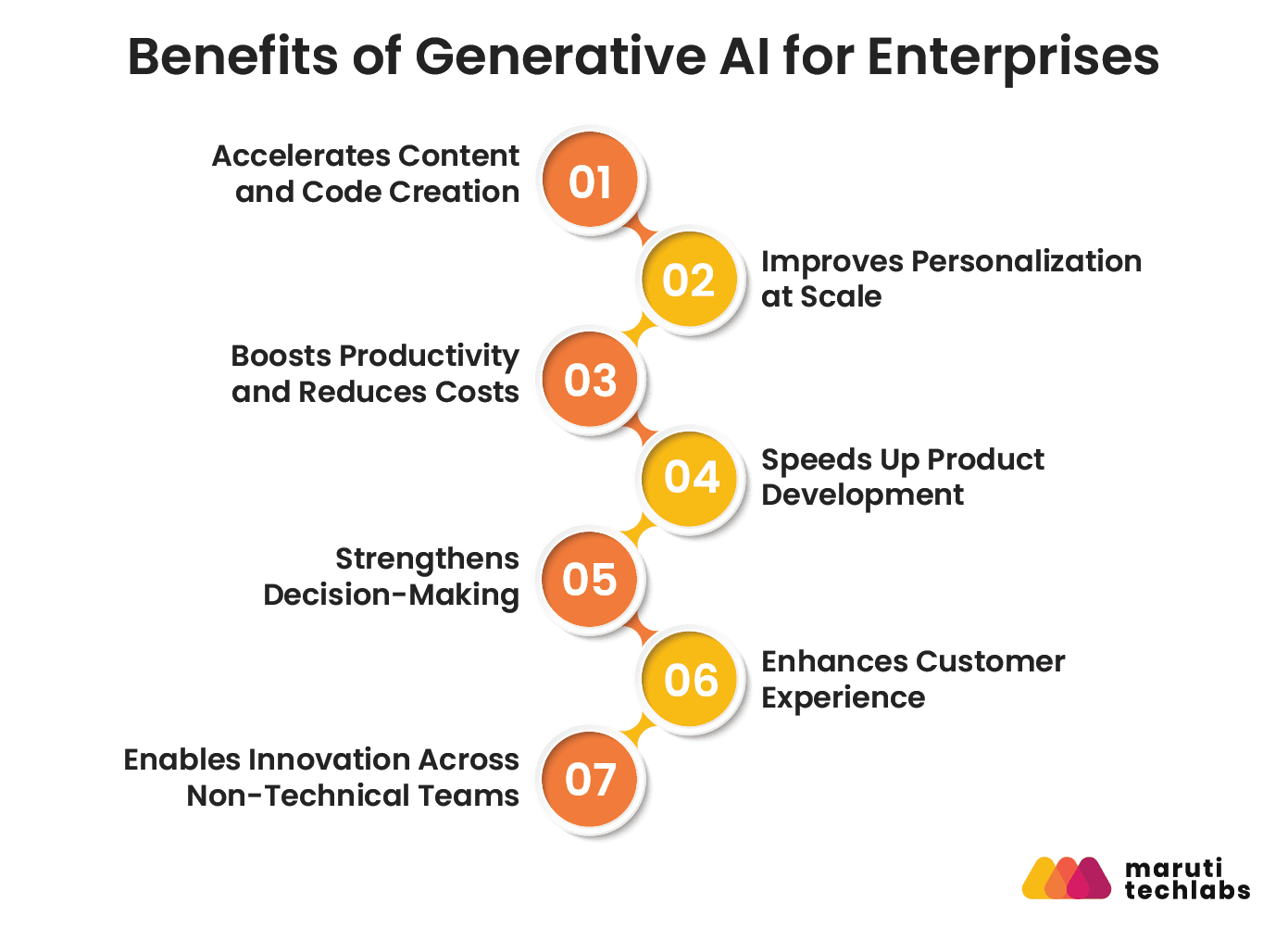
1. Accelerates Content and Code Creation
Generative AI drafts marketing copy, reports, and even code snippets in minutes, giving creative and engineering teams a working first draft instead of a blank page.
2. Improves Personalization at Scale
Instead of broad customer segments, the technology can tailor messaging, offers, and product recommendations to individual preferences and behavior.
3. Boosts Productivity and Reduces Costs
Repetitive tasks such as documentation, summarization, and reporting become largely automated, freeing employees for higher-value work.
4. Speeds Up Product Development
Generative design tools support faster prototyping and material exploration, with research from McKinsey estimating 10 to 15% savings in R&D expenses from generative AI adoption.
5. Strengthens Decision-Making
Large datasets become clear summaries and recommendations, helping leaders make informed decisions faster than manual analysis would allow.
6. Enhances Customer Experience
Conversational assistants built on generative AI respond naturally, handle multiple languages, and maintain consistency across support channels.
7. Enables Innovation Across Non-Technical Teams
Employees without coding or data science backgrounds can generate insights, drafts, and designs directly, widening who can contribute to AI-driven work.
How Is Generative AI Used Across Industries?
Generative AI is used across manufacturing, healthcare, insurance, marketing, retail, and automotive. Enterprises are running it in live workflows. Here is a closer look at how each industry is putting it to work.
1. Generative AI Use Cases in Manufacturing
Mature generative AI models now integrate with analytical AI to support end-to-end manufacturing operations, from the factory floor to the supply chain.
Inventory Management
Generative AI enables real-time tracking and more accurate demand forecasting by continuously adjusting inventory levels based on incoming data. In addition to helping teams maintain ideal stock levels without continual human recalculation, this lowers the risk of stockouts and surplus inventory.
Quality Control
Generative AI is used by manufacturers to automate the development of standard operating procedures, do predictive analytics, and identify process risks before they have an impact on production. This shortens the quality-checking cycle while keeping product standards consistent across production lines.
Faster Time-to-Market
Generative AI helps manufacturers move from concept to final product more quickly by facilitating rapid prototyping and simplifying design exploration. This includes more intelligent material selection and component sourcing that shortens launch delays.
2. Generative AI Use Cases in Healthcare
Healthcare is one of the fastest-growing adopters of generative AI. According to Precedence Research, the global generative AI in healthcare market is expected to grow from USD 3.57 billion in 2026 to USD 48.23 billion by 2035, at a CAGR of 33.71%.
This rapid growth reflects how hospitals, healthcare providers, and life sciences organizations are using generative AI to modernize clinical and administrative workflows.
Automated Administrative Tasks
Large language models generate concise summaries directly from electronic health records, improving communication between providers while reducing the chance of overlooked details. Generative AI also supports smart scheduling and automated billing, cutting down the manual workload on administrative staff.
Medical Research and Data Analysis
Generative models propose new molecular structures that can shorten early-stage drug discovery timelines and help predict protein structures relevant to specific diseases. They also extract structured information from unstructured clinical notes, making research data far easier to analyze.
Medical Education and Training
Before working with actual patients, generative AI helps students hone their clinical reasoning and communication abilities by simulating patient encounters in a risk-free setting and adjusting the content to each learner's speed.
3. Generative AI Use Cases in Insurance
Historically, the insurance industry has been reluctant to adopt new technologies, but generative AI is changing that by increasing underwriting and claims accuracy and speed.
Claim Management
Generative AI extracts and verifies data from claim submissions, interprets complex claim language using natural language processing, and flags inconsistencies early. This speeds up processing while maintaining a high level of accuracy throughout the claims lifecycle.
Fraud Detection
By generating synthetic fraudulent claims for training purposes, generative AI strengthens fraud detection models and helps verify document authenticity by spotting inconsistencies that might otherwise go unnoticed.
Contract Management
Generative AI is used by insurers to predict various risk situations, automate contract generation from templates, and facilitate negotiation by proposing counteroffers, all of which cut down on manual review time.
4. Generative AI Use Cases in Marketing and Advertising
Marketing teams have become one of the most visible adopters of generative AI, using it to scale content production without proportionally scaling headcount.
Content Creation
Generative AI drafts ad copy, brainstorms campaign ideas, and personalizes messaging based on past campaign performance and audience response, helping marketers refine content faster than manual processes allow.
Image and Video Production
Tools that generate high-quality images and AI-driven avatars let marketing teams produce visuals and video content at a fraction of traditional production costs, without sacrificing creative quality.
Marketing Segmentation
By analyzing behavioral patterns, generative models can group customers into micro-segments and adjust these segments dynamically as behavior changes, enabling more precisely targeted campaigns.
5. Generative AI Use Cases in Retail and eCommerce
Retailers use generative AI as an end-to-end solution, connecting content creation with real-time personalization across the shopping journey.
Product Recommendations
By modeling relationships between customer behavior and product attributes, generative AI produces recommendations that go beyond simple purchase history, incorporating real-time signals to keep suggestions relevant.
Smarter Product Research
Generative AI automates hypothesis testing on merchandising and product display strategies, analyzing structured and unstructured data to help retailers adjust online layouts quickly when a trend emerges.
6. Generative AI Use Cases in Automotive
From design to the driving experience itself, automotive companies are applying generative AI across the entire vehicle lifecycle.
Customer Engagement
Virtual assistants built on generative AI understand natural language and voice commands, personalizing in-car entertainment and navigation based on driver preferences and real-time traffic conditions.
Generative AI-Enhanced ADAS
Advanced driver assistance systems use generative AI to improve object detection, recognize pedestrians and road signs, and interpret road scenes in real time, supporting safer driving decisions.
Content Synthesis for Vehicle Testing
Generative AI produces synthetic sensor data, such as simulated LiDAR and camera inputs, to test autonomous driving systems against rare or extreme scenarios that would be difficult and costly to capture in the real world.
What Are the Popular Generative AI Tools and Techniques?
Generative AI includes a growing ecosystem of tools and techniques, from conversational assistants like ChatGPT and multimodal models like Gemini to image generators and core technologies such as LLMs, RAG, and diffusion models.
Generative AI Tools
- OpenAI ChatGPT / GPT-4: A widely used conversational model for drafting text, answering questions, and supporting coding tasks.
- Google Gemini: A multimodal model that handles text, images, and code within a single system.
- Microsoft Copilot: An AI assistant embedded across Microsoft 365 applications for drafting documents, summarizing data, and generating code.
- Adobe Firefly: A generative image and design tool built for creative and marketing teams.
- Midjourney and DALL-E 3: Image generation tools used for concept art, marketing visuals, and rapid design exploration.
- Synthesia: A platform for generating AI avatar-led video content without traditional filming.
Generative AI Techniques
- Large Language Models (LLMs): Models trained on massive text datasets to generate human-like language.
- Diffusion Models: Techniques that generate images by gradually refining random noise into a coherent output.
- Generative Adversarial Networks (GANs): A pair of competing models that together produce increasingly realistic synthetic content.
- Retrieval-Augmented Generation (RAG): A method that connects a model to external, up-to-date data sources during generation.
- Prompt Engineering and Fine-Tuning: Techniques for guiding a general-purpose model toward specific, reliable outputs for a given task.
Conclusion
Generative AI has moved well past the experimentation phase. Across manufacturing, healthcare, insurance, marketing, retail, and automotive, it is already producing content, accelerating research, and personalizing customer experiences at scale.
The generative AI use cases across industries highlighted in this guide show that the technology delivers the most value when applied to a specific, well-defined problem rather than treated as a blanket solution. Enterprises that pair the right tools with clear governance and a phased rollout consistently see faster, more measurable results.
As adoption continues to accelerate, the organizations that identify their highest-value use cases early and build the right data and governance foundation around them will be best positioned to turn generative AI from an interesting experiment into a lasting competitive advantage. For businesses ready to move from identifying opportunities to putting them into practice, our AI development services help turn high-value AI use cases into scalable, production-ready solutions aligned with business goals.
FAQs
1. What are the most common generative AI use cases for businesses?
Common use cases include content creation, product design, personalized recommendations, fraud detection, synthetic data generation, and conversational customer support.
2. Which industries benefit the most from generative AI use cases?
Healthcare, finance, insurance, retail, manufacturing, and automotive are among the industries seeing the fastest and most measurable results from generative AI today.
3. What are the risks of adopting generative AI in the enterprise?
Key risks include data privacy exposure, inaccurate or "hallucinated" outputs, high compute costs, and gaps in governance if usage policies are not clearly defined.
4. What tools do businesses commonly use for generative AI?
Popular tools include OpenAI's ChatGPT and GPT-4, Google Gemini, Microsoft Copilot, Adobe Firefly, Midjourney, and Synthesia, depending on the specific use case.
5. How can a business identify the right generative AI use case to start with?
Businesses typically start by identifying a repetitive, high-volume task, such as content drafting or documentation, where generative AI can show measurable value quickly before scaling to more complex use cases.
How Maruti Techlabs Helped an Automotive Client Build a Custom Vehicle Recognition Model
A client in the automotive and mobility space needed a way to automatically identify and classify vehicles from live and recorded camera feeds, a task that had previously relied on manual review and generic, off-the-shelf models that struggled with real-world variation in lighting, angle, and vehicle type.
Maruti Techlabs built a custom computer vision model trained on the client's own image data, including synthetically generated training examples to cover rare vehicle types and edge-case conditions that were underrepresented in the original dataset.
The impact,
- 99% reduction in image processing time through AI-powered image verification.
- 90% image classification accuracy achieved after six months of continuous feedback and model improvements.
- 120,000+ images processed every month, significantly reducing the manual review workload.
- 15-person moderation team freed from repetitive image verification, enabling faster approvals and better quality control.
- 85% initial model accuracy achieved after training on 1,500 images, with human-in-the-loop validation for predictions below 80% confidence.