

What Is a Forward-Deployed Engineer? How It Differs From a Traditional Dev Shop
Key Takeaways
- Forward-deployed engineers work inside customer teams, adapting technology to real business processes until it works in production.
- Dev shops work well for projects with clear goals, defined requirements, and fixed delivery plans.
- AI projects often need continuous improvement after deployment, not just successful development.
- The right delivery model depends on the complexity of the problem and the level of collaboration required.
- Forward-deployed engineers measure success by user adoption and business impact, while dev shops measure it by scope, timelines, and milestones.
- Choose a forward-deployed model when requirements are unclear, several systems are involved, or AI is stuck between prototype and production.
Introduction
What happens after an AI system is built but before it becomes part of everyday work? The answer often depends on the people responsible for connecting technology with real business environments. That's where the delivery model becomes just as important as the technology.
While a traditional dev shop builds software against an agreed scope, forward-deployed engineers work alongside business teams to integrate, adapt, and improve AI in software development from prototype to production.
This approach is gaining momentum across the industry. In June 2026, AWS announced a $1 billion investment to build a dedicated Forward Deployed Engineering organization and embed thousands of engineers with customers to accelerate AI deployment.
If you're evaluating AI partners, understanding these two engineering models can help you make better implementation decisions. In this blog, you'll learn what a forward-deployed engineer does, how a traditional dev shop operates, the key differences between the two models, how forward-deployed engineering works in practice, and when this approach is the right fit for your business.

Speak with our AI engineering experts to determine whether a forward-deployed approach aligns with your business goals and implementation requirements.
What Is a Forward-Deployed Engineer?
A forward-deployed engineer (FDE) is a software engineer who works directly with customers to solve technical and business problems together. Unlike engineers who spend most of their time building products internally, FDEs operate within the customer's environment, helping design, develop, and refine solutions based on real-world needs.
The term was introduced by Palantir, where forward-deployed engineers partnered closely with customers to implement complex software. Since then, the role has expanded across the AI industry as organizations recognize the need for engineers who can bridge product development and customer implementation.
Forward-deployed engineers combine technical expertise with customer collaboration. They write production code, understand business processes, troubleshoot implementation challenges, and adapt solutions as requirements change. Instead of focusing on a single product capability, they focus on helping a specific customer achieve the desired outcome.
Their responsibilities often include:
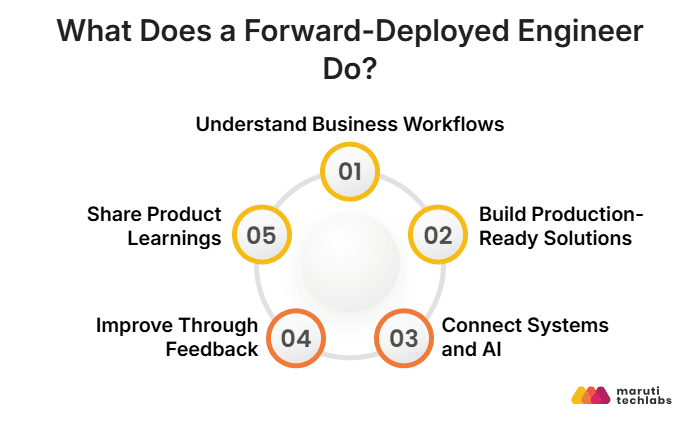
- Understanding customer workflows and identifying technical requirements.
- Building and deploying production-ready software within customer environments.
- Integrating AI models, enterprise systems, and business processes.
- Iterating on solutions using continuous customer feedback.
- Turning customer-specific learnings into improvements that benefit future implementations.
Because they stay involved throughout implementation, forward-deployed engineers often work across engineering, product, and business teams. Their role extends beyond software delivery to ensuring the solution works effectively for the people using it every day.
What Is a Dev Shop?
A dev shop, or development shop, is a third-party software development company that designs and builds custom software for clients. Organizations typically work with dev shops when they need additional engineering expertise, want to accelerate product development, or require a dedicated team to build a new application.
A dev shop brings together different specialists required to deliver a software project. Depending on the engagement, this may include software engineers, UI/UX designers, architects, quality assurance teams, and project managers.
A typical dev shop engagement may include:
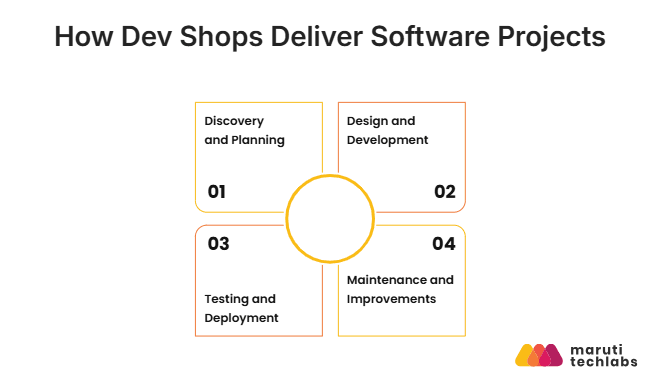
- Discovery and Planning: Understanding business requirements, technical needs, and project goals.
- Design and Development: Building custom applications, platforms, integrations, or digital products.
- Testing and Deployment: Verifying that the software works reliably before release.
- Maintenance and Improvements: Supporting updates, fixes, and future enhancements after launch.
Dev shops work through different technology stacks and project types. They may build customer-facing applications, internal business tools, mobile apps, enterprise platforms, or modernize existing software systems.
Many organizations turn to dev shops when they need to move faster or fill engineering gaps for a specific project. The team is already in place, so work can begin without spending months hiring developers, designers, testers, and project managers.
Most dev shop engagements are tied to a specific project or scope of work. The team works closely with the client during planning and development, delivers the agreed solution, and then transitions it to the client's team or an ongoing support arrangement.
Dev shops have helped organizations build successful software for decades, and they continue to play an important role today. AI projects, however, often demand a different level of collaboration, which has led to the growing adoption of forward-deployed engineering.
Forward-Deployed Engineer vs. Traditional Dev Shop
Both forward-deployed engineers and traditional dev shops help organizations build software, but they operate in very different ways. The biggest difference comes down to where they work, how they solve problems, and what success looks like.
A traditional dev shop is typically brought in to build a defined product or feature based on agreed requirements. The team plans, develops, tests, and delivers the software, usually within a specific scope and timeline.
A forward-deployed engineer works directly with customer teams throughout implementation. They understand existing systems and workflows, build what is needed, and adjust the solution as real requirements emerge.
| Area | Forward-Deployed Engineer | Traditional Dev Shop |
| Working model | Embedded with the customer team and involved throughout implementation | External team hired for a specific software project |
| Primary focus | Adapting and deploying technology within real business environments | Building custom applications or features based on requirements |
| Requirements | Discovered through ongoing collaboration and real user feedback | Defined through project requirements, documentation, and specifications |
| Development approach | Builds integrations, workflows, and customizations around existing systems | Develops a standalone application or solution for the client |
| Success measure | User adoption, deployment success, and business impact | Meeting project scope, timelines, and delivery milestones |
| Customer interaction | Frequent interaction with users, technical teams, and business leaders | Usually managed through project managers or account teams |
The difference becomes more noticeable when projects involve changing requirements and unclear paths forward. Dev shops work well when the goal is clear and the team needs to build a specific application or feature. Forward-deployed engineers are better suited for situations where the technology needs to evolve alongside the business and adapt based on how people actually use it.
This matters especially for AI projects, where the first version is rarely the final one. Teams often need to refine workflows, improve system performance, and adjust the solution based on feedback from real users.
For example, an FDE may spend time understanding how employees use a system, identify workflow gaps, and make adjustments based on their feedback. A traditional development team may focus on delivering the agreed functionality and handle future changes through a separate process.
Neither approach is better in every situation. The right choice depends on the complexity of the problem, the level of collaboration required, and how closely the technology needs to evolve with the business.
How Forward-Deployed Engineering Works in the Real World
Forward-deployed engineering goes beyond software development. FDEs work closely with customer teams throughout implementation, solving technical and operational challenges as they arise. Their responsibility isn't limited to building an application. It's making sure the solution works in the environment it was built for.
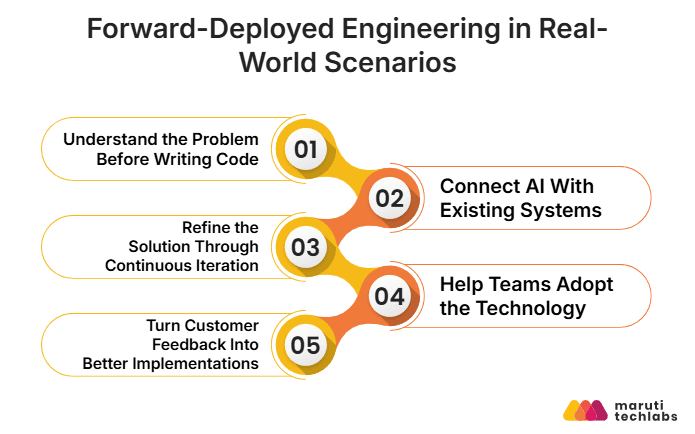
1. Understand the Problem Before Writing Code
The first few days are usually spent asking questions before development begins. FDEs sit with the teams using the system, watch how work moves from one step to the next, and quickly discover that the documented process isn't always the one people follow.
2. Connect AI With Existing Systems
Most companies already have a lot in place before bringing in AI. There are existing tools, databases, and processes that teams depend on. FDEs figure out how the new AI system can work with those pieces instead of forcing teams to start over.
3. Refine the Solution Through Continuous Iteration
Once people start using the application, unexpected issues usually come up. A process that looked simple during planning may have exceptions, missing information, or steps that need adjustment. FDEs work through those issues with the team, making changes based on what they learn from real usage.
4. Help Teams Adopt the Technology
Launching the application does not mean the work is finished. FDEs continue working with teams after deployment, helping users get comfortable with the new system and addressing problems as they appear.
5. Turn Customer Feedback Into Better Implementations
Every deployment creates new learnings. FDEs share implementation insights with engineering and product teams so recurring improvements become part of the core platform, making future customer deployments faster and more effective.
When Should You Choose a Forward-Deployed Engineering Model
A forward-deployed engineering model makes sense when the challenge is not simply building software, but making technology work inside a complex business environment. This is especially true for AI projects where the path from prototype to production involves changing requirements, existing systems, and constant feedback from users.
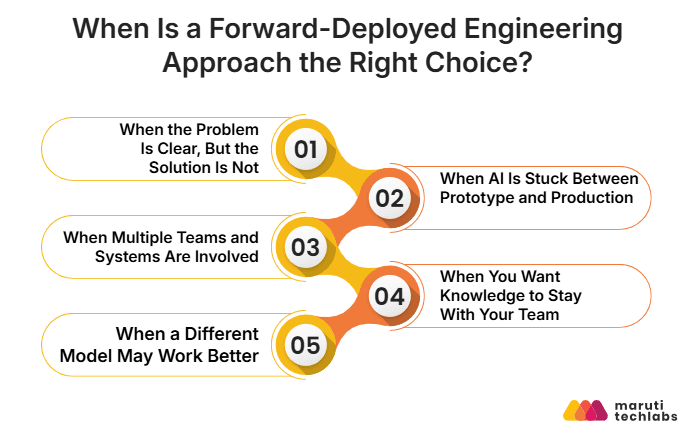
1. When the Problem Is Clear, But the Solution Is Not
Many organizations know the outcome they want but don't have all the technical details figured out. They may want to automate a process, improve decision-making, or introduce an AI assistant, but the right approach only becomes clear after teams start using the technology. FDEs help shape the solution while building it.
2. When AI Is Stuck Between Prototype and Production
A working demo does not always become a useful business tool. Problems often appear when AI needs to connect with internal data, existing applications, security requirements, or everyday processes. FDEs help bridge that gap by working through the practical challenges that appear during deployment.
3. When Multiple Teams and Systems Are Involved
Some technology projects touch several departments, legacy systems, and internal processes. In these situations, having an engineer who understands both the technical side and the business context can help resolve issues faster.
4. When You Want Knowledge to Stay With Your Team
A strong FDE engagement should not create long-term dependency. The goal is to build the solution, document what was learned, and help internal teams understand how to maintain and improve it after deployment.
5. When a Different Model May Work Better
Not every project needs a forward-deployed engineer. If the requirements are already well defined and the goal is simply to build a specific application, a traditional development team may be the better fit. Similarly, routine maintenance work or additional engineering capacity may not require this level of collaboration.
The right question is not whether forward-deployed engineering is better than other models. It is whether your project needs someone who can stay close to the problem while the technology evolves.
Conclusion
Choosing between a forward-deployed engineer and a traditional dev shop comes down to the kind of challenge you are trying to solve. A dev shop can be the right choice when you have a defined scope and need a team to build a specific application. A forward-deployed engineering model becomes valuable when the path is less certain, especially for AI projects that need to adapt to existing systems, workflows, and user feedback.
The difference is not just about who writes the code. It is about how closely engineering stays connected to the problem after development begins. The right partner helps turn an idea into a solution that works within the realities of your business.
Maruti Techlabs applies the same problem-first principle to complex AI work: we start with how teams actually work, then build around it. One example is the agentic AI platform we built for an Am Law 200 law firm.
How Maruti Techlabs Helped an Am Law 200 Firm Build AI Into Everyday Legal Workflows
Our client, Fennemore, an Am Law 200 law firm with 1,000+ attorneys, wanted to move beyond fragmented AI experiments and build a reliable foundation for legal teams. Existing AI tools struggled with large legal documents, inconsistent workflows, and limited scalability. The firm needed a more structured approach to apply AI across research, document analysis, drafting, and repeatable legal processes.
We designed and developed a custom agentic AI platform that brought these capabilities together in one environment. The platform combined AI-powered search, chat, and task-specific agents with scalable architecture, enabling attorneys to process large documents, automate repetitive workflows, and access AI support within their existing legal operations.
The implementation helped the firm achieve 95%+ accuracy in legal reasoning, reduce 7–8 hour tasks to minutes, process 300–1,000+ page documents without manual chunking, and create a structured roadmap for future AI adoption.
This implementation shows why enterprise AI success requires more than selecting the right model. Organizations need AI systems that are built around their workflows, integrated with their technology environment, and designed for long-term adoption.
We help organizations build custom AI solutions through our AI development services, helping teams move from AI ideas and prototypes to production-ready applications.
For businesses building intelligent digital products, our software product engineering services cover design, development, and integration with your existing systems.
Our team can help you design and develop AI solutions that align with your workflows, technology environment, and business goals.
FAQs
1. What problems can a forward-deployed engineer help solve?
A forward-deployed engineer helps solve situations where technology works in theory but struggles in actual business use. This may include connecting systems, adapting solutions to existing processes, handling changing requirements, or helping teams adopt new tools. Their role is to stay close to the problem and make sure the technology works in the environment where it will be used.
2. Is a forward-deployed engineer the same as a consultant?
No. A consultant usually focuses on recommendations, strategy, or planning, while a forward-deployed engineer stays involved in building and implementing the solution. They combine technical development with a deep understanding of the customer's needs, helping turn recommendations into working systems that teams can use.
3. Can forward-deployed engineers work with existing internal engineering teams?
Yes. Forward-deployed engineers usually work alongside internal teams instead of replacing them. They help solve complex technical challenges, fill gaps when needed, and work with existing engineers to move projects forward. Over time, they also share their knowledge with the team so the organization can continue managing and improving the technology independently.
4. How do I know if my AI project needs a forward-deployed approach?
A forward-deployed approach may be useful when your AI project involves unclear requirements, multiple systems, complex workflows, or challenges moving from a prototype to production. If you already know exactly what needs to be built and have a clear technical plan, a traditional development approach may be a better fit.
5. How does Maruti Techlabs approach complex AI projects?
At Maruti Techlabs, we focus on understanding the business problem before building the technology. Our teams work closely with organizations to identify opportunities, design the right architecture, integrate AI into existing systems, and develop solutions that fit real operational needs.
6. What should I look for in an AI development partner?
Look for a partner that can go beyond building a demo. A strong AI development partner should understand your workflows, work with your existing technology environment, explain technical decisions clearly, and help you move from experimentation to a solution that teams can use confidently.