

Why 40% of Software Projects Fail Before a Single Line of Code Is Written?
Key Takeaways
- Most projects fail before development begins. Skipping technical feasibility leads to rework, delays, and lost stakeholder confidence.
- Feasibility answers one foundational question. Can this be built with the technology, team, and infrastructure you currently have?
- The TELOS framework covers every angle. Technical, Economic, Legal, Operational, and Scheduling; each one surfaces a different category of risk before it gets expensive.
- Legacy systems are always harder than they look. Treat them as a separate workstream in your assessment, not something to figure out mid-build.
- Skill gaps are a feasibility risk, not just an HR problem. If the team cannot build and sustain the system, the architecture does not matter.
- Feasibility is not a one-time exercise. Revisit your core assumptions at every major milestone, not just at the start of a project.
Even the best product ideas can fail if the technical foundation isn't validated before development begins.
Buzzz Media, a SaaS company building a media management platform for ad agencies, had a clear market, a working concept, and a team ready to build. What they were missing was a structured technical assessment before development began.
This led to:
- Months of delayed progress
- The codebase thoroughly overwhelmed with inconsistencies
- Wrongly linked entities, unnormalized databases, zero documentation, and
- No proactive error handling
It's a pattern that plays out far too often. Teams that skip or rush technical feasibility end up paying for it in rework, delays, and lost investor confidence. As projects grow more complex, with AI integrations, microservices dependencies, and tighter release cycles becoming the norm, the cost of skipping this step only compounds.
When Buzzz Media partnered with Maruti Techlabs, the first step wasn't development. It was a two-week feasibility assessment: a systematic audit of the existing stack, architecture, workflows, and backlog. That audit clarified what was broken, what was recoverable, and what needed rebuilding. The team mapped a 90-day roadmap, resolved the technical debt, and delivered a stable product in 12 weeks, reducing user drop-off by 50% and positioning Buzzz Media for Series A funding.
Technical feasibility answers one foundational question before you commit resources: can this actually be built with the technology, infrastructure, and expertise you have?
This guide covers everything you need to run an effective technical feasibility in software engineering. From why it matters, when to conduct it, the key factors to evaluate, to the most common pitfalls that derail even well-intentioned teams.
What is Technical Feasibility in Software Engineering?
Technical feasibility is the process of evaluating whether a proposed software solution can be developed using current technologies, infrastructure, resources, and expertise. It helps determine if a project is technically achievable before moving forward with full-scale development.
Why Should Engineering Leaders Prioritize Technical Feasibility Early?
Technical feasibility is important because it tells you if an idea or project can actually be built with the tech, time, and resources you have. Before engineering leaders invest money or effort in something new – like a product, app, or system – this assessment provides the clarity they need to determine whether it can actually work in real life.
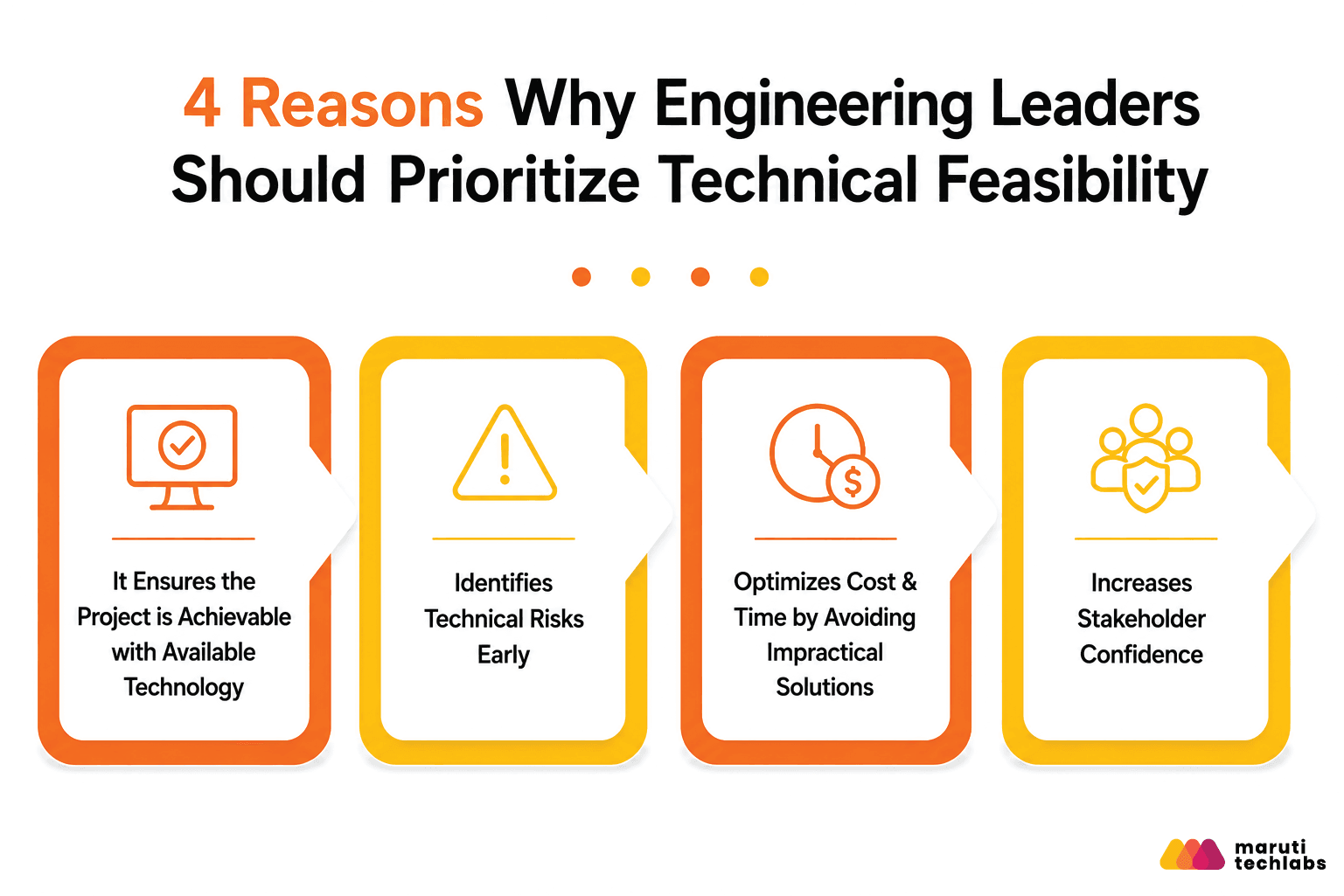
1. Ensures Technical Feasibility
It confirms that the tools, frameworks, and platforms required are accessible and compatible with the project goals.
2. Identifies Technical Risks Early
It helps uncover limitations in integration, architecture, or performance before significant resources are invested.
3. Optimizes Cost & Time by Avoiding Impractical Solutions
It steers teams away from infeasible tech stacks or over-engineered architectures that could derail budgets or timelines.
4. Increases Stakeholder Confidence
By validating the technical roadmap, stakeholders gain clarity and confidence in the project’s potential for success.
The TELOS Framework: Core Pillars of Technical Feasibility Assessment
The TELOS framework’s five core components stand for Technical, Economic, Legal, Operational, and Scheduling. These core pillars are used to evaluate the potential success of proposed projects, identify potential roadblocks, and avoid costly project failures beforehand. Let’s look at each one in detail.
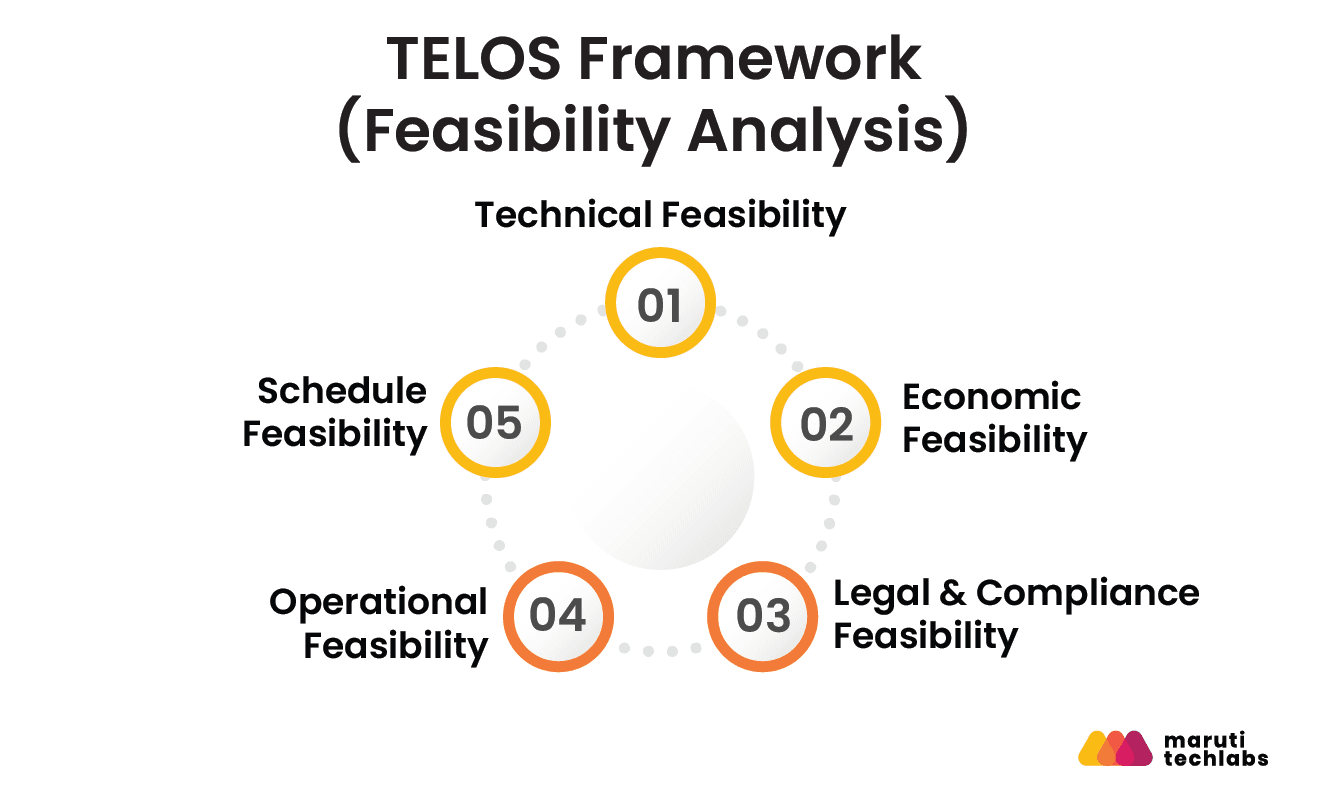
1. Technical Feasibility: Can the System Be Built and Scaled?
The real question is not buildability. It is whether the architecture will hold under production stress.
- Architecture choice: Microservices improve scaling but introduce latency and overhead. Monoliths fail when scaling boundaries are unclear.
- Stack maturity: Adopting emerging frameworks too early creates integration risk and limits hiring flexibility.
- Scalability: Synchronous processing and poor data flows degrade quickly under load.
- Integration complexity: Legacy systems and unstable third-party APIs are frequent failure points.
- Cloud alignment: Cloud-native assumptions fail without stateless scaling and fault tolerance.
A system is technically feasible only if it can handle scale, failure, and change without architectural rework.
2. Economic Feasibility: Is the Engineering Investment Justified?
Many technically sound systems fail because cost structures were not modeled early.
- Build vs. Buy vs. Partner: Custom builds offer control but raise long-term costs. Buying accelerates launch but limits flexibility. Partnering reduces risk but requires architectural alignment.
- Cloud costs: Poorly designed pipelines and unoptimized AI workloads drive up spend non-linearly. Proactively monitor cloud costs to identify waste, optimize workloads, and maintain budget control.
- Technical debt: Speed-driven shortcuts often force re-architecture within 12 to 18 months.
- Lifecycle cost: Maintenance and scaling costs frequently exceed initial development if not planned upfront.
Economic feasibility fails when the system scales faster in cost than in value.
3. Legal & Compliance Feasibility: Can the System Meet Regulatory Requirements?
- Data protection: GDPR and HIPAA affect storage, access patterns, and system boundaries.
- Security architecture: Systems misaligned with Zero Trust principles struggle with distributed access control.
- Domain constraints: Payment processing, healthcare, and identity management systems require strict validation, encryption, and audit trails.
- Auditability: Missing log traceability becomes a blocker during audits and incident investigations.
4. Operational Feasibility: Can the Team Build and Sustain the System?
Operational feasibility fails when system complexity exceeds the team's capacity to manage it.
- Skill alignment: Distributed systems and AI pipelines require specialized expertise. Without it, systems become fragile.
- DevOps maturity: Without infrastructure automation, deployments become unstable.
- CI/CD readiness: Unreliable pipelines slow release cycles and increase risk.
- Observability: Without structured logging and tracing, systems cannot be operated at scale.
For instance, Robotic Process Automation (RPA) can be applied across various industries to improve operational efficiency. RPA in Human Resources can automate tasks such as data entry, payroll processing, and benefits administration. It also assists with claims processing, patient data management, and medical billing. While RPA in Banking & Finance can help with accounts payable and accounts receivable processing, invoice reconciliation, and compliance reporting.
5. Schedule Feasibility: Can It Be Delivered on Time?
Delays result from underestimating complexity and dependencies.
- Complexity mismatch: Aggressive timelines ignore integration effort and testing overhead.
- External dependencies: Third-party APIs and legacy systems introduce unpredictable delays.
- Delivery strategy: Big-bang releases increase risk. Phased delivery exposes issues earlier.
- Business impact: Delays affect revenue timelines, stakeholder confidence, and competitive positioning.
Proof of Concept, Prototype, and MVP: How They Relate to Feasibility
A PoC, Prototype, & MVP: all three are different layers of risk validation in software product engineering that validate the unique aspects of feasibility. Misusing them distorts feasibility signals and leads to premature scaling or delayed execution. A structured approach treats them as progressive filters. Each resolves a specific type of uncertainty before moving forward.
Dimension | Proof of Concept (PoC) | Prototype | Minimum Viable Product (MVP) |
| Primary Goal | Validate technical viability | Validate user interaction and design assumptions | Validate real-world business viability |
| Core Question | Can this be built? | Will this work as expected? | Will this deliver value at scale? |
| Scope | Narrow, risk-focused | Partial system or workflow | End-to-end but limited feature set |
| Engineering Quality | Experimental, disposable | Semi-structured, not production-ready | Production-grade baseline |
| Focus Area | Architecture, algorithms, integrations | UX flows, system behavior | Performance, adoption, operations |
| Users Involved | Internal teams | Internal and limited stakeholders | Real users |
| Success Criteria | Feasibility signal | Usability clarity | Market validation and system stability |
| Time and Cost | Low | Moderate | High relative to others |
| Risk Addressed | Technical uncertainty | Design and workflow misalignment | Market and operational risk |
| Failure Impact | Low, early discard | Moderate, design rework | High, costly iteration or pivot |
What are the Key Factors to Consider Before Evaluating Technical Feasibility?
Evaluating technical feasibility starts with understanding the technical and business conditions that influence project success. Before assessing implementation, organizations should define the project scope, evaluate system complexity, review technology constraints, and align delivery timelines with realistic expectations.
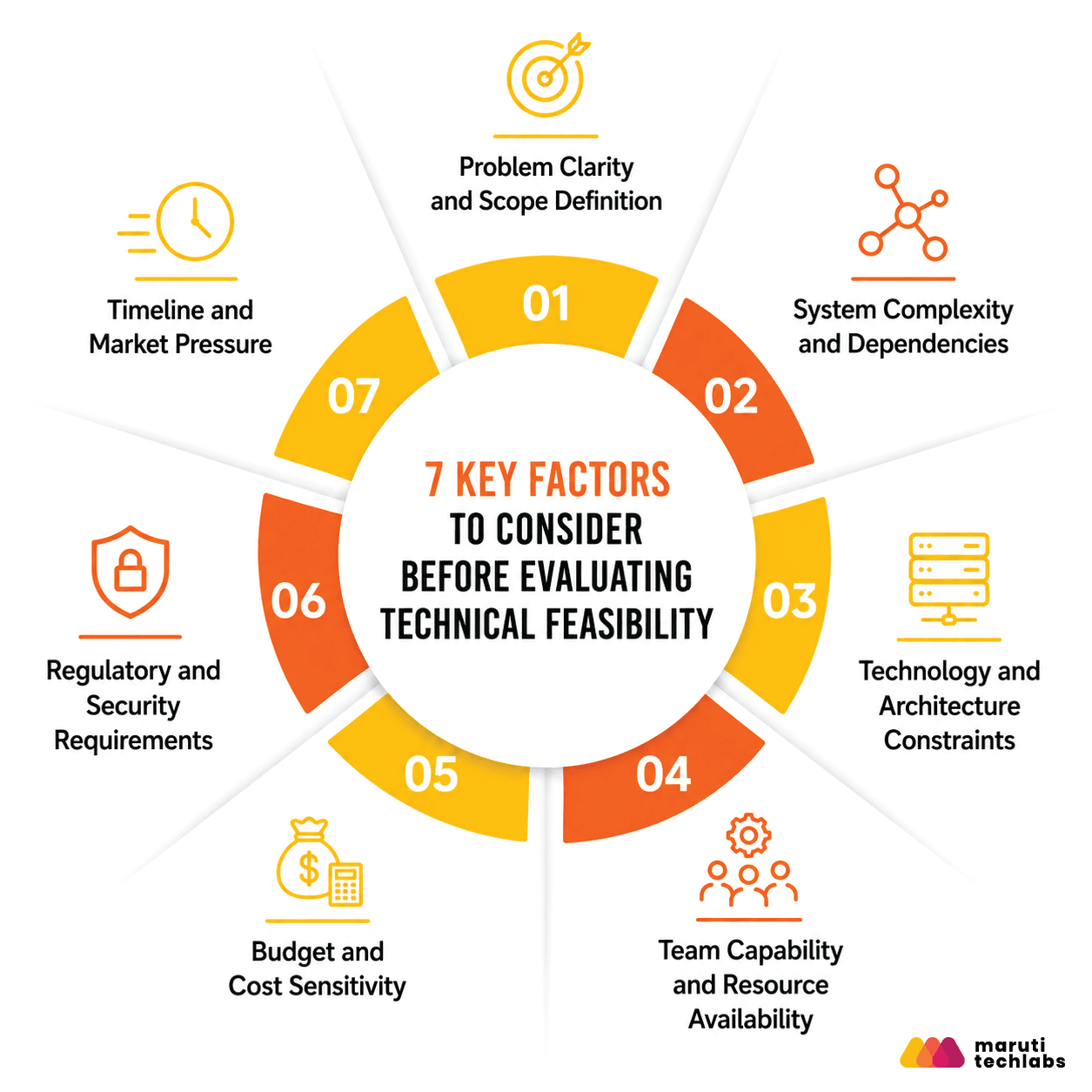
1. Problem Clarity and Scope Definition
Feasibility depends on how precisely the problem is defined. Ambiguity in use cases or success metrics leads to misaligned architecture and inflated scope. Clear boundaries prevent hidden complexity and rework.
2. System Complexity and Dependencies
Integrations are the main source of feasibility risks. Performance and dependability are impacted by variation caused by data pipelines, third-party APIs, and legacy systems. Early effort and failure points are defined by complexity.
3. Technology and Architecture Constraints
Feasibility is shaped by existing stack, infrastructure, and scalability expectations. Introducing new technologies increases flexibility but adds integration and maintenance overhead. Poor alignment leads to re-architecture later.
4. Team Capability and Resource Availability
A system is only feasible if the team can build and sustain it. Skill gaps in areas like distributed systems or cloud operations create execution risk. Limited bandwidth further impacts delivery quality and timelines.
5. Budget and Cost Sensitivity
Feasibility must account for how costs behave beyond initial build. Infrastructure, scaling, and maintenance often exceed early estimates. Poor architectural decisions lead to unsustainable cost structures.
6. Regulatory and Security Requirements
Compliance requirements directly influence system design, not just implementation. Data privacy, security architecture, and auditability must be built in from the start. Ignoring these leads to redesign and deployment delays.
7. Timeline and Market Pressure
Aggressive timelines force trade-offs that impact scalability and reliability. External dependencies and approvals introduce delays that are often underestimated. Feasibility must reflect realistic delivery conditions.
A Practical Framework to Evaluate Technical Feasibility
A practical framework does two things well:
- It isolates high-risk assumptions early
- It validates them using the lowest-cost method possible
The framework below gives you a structured way to evaluate technical feasibility across any software project, whether you're building from scratch, inheriting a codebase, or planning a significant architecture change.
Step 1: Define the Technical Scope Before You Evaluate Anything
Feasibility assessments often go sideways because the scope is vague. Before evaluating whether something can be built, you need to be clear about what you're actually evaluating.
At this stage, document:
- The core functionality the system must deliver (not a full product spec, just the load-bearing features)
- Non-functional requirements: expected user load, response time targets, data volumes, and uptime requirements
- Known integration points: third-party APIs, legacy systems, and external data sources
- Regulatory or compliance constraints that will shape technology choices (HIPAA, GDPR, SOC 2, etc.)
This scoping step takes a day or two but eliminates a significant amount of wasted effort later. You cannot evaluate whether a system is technically achievable if you haven't clearly defined what it needs to achieve.
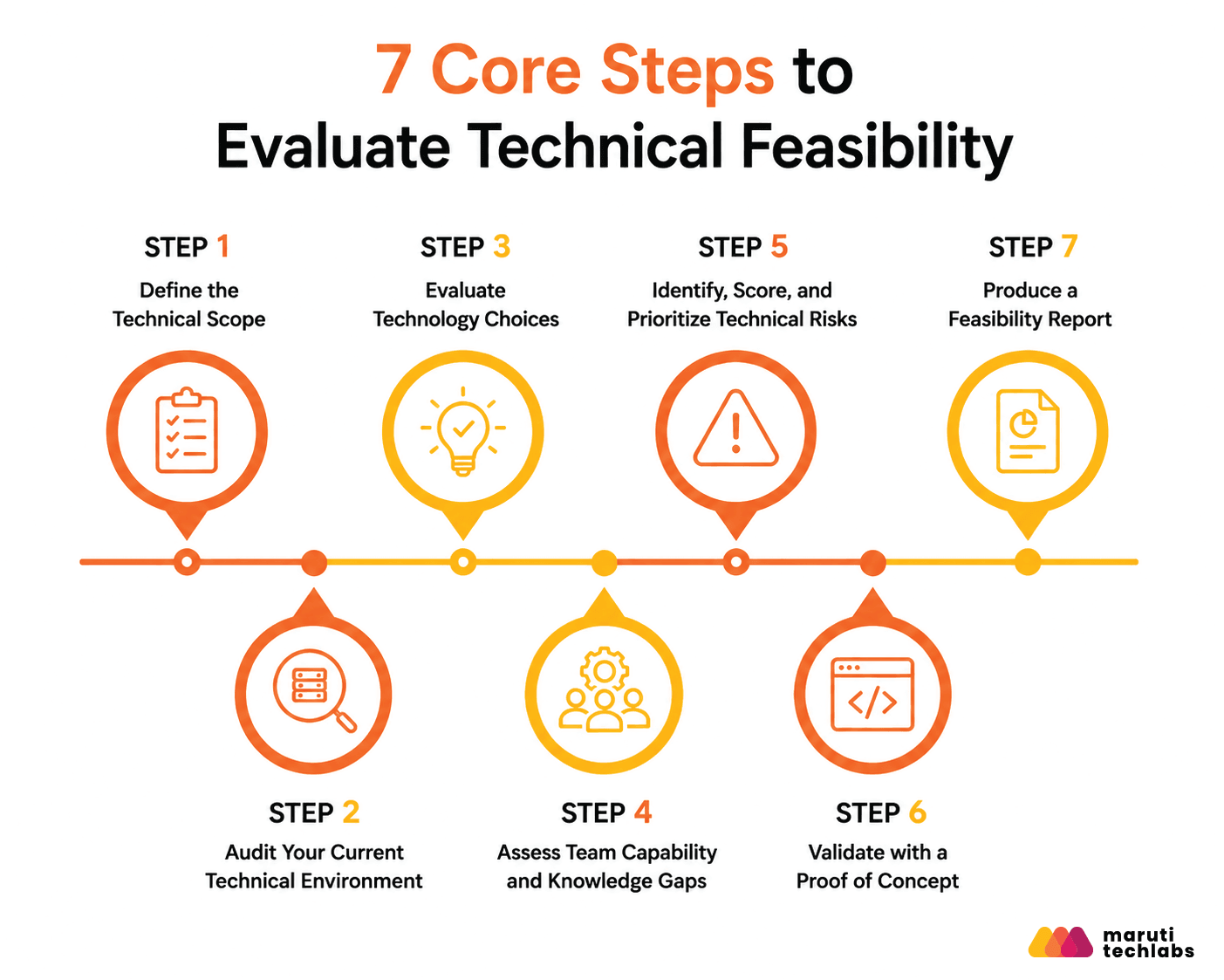
Step 2: Audit Your Current Technical Environment
The question isn't just "can this be built?" It's "can this be built given what we already have?"
This step requires an honest look at your existing infrastructure:
- Infrastructure capacity: Can your current servers, cloud setup, or database architecture handle the projected load? If you're expecting 10x user growth in 18 months, your architecture needs to account for that now, not after you've shipped.
- Tech stack compatibility: Do the technologies you plan to use work cleanly with what's already in place? Incompatible stacks create hidden rework costs that rarely surface until mid-development.
- Security posture: If the proposed system will process sensitive data, does your current environment meet the required security standards? Retrofitting security after the fact is significantly more expensive than building it in from the start.
- Existing technical debt: Inherited codebases or legacy systems often carry debt that affects what can realistically be added or changed. Surface this early.
The Buzzz Media project is a direct example of what happens when this audit is skipped. When Maruti Techlabs stepped in, the environment review revealed unnormalized databases, missing error handling, and inconsistent code throughout. These issues need to be addressed before any new development could begin.
Step 3: Evaluate Technology Choices Against Project Requirements
Once you know what you're building and what you're working with, the next step is checking whether your proposed technology choices can actually meet the project requirements.
For each core technology in the stack, including frameworks, databases, cloud services, APIs, and infrastructure tools, evaluate:
- Maturity and stability: Is this technology production-ready, or is it still changing rapidly? Early-stage frameworks introduce risk, especially for systems that need long-term support.
- Community and vendor support: If something breaks or a critical update is needed, how quickly can you get help? Niche or abandoned technologies create long-term maintenance problems.
- Scalability ceiling: Every technology has limits. Know where your choices top out and whether your projected scale stays comfortably within those limits.
- Integration overhead: How much custom work is needed to connect each component? Complex integration layers increase delivery time and introduce points of failure.
- Licensing and compliance fit: Particularly relevant for open-source components. Certain licenses restrict commercial use or require code disclosure.
A weighted decision matrix, where you score each option across these dimensions, is useful here. Not as a rigid output, but as a tool that makes trade-offs visible and easier to discuss with stakeholders.
Step 4: Assess Team Capability and Knowledge Gaps
Technology decisions don't exist in isolation from the people building them. A technically sound architecture can still fail if the team doesn't have the skills to implement it.
At this step, evaluate:
- Does the team have hands-on experience with the proposed stack, or will there be a learning curve built into the delivery timeline?
- Are there specialized skill requirements, such as ML infrastructure, real-time data pipelines, or security architecture, that the current team can't cover?
- How realistic are the timelines given current team capacity and competing priorities?
This is often the most uncomfortable part of a feasibility assessment because it requires honest answers rather than optimistic ones. If a critical skill gap exists, the options are to hire, train, bring in a specialist, or choose a technology the team can actually execute with confidence. Ignoring the gap doesn't make it go away; it just defers the problem until it costs far more to fix.
Step 5: Identify, Score, and Prioritize Technical Risks
Every feasibility assessment produces a risk register. The goal isn't to eliminate all risks, which is impossible, but to understand which risks are acceptable and which ones could derail the project.
For each identified risk, capture:
- Probability: How likely is this risk to materialize?
- Impact: If it does materialize, what does it cost in time, money, or scope?
- Mitigation path: What would it take to reduce the likelihood or contain the damage?
Risks that are high probability and high impact need mitigation plans before development begins. Risks that are low probability and low impact can be monitored. The category that causes the most damage is low probability but high impact.
These are the architectural decisions or third-party dependencies that seem unlikely to fail but would be extremely costly if they did. They tend to get ignored precisely because they seem unlikely, and that's what makes them dangerous.
Step 6: Validate with a Proof of Concept Where the Risk Warrants It
For risks that can't be resolved through analysis alone, particularly around novel integrations, performance at scale, or untested technology combinations, a targeted proof of concept (POC) is the most reliable way to reduce uncertainty before committing to full development.
A POC should be narrow and time-boxed. It's not a prototype of the full product; it's a direct test of the specific assumption that carries the most risk. A two-week POC that confirms a critical integration works as expected is worth far more than weeks of theoretical analysis.
If the POC fails, that's not a project failure. It's exactly the kind of information a feasibility study is designed to surface early, before it becomes expensive.
Step 7: Produce a Feasibility Report with a Clear Recommendation
The output of this framework isn't just a document. It's a decision. The feasibility report should give stakeholders a clear, well-supported answer, landing on one of three conclusions:
- Proceed as planned: The project is technically viable with the current stack, team, and timeline.
- Proceed with modifications: The project is viable, but specific technology choices, timelines, or scope elements need to be adjusted before development begins.
- Do not proceed: The technical risks or constraints are significant enough that the project in its current form is not viable. This is a valid and valuable outcome. It prevents far more costly failures down the line.
A feasibility report that hedges everything and commits to nothing isn't useful. The entire value of the exercise lies in the recommendation.
Example of Technical Feasibility Analysis
Case: Building a HIPAA-Compliant Telemedicine App
A healthcare startup plans to launch a HIPAA-compliant telemedicine app that supports video consultations and EHR integration. During the technical feasibility study, the team analyzes:
- Whether existing video conferencing APIs (e.g., Twilio, Vonage) support HIPAA compliance out of the box.
- If the current backend can securely interface with popular EHR systems like Epic or Cerner.
- Whether the existing team has mobile app development skills in Flutter or React Native.
- What security protocols are required for storing patient data (e.g., data encryption, secure cloud hosting).
- Estimated costs of implementing video APIs and scalable cloud hosting.
The comprehensive feasibility study identifies that the tech stack can support core features, but also recommends adding a data engineering layer and utilizing AWS HealthLake for secure handling of medical data.
Common Technical Feasibility Challenges (and How to Address Them)
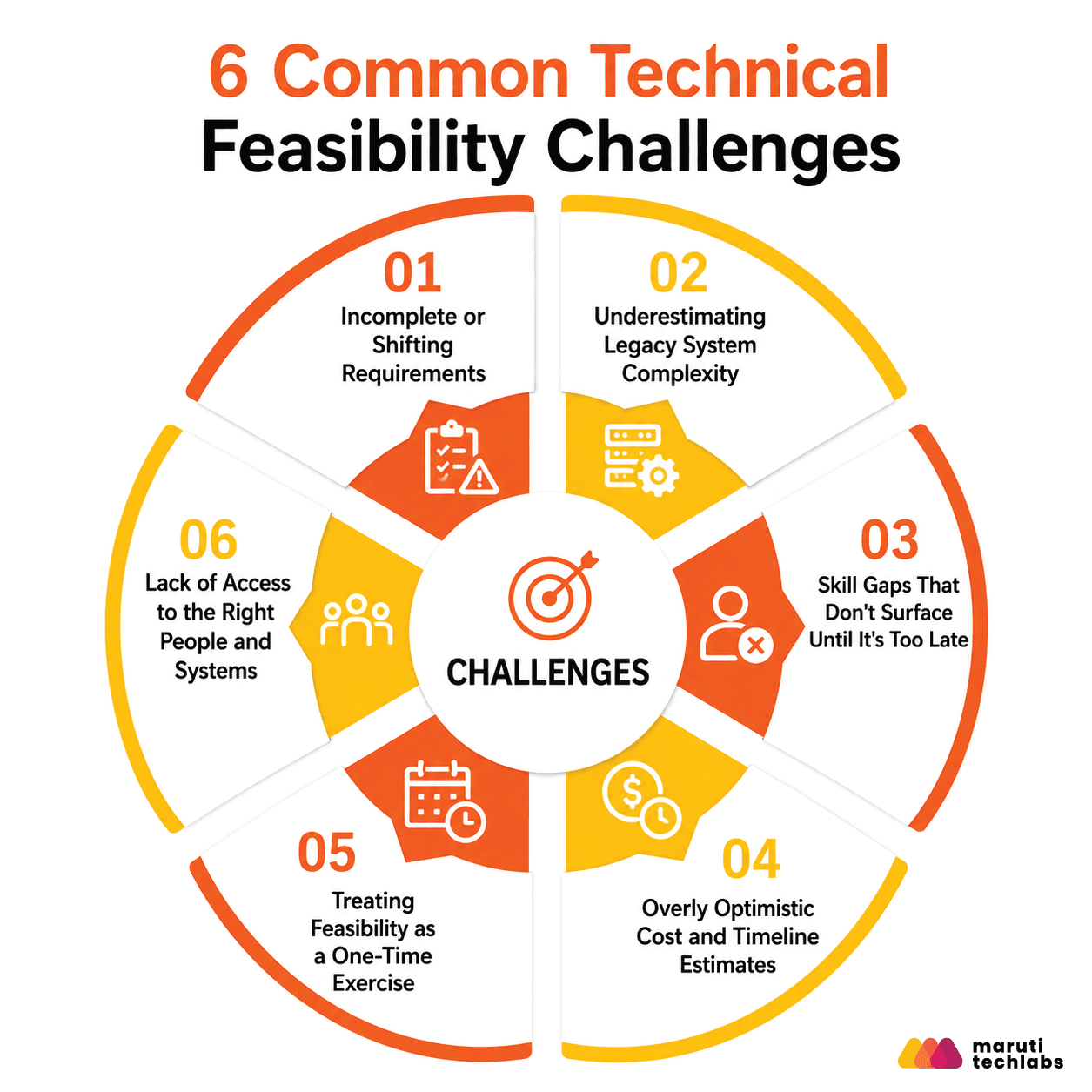
Technical feasibility challenges arise when technical limitations, unclear requirements, resource constraints, or unrealistic assumptions affect a project's ability to succeed. Understanding these challenges before you start puts you in a much better position to work through them without derailing the assessment or, worse, arriving at conclusions you can't trust.
Challenge 1: Incomplete or Shifting Requirements
One of the most common reasons a feasibility assessment produces unreliable results is that the requirements it's based on keep changing. When product owners, business stakeholders, and engineering leads are not aligned on what the system needs to do, the feasibility team ends up evaluating a moving target.
A feasibility study built on vague requirements does not give you a clear answer. It gives you a range of answers that nobody can act on.
How to solve it:
Before the feasibility assessment begins, lock down a working version of the requirements. This does not need to be a full product specification. You need enough clarity on core functionality, non-functional requirements, and known constraints to evaluate whether the project is achievable.
Before the technical work begins, conduct a brief requirements alignment meeting with all important stakeholders. In order for the team to know which conclusions need to be reviewed when requirements change later, all assumptions made during the feasibility study should be clearly recorded in the report.
Challenge 2: Underestimating Legacy System Complexity
Projects that involve integrating with or building on top of existing systems consistently take longer and cost more than expected. Legacy systems often have poor documentation, outdated dependencies, and architectural patterns that do not connect cleanly with modern tools and frameworks.
The deeper problem is that these issues are rarely visible from the outside. Teams often discover the true complexity of a legacy system only after development has already started, at which point the cost of course-correcting is significantly higher.
How to solve it:
Treat legacy system assessment as a separate workstream within the feasibility study. Request full access to the existing codebase, architecture documentation, database schemas, and integration logs before forming any conclusions. If documentation is missing or incomplete, budget time for a code audit as part of the feasibility process, not as an afterthought during development.
The Buzzz Media project is a direct example: the environment audit Maruti Techlabs ran upfront revealed database normalization issues and missing error handling that would have caused significant delays if discovered mid-build.
Challenge 3: Skill Gaps That Don't Surface Until It's Too Late
A feasibility study can confirm that a technology is the right choice for a project and still overlook the fact that the team lacks the expertise to implement it. Technical skill gaps are among the most consistent sources of delivery risk in software projects and among the least honestly evaluated during feasibility.
How to solve it:
As a formal phase in the feasibility process, incorporate an honest team capability evaluation. Compare the talents that the present team can actually provide with those needed by the suggested tech stack.
Where gaps exist, the feasibility report should specify whether the gap will be addressed through hiring, training, or engaging an external partner, along with a realistic estimate of how long each will take. Leaving skill gaps unaddressed in the feasibility report and hoping they resolve themselves during development is one of the most common and costly planning mistakes in software projects.
Challenge 4: Overly Optimistic Cost and Timeline Estimates
Feasibility assessments are supposed to stress-test assumptions, but they often end up validating them instead. When the team running the assessment is also the team that proposed the project, there is a natural tendency to estimate conservatively on risk and optimistically on cost and timeline. The result is a feasibility report that approves a project that is not actually viable within its stated constraints.
How to solve it:
Build estimates from the bottom up rather than working backward from a deadline or budget. Break the project into specific components, estimate each one independently, and add a risk buffer based on the complexity and uncertainty in each area.
For any area where the team has limited prior experience, apply a larger buffer. Where possible, get a second opinion from someone who was not involved in scoping the project. A feasibility report that identifies the realistic cost and timeline, even if those numbers are uncomfortable, is far more valuable than one that tells stakeholders what they want to hear.
Challenge 5: Treating Feasibility as a One-Time Exercise
Technical feasibility is typically run once at the start of a project and then filed away. This works for straightforward projects with stable requirements and a short delivery window. For larger, more complex projects, a single upfront assessment can become outdated quickly as requirements evolve, new constraints emerge, or the technical environment changes.
How to solve it:
For projects that run longer than three to four months, treat feasibility as an ongoing checkpoint rather than a one-time gate.
At the start of each major phase or milestone, take 30 to 60 minutes to review whether the original feasibility assumptions still hold.
- Has the scope changed?
- Have new integration requirements appeared?
- Has a key technology choice turned out to be more complex than expected?
Catching these shifts early keeps the project on a realistic track rather than discovering the gap at the point of delivery.
Challenge 6: Lack of Access to the Right People and Systems
A feasibility study is only as good as the information it is based on. When key stakeholders are unavailable, system access is restricted, or the team running the assessment does not have visibility into the full technical environment, the conclusions will have blind spots.
How to solve it:
Before the feasibility assessment begins, confirm that the team will have access to relevant codebases, infrastructure documentation, third-party API documentation, and the right people across product, engineering, and operations.
If access to a critical system or stakeholder cannot be secured before the study starts, document that explicitly in the feasibility report as a risk, along with what decisions cannot be made until that access is available.
Decision Matrix: Is Your Project Technically Feasible?
A technical feasibility decision matrix is a structured assessment tool that helps determine whether a project is ready for development. By evaluating key factors such as requirements, technology, team capability, infrastructure, risk, and cost, it provides an objective view of project readiness and highlights areas that need attention before implementation begins.
The matrix below gives you a structured way to assess readiness across the areas that matter most.
Score each dimension on a scale of 1 to 5:
- 1 to 2: Significant gaps or unknowns. Not ready to proceed.
- 3: Partially addressed. Needs more clarity before development begins.
- 4 to 5: Well understood and covered. Ready to proceed.
| Dimension | What to Evaluate | Score (1 to 5) |
| Requirements Clarity | Are the core functional and non-functional requirements defined well enough to evaluate technical choices? | |
| Tech Stack Fit | Does the proposed technology meet performance, scalability, and integration requirements? | |
| Team Capability | Does the current team have the skills to build and maintain the proposed solution? | |
| Infrastructure Readiness | Can the existing or planned infrastructure handle the expected load and data volumes? | |
| Integration Feasibility | Have key integration points (APIs, legacy systems, third-party tools) been evaluated for compatibility? | |
| Security and Compliance | Are the regulatory and security requirements identified, and can the proposed architecture meet them? | |
| Risk Awareness | Have the top technical risks been identified, scored, and assigned mitigation paths? | |
| Cost and Timeline Realism | Are the estimates built from actual component-level analysis rather than top-down assumptions? | |
| POC or Validation | For high-risk assumptions, has a proof of concept been run or planned? |
How to Read Your Score?
Copy the above table and add up your scores across all nine dimensions. The total gives you a directional read on project readiness.
| Total Score | What It Means |
| 36 to 45 | Strong technical foundation. The project is ready to move into development planning. |
| 27 to 35 | Mostly ready, but specific gaps need to be addressed before development begins. Review dimensions scoring 3 or below and resolve them first. |
| 18 to 26 | Several areas need significant work. Rushing into development at this stage carries meaningful risk of rework and cost overrun. |
| Below 18 | The project is not ready to proceed. A more thorough feasibility study is needed before any development commitments are made. |
How to Use This Matrix Effectively?
A few things worth keeping in mind when working through this:
How to Use This Matrix Effectively
- Score honestly - If you are unsure about a dimension, score it lower. Uncertainty is a risk, and this matrix is designed to surface it.
- Involve more than one person - When multiple people score independently and compare, the gaps in perception often tell you more than the scores themselves. Disagreement is a signal worth investigating.
- Review at major milestones, not just at the start - Requirements shift and constraints change. A project that scored well at kickoff may look very different three months in.
- Treat low scores as inputs, not blockers - A low score on "Team Capability" means the gap needs a plan: hire, train, or bring in a specialist. The matrix tells you where the work is.
The Bottom Line
The most costly errors in software development rarely occur during development. They occur prior to it, when risks and presumptions are ignored. A methodical technical feasibility study provides your team with the information they need to build confidently, avoid costly detours, and win over stakeholders right away. Everything that comes after gets much simpler if you do this step correctly.
Whether you are launching a new product, rebuilding an existing system, or integrating AI into your stack, the fundamentals remain the same. Validate before you build. Surface risks before they become blockers. And treat feasibility not as a formality, but as the foundation your entire project depends on.
FAQs
1. What is the ideal structure of a Feasibility Report?
A technical feasibility report typically covers six sections: an executive summary, project scope and objectives, technical assessment (architecture, stack, integrations, and scalability), risk identification with mitigation plans, resource and timeline estimates, and a final recommendation with a go/no-go conclusion. The goal is to give decision-makers a clear, evidence-based picture before any development commitment is made.
2. When to Conduct a Technical Feasibility Study?
Run a feasibility study before development begins on any new product, before migrating or rebuilding an existing system, when introducing a new technology like AI or microservices, or when a previous development effort has stalled. The earlier it is conducted, the cheaper it is to course-correct.
3. What are the Key Roles Involved in Technical Feasibility?
A feasibility study typically involves a solutions architect or tech lead to evaluate architecture and stack, a project manager to assess timelines and dependencies, a business analyst to validate requirements and scope, and a security or compliance specialist when regulatory constraints apply. For AI-heavy projects, a data engineer or ML engineer is also essential.
4. Can AI and ML Projects Fail a Feasibility Study?
Yes, and they do so more often than traditional software projects. Common failure points include insufficient or low-quality training data, lack of in-house ML expertise, unclear success metrics, infrastructure not designed for model training and inference, and regulatory constraints around data usage. A feasibility study for AI projects should specifically evaluate data readiness and model deployment requirements.
5. What are the Tools to Validate Technical Feasibility?
Common tools include architecture diagramming tools like Lucidchart or Miro for visualizing system design, load testing tools like k6 or Apache JMeter for validating performance assumptions, proof-of-concept environments for testing integrations, static code analysis tools like SonarQube for existing codebases, and cloud cost calculators from AWS, GCP, or Azure for estimating infrastructure spend.
How Does Maruti Techlabs Ensure Technical Feasibility Before Development?
With 16 years of experience and 250+ engineers across full-stack, cloud, AI, and quality engineering, Maruti Techlabs treats technical feasibility as a prerequisite to every engagement. Before any development work begins, the team conducts a structured discovery process to surface risks, validate assumptions, and provide clients with a clear picture of what it will take to build their product.
Discovery Workshop
A systematic discovery workshop covering functional requirements, low-fidelity prototypes, tech stack suggestions, and a project roadmap with dates and budget estimations is the first step in any project. Before work starts, both teams are completely in sync.
Code and Architecture Reviews
Maruti Techlabs performs a comprehensive code and architectural analysis for projects involving an existing codebase in order to uncover technical debt, surface integration issues, and map out what needs to be corrected, rebuilt, or carried forward.
Tech Stack and Architecture Evaluation
The team evaluates and recommends the right technology stack for each specific use case, assessing compatibility, scalability, integration overhead, and long-term maintainability based on hands-on delivery experience across MEAN, MERN, microservices, cloud, and AI systems.
Technical Risk Assessment
Before development starts, a mitigation path is mapped to each of the high-probability and high-impact risks found across the proposed architecture and delivery plan.
MVP and POC Validation
Where technical assumptions need to be tested before full development is committed, Maruti Techlabs builds targeted proofs of concept to validate the approach, particularly for projects involving novel integrations, AI components, or significant scale requirements.
Transparent, Milestone-Driven Engagement
Clients have direct visibility into progress, blockers, and decisions at every stage through Agile delivery practices, with no surprises at delivery.
If you are evaluating a new product idea, planning a system migration, or trying to understand why a previous development effort stalled, start with a structured technical assessment. A clear understanding of technical risks, architecture, and resource requirements before development can save months of rework and significantly improve project outcomes.



