

How to Engineer a Legal Research AI Agent With Traceable Sources and Reliable Citations (Lessons From Real-World Development)
Key Takeaways
- Reliable legal research AI depends on retrieval, provenance, verification, and human review working together, not on the language model alone.
- Every legal claim should be traceable to an exact source passage and verified before reaching a lawyer.
- Structure-aware retrieval, authority metadata, and citation graphs help reduce retrieval and context errors.
- Citation accuracy needs continuous testing and monitoring as models, legal sources, and system components change.
- Treat every model, corpus, or retrieval change as a regression risk and re-run your citation evaluation set before release.
A national law firm with 475 attorneys across 17 offices already had AI research tools. They just didn't trust them. Missing citations and weak traceability kept eating away at their confidence in what the tools produced.
Maruti Techlabs built an agentic deep research tool with a validation and traceability layer, so every insight is backed by a source a lawyer can verify. Research time fell by 60%, and the manual checking that used to follow every answer dropped across their workflows.
The trust gap isn't unique to one firm. Courts are now documenting the problem at scale. Damien Charlotin's public AI Hallucination Cases database listed 1,981 court decisions involving AI-generated fabrications by late August 2026, up from roughly 200 in mid-2025. In 824 of them, the authority was misrepresented.
So how do you engineer a legal research AI agent with traceable sources and reliable citations? Reliable legal research AI agents come down to three engineering decisions:
- Ground retrieval in authoritative legal sources,
- Tie every claim to the exact passage that supports it, and
- Run each citation through independent checks that block anything unverified.
The sections below walk through how each layer works and what real builds taught us.

Develop legal research workflows that connect findings to source evidence, reduce manual verification, and support more efficient legal review.
Why do legal research AI agents still produce unreliable citations?
Legal research agents produce unreliable citations because language models predict plausible text instead of looking up authority, and retrieval alone does not close that gap. Errors enter at three points: retrieval, generation, and verification, and a system that guards only one of them still leaks.
The first cause is generation without grounding. LegalCiteBench, presented at ICML 2026, tested 21 LLMs, and even the strongest scored below 7 out of 100 on closed-book citation retrieval and completion.
A model asked to cite from memory produces a believable case name, reporter, and year that may point to nothing real. Telling it to admit uncertainty cuts some confident fabrication but does not make the remaining citations correct.
The second cause is verification that stops at existence. A database lookup catches invented cases, but it cannot tell whether a real case supports the claim attached to it.
A 2026 study of citation verification, accepted at the ICML 2026 AI for Law workshop, tested 14 model configurations. The models caught 93% to 100% of citations swapped to a different case. They caught only 37% to 61% where just the pinpoint page was wrong.
Even GPT-5.4 with high reasoning missed about 40% of those errors. In most of the misses, the model told the reader the cited page "expressly states" the proposition when the text was not there.
Two more failure patterns compound this.
- Near-miss retrieval. Retrieval returns an opinion from the wrong jurisdiction, an outdated ruling, or a case later overturned, and the model writes confidently around it.
- Quote drift. A real opinion is cited with a quotation it never contained, or a paraphrase is presented as the court's words.
The engineering takeaway is that citation reliability has to be enforced after generation, with checks that test support at the cited page, not requested in the prompt.
What must a traceable, citation-reliable legal research agent do?
A traceable, citation-reliable legal research agent links every claim to an exact passage in a verified source. No citation reaches the lawyer until independent checks pass. Traceability means a reviewer can replay how each claim was reached. Reliability means the citation survives those checks.
Four requirements make that possible.
- Grounded retrieval: The agent searches a defined body of authoritative law, filtered by jurisdiction, court level, and date, instead of the open web or the model's memory.
- Claim-level provenance: Each claim carries its source ID, an exact quoted span, a pinpoint location, and a retrieval timestamp.
- Independent verification: A separate step checks that the authority exists, the quote appears, the cited passage supports the claim, and the opinion is still good law.
- Audit trail: Every run is logged, so a partner can see which sources were retrieved, which were rejected, and why.
The reference architecture follows four stages: retrieve, draft, verify, and human review. Verification sits between drafting and the lawyer, and it fails closed. If a check cannot confirm a citation, the agent withholds it or flags it as unverified instead of presenting it as fact.
How should you architect the retrieval layer for legal authority?
Architect the retrieval layer first, because it sets the ceiling for everything the agent writes. Legal RAG Bench, a March 2026 benchmark, found that retrieval quality drives legal RAG performance more than the choice of language model, and that many errors blamed on hallucination were triggered by retrieval failures.
In its tests, the strongest legal embedding model beat the next best alternative by 34 points in retrieval accuracy. Four design decisions shape retrieval quality in a legal agent:
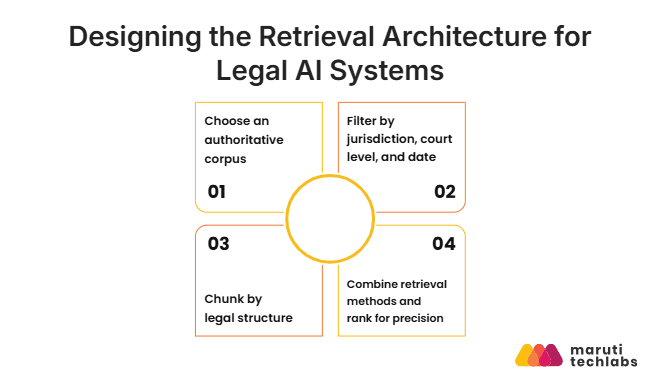
Choose an authoritative corpus
Retrieve from a defined body of law, such as court opinion archives and official statute sources, instead of the open web. Firm work product like briefs and memos can sit alongside it, but only after the documents are organized, deduplicated, and permissioned.
An AI readiness assessment for law firms is a practical way to check that data foundation before you connect it.
Filter by jurisdiction, court level, and date
Store these as metadata on every document and apply them before ranking. A Ninth Circuit question should not surface a state trial court ruling, or a decision that predates a change in controlling law.
Chunk by legal structure
Split opinions by holding and paragraph, and statutes by section and subsection, then keep page and paragraph offsets with every chunk so a pinpoint citation can be built later.
In an October 2026 study, structure-aware chunking lifted Recall@5 on Indian criminal procedure code queries from 0.557 to 0.804, and chunking explained 88% of the gain.
Combine retrieval methods and rank for precision
Pair keyword search, which catches exact statute numbers and case names, with semantic search, then rerank the results.
Add a citation graph so the agent can pull supporting and contrary authority and see whether a case was later overturned. This is the retrieval layer that agentic AI legal workflows depend on when a research agent hands sources to a drafting or review agent.
Design choice | What to build | Failure it prevents |
| Authoritative corpus | Opinions and statutes from defined sources | Fabricated or unofficial sources |
| Metadata filters | Jurisdiction, court level, and date applied before ranking | Wrong-jurisdiction and outdated authority |
| Structure-aware chunks | Holding- or section-level chunks with page offsets | Lost context and unusable pinpoints |
| Hybrid ranking and citation graph | Keyword plus semantic search, reranking, treatment links | Near-miss retrieval and overruled cases |
How do you make every claim traceable to a source passage?
Make traceability a data structure, not a prompt instruction. Every legal claim the agent writes should be stored as a record that links it to the exact passage that supports it, so a reviewer can go from sentence to source in one step.
A citation the model prints is not proof that retrieval found it. A 2026 study of commercial models and deep research agents found that 3 to 13% of the citation URLs they supplied appeared to be fabricated, even with web search access. So the source ID on every claim must be checked against the retrieval log, not against the model's own text. The four rules mentioned below make this work.
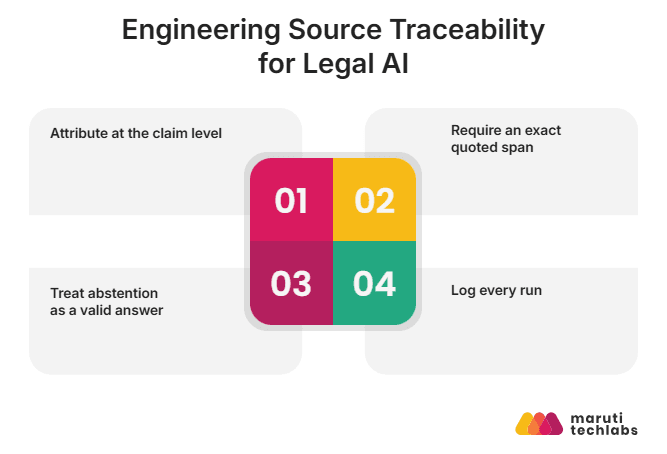
1) Attribute at the claim level
Break each draft into atomic claims and give each one its own support record, because a single citation at the end of a paragraph hides which sentence is unsupported.
2) Require an exact quoted span
The quote must be a verbatim substring of the retrieved passage, and code should check it, not the model. In a 2026 study on Canadian federal statutes, 83.2% of the quotes a fine-tuned legal model produced could not be traced to the source once the statute text was withheld, against 19.5% when the text was supplied.
3) Treat abstention as a valid answer
If no retrieved passage supports a claim, the agent returns "no authority found" instead of writing around the gap.
4) Log every run
Record the queries, the passages retrieved and rejected, the verification results, and the reviewer's decisions. Courts are starting to ask lawyers to certify verification, and Broward and Miami-Dade orders in 2026 require AI-assisted filings to carry a certification that citations and legal authority were independently checked. The log is your evidence.
Field | What it holds |
| Claim text | One atomic legal proposition from the draft |
| Source ID | An identifier that must exist in the retrieval log |
| Quoted span | Verbatim text copied from the retrieved passage |
| Pinpoint | The page or paragraph where the span appears |
| Authority metadata | Court, jurisdiction, and decision date |
| Retrieved at | Timestamp of the retrieval that returned the passage |
| Verification status | Passed, failed, or unverified after the checks described next |
How do you verify citations before they reach a lawyer?
Run four independent checks after the draft is written, and release a citation to the lawyer only when all four pass. A single model reading its own output is not enough.
The reason is that models are weakest where the risk is highest. Built from New York Court of Appeals decisions, PARCEL found that models wrongly accepted 15.4% of claims the opinion never addresses, versus 4.3% of claims it directly contradicts. Silence fools models more often than contradiction.
Another 2026 benchmark of citation-checking agents found that GPT-5 in an agentic setup reached 82.8% recall but only a 60.5% F1 score, averaging 16.9 steps per excerpt. That gap points to many false alarms, so a checker that flags everything just moves the workload to the reviewer.
A reliable pipeline splits the work, using plain code where it can and a model only where judgment is needed.
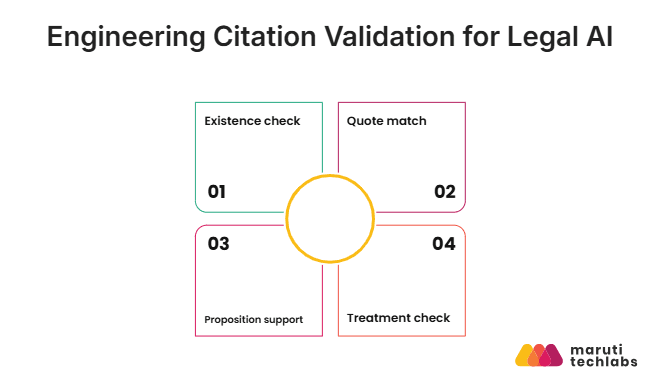
- Existence check: Look up every citation in a canonical legal database. This is deterministic and catches invented cases.
- Quote match: Confirm that each quoted span is an exact substring of the retrieved text at the stated pinpoint. This is also code, not a model.
- Proposition support: Test whether the cited passage actually supports the claim. Give the model only that passage, require it to quote the supporting sentence, and run the check with two models from different families. Escalate any disagreement to a person.
- Treatment check: Confirm the authority is still good law by using citator signals or a citation graph, so overruled or reversed decisions are caught.
The system should fail closed. If any check fails or cannot be resolved, the citation is removed from the answer or clearly labeled unverified, and it never appears as if it had been checked.
The lawyer then sees each claim with its check results beside it and spends review time on exceptions. Professional responsibility stays with the lawyer, so the pipeline's job is to make that review faster and more focused, not to replace it.
What Are the Key Engineering Challenges in Building Legal Research AI Agents?
Building a legal research AI agent is not just a matter of connecting an LLM to a legal database. The difficult part is making the system behave reliably when legal sources are incomplete, conflicting, constantly changing, or difficult to interpret.
The engineering challenges usually fall into four areas: maintaining source quality, preserving legal context, controlling agent behavior, and proving that the system's output is trustworthy.
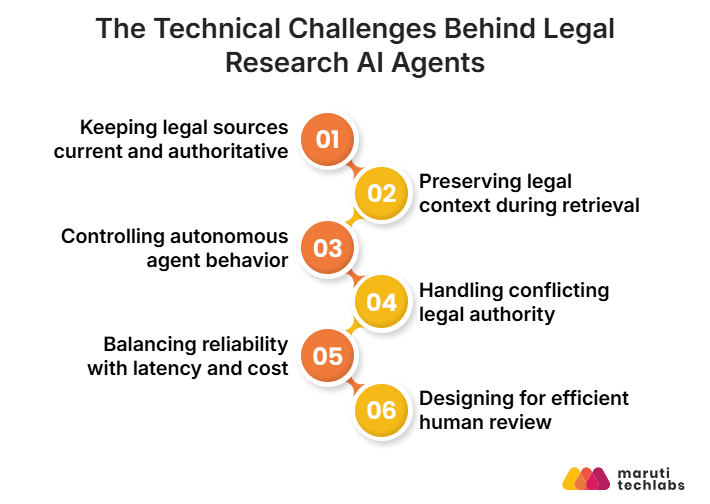
Keeping legal sources current and authoritative
Legal information changes constantly. A case that was relevant when it entered the knowledge base may later be limited, overturned, or superseded, while a technically relevant decision may come from a court or jurisdiction that does not apply to the question.
Solution:
Treat source management as part of the architecture. Store metadata such as jurisdiction, court level, decision date, and treatment status, and apply these filters before ranking results. The corpus should also have a defined process for incorporating new decisions and legal updates.
Preserving legal context during retrieval
Legal meaning often depends on the surrounding context. If an agent retrieves only a sentence or paragraph, it may miss a qualification, exception, factual distinction, or limitation that changes what the court actually held.
Solution:
Use structure-aware or hierarchical retrieval. Retrieve the precise passage needed for citation, but allow the reasoning layer to expand into surrounding paragraphs, sections, or the relevant portion of the opinion when additional context is required.
Controlling autonomous agent behavior
Agentic research introduces another failure point because the system decides what to search, which sources to investigate, and when to stop. An early incorrect assumption can therefore propagate through several subsequent research steps.
Solution:
Give the agent bounded autonomy with defined rules for query expansion, source selection, contrary-authority checks, and stopping conditions. When the system cannot establish sufficient support, it should escalate the issue rather than continue generating increasingly confident reasoning.
Handling conflicting legal authority
Legal research does not always produce one definitive answer. Different courts may reach different conclusions, or a later decision may distinguish, limit, or overturn an earlier authority.
Solution:
Build relationships between cases, statutes, and subsequent decisions into the research layer through citation or authority graphs. The agent can then surface competing authorities and clearly distinguish settled positions from areas where the law remains unresolved.
Balancing reliability with latency and cost
A research agent may need multiple retrieval, reasoning, and verification steps to produce a reliable answer. Running expensive model calls at every stage can make the system too slow or costly for regular legal workflows.
Solution:
Use deterministic code for tasks such as source lookup, metadata filtering, and quote matching, while reserving capable models for tasks that require contextual or legal reasoning. This keeps the verification pipeline rigorous without making every step dependent on an expensive model call.
Designing for efficient human review
Even a reliable research agent cannot remove the lawyer's responsibility to review its output. If the lawyer has to manually reconstruct how a claim was generated and whether its citation is valid, much of the efficiency gained from automation disappears.
Solution:
Make the review path part of the product design. Present each claim with its supporting passage, pinpoint, source metadata, and verification status so a lawyer can inspect the evidence quickly and focus attention on exceptions rather than rechecking every step from scratch.
These challenges show why AI for legal research and analysis requires more than a capable language model and a legal document database. Reliability has to be engineered across the corpus, retrieval, agent workflow, verification layer, and human review process.
What did real-world development teach us about building legal research agents?
The clearest lesson from our work is that attorneys adopt a research agent when they can check it, not when it is merely fast.
In the deep research tool we built for a national law firm, the firm already had legal AI tools, but missing citations and weak traceability kept confidence low. Once every insight was tied to a verifiable source, the project reported a 3x improvement in insight accuracy and a 40% increase in team productivity. Four more lessons came out of that build.
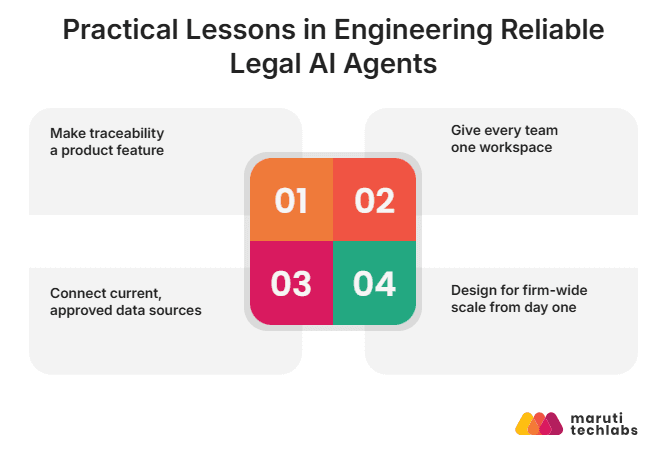
- Make traceability a product feature. We designed a validation and traceability layer into the core of the system, not as an afterthought, so every insight links back to a verifiable source and manual verification effort dropped.
- Give every team one workspace. Research had been scattered across tools, and quality varied from team to team. A centralized research platform put everyone on the same sources and gave results a consistent standard.
- Connect current, approved data sources. The agent draws on live data so outputs reflect current legal and regulatory information, which matters because law keeps changing.
- Design for firm-wide scale from day one. The architecture was built to support multiple offices and teams, so adoption could grow from one group to the whole firm.
Each lesson points back to the same principle behind the earlier sections. Reliability comes from the system around the model, not from the model alone.
How do you test and monitor citation accuracy over time?
Citation accuracy cannot be validated once and then considered solved. Changes to the legal corpus, retrieval model, chunking strategy, prompts, or underlying LLM can introduce new citation failures. A production legal research agent therefore needs a repeatable evaluation framework that measures citation quality before and after every significant change.
Build a legal research evaluation set
Start with a representative set of real legal research questions covering different jurisdictions, practice areas, authority types, and levels of difficulty. Each question should have a reviewed reference answer with the expected authorities, supporting passages, and acceptable conclusions.
This becomes the benchmark against which new versions of the agent are tested. It should also include known failure cases, such as outdated authorities, conflicting decisions, incorrect pinpoints, and claims that have no supporting authority.
Measure citation accuracy at multiple levels
A single accuracy score can hide important failures. Track separate metrics for whether the cited authority exists, whether the quoted passage matches the source, whether the passage actually supports the claim, and whether the authority remains valid.
Also monitor retrieval metrics such as recall of relevant authorities and precision of the top-ranked results. This helps identify whether a citation failure originated in retrieval or occurred later during generation and verification.
Run regression tests after system changes
Every major change should trigger the same evaluation set. This includes changes to the embedding model, reranker, chunking strategy, legal corpus, prompts, or LLM.
Compare the new results against the previous version and investigate any drop in citation support, retrieval quality, or correct abstention. A system that improves answer fluency while reducing citation accuracy should not be considered an improvement.
Monitor production failures and reviewer feedback
Offline benchmarks cannot capture every legal research scenario. Once deployed, log citation failures, rejected sources, reviewer corrections, and cases where the agent abstained unnecessarily.
Feed these examples back into the evaluation set. Over time, this creates a continuously growing collection of real failure cases that can be used to test whether the system is actually becoming more reliable.
The goal is not to achieve a high benchmark score once. It is to create a feedback loop where every failure becomes a test case, every system change is evaluated, and citation quality remains measurable as the agent evolves.
Engineering Legal Research AI Agents That Lawyers Can Trust
A reliable legal research AI agent requires more than accurate retrieval or a capable LLM. It needs an authoritative legal corpus, claim-level traceability, independent citation verification, and continuous evaluation to ensure that every conclusion remains grounded in verifiable legal sources. The right architecture also accounts for conflicting authority, changing laws, and human review, with clear safeguards when the system cannot establish sufficient support.
As Maruti Techlabs’ experience building an agentic legal research tool demonstrates, these engineering decisions can translate into measurable workflow improvements, including a 60% reduction in research time. The primary goal is not simply to generate answers faster, but to build a research capability that lawyers can verify, evaluate, and rely on in their daily work.
FAQs
1. What is a legal research AI agent?
A legal research AI agent is an AI-powered system that searches legal sources, retrieves relevant authorities, analyzes supporting evidence, and generates research findings. A reliable agent also links its claims to verifiable source passages and checks citations before presenting its findings to a lawyer.
2. How do you prevent hallucinated citations in legal research AI?
Preventing hallucinated citations requires multiple safeguards. The system should retrieve from authoritative legal sources, verify that each cited case exists, confirm that quoted passages match the original text, and check whether the cited authority supports the associated claim. Unsupported citations should be withheld or flagged for human review.
3. What is the role of RAG in a legal research AI agent?
Retrieval-augmented generation (RAG) connects a language model to an external knowledge base, allowing it to generate answers using retrieved legal documents rather than relying solely on its training data. In legal research, effective RAG requires authoritative sources, jurisdiction-aware retrieval, structure-preserving document chunks, and traceable links between claims and source passages.
4. How do you evaluate the accuracy of a legal research AI agent?
Evaluate the agent using a benchmark of representative legal research questions with reviewed reference answers and supporting authorities. Measure citation existence, pinpoint accuracy, passage-level support, retrieval quality, and the agent's ability to abstain when evidence is insufficient. Repeat these tests after changes to the model, retrieval pipeline, or legal corpus.
5. Can a legal research AI agent determine whether a case is still good law?
An agent can help assess whether a case remains authoritative by checking subsequent judicial treatment, citations, and available citator signals. However, citation relationships alone are not sufficient to establish a case's current legal status. The system should use reliable legal sources, account for jurisdiction and relevant treatment, and flag unresolved issues for lawyer review.
6. Should a law firm build or buy a legal research AI agent?
Buying is suitable when a commercial platform meets the firm's research, source coverage, and verification requirements.
Building may be appropriate when the firm needs specialized workflows, proprietary document integration, or greater control over its verification architecture. Extending an existing platform can be a practical middle ground when its underlying data and interfaces support the required capabilities.
How Did Maruti Techlabs Cut Deposition Review Time by 95% While Keeping Every Finding Traceable?
A full-service US law firm founded in 1850, with more than 500 attorneys and government relations professionals, was spending hours reviewing 300 to 600-page deposition transcripts. Attorneys had to manually find testimony, verify statements, track contradictions, and return to source pages to validate findings.
Maruti Techlabs built a custom AI-powered deposition review platform that turns lengthy transcripts into searchable summaries, categorized testimony, contradiction maps, and citation-linked findings. This reflects how Generative AI Services can be applied to document-heavy legal workflows where accuracy and source traceability matter.
The platform identifies speakers, structures testimony, builds chronological case narratives, and allows attorneys to ask questions in natural language with supporting citations. Its six-phase workflow covers transcript intake, testimony structuring, content examination, contradiction mapping, citation linking, and insight retrieval.
The system follows the same claim-to-source principle discussed earlier. Every finding is linked to its exact page-line reference, allowing attorneys to return directly to the transcript and verify the underlying testimony. This type of workflow can be further extended through AI Agent Development Services to support more autonomous research and review tasks.
The solution combines large language models from Anthropic and OpenAI with document processing, vector search, and monitoring. For legal teams evaluating where AI fits into existing workflows, our experienced AI consultants can help to identify suitable use cases and determine the right architecture before development begins.
The impact
- 95% less review time, with 300- to 600-page deposition transcripts moving from hours of manual reading to minutes of AI-assisted analysis.
- More than 95% of generated summaries contained correct page-line references, which reduced the need for extensive manual verification.
- 3x quicker testimony retrieval, with attorneys locating relevant statements and objections within seconds instead of spending 20 to 30 minutes searching manually.
- Reduced duplicate review, because shared, structured summaries gave litigation teams a common reference point.
- Faster litigation preparation, including motion drafting and response preparation.
- Greater team productivity, as transcript chat, automated summaries, and topic-based organization reduced repetitive research.
Our AI agent development team designs the retrieval, citation, and verification layers that keep every legal claim linked to its source.