

AI Readiness Assessment for Law Firms: What You Need to Know
Key Takeaways
- AI readiness is about preparing your firm’s people, processes, data, and technology before introducing AI into legal work.
- Buying an AI tool does not guarantee results unless firms know where it fits and how teams will use it.
- Law firms need clear AI guidelines to protect client information and maintain confidentiality.
- The most useful AI applications often start with repetitive tasks like legal research, contract review, and document analysis.
- Lawyers remain essential because AI supports their work but does not replace legal judgment or decision-making.
- An AI readiness assessment helps firms identify gaps in data, security, and staff training before investing in new tools.
Introduction
Legal research shouldn’t begin with hours of searching and manual verification. For a national law firm with 475 attorneys across 17 offices, fragmented information and unreliable AI outputs slowed case preparation.
Maruti Techlabs built an agentic AI-powered deep research platform with live data access, contextual reasoning, and source-backed citations. The solution reduced research time by 60%, improved insight accuracy by 3x, and increased team productivity by 40%.
Stories like this are becoming more important as client expectations continue to rise. According to the 2026 Thomson Reuters Future of Professionals Report, 78% of clients now consider AI-enabled quality improvements essential, yet only 6% believe most legal service providers consistently deliver them. At the same time, 46% of lawyers say they do not know enough about AI to answer basic client questions about its potential benefits.
The question for law firms is how to adopt AI in a way that fits their work and meets their responsibilities. That starts with understanding why adoption can be difficult, assessing the firm’s readiness, and identifying where AI can support legal work. This guide looks at each step and explains how firms can prepare for adoption.

Our AI readiness assessment helps evaluate priorities, risks, and opportunities before implementation.
Why Most Law Firms Are Not Ready for AI
Law firms may struggle to adopt AI when they lack clear usage guidelines, reliable data, staff training, and processes for checking AI-generated work. Client confidentiality and the need for sound legal judgment add further considerations.
In our work with clients, we have seen AI adoption vary across teams. Some employees already use AI in their daily work, while others are still unsure where it fits or how to use it responsibly. The difference often comes down to whether people have the time, guidance, and confidence to use AI in their work.
Several factors continue to slow down AI adoption in law firms:
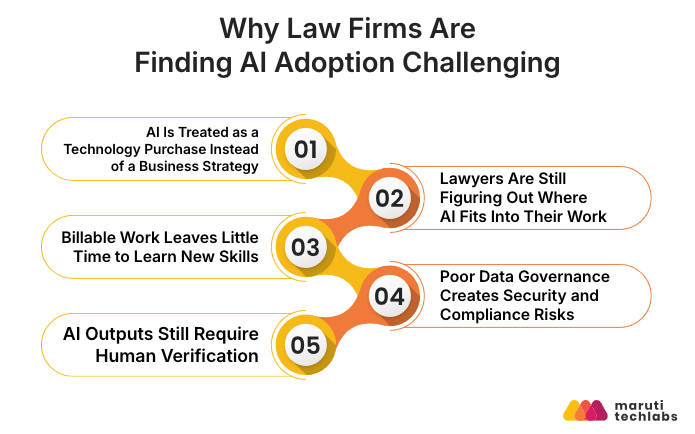
1. AI Is Treated as a Technology Purchase Instead of a Business Strategy
The first step in many AI projects is a vendor conversation. Firms compare platforms, review capabilities, and discuss pricing before defining the role AI should play in their workflows. When the business goal is unclear, even a capable AI system can end up being underused.
2. Lawyers Are Still Figuring Out Where AI Fits Into Their Work
Many lawyers are still trying to understand where AI can help and where human judgment remains necessary. They may know AI is becoming part of legal work, but questions around accuracy, limitations, and responsible use often make adoption difficult. Without practical experience using these tools, it becomes harder for teams to build trust and use AI effectively.
3. Billable Work Leaves Little Time to Learn New Skills
Lawyers often have limited time outside their daily workload to learn new technology. Client deadlines, case preparation, and billable targets take priority, leaving little time to experiment with AI tools or understand how they fit into existing workflows.
4. Poor Data Governance Creates Security and Compliance Risks
For AI to be useful in legal work, firms need to know what data they have, where it is stored, and who can access it. That remains a challenge for firms managing information across multiple platforms, shared folders, and document systems. Weak data controls can lead to confidentiality issues, compliance concerns, and the rise of shadow AI usage.
5. AI Outputs Still Require Human Verification
Generative AI can help lawyers review documents, find relevant information, and work through large amounts of legal content faster. But the output still needs to be checked for accuracy, context, and reliable sources. A missed detail or incorrect citation can create serious issues, which is why legal expertise remains necessary when using AI.
What AI Readiness Means for Law Firms
AI readiness for law firms is about knowing where AI fits into legal work before bringing it into daily operations. It requires firms to look at their workflows, prepare their teams, organize their information, and set clear boundaries around how AI should be used.
A firm may have access to powerful AI tools, but that does not answer the practical questions that come with using them. Which tasks should AI support? What information can it access? Who reviews its output? Answering these questions helps firms use AI in a way that works for their lawyers, clients, and existing processes.
Four areas that shape a firm’s AI readiness are:
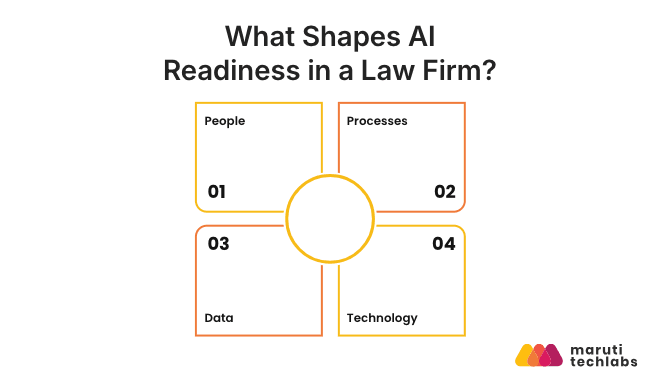
- People: Lawyers and staff need practical knowledge of how AI works, where it can support their work, and how to review AI-generated outputs. Firms also need clear ownership for AI policies and internal usage standards.
- Processes: AI adoption requires identifying the legal tasks and workflows where technology has the ability to provide support. Areas such as document review, legal research, contract analysis, and client intake often require workflow changes to ensure AI fits into existing practices.
- Data: AI systems count on the information they receive. Firms need well-organized, secure, and accessible data to reduce errors, protect client confidentiality, and improve the reliability of AI outputs.
- Technology: The selected AI solutions should integrate with existing legal systems and security requirements. Tools that operate separately from firm workflows can create additional complexity and adoption challenges.
Buying AI tools does not automatically make a firm ready for AI. Firms still need to define use cases, prepare their teams, organize their data, and establish the right safeguards before AI can become part of legal operations.
How to Conduct an AI Readiness Assessment for Your Law Firm
To conduct an AI readiness assessment for your law firm, evaluate your business goals, data, infrastructure, security, legal workflows, and your team's readiness to use AI. This helps identify where your firm is prepared for AI and where additional work is needed before implementation.
A practical assessment usually covers the following areas:
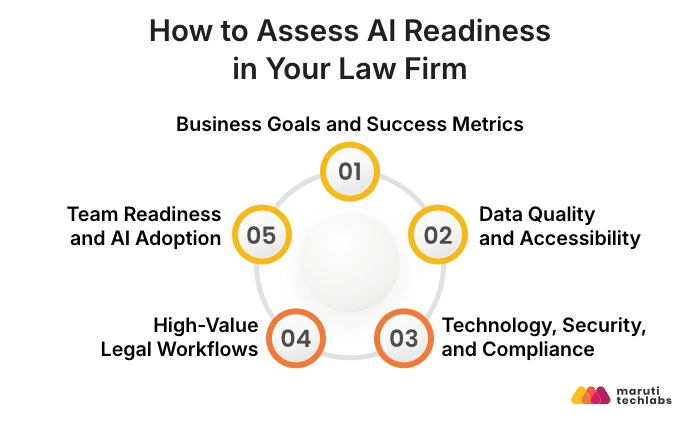
1. Business Goals and Success Metrics
Before assessing AI readiness, the firm should be clear about why AI is being considered in the first place. Some firms want to reduce the time lawyers spend reviewing documents. Others are looking to speed up legal research, improve client intake, or reduce repetitive administrative work. The assessment should begin with those priorities, not with the technology.
2. Data Quality and Accessibility
AI relies on the information available within the firm. If client files, contracts, and legal knowledge are scattered across different systems, outdated, or difficult to access, the output will be affected. Reviewing how information is stored and managed is an important part of assessing AI readiness.
3. Technology, Security, and Compliance
Before bringing AI into legal workflows, firms need to understand how it will work with their existing systems. Case management tools, document repositories, security practices, and access controls all need to be reviewed to avoid issues with client confidentiality and compliance.
4. High-Value Legal Workflows
Not every legal task needs AI. The assessment should focus on repetitive, high-volume work where AI can reduce manual effort while allowing lawyers to retain control over legal judgment. Document review, legal research, contract analysis, and matter intake are common starting points.
5. Team Readiness and AI Adoption
A readiness assessment should also look at how lawyers and staff currently use technology in their work. It can reveal where teams need more guidance, whether around writing effective prompts, reviewing AI-generated content, or understanding confidentiality requirements.
Real-World Use Cases of AI for Lawyers
Law firms are using AI across specific legal workflows where lawyers spend significant time reviewing information, preparing documents, and managing large volumes of data.
Some practical applications of AI in legal work include:
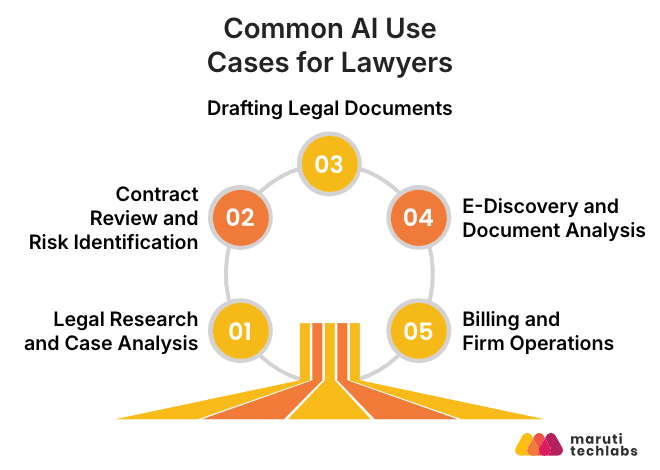
1. Legal Research and Case Analysis
Finding relevant case law, statutes, and prior matters can take hours of manual research. AI tools can help lawyers search through large legal databases, summarize relevant information, and identify supporting authorities while keeping citation review as part of the process.
For example, platforms such as LexisNexis and Ask Westlaw use natural language processing to help legal professionals find relevant cases and legal materials more efficiently.
2. Contract Review and Risk Identification
A single contract can contain dozens of clauses that lawyers need to review carefully. AI can help with the initial review by pointing out missing information, inconsistent wording, or terms that may need a closer look.
Tools such as Spellbook and CoCounsel help lawyers review agreements and flag areas that may require more review.
3. Drafting Legal Documents
Drafting legal documents takes time because lawyers must adapt standard language to the facts, terms, and requirements of each matter. Generative AI can help create first drafts of documents such as NDAs, lease agreements, client updates, and routine correspondence that lawyers can then review and refine.
For instance, firms including A&O Shearman have explored generative AI tools to speed up early-stage drafting while keeping lawyers involved in the final review.
4. E-Discovery and Document Analysis
During large litigation matters, lawyers may need to review thousands of documents to find relevant information. AI can help organize records, highlight important evidence, summarize transcripts, and make legal knowledge, including case notes, research findings, and internal guidance, easier to search and access. This helps teams locate relevant information across case files and internal knowledge repositories.
5. Billing and Firm Operations
Beyond legal work, firms are also using AI for everyday operational tasks. Tools like Mitratech InvoiceIQ and Billables.ai can help with invoice reviews, time entry classification, and other billing processes that usually require significant manual effort.
These examples show how AI is being applied throughout different parts of legal practice, from research and drafting to litigation support and internal operations.
How to Prepare Your Law Firm for Successful AI Adoption
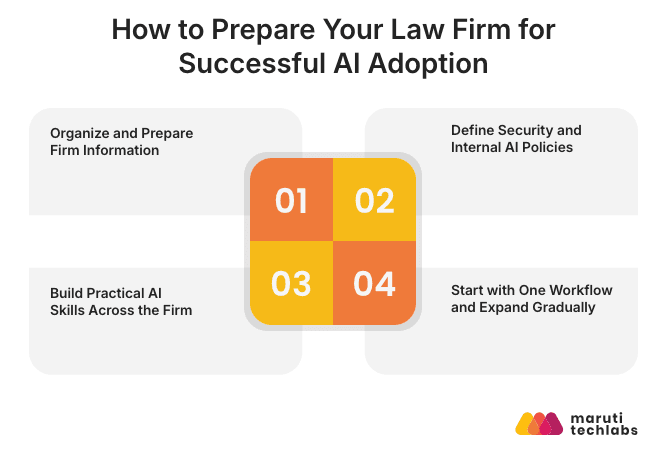
Getting a law firm ready for AI usually has less to do with the technology than with everything around it. Documents may be stored in different places, teams may follow different ways of working, and lawyers may have different levels of experience with AI. Spending time on these areas first gives firms a much stronger foundation for introducing AI into legal workflows.
1. Organize and Prepare Firm Information
The quality of AI outputs depends on the information available to the system. If client files, contracts, legal precedents, and internal knowledge are difficult to locate or exist in multiple versions, AI will struggle with the same problem. Organizing documents, removing duplicate files, and using consistent naming or tagging practices gives AI access to more reliable information. Many firms also choose to centralize documents within a secure document management system before expanding AI use.
2. Define Security and Internal AI Policies
Law firms deal with confidential client information every day, making security a key part of AI adoption. Before lawyers begin using AI tools, firms should have clear internal policies covering approved applications, the types of legal work AI can support, and situations where human review is required. Commercial AI platforms that provide contractual protections around client data are generally a better fit than public tools that may not meet the firm's security and privacy expectations.
3. Build Practical AI Skills Across the Firm
AI becomes easier to understand when lawyers can connect it to the work they already do. Instead of explaining AI through generic examples, firms can use real tasks like contract review, legal research, or document drafting to show where it can help. Having lawyers from different practice groups experiment with these use cases also helps others understand how AI can fit into their own work.
4. Start with One Workflow and Expand Gradually
Introducing AI across the entire firm at once can make it difficult to understand what is working and what needs to change. Many firms begin with a single workflow, such as document review, legal research, contract analysis, or meeting summarization. Once teams become familiar with the process and internal guidelines are established, it becomes easier to expand AI into other areas of legal work with greater confidence.
Conclusion
Before introducing AI across a firm, there are a few questions that need clear answers: Where can AI support lawyers? What information will it use? How will teams review its output? Who will be responsible for setting guidelines and addressing concerns as usage grows? Thinking through these areas helps firms avoid rushed decisions and take a more practical approach to bringing AI into legal work.
An AI readiness assessment gives firms a clearer picture of their current capabilities and the gaps they need to address. Starting with focused use cases, clear internal guidelines, and the right support for lawyers can help firms introduce AI in a way that fits their existing practices.
The next section looks at how Maruti Techlabs helped a legal organization apply AI to a specific workflow challenge and achieve measurable improvements.
See How We Helped a Legal Team Streamline Syndicated Loan Reviews
One of our clients, a leading law firm with more than 500 attorneys and government professionals, wanted to simplify the review of syndicated loan documents. Lawyers were manually comparing credit approvals, term sheets, and credit agreements to identify inconsistencies, validate key clauses, and extract important information.
Maruti Techlabs developed an AI platform that automated document processing, compared clauses using LSTA standards, validated information across related documents, and extracted critical legal data. The solution reduced manual review effort by 60–70%, reached 95% accuracy, and made deal processing three times faster. It also reduced the time required to find key deal information, giving legal teams a more structured and consistent review process.
Our AI Development Services help legal organizations build AI solutions that fit their existing workflows, systems, and security requirements. For firms with more specialized needs, our Custom AI/ML Development Services support everything from document intelligence and AI agents to workflow automation built around legal operations.
our experts can help you identify the right starting point and build a solution around your legal workflows.
FAQs
1. How is AI used in law firms?
Law firms are using AI across a range of legal and administrative tasks. It can help lawyers review contracts, search legal information, prepare first drafts, and organize large volumes of documents. Some firms are also using it to simplify billing and other internal processes, while keeping lawyers involved in reviewing the final results.
2. Will AI replace lawyers?
AI can help lawyers work through documents and legal information much faster, but it does not replace the role of a lawyer. Clients still rely on legal professionals for advice, negotiation, strategy, and judgment. Reviewing facts, understanding context, and making legal decisions remain the responsibility of the lawyer, even when AI is used during the process.
3. What are the benefits of AI for lawyers?
For many lawyers, the biggest benefit is spending less time on repetitive work. Tasks such as searching legal authorities, reviewing contracts, summarizing documents, or preparing an initial draft can often be completed more quickly with AI. That gives lawyers more time to focus on legal analysis, client discussions, negotiations, and other work that requires professional judgment.
4. What is AI readiness for a law firm?
AI readiness refers to how prepared a law firm is to introduce AI into its day-to-day work. It covers practical areas such as where legal information is stored, how confidential data is protected, which legal workflows are suitable for AI, and whether lawyers have the guidance needed to use these tools responsibly within the firm.
5. What legal tasks can law firms automate with AI?
Law firms usually begin with tasks that involve repetitive document or information review. Legal research, contract analysis, document summarization, due diligence, compliance reviews, and e-discovery are common examples. Administrative work, including billing support, time entry classification, and document organization, can also be handled more efficiently with the help of AI.
6. How can law firms use AI without compromising client confidentiality?
Law firms handle highly confidential client information, so AI cannot be used without clear internal rules. Many firms approve only specific AI tools, decide what information lawyers can enter into those tools, and require lawyers to check AI-generated work before it becomes part of a legal matter. This allows teams to use AI without changing their professional responsibilities.
7. When should a law firm consider custom AI instead of a standard AI tool?
Off-the-shelf AI tools work well for many everyday tasks, but they may not fit the way every law firm operates. Firms with their own review processes, internal knowledge, or security requirements often choose custom AI so it can work with their existing systems and support the way their legal teams already work.
8. What is the best way for a law firm to start using AI?
Many law firms begin with a single legal workflow where the results are easier to evaluate. Contract review, legal research, document summarization, or matter intake are common starting points because they involve repetitive work and clear outcomes. Once the process is working well, firms can gradually introduce AI into other areas of legal practice.

![[GetPaidStock.com]-65b9d3432ecc1.webp](https://cdn.marutitech.com/small_Get_Paid_Stock_com_65b9d3432ecc1_c1b16b05fb.webp)


