

Why Is Agentic AI the Next Step for Legal Workflows?
Key Takeaways
- Standalone AI tools often solve individual legal tasks but struggle to support complete legal workflows.
- Law firms are moving toward connected systems that bring together data, applications, and specialized capabilities.
- Agentic AI helps coordinate different stages of legal work, from research and analysis to drafting and review.
- Integrated AI infrastructure improves workflow efficiency while maintaining security, governance, and lawyer oversight.
- The biggest value of legal AI comes from reducing manual effort and helping lawyers focus on higher-value decisions.
- Successful AI adoption depends on selecting workflows, systems, and technologies that align with a firm’s operational needs.
Introduction
According to the 2026 Thomson Reuters Institute AI in Professional Services Report, organization-wide AI adoption nearly doubled from 22% in 2025 to 40% in 2026, showing a clear shift from AI experimentation to enterprise-wide implementation. As law firms expand AI adoption, the next challenge is making these technologies work together.
Many law firms have already introduced AI into their daily work, whether for legal research, document review, contract analysis, drafting, or case management. But using multiple AI tools doesn't always create a connected workflow. Lawyers often have to switch between applications, carry context forward manually, and review information more than once.
This shift is moving legal AI beyond individual applications toward connected systems that can support complete workflows, maintain context, and work alongside existing legal technology.
In this blog, you'll learn why law firms are moving beyond standalone AI tools, how agentic AI changes legal workflows, the business benefits of connected AI systems, and what to consider when building an integrated AI ecosystem.
Turn Your Legal AI Tools Into One Connected Workflow
Already using AI across your firm? We help you connect the right tools, systems, and AI agents into workflows that actually move legal work forward.
Why Law Firms Are Moving Beyond Standalone AI Tools
Law firms are moving beyond standalone AI tools because legal work involves multiple connected stages, while most applications are designed to solve individual tasks. When these tools operate separately, firms face challenges with maintaining context, managing handoffs, and supporting secure workflows from one stage of a matter to the next.
Where Standalone AI Tools Fall Short in Legal Work
Standalone tools can work well for individual tasks, but legal work requires many connected steps. When information is spread across different systems and teams have to manage the connections manually, it becomes harder to maintain accuracy, security, and efficiency across the workflow.
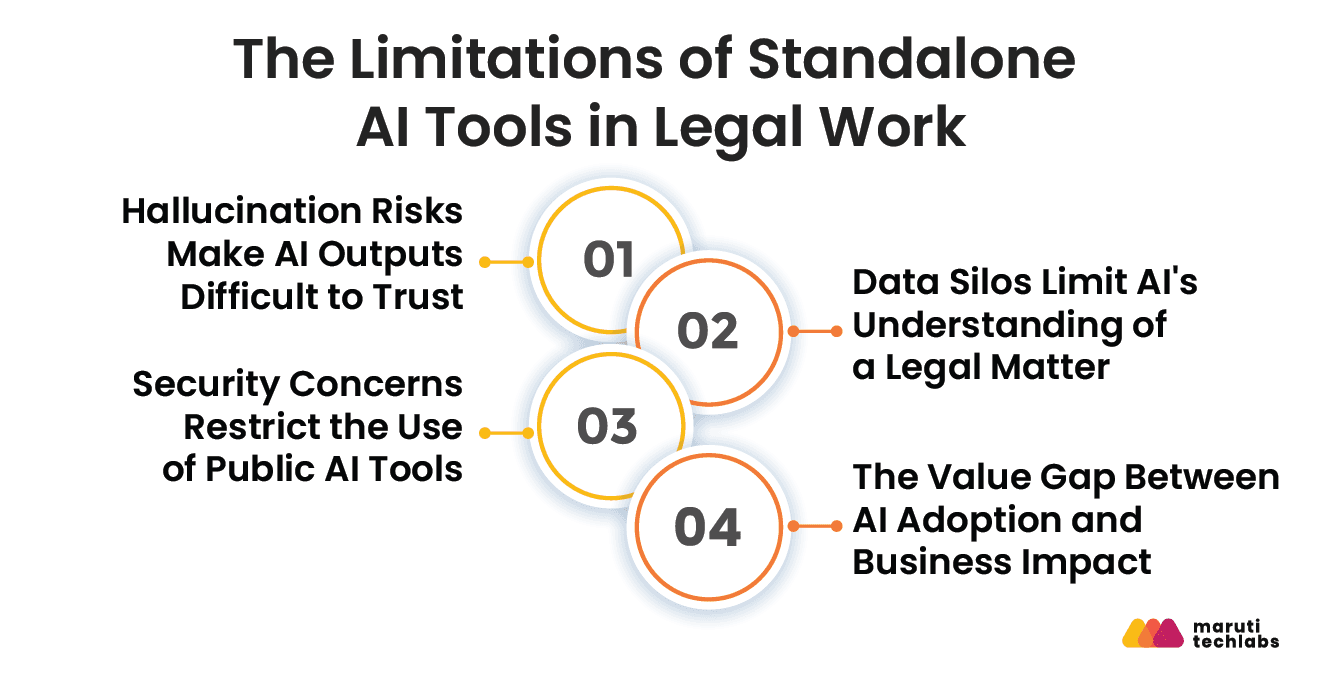
1. Hallucination Risks Make AI Outputs Difficult to Trust
Generic AI tools can struggle to understand the full context of a legal matter. Without access to trusted legal sources, internal documents, or firm-specific knowledge, they may generate outputs that require careful review before they can be used.
Research from the Stanford Institute for Human-Centered Artificial Intelligence also highlights the importance of evaluating AI reliability and maintaining human oversight when these systems are used in high-impact areas.
2. Data Silos Limit AI's Understanding of a Legal Matter
Legal matters often involve information spread across contracts, case files, emails, document repositories, and practice management systems. When these systems do not work together, lawyers have to move information manually between platforms, making it harder to maintain context throughout the matter.
3. Security Concerns Restrict the Use of Public AI Tools
Legal teams handle sensitive information that requires strict control and oversight. Standalone AI tools that are not built with appropriate security, governance, and access controls can make it harder for firms to maintain data protection standards and compliance obligations.
The American Bar Association has also highlighted the need for lawyers to understand the risks and responsibilities associated with using generative AI tools, including issues related to confidentiality, competence, and supervision.
4. The Value Gap Between AI Adoption and Business Impact
Adding more AI tools does not always lead to better legal operations. While individual applications may speed up specific tasks, firms often struggle to see broader improvements when those tools do not connect with existing systems, processes, and workflows.
How Connected AI Workflows Differ From Standalone AI Tools
The difference is not only in the technology being used, but in how these systems support legal work from start to finish.
Standalone AI Tools | Connected Agentic AI Workflows |
| Handle individual tasks such as research, summarization, or document review | Support connected workflows across multiple stages of legal work |
| Work with limited context from a single interaction | Maintain relevant context across documents, systems, and workflow steps |
| Require lawyers to manually move information between tools | Allow information to flow between connected systems and agents |
| Depend on users to provide prompts and instructions for each task | Allow specialized agents to coordinate defined steps within a workflow |
| Operate separately from existing legal technology | Integrate with existing systems, data sources, and processes |
| Focus on completing individual tasks | Focus on achieving broader legal objectives |
Moving From Standalone Tools to Connected AI Workflows
To solve these challenges, law firms are moving toward connected AI systems that allow information, workflows, and different AI capabilities to work together. Instead of managing separate tools, firms can build connected legal workflows. These workflows use relevant matter information, support multiple steps, and work alongside existing legal technology.
Building this kind of connected environment requires more than adding another AI application. It involves combining AI agents, software engineering, data integration, and security practices in a way that fits the firm's existing operations.
What Is Agentic AI in Legal Practic
Agentic AI in legal practice refers to systems that can break down objectives, coordinate tasks, use connected tools, and support multi-step legal workflows with limited manual intervention.
Unlike traditional generative AI (GenAI) chatbots that only respond to individual prompts or draft isolated blocks of text, agentic AI breaks down complex assignments, utilizes digital tools, self-corrects, and completes end-to-end tasks.
According to Mordor Intelligence, the agentic AI market in the legal and regulatory technology sector is expected to grow from USD 103.4 million in 2025 to USD 134.41 million in 2026 and reach USD 478.39 million by 2031.
What Integrated AI Infrastructure Looks Like
An integrated AI infrastructure connects legal data, systems, and AI capabilities into one environment so work can move without losing context. Instead of relying on separate applications, firms can create an environment where information stays connected, workflows remain secure, and different capabilities support each other.
Here are the key components:
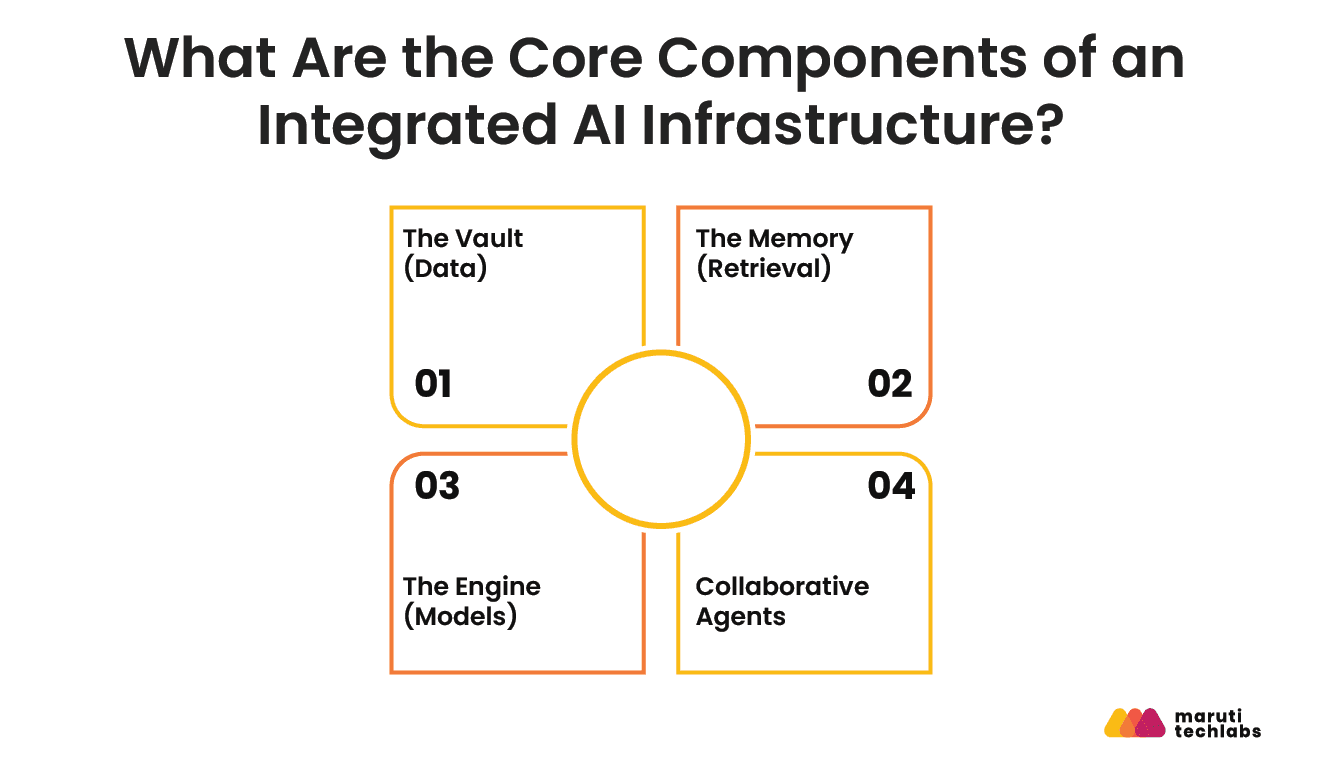
1. The Vault (Data): Keeping Legal Information Secure
The foundation starts with secure access to firm information. This includes connecting with document management platforms such as iManage and NetDocuments, along with practice management systems and internal repositories, while maintaining confidentiality, user permissions, and strict access controls.
2. The Memory (Retrieval): Bringing the Right Context Into Each Task
Retrieval-augmented generation (RAG) helps systems find relevant information from firm files, precedents, and matter history before generating responses. This allows legal teams to work with outputs supported by relevant sources and verifiable citations.
3. The Engine (Models): Using the Right Capability for Each Task
Different legal activities require different capabilities. A flexible setup allows firms to use suitable models for tasks such as research, drafting, and document review instead of depending on one platform for everything.
4. Collaborative Agents: Connecting Multiple Steps of Legal Work
Agentic systems allow specialized agents to handle different parts of a workflow while using shared information. This helps complex tasks move forward without requiring lawyers to coordinate every step manually.
Bringing these components together requires thoughtful system design, secure integrations, and governance. When these foundations are in place, legal teams can move from isolated AI tools to connected workflows.
How Does an Agentic AI Legal Workflow Work
An agentic AI workflow starts with a legal objective and breaks it into smaller tasks handled by specialized agents. Instead of relying on one tool to complete everything, the workflow allows different agents to contribute at different stages while maintaining the necessary context.
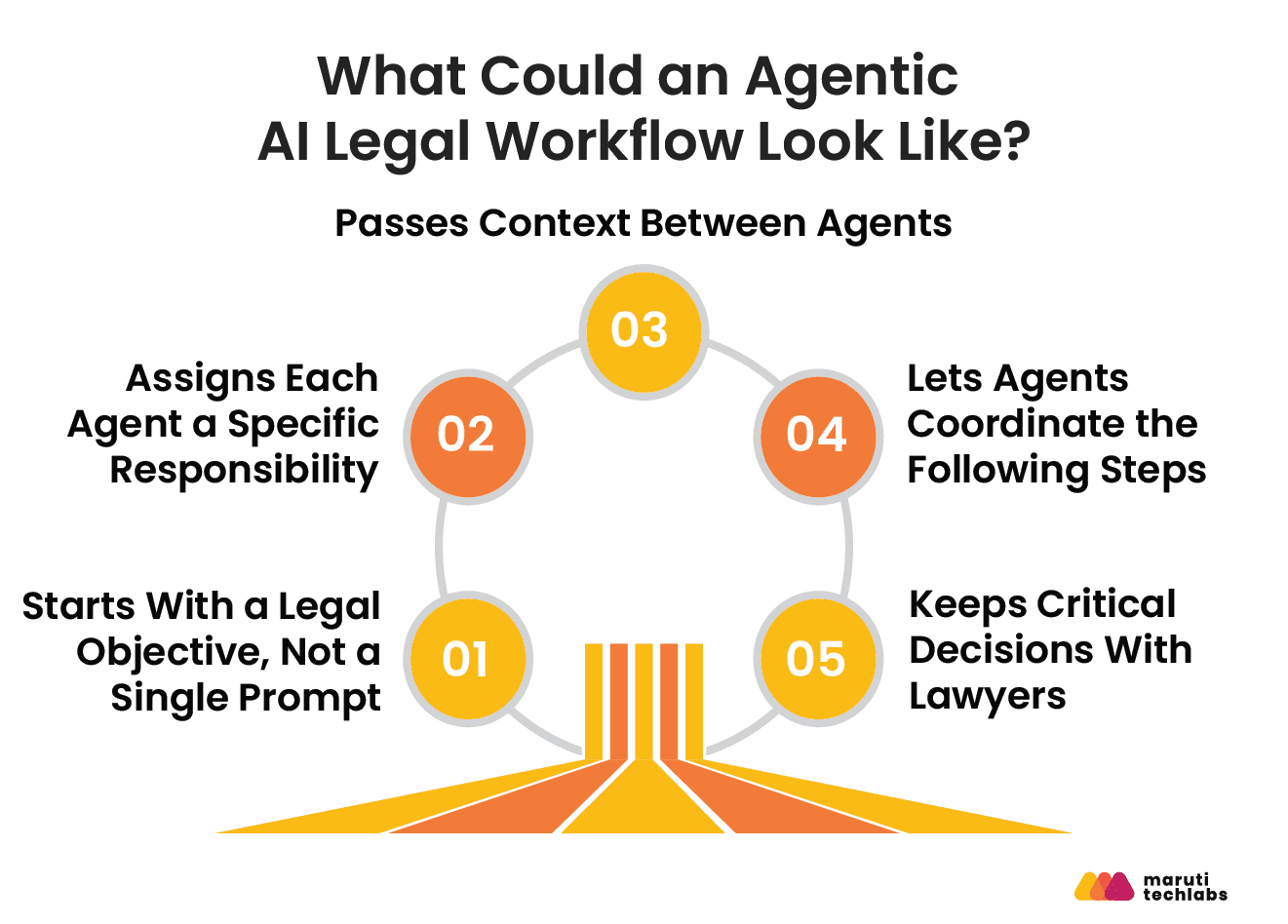
1. Starts With a Legal Objective, Not a Single Prompt
An agentic workflow begins with a wider goal, such as reviewing a commercial agreement or preparing for due diligence. The system identifies the required steps and determines which agent or tool should support each stage.
2. Assigns Each Agent a Specific Responsibility
Different agents can focus on different activities. One may conduct research, while another reviews documents and identifies possible risks. This approach allows each agent to perform a specific role instead of expecting one system to manage every part of the process.
3. Passes Context Between Agents
Once one agent completes its task, the relevant information moves to the next stage. Take a commercial contract review as an example. One agent identifies important clauses, another checks them against the firm's internal playbooks, and a third prepares a summary. The lawyer reviews the findings before sharing advice with the client.
4. Lets Agents Coordinate the Following Steps
The workflow can determine what should happen based on previous findings. For example, identifying an unusual clause during document review may trigger additional research before recommendations are prepared.
5. Keeps Critical Decisions With Lawyers
Agentic workflows help legal teams handle time-consuming tasks while keeping lawyers involved in critical decisions. They support activities like research, analysis, preparation, and verification, with defined review points for professional supervision.
A successful workflow depends on how well these AI agents work with existing systems, share relevant information, and keep lawyers involved where professional judgment matters.
How Does Agentic AI Benefit Legal Firms
Agentic AI can help legal teams improve how work moves across the firm by reducing unnecessary coordination, improving access to information, and supporting more consistent processes. These benefits help firms identify where connected AI workflows can create practical improvements.
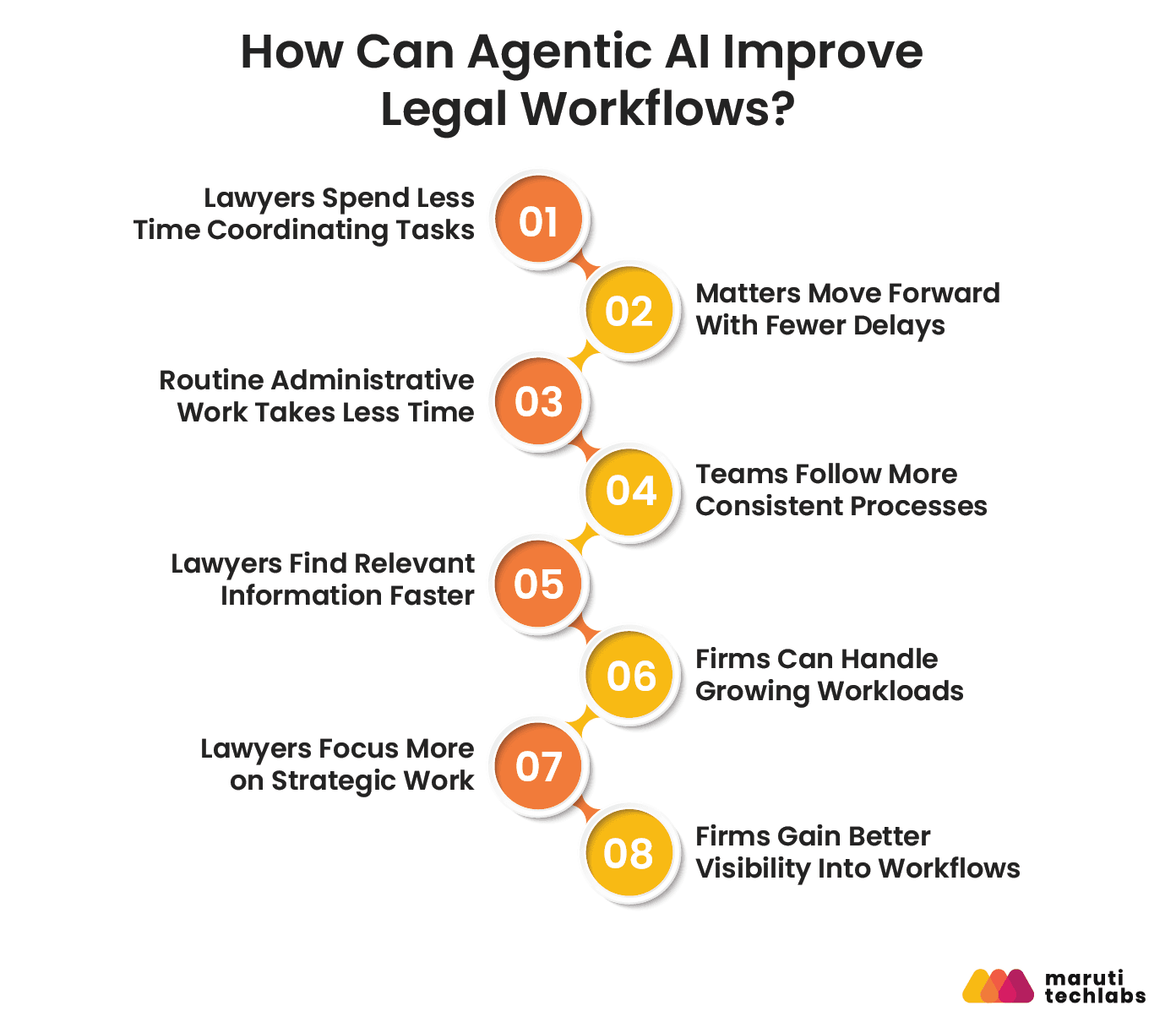
1. Lawyers Spend Less Time Coordinating Tasks
Legal work often involves multiple people, systems, and review stages. Connected workflows help reduce the effort required to move information between these points, allowing lawyers and staff to spend more time on activities that require their expertise.
2. Matters Move Forward With Fewer Delays
Many legal tasks slow down when information waits between different stages of a matter. Connected workflows help teams move research, analysis, drafting, and review forward with fewer interruptions.
3. Routine Administrative Work Takes Less Time
Legal teams spend significant time organizing documents, preparing summaries, updating records, and managing routine follow-ups. Simplifying these activities helps reduce administrative workload and allows teams to focus on more complex legal responsibilities.
4. Teams Follow More Consistent Processes
Legal matters often involve different teams, review requirements, and documentation standards. Connected workflows help firms create more consistent processes across matters while still allowing lawyers to apply their judgment when needed.
5. Lawyers Find Relevant Information Faster
Legal information is often distributed across documents, repositories, and internal systems. Bringing relevant information together at the right stage helps lawyers spend less time searching and more time reviewing, analyzing, and making informed decisions.
6. Firms Can Handle Growing Workloads
As firms manage more contracts, documents, and due diligence requests, maintaining efficiency becomes challenging. Connected workflows help support repeatable activities at scale while allowing legal teams to focus their expertise where it matters most.
7. Lawyers Focus More on Strategic Work
The goal of agentic workflows is not to replace legal professionals but to support them. By reducing routine workload across research, preparation, analysis, and documentation, lawyers can spend more time on strategy, negotiation, client advisory, legal analytics, and the new era of informed decision-making.
Firms Gain Better Visibility Into Workflows
Understanding how work progresses is important for legal teams managing complex matters. Connected workflows can provide clearer visibility into completed tasks, reviewed information, and decision points, helping firms strengthen monitoring and governance.
Implementing agentic workflows requires understanding legal processes, integrating the right technologies, and designing workflows that fit how teams actually work.
The biggest gains come from improving how legal work moves across the firm, not simply introducing more AI tools. That's why many firms are focusing on connected workflows rather than adding another standalone application.
How to Get Started with Agentic AI
Moving to agentic AI does not require replacing every existing system at once. The most effective approach is to start with the workflows where connected AI can create measurable improvements and expand from there.
Step | What Law Firms Should Consider |
| Identify the Right Workflow | Start with processes that involve repetitive tasks, large volumes of information, or multiple review stages, such as legal research, contract review, or due diligence. |
| Evaluate Existing Systems and Data | Understand where relevant information is stored, including document management systems, practice management platforms, and internal repositories. |
| Define Agent Responsibilities | Determine which tasks require automation, where agents can support the workflow, and where lawyer review should remain part of the process. |
| Start Small and Expand | Begin with one high-value area, evaluate the results, and expand adoption based on what works best for the firm. |
| Build Secure Integrations | Connect AI capabilities with existing technology environments while maintaining permissions, confidentiality, and governance requirements. |
| Measure Business Outcomes | Track improvements through metrics such as research time, document processing speed, manual effort, and team productivity. |
Conclusion
The future of legal AI is about creating workflows where the right AI capabilities work together, share context, and move matters forward while lawyers remain in control of important decisions.
Agentic AI for law firms helps connect research, analysis, drafting, review, and other stages into a more coordinated process. The firms that benefit most won't necessarily be those using the most AI tools. They will be the ones that know where AI belongs, how those systems should work together, and where human judgment must remain part of the process.
As legal work continues to evolve, firms will need technology that fits naturally into their existing processes. The biggest advantage will come from reducing unnecessary effort, improving how teams work, and giving lawyers more time for tasks that require experience and judgment.
Connected AI workflows require more than AI models. They rely on thoughtful engineering, secure integrations, and an understanding of how legal teams work. The following example shows how Maruti Techlabs applied these principles to solve a real legal research challenge.
How Maruti Techlabs Helped a National Law Firm Reduce Legal Research Time by 60%
One of our clients, a national law firm with 475 attorneys across 17 offices, wanted to improve its legal research process. Attorneys spent significant time searching across multiple research sources before they could begin legal analysis. The firm needed a faster way to find reliable information while maintaining consistency across teams.
Maruti Techlabs developed a customized legal research solution that streamlined information gathering, improved research quality, and reduced repetitive manual effort. Attorneys spent less time searching across sources and more time reviewing relevant findings. As a result, the firm reduced research time by 60%, improved insight accuracy by 3x, and increased team productivity by 40%.
This implementation highlights why connected legal AI workflows require the right combination of AI capabilities, software engineering, integrations, and security practices.
Maruti Techlabs helps organizations develop secure AI solutions through our AI development services, designed to integrate with existing systems, workflows, and business requirements.
For firms looking to automate complex legal processes, our AI agent development services help create specialized agents that support multi-step workflows while keeping lawyers involved in critical decisions.
Let's Design the Right AI Foundation
Our team can help you design an AI architecture that fits your legal workflows, technology stack, and business objectives.
FAQs
1. What is the difference between standalone legal AI tools and agentic AI workflows?
Standalone legal AI tools typically handle individual tasks such as research, summarization, or contract analysis. Agentic AI workflows connect multiple specialized agents that can execute sequential tasks, exchange context, use approved tools, and escalate decisions to lawyers. The key difference is workflow orchestration instead of isolated task automation.
2. How do AI agents hand off information and context to one another in a legal workflow?
An AI agent passes relevant outputs, context, instructions, evidence, and source information to the next agent. For example, a research agent can provide authorities and findings to an analysis agent, which then uses them for the next step. This lowers manual information transfer and keeps the workflow connected.
3. Which legal workflows are best suited for agentic AI?
Agentic AI works best for workflows involving multiple repeatable steps, large volumes of information, and defined decision points. Strong candidates include contract review, legal research, due diligence, litigation support, regulatory monitoring, document preparation, compliance, and client intake. Firms ought to prioritize workflows with measurable efficiency or service improvements.
4. How can law firms connect AI agents with their existing legal software and systems?
Law firms can connect AI agents to existing systems through APIs, secure integrations, data connectors, and orchestration platforms. Depending on the workflow, agents can interact with document management, practice management, CRM, research, billing, and other legal systems while following defined permissions and security controls.
5. What ROI can a law firm realistically expect from agentic AI?
ROI depends on the workflow being improved and the firm’s goals. Firms should measure outcomes such as reduced research time, faster document processing, lower manual effort, and improved productivity. The value comes from helping legal teams spend less time on repetitive tasks and more time on analysis, strategy, and client-focused work.
6. How can law firms ensure AI agents maintain client confidentiality and data security?
Security should be considered from the beginning of any legal AI implementation. Firms should use secure integrations, access controls, data protection practices, and governance frameworks to maintain control over sensitive client information while using AI within their existing technology environment.
7. How can law firms measure the success of an agentic AI implementation?
Success should be linked to practical improvements in daily operations. Firms can measure factors such as reduced research time, faster document review, lower manual effort, improved consistency, and better team productivity. The goal is to create measurable improvements that support both legal teams and client service.




![[GetPaidStock.com]-65b9d3432ecc1.webp](https://cdn.marutitech.com/small_Get_Paid_Stock_com_65b9d3432ecc1_c1b16b05fb.webp)


