

How to Build a Data Marketplace: Steps, Tools, and Best Practices
Key Takeaways
- A data marketplace is a platform where providers publish datasets and consumers find, license, and access them.
- It can be internal (across teams) or external (sold to customers and partners).
- Build one in 8 steps, from defining scope to monitoring usage.
- Snowflake, AWS Data Exchange, and Databricks let buyers query live data without copying it.
- The hardest problems are cold start, pricing, privacy rules, and schema changes.
Introduction
Most organizations already own data that other teams, partners, or customers could use. The problem is access. Datasets sit in departmental databases, nobody knows who owns them, and every request turns into a ticket for data engineering.
A data marketplace fixes that. Providers get one place to publish trusted data products, and consumers get one place to find, license, and use them. Demand is rising fast: the data marketplace platform market is about $1.5 billion in 2024 and is projected to reach $5.7 billion by 2030.
Picking Snowflake or AWS is the easy part. The harder work is quality, data governance, pricing, and getting the first users through the door. Data analytics consulting services can help you assess your data infrastructure, define your marketplace requirements, and choose an approach that supports your business goals.
This guide covers how a data marketplace works, which platforms to build on, and an eight-step plan to launch one.

Our data engineering team can help you choose a platform, set governance rules, and launch your first 20 data products.
What Is a Data Marketplace?
A data marketplace is a platform where data providers publish datasets and data consumers find, evaluate, license, and access them. It works like an online marketplace, except the product is data rather than goods or services. The goal is to make trusted data easy to discover and easy to obtain, with licensing and access rules enforced by the platform.
Internal vs. External Data Marketplaces
An internal data marketplace serves teams within your organization. Engineers, analysts, and data scientists can discover and access trusted datasets without filing support tickets or waiting on data engineering.
An external data marketplace lets your organization sell or share data products with paying customers, partners, or the public. Many large enterprises build internal first and extend to external as their governance matures.
| Criteria | Internal marketplace | External marketplace |
| Audience | Employees and internal teams | Customers, partners, or the public |
| Main goal | Self-service access, fewer silos, faster analytics and AI/ML | Revenue from data products, partner ecosystems |
| Payments | Often none, or internal chargeback | Subscriptions, usage-based pricing, one-time sales |
| Governance focus | Internal access policies, lineage, quality standards | Licensing agreements, stricter privacy controls, since data leaves your boundary |
| Examples | Airbnb Dataportal and Lyft Amundsen (data discovery platforms) | AWS Data Exchange, Snowflake Marketplace, Bloomberg Data License |
Airbnb built Dataportal, an internal data catalog, so employees could find and trust data across a fast-growing warehouse.
Lyft built Amundsen for the same discovery problem, then open-sourced it; it is now an incubation-stage project of the LF AI & Data Foundation. Both are closer to data catalogs than full marketplaces, which makes them useful internal models: the discovery layer comes first, and transactions can be added later.
What Are the 4 Key Requirements of a Data Marketplace?
A data marketplace needs four things to work: data quality and integrity, security and privacy, user accessibility, and transaction management. Each one below includes how to implement it.
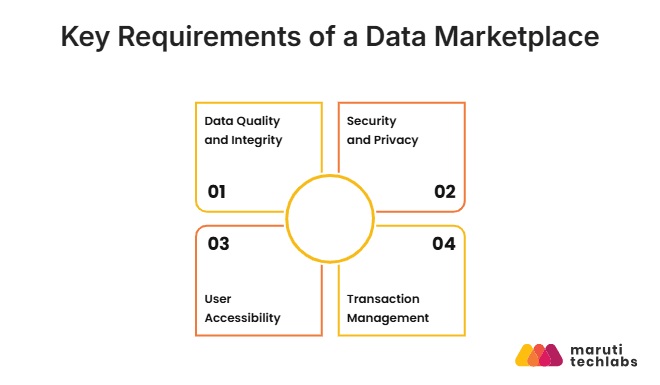
1. Data Quality and Integrity
Datasets should be accurate, documented, and published in standard formats and schemas.
Implementation: Use a data catalog tool, like DataHub or Alation or Apache Atlas to make sure metadata follows the rules everywhere. Run automated profiling on ingestion, checking column-level completeness, uniqueness, and format, so buyers see a quality score before they purchase.
Platforms add their own controls: AWS Data Exchange requires providers to complete onboarding before they can publish data products, Snowflake's Provider Studio lets providers manage listings and monitor usage, and Bloomberg offers a Virtual Data Room where buyers can explore bulk datasets before purchasing.
2. Security and Privacy
The marketplace must protect sensitive data and follow privacy laws, including GDPR.
Implementation: Start by identifying which datasets contain personal data, then apply technical controls such as anonymization, pseudonymization, and consent management. Keep in mind that pseudonymized data generally remains personal data under GDPR.
If the marketplace handles protected health information in the US, every business associate that handles it needs a HIPAA Business Associate Agreement. Role-based access control (RBAC) at the dataset level is the minimum. Attribute-based access control (ABAC) fits marketplaces with several buyer types and complex permissions.
3. User Accessibility
Discoverability is the requirement teams underestimate most. A marketplace with 10,000 datasets is useless if buyers cannot find the one they need.
Implementation: Offer faceted search (filter by industry, geography, update frequency, and data type), natural language search that lets buyers describe what they need, and recommendations based on browsing and purchase history. A focused UI/UX design pass on the storefront pays off here, and recommendation engines are a typical custom AI/ML development task.
4. Transaction Management
This requirement covers three separate layers.
a) Licensing model
Subscriptions suit recurring data feeds. Usage-based pricing (per query, per API call, or per row) suits analytics data. One-time purchases suit static datasets. Freemium offers a free sample with a paid full dataset.
b) Payment infrastructure
On cloud-native platforms, use the built-in billing layer instead of building payments from scratch. Snowflake paid listings support flat-fee and usage-based plans, with provider payouts handled through Stripe. AWS Data Exchange uses AWS Marketplace billing. For a custom marketplace, Stripe Billing supports usage-based pricing through meters.
c) Data licensing
Work with legal counsel on standard terms covering permitted uses, redistribution rights, retention periods, and indemnification. Most enterprises tier this: a click-wrap license for lower-value datasets and a negotiated master data licensing agreement for high-value proprietary products.
How Does a Data Marketplace Work?
A data marketplace works in six steps: providers list data, buyers search for it, validate it with previews, complete a transaction, receive the data, and get ongoing updates. The cycle mirrors an e-commerce platform, with extra focus on licensing and delivery.
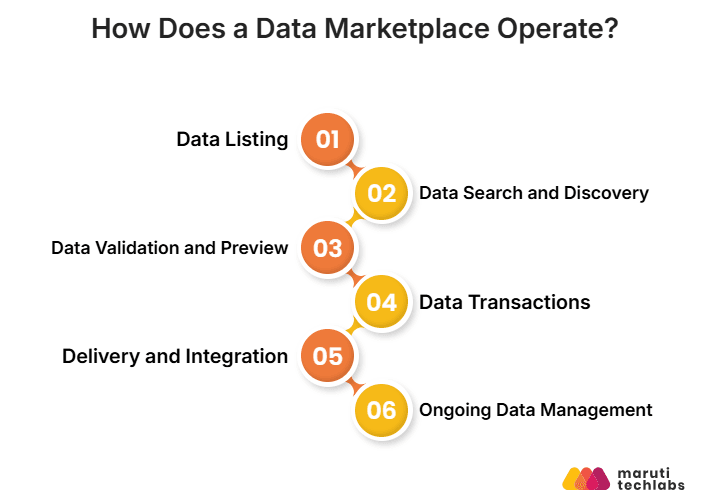
1. Data Listing
Providers list datasets, with metadata that explains what the data is, how it is formatted and where it can be used. These datasets are sorted by industry, data type and licensing terms to make them easier to find.
2. Data Search and Discovery
Buyers search and filter by industry, keyword, or data type. Many platforms add AI-based recommendations to surface relevant datasets.
3. Data Validation and Preview
Buyers test quality before they pay, using sample datasets, schema previews, or sample queries. Some marketplaces also certify providers or datasets.
4. Data Transactions
Buyers accept licensing terms and pay by one-time purchase, subscription, or usage. The platform's billing and entitlement layer automates transactions. Snowflake Marketplace handles paid listings through its own listing and billing system, with payouts through Stripe.
AWS Data Exchange uses AWS Marketplace billing. Custom marketplaces typically integrate Stripe or a similar payment provider. Smart contracts are used in blockchain-based data marketplaces such as Ocean Protocol, but the major enterprise platforms do not rely on them.
5. Delivery and Integration
Delivery decides whether data is usable. The main patterns are direct download, API access, and, increasingly, zero-copy sharing, where the buyer queries a live, read-only view of the provider's data without copying it. Several platforms support this:
- Snowflake consumers query the provider's live data through a shared database.
- BigQuery sharing (formerly Analytics Hub) gives subscribers linked datasets that point to the shared data without replication.
- AWS Data Exchange offers in-place, read-only access to a provider's Amazon S3 data and to Amazon Redshift data shares.
- Databricks Marketplace uses Delta Sharing, which also works with non-Databricks tools such as Power BI, pandas, and Apache Spark.
Zero-copy sharing keeps data current, avoids duplicate storage, and lets the provider control exactly what is visible. It has limits. Snowflake sharing is zero-copy within a region; when a listing reaches consumers in other regions or clouds, Snowflake replicates the data through Cross-Cloud Auto-Fulfillment, and the provider pays for the storage, compute, and data transfer involved.
Azure Data Share is mostly snapshot-based, with in-place sharing available only for Azure Data Explorer. Consumers also pay for the compute they use to query shared data.
6. Ongoing Data Management
Buyers subscribe to updates and alerts, and providers monitor usage, quality issues, and feedback to keep products current.
What Are the 4 Key Benefits of Building Your Own Data Marketplace?
Building your own data marketplace gives you new revenue from proprietary data, consistent governance, better collaboration and AI adoption, and a compounding competitive advantage.
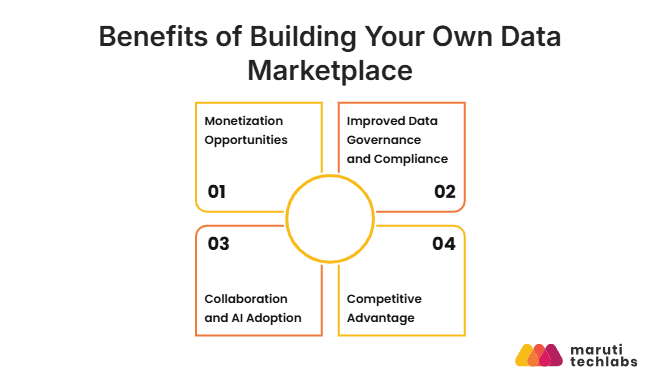
1. Monetization Opportunities
You can package and sell proprietary data, such as transaction records, IoT sensor data, consumer behavior data, or original research. Bloomberg is a well-known example: it sells data as a product through Bloomberg Data License. A marketplace is how an organization starts building that kind of business: one place to list products, set pricing, and manage licenses.
2. Improved Data Governance and Compliance
Without a marketplace, governance is only as strong as the weakest team's practices. With one, access controls, lineage tracking, and quality standards are enforced at the platform layer and applied to every dataset and transaction. That shortens audit preparation and reduces compliance risk, particularly under GDPR, HIPAA, or financial data rules.
3. Collaboration and AI Adoption
Data access and data readiness are common reasons AI projects stall, as the Gartner figures above show. When ML engineers can find and access curated training data through self-service instead of filing requests with data engineering, projects spend less time waiting on data. Shared, documented datasets also cut duplicate work across teams.
4. Competitive Advantage
A marketplace can build a flywheel. More data products attract more consumers, usage data shows which products deliver value, and that feedback improves the products.
Not sure where your data stands? An AI strategy and readiness assessment is a practical first step.
Should You Build a Data Marketplace or List Your Data in an Existing One?
Build on a cloud platform when you want control over the buyer experience, and list in an established marketplace when you want access to existing buyers. Most organizations end up doing both, for different purposes.
Weigh technical feasibility before you commit to a custom build. Platforms in Category A are the technology for building your own marketplace experience. Marketplaces in Category B are distribution channels with existing buyers.
Category A: Platforms for Building Your Own Data Marketplace
| Platform | Best for | How sharing works |
| Snowflake (Marketplace and Secure Data Sharing) | Analytics data, live sharing between Snowflake accounts | Consumers query the provider's live data; zero-copy within a region, replicated across regions or clouds |
| AWS Data Exchange | Teams on AWS; S3, Redshift, and API delivery | In-place read-only access to S3 data and Redshift data shares, plus API assets |
| Databricks (Marketplace and Delta Sharing) | AI/ML data products and Delta tables | Delta Sharing; provider needs a Unity Catalog-enabled workspace; open connectors reach non-Databricks tools |
| BigQuery sharing (formerly Analytics Hub) | Google Cloud teams | Linked, read-only datasets; no replication; can be monetized via Google Cloud Marketplace or your own channels |
| Azure Data Share and Microsoft Fabric | Azure-centric organizations | Azure Data Share is snapshot-based, with in-place sharing for Azure Data Explorer only. Microsoft's Purview Data Sharing preview was retired, with support until September 2025, and Microsoft points users to Fabric external data sharing. |
| Informatica (now part of Salesforce) | Catalog, data quality, governance, lineage | Metadata and governance layer rather than a sharing engine |
How Do Marketplace Platforms Charge Providers and Consumers?
Snowflake pricing has two sides.
- Consumers pay for the warehouse credits they use to query shared data, plus the listing price if the product is paid.
- Providers can publish free listings or paid listings using a subscription (flat fee) or a usage-based plan that combines a monthly fee, a per-query fee, or billable events.
Category B: Established Marketplaces to List Your Data In
- AWS Data Exchange: reaches AWS customers. Listing and publishing cost nothing; AWS takes a 3% fee when a public offer settles. Providers must register as an AWS Marketplace seller and complete data provider onboarding. AWS fee schedule
- Snowflake Marketplace: reaches Snowflake users, with free, trial, and paid listings.
- Databricks Marketplace: reaches Databricks users and, through Delta Sharing, users of other tools.
- Azure Marketplace: offers datasets, APIs, and ML models inside the Azure ecosystem.
- Google Cloud Public Datasets: public datasets for analysis in Google Cloud, without moving the data.
- Kaggle Datasets: community-shared datasets for data science and ML.
A common pattern is to build an internal marketplace on your own platform for employees and trusted partners, then list selected data products in one or two external marketplaces to reach buyers you do not already know.
How Do You Build a Data Marketplace in 8 Steps?
Build a data marketplace in eight steps: define scope, inventory your data assets, set governance, choose a platform, build the catalog, configure access and monetization, onboard providers, and monitor results. The steps work for internal and external marketplaces; where the two differ, the step says so.
Step 1: Define Scope (Internal, External, or Hybrid)
Decide who the marketplace serves before you make any technology decision. An internal marketplace serves analysts, data scientists, and engineers who need self-service access. An external marketplace lets outside buyers purchase or access your data products. A hybrid starts internally and extends to trusted partners.
Each scope calls for a different governance model, security architecture, and monetization approach. A structured scoping session with stakeholders helps settle this early.
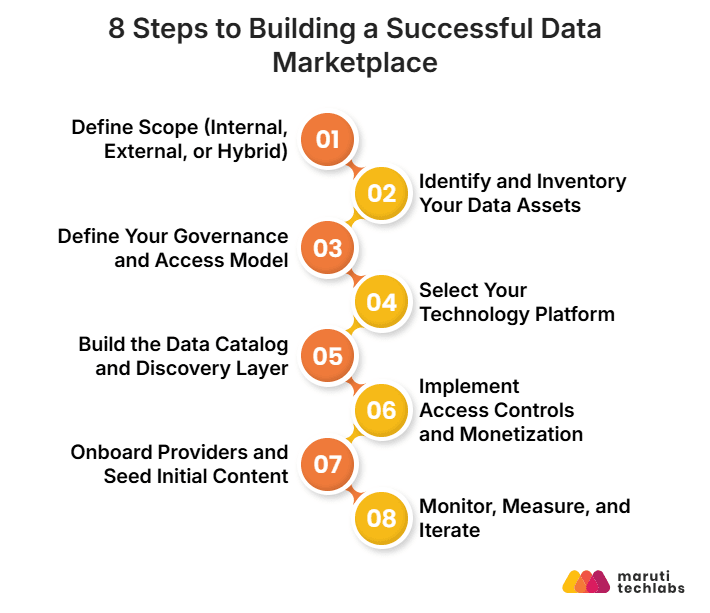
Step 2: Identify and Inventory Your Data Assets
Audit what data you have, how good it is, and what value it holds for other teams or outside buyers. Use a data catalog (DataHub, Alation, or Apache Atlas) to record each dataset's owner, update frequency, schema, lineage, sensitivity, and potential use cases.
This inventory becomes your first product catalog. Start with 10-20 high-quality datasets instead of cataloging everything at once. If you are unsure how ready your data is, take a data maturity assessment.
Step 3: Define Your Governance and Access Model
Set out who can publish (providers), who can access (consumers), and on what terms. Define data classification tiers (public, internal, confidential, restricted) and map access controls to each tier. Write down your quality standards: what must be true of a dataset before it can be published. For external marketplaces, agree the data licensing template with legal counsel before you publish anything.
Step 4: Select Your Technology Platform
- Snowflake: strong for analytics data and live sharing between Snowflake accounts.
- AWS Data Exchange: the broadest reach inside the AWS ecosystem.
- Databricks: suited to AI/ML data products built on Delta tables.
- BigQuery sharing: a fit for Google Cloud environments.
- Custom build: combine a data catalog (DataHub or Alation), cloud storage (S3, Azure Data Lake, or GCS), an API gateway (Kong or Apigee), billing (Stripe), and governance (Apache Ranger or native cloud IAM). Open-source frameworks cut license costs but need engineers to run them.
Step 5: Build the Data Catalog and Discovery Layer
The catalog is the marketplace's storefront. Every dataset needs a name and description, schema documentation, lineage, quality metrics (completeness and accuracy scores), usage terms and licensing, update frequency, and a sample or preview. Add faceted search and recommendations. Poor discoverability is a common reason marketplace adoption fails, so invest more here than anywhere else.
Step 6: Implement Access Controls and Monetization
Configure role-based access control at the dataset level, backed by identity and access management. For external monetization, set the pricing model (subscription, usage-based, or one-time) and connect billing.
Test the full buyer journey with structured quality engineering checks: discovery, preview, purchase, access, ingestion, and use. Remove every point of friction, because each extra step costs conversions. For an internal marketplace, "monetization" may mean an internal chargeback model instead of payment processing.
Step 7: Onboard Providers and Seed Initial Content
A marketplace without content has no users.
For an external marketplace, recruit three to five anchor providers whose products will attract buyers. For an internal one, find the 10-15 datasets that data engineering is asked for most often and publish those first.
Give providers a self-service publishing workflow, since the easier it is to publish, the more content you will attract. Publish clear guidelines for metadata quality, update SLAs, and licensing terms.
Step 8: Monitor, Measure, and Iterate
Define success metrics up front:
- Discovery rate: do buyers find what they need?
- Time to data: how long from discovery to first query?
- Provider publication rate: are providers adding new datasets?
- Consumer satisfaction: NPS or feedback ratings.
- Revenue per active consumer (external marketplaces).
Track usage on every dataset: which are accessed most, which see high abandonment after preview, and which consumers get the most value. Use the data to decide which datasets to acquire next and which to retire.
What Are the Challenges of Building a Data Marketplace?
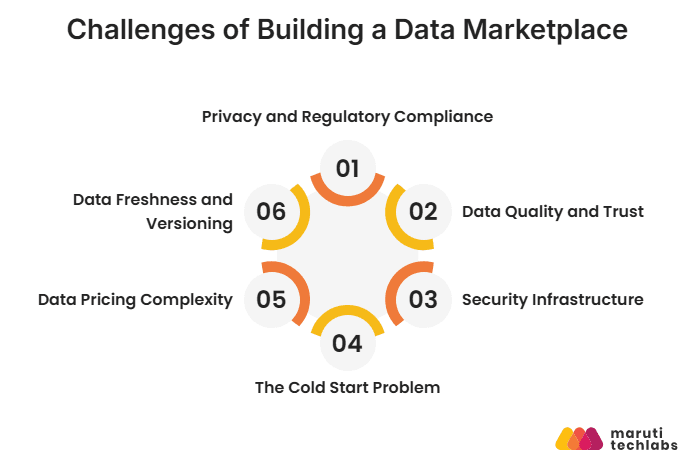
The main challenges are privacy and regulatory compliance, data quality and trust, security, the cold start problem, pricing, and data freshness and versioning. Each one below includes ways to handle it.
1. Privacy and Regulatory Compliance
Marketplaces operate across jurisdictions with different rules: GDPR in the EU, CCPA in California, LGPD in Brazil, and PDPA in Singapore. A common failure is assuming that anonymized data is always safe to share. Under GDPR, data that can be re-identified, including by combining it with other datasets, is still personal data.
The danger increases when buyers mix marketplace data with their own. Use methods like differential privacy, for datasets that have information and do re-identification risk checks before you share anything that could have personal details.
2. Data Quality and Trust
Quality in a marketplace is continuous, not a one-time check. Three issues matter most.
- Data drift. A dataset that was accurate at publication degrades if the source changes and nobody updates it. Monitor freshness automatically and require providers to publish updated cadences and SLAs.
- Provider accountability. Quality varies across providers. Add consumer ratings and reviews, and a dispute process for quality problems.
- Trust for new providers. A provider with no track record struggles to win buyers. A certification program or a review process for featured data products helps good providers get early visibility.
3. Security Infrastructure
Standard controls apply: encryption in transit and at rest, authentication, and regular security audits. Marketplaces add a risk that ordinary data platforms handle less often. A buyer with legitimate access to one dataset may probe for information about datasets they have not bought, or pull far more than their license intends through repeated queries.
Dataset-level permissions do not catch this. Add query-level access controls, monitor for unusual query patterns, and review access logs on a schedule.
4. The Cold Start Problem
Providers will not publish without buyers, and buyers will not join without data. Four tactics help:
- Seed the marketplace with your own high-value datasets, free or low-cost, to attract early consumers.
- Recruit two or three well-known anchor providers whose presence draws buyers.
- Start with a vertical focus, such as financial services or healthcare, so critical mass is easier to reach.
- Go internal first. Many external marketplaces began as internal platforms that proved their value.
5. Data Pricing Complexity
The value of a dataset depends on who is buying. A traffic pattern dataset is worth little to a retail marketing team and a lot to a logistics company optimizing delivery routes. Three approaches work:
- Usage-based pricing (per API call, row, or query) ties price to value but needs metered billing.
- Tiered subscriptions separate casual users from heavy users.
- Value-based pricing for exclusive or proprietary data: negotiate based on the buyer's quantified business value, not your cost of collecting the data.
Start with a simple model and add complexity once you see how buyers use the data.
6. Data Freshness and Versioning
Consumers build systems and models on marketplace data. When a provider adds a column, renames a field, or changes a data type, downstream systems break. Treat dataset schemas like API versions: version them strictly and announce deprecations well before changes take effect.
Automated schema checks in CI/CD pipelines, set up through DevOps practices, catch breaking changes before they ship. Zero-copy sharing keeps data live and provider-managed, which reduces some of this risk, but schema governance is still required to prevent breaking changes.
What Are the Best Practices for Building a Successful Data Marketplace?
Four practices matter most: treat data quality and metadata as product features, apply least privilege and monitor queries, design for time to first value, and review data product health every month. They guide the decisions inside each build step.
1. Treat Data Quality and Metadata as Product Features
Data quality and metadata should be built into every data product, not added after publication. Data quality and metadata help users understand what a dataset contains, how recently it was updated, where it came from and whether it suits their intended use.
Document schemas, define data freshness commitments, and run automated quality checks to identify missing values, duplicates, and inconsistencies. Display quality indicators and assign clear ownership for resolving issues. These practices help users evaluate datasets before accessing or purchasing them and build trust in the marketplace over time.
2. Apply Least Privilege and Monitor Queries
No user or system should have access beyond what its role requires. For external marketplaces, add query-level monitoring on top of access controls. A buyer with legitimate access to a dataset can still extract more than intended through repeated or carefully built queries.
3. Design for Time to First Value
The useful UX metric is the time it takes a new user to go from finding a dataset to running a first successful query. Set a goal like under 30 minutes, for a marketplace and track onboarding to see where people stop using the system. Every step that needs approval or a support ticket adds time so remove as many manual steps as you can.
4. Review Data Product Health Every Month
Usage data shows what to fix. Datasets that are often previewed but rarely purchased point to a quality or pricing mismatch. Datasets accessed once and never again point to an onboarding or usability problem. A monthly review where low performers are improved, re-priced, or retired keeps the catalog lean and credible.
Conclusion
Building a data marketplace requires a clear strategy for data discovery, quality, governance, security, and access. Organizations must also choose the right platform, define licensing and pricing models, and make it easy for providers to publish data and consumers to find and use it.
This guide's eight-step process provides a practical starting point, whether you want to improve internal data sharing or create new revenue streams from proprietary data. Start with a focused set of high-value datasets, establish quality and access standards, and expand based on user adoption and business results.
A data marketplace's long-term success depends on how the data marketplace serves its users and maintains trust in its data. With the architecture and ongoing management the data marketplace can become a valuable foundation for better decision‑making, collaboration and AI initiatives.
How Maruti Techlabs Built a Data Platform for a UK Data-as-a-Service Startup
We built a centralized data analytics platform for a UK-based data-as-a-service startup in the recruitment industry. Workforce data sat in disconnected agency silos, and employers had no accurate view of what temporary labor actually cost them.
The team started with a seven-day discovery workshop that mapped requirements using the MoSCoW method. After that, the team designed the platform in Figma creating data flow diagrams. The team built the MVP step by step, showing demos and listening to client feedback. Finally, the team deployed the MVP on AWS using EC2 and RDS. Kept providing technical support.
Impact
- Faster onboarding and better retention: HR teams can see work history, achievements, and ratings in one place.
- Automated wage calculations: finance teams use real-time shift tracking that accounts for employment type, pension, National Insurance, and Working Time Regulations.
- Lower labor pay-outs: employers moved from fixed agency rate cards to actual employment costs, without disrupting operations.
- Stronger agency collaboration: agencies use key employee metrics to allocate workers and place better candidates.
- Higher worker voice and satisfaction: pulse surveys and native-language training improved work culture.
Why Choose Maruti Techlabs for Data Marketplace Planning?
Data marketplace decisions span data readiness, architecture, governance, access, discovery, and adoption. Maruti Techlabs can help teams assess their current data environment and define the requirements for a practical solution.
A data maturity assessment can help identify gaps in ownership, quality and data management before a platform decision is made. For organizations considering AI‑enabled search or recommendations, an AI strategy and readiness assessment can help evaluate whether AI‑enabled search or recommendations fit the data and business goals.
Starting with a clear use case is essential. A clear use case, plus an inventory of usable data and rules everyone agrees on for access and maintenance, makes the process smoother. When those decisions are solid, it becomes easier to decide whether to use a managed sharing platform, an established marketplace, or a custom build.
Assess your data maturity, identify gaps in data management, and establish a stronger foundation for building a scalable data marketplace.
Frequently Asked Questions
1. How Do You Measure the ROI of a Data Marketplace?
Measure ROI through reduced time spent finding and preparing data, lower data duplication costs, increased dataset usage, and revenue from paid data products. For internal marketplaces, track analyst productivity and faster project delivery. For external marketplaces, monitor subscription revenue, purchase rates, and revenue per data product.
2. Who Should Own a Data Marketplace Within an Organization?
Ownership typically involves a cross-functional team. A data product owner manages the catalog and business value, data engineers handle pipelines and integrations, governance teams define quality and access policies, and security teams oversee protection and compliance. A designated marketplace owner coordinates these responsibilities and tracks adoption.
3. How Do You Encourage Employees to Use an Internal Data Marketplace?
Begin with high-demand datasets that solve problems for employees. Provide documentation for datasets, reliable quality indicators for datasets, self-service access for datasets and intuitive search for datasets.
Integrate the marketplace into existing analytics workflows and collect user feedback to identify gaps. Adoption improves when employees can find and use trusted data more easily than through manual requests.
4. Can a Data Marketplace Integrate With Existing Data Warehouses and BI Tools?
Yes. A data marketplace can work with data warehouses, cloud storage, APIs, and business intelligence tools using connectors, APIs, and data-sharing capabilities. The best way to connect depends on the system, the types of data, how people need to access it and whether users want copies of the data or direct access to the data that is being shared.
5. What Happens When a Dataset Becomes Outdated or Is No Longer Available?
The marketplace needs to inform affected users, mark datasets that're no longer current, and keep update schedules and ownership details easy to find. When a dataset is taken out of service or its structure changes, the providers must give advance notice. Explain what alternatives are available.
Versioning, automated freshness checks, and deprecation policies help prevent disruptions to downstream reports, applications, and AI models.
6. How Much Does It Cost and How Long Does It Take to Build a Data Marketplace?
The cost and timeline depend on platform fees, catalog licenses, engineering effort, integrations and legal reviews. An internal data catalog MVP is generally simpler to build than a paid marketplace. An external paid marketplace also requires buyer onboarding, licensing and payment processing.
The core team typically includes a data product owner, data engineers, a governance lead, and a security specialist. Assessing your existing infrastructure and requirements helps define a realistic budget and delivery timeline. Actual Maruti Techlabs project ranges should be added once verified internal cost and timeline data is available.