

AI Transformation Is a Problem of Governance: A Practical Guide
Key Takeaways
- AI transformation is a problem of governance: most failures trace back to people and process gaps, not models.
- Every AI system needs a named business owner, clear approval rights, and defined points for human review.
- An effective AI transformation strategy ties each use case to a measurable business goal before anything gets built.
- A governance-first AI transformation roadmap moves through five stages: assess, build, verify, deploy, and monitor.
- AI transformation change management decides whether employees actually use what you deploy.
- Build governance in from day one. Adding controls after launch slows every rollout that follows.
Introduction
Your AI pilot worked. So why does scaling it across the enterprise remain a challenge?
Many organizations successfully demonstrate value through focused AI initiatives. The complexity begins when those initiatives need to operate across teams, systems, and business functions. Enterprise AI adoption requires governance structures, clear accountability, and processes that support responsible scaling.
Nearly 70% of AI transformation challenges come from people and process issues rather than technology limitations. As organizations move toward more autonomous AI systems, the need for governance becomes even more critical. 74% of enterprise leaders plan to deploy agentic AI within two years, yet only 21% of organizations have governance capabilities mature enough to manage these systems at scale.
This blog explores why AI transformation is fundamentally a governance challenge and how organizations can build the strategy, roadmap, and change management practices needed to scale AI responsibly.

We help organizations build governed AI systems with the right foundations for secure and scalable adoption.
What Is AI Transformation?
AI transformation is the process of changing how an organization works through integrating artificial intelligence into everyday business operations. It is not limited to implementing a new tool or automating a single workflow. Instead, it involves rethinking how teams perform tasks, how decisions are made, and how businesses create value using AI.
For many organizations, the AI journey starts with focused experiments in areas like customer support, document workflows, software development, or data analysis. But the real shift happens when these individual use cases move beyond isolated teams and become part of everyday business operations. This requires organizations to rethink workflows, align AI initiatives with business priorities, and create the processes needed for wider adoption.
When organizations move beyond isolated AI initiatives, they can automate repetitive work, uncover insights, improve customer interactions, and support better decisions. Technologies such as machine learning, generative AI, natural language processing, and computer vision make this possible, but success depends on more than technology alone. It requires the right combination of people, processes, data, and governance.
The organizations that successfully scale AI focus on three areas together:
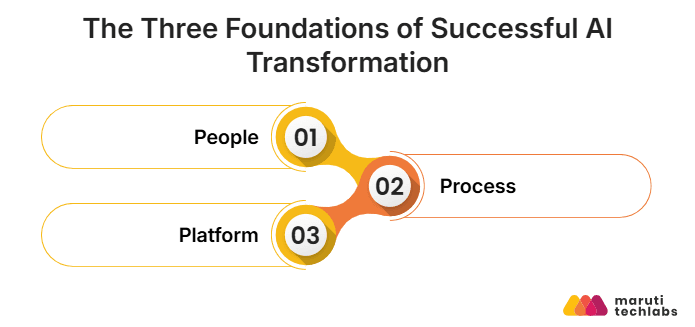
- People: Helping employees understand what is changing, how it affects their work, and how to use new capabilities effectively.
- Processes: Creating clear workflows, ownership models, and governance practices around AI usage.
- Platforms: Establishing the data, infrastructure, and systems required to deploy and scale AI applications.
The goal isn't simply to roll out AI across different teams. It is to create an operating model where technology, people, and processes work together to support better decisions and stronger business outcomes.
That is what makes AI different from traditional technology adoption. As organizations rely on it for more decisions and everyday operations, governance becomes essential for managing risk, maintaining accountability, and scaling with confidence.
Why AI Transformation Is a Problem of Governance
A successful AI pilot does not guarantee successful enterprise adoption. The real challenge begins when organizations try to expand a solution across teams, processes, and business functions. What works well for one team or one use case doesn't automatically work across multiple functions, processes, and stakeholders.
At that point, technology is no longer the biggest concern. Business leaders need answers to practical questions. Who owns each AI system? Who is responsible for the decisions it influences? How are risks identified and managed? Where should human review be part of the process? Without clear answers, even promising initiatives can lose momentum before they deliver organization-wide value.
The biggest challenges include:
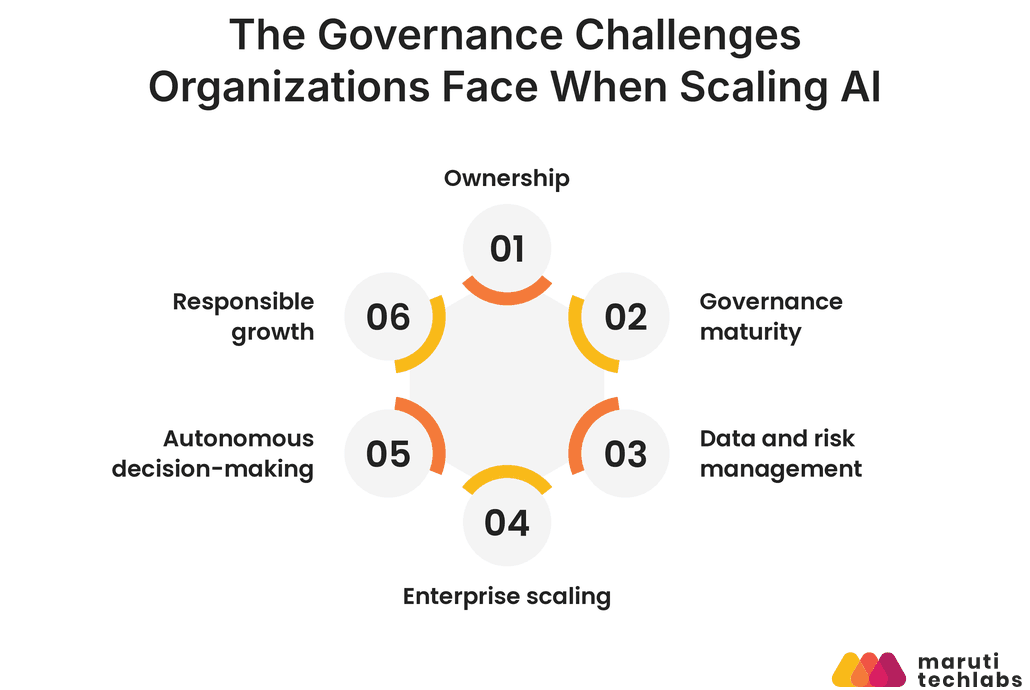
- Ownership: Every AI system needs clear ownership and accountability.
- Governance maturity: New AI initiatives often outpace the policies, controls, and oversight needed to manage them.
- Data and risk management: Organizations need clear controls around data access, privacy, security, and risk before expanding AI across different functions.
- Enterprise scaling: A use case that succeeds in one team needs common standards before it can be replicated across the organization.
- Autonomous decision-making: As agentic AI becomes more common, organizations need stronger monitoring, review processes, and clear risk boundaries.
- Responsible growth: Governance provides the structure needed to scale AI securely, consistently, and with confidence.
This challenge is becoming more visible as organizations expand their use of AI. Research from IBM and Oxford Economics found that 77% of senior executives believe AI adoption is moving faster than their organization's ability to govern it. The businesses that succeed will be the ones that build AI governance into their operating model instead of treating it as a final compliance step.
What an Effective AI Transformation Strategy Looks Like
An effective AI transformation strategy links AI initiatives to business priorities while aligning data readiness, technology infrastructure, governance, and workforce adoption. It helps organizations identify high-value opportunities, build the capabilities needed to execute them, and create a clear path from experimentation to scaled adoption across the business.
A comprehensive strategy typically includes the following elements:
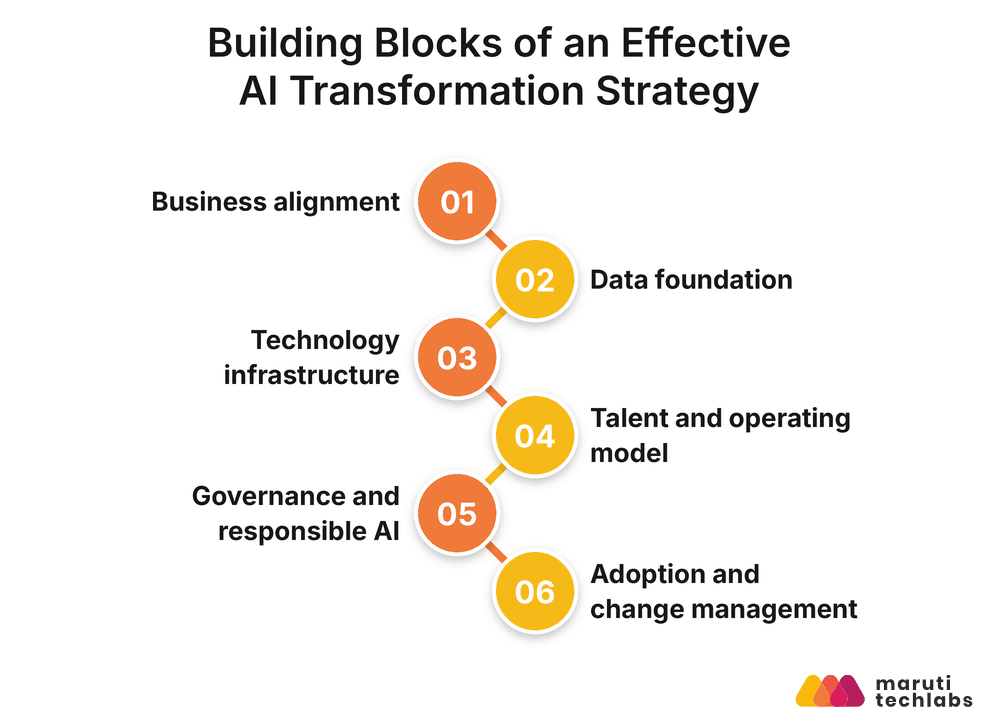
- Business alignment: A clear understanding of where AI can make a meaningful difference, whether that means improving a business process, reducing manual effort, or helping teams make better decisions.
- Data foundation: Reliable, secure, and accessible data that provides the foundation for building solutions teams can trust.
- Technology infrastructure: The right platforms, tools, and architecture to support current needs while allowing organizations to scale and evolve over time.
- Talent and operating model: The capabilities, ownership, and workflow changes needed for teams to work effectively with AI and adapt how decisions and tasks are handled.
- Governance and responsible AI: Practical guidelines around security, compliance, transparency, risk management, and human oversight.
- Adoption and change management: Helping teams understand, use, and adapt to new processes through training and continuous improvement.
Most successful organizations start with focused, high-value use cases, learn from implementation, and gradually expand adoption across the business. This steady, business-led approach creates a stronger foundation for long-term success than chasing every new AI capability as it emerges.
How to Build an AI Transformation Roadmap With Governance in Mind
Moving from individual use cases to broader adoption requires a clear AI Transformation Roadmap that defines where these initiatives can create value, who owns the outcomes, and how risks are managed throughout the process. A well-structured roadmap guides organizations from evaluating potential use cases to development, deployment, and ongoing monitoring with the necessary governance controls in place.
A functional governance lifecycle includes the following stages:
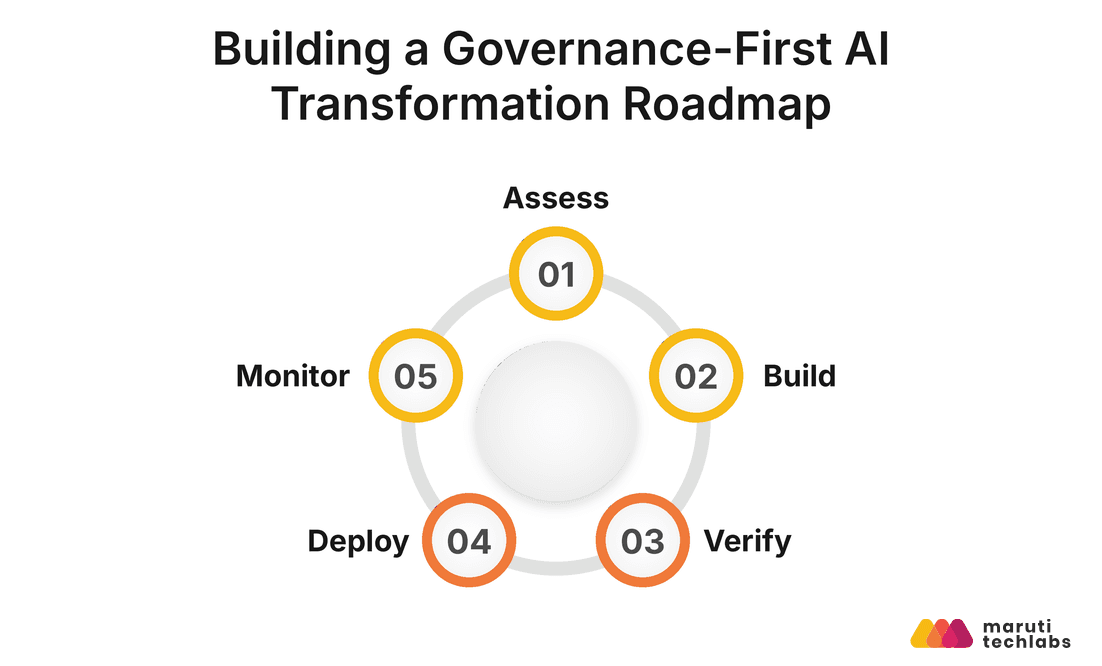
- Assess: Before building an AI solution, organizations need to evaluate the business objective, anticipated results, data sensitivity, regulatory requirements, possible risks, and key stakeholders involved. This stage helps determine whether a use case is appropriate for deployment and what controls will be required.
- Build: Governance becomes part of the development process through decisions around data access, architecture, vendor responsibilities, documentation, and ownership.
- Verify: Testing validates performance, reliability, security, privacy considerations, and limitations before the solution moves into production. The results help teams understand risks, document findings, and determine AI readiness.
- Deploy: The solution moves into production with defined access controls, ownership responsibilities, and review processes for decisions that require human judgment.
- Monitor: Ongoing reviews track performance changes, data quality issues, security risks, and compliance requirements after deployment. Regular audits and feedback help maintain reliability over time.
Governance Foundations for AI Transformation
A strong governance approach depends on a few core foundations:
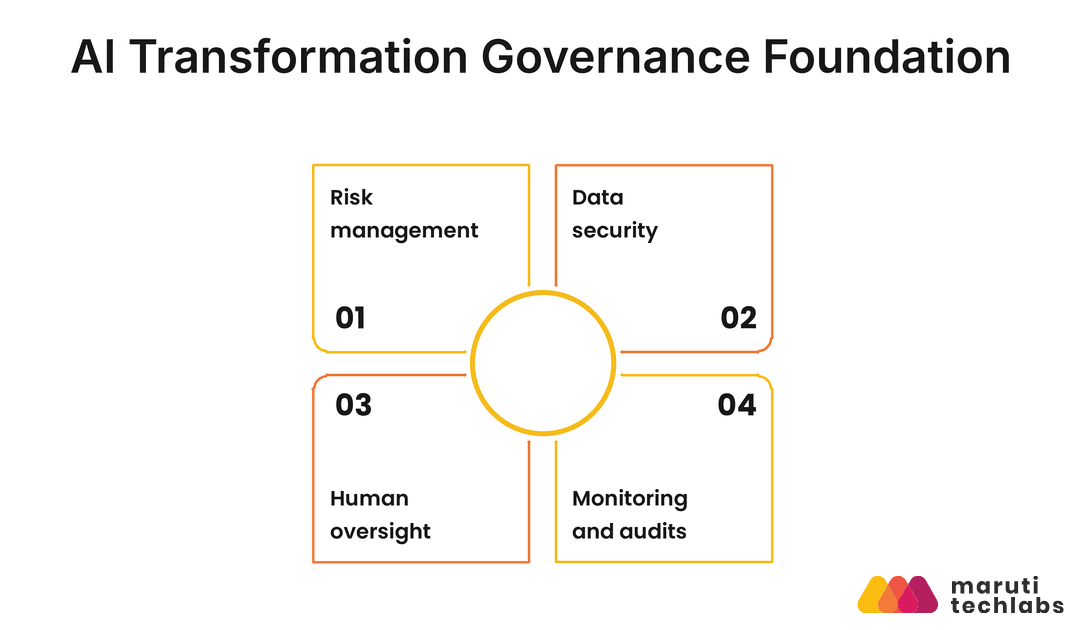
- Risk management: Potential risks are identified early, including security gaps, compliance concerns, inaccurate results, and unexpected outcomes.
- Data security: Clear controls around data access, quality, privacy, and protection help ensure information is handled appropriately throughout its use.
- Human oversight: Defined review points ensure that critical decisions have appropriate human involvement and accountability.
- Monitoring and audits: Regular reviews help track performance, identify issues, document changes, and improve processes over time.
Aligning AI Governance With Legal and Industry Frameworks
As AI becomes part of more business processes, organizations need to align with evolving regulations and industry standards. Frameworks such as ISO/IEC 42001, NIST AI RMF, the EU AI Act, and US state regulations provide guidance for managing risk and accountability.
These frameworks help organizations establish clear ownership, document processes, assess risks, maintain transparency, and demonstrate compliance where required. However, governance cannot follow a one-size-fits-all approach. The right framework depends on factors such as industry requirements, the type of AI system being deployed, the data involved, and the regions where the system operates.
A governance-first roadmap allows organizations to scale AI with greater confidence by creating the controls, accountability, and processes needed for long-term adoption.
Why AI Transformation Change Management Determines Success
AI transformation change management plays a major role in helping organizations successfully adopt new AI capabilities because people are the ones who turn technology into everyday business improvements. A solution can be ready, but adoption often slows when employees do not understand how it fits into their work or feel uncertain about the changes ahead. Helping teams understand the purpose behind the change, their role in the process, and how AI supports their work is what drives successful adoption.
It supports organizations by:
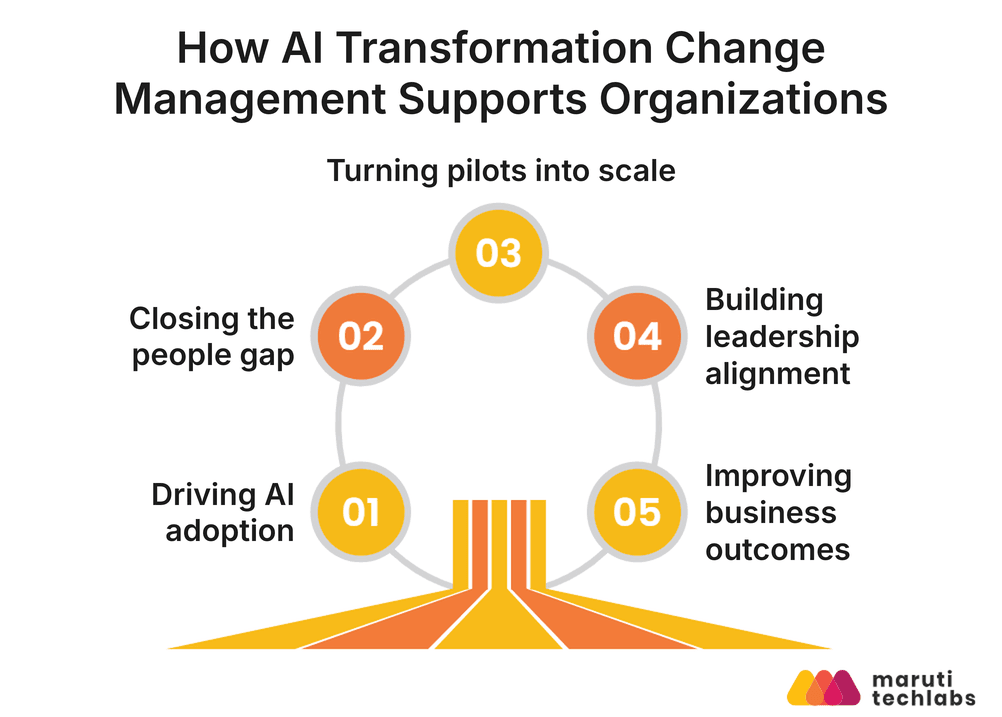
- Driving AI adoption: Helping employees incorporate AI into daily workflows and understand where it can add value.
- Closing the people gap: Addressing concerns, skill gaps, and changing responsibilities as teams adapt to new ways of working.
- Turning pilots into scale: Helping teams take what works in a pilot and make it part of their regular way of working.
- Building leadership alignment: Making sure leaders are involved, support the change, and help teams navigate the transition.
- Improving business outcomes: Moving beyond simple tool usage to achieve measurable improvements in efficiency, decision-making, and business performance.
The organizations that see lasting value from AI are the ones that focus on more than deployment. They help employees build confidence, encourage practical experimentation, and create an environment where people understand how AI supports their work. This is what turns individual AI initiatives into meaningful business improvements.
Conclusion
In any AI transformation, the real challenge begins after deployment, when teams start using it in their everyday work. Long-term success depends on having the right governance, clear ownership, practical change management, and processes that keep AI reliable as the business grows.
Organizations that put these foundations in place early are in a much stronger position to expand AI across the business. They can manage risks more effectively, respond to changing business and regulatory requirements, and scale new initiatives without losing consistency or control.
The organizations leading the next phase of AI adoption are not simply deploying more AI. They are building systems that can improve, adapt, and scale responsibly as their business evolves.
The following case study shows what this looks like in practice and how Maruti Techlabs helped an enterprise move from AI experimentation to measurable business outcomes.
How Maruti Techlabs Helped an Am Law 200 Firm Scale AI Across Legal Workflows
One of the clearest examples of AI transformation in practice comes from our work with an Am Law 200 law firm with more than 1,000 attorneys. The firm wanted to move beyond disconnected AI initiatives and create a single platform that could support legal research, document review, drafting, and other knowledge-intensive workflows at scale.
The results were significant. The platform achieved 95%+ accuracy in legal reasoning across complex workflows. It reduced legal research and document review from 7–8 hours to minutes. The platform also processed 300–1,000+ page documents without manual chunking and supported future AI expansion across the firm.
This engagement was more than building an AI platform. It required defining where AI could create value, putting the right technical and governance foundations in place, integrating AI into existing legal workflows, and creating a system the firm could continue expanding with confidence.
Learn more about our AI Development Services to see how we build custom AI applications for enterprise use cases. You can also explore our Agentic AI Services to understand how intelligent AI agents can automate complex, multi-step business workflows.
we’d be happy to discuss your goals and explore the best path forward.
FAQs
1. Why is AI transformation a problem of governance?
AI transformation becomes a governance challenge when organizations move from small experiments to wider adoption. They need clear ownership for AI systems, defined rules for data usage, and processes to review decisions and manage risks. Without these structures in place, even successful AI initiatives can face challenges when scaling across the business.
2. What is the difference between AI adoption and AI transformation?
AI adoption usually means using AI tools to improve a specific task or process. AI transformation is a broader change in how a company works, makes decisions, and solves problems with AI. It involves updating processes, helping teams adapt, and building the right foundation so AI can become part of everyday operations.
3. Why do AI projects fail after successful pilots?
A successful pilot doesn't mean an AI project is ready for wider use. Projects often stall because no one owns the system once it leaves the pilot team, there's no review process for its decisions, or employees aren't sure how it fits their work. The gap is usually governance and adoption, not technology.
4. How can organizations identify the right AI use cases?
Organizations should start by looking at problems that affect their teams and customers instead of searching for places to add AI. Good use cases often involve repetitive tasks, large amounts of information, or processes that require faster decisions. The focus should be on where AI can solve a real business challenge.
5. What should organizations consider before scaling AI across teams?
Before expanding AI across teams, organizations need to understand what they want to achieve, how employees will use the solution, and what changes may be needed in existing workflows. Clear ownership, employee involvement, and a practical rollout plan help avoid situations where useful tools are introduced but rarely used.
6. How does AI transformation change business processes?
AI transformation can change how teams handle everyday work, find information, and make decisions. It can take care of repetitive tasks, help employees get answers faster, and give teams more time to focus on complex work. But the real impact comes from how people adjust their workflows and learn where AI can support their work and where their own expertise is needed.
7. What role does data quality play in AI transformation?
AI systems depend on the information they are given. If data is incomplete, outdated, or inconsistent, the results may not be reliable. Organizations need to understand their data, improve its quality, and maintain good practices around how information is collected and managed before depending on AI for important decisions.
8. How can companies measure the success of AI transformation?
AI transformation success should be tied to the improvements a business wants to achieve. This could include reducing time spent on manual work, improving decision-making, lowering costs, or creating better customer experiences. The goal is not simply to use AI, but to see whether it is making a meaningful difference.
9. How can businesses build responsible AI systems?
Businesses can build responsible AI systems by setting clear rules around how AI is used, protecting important information, and regularly reviewing how solutions perform. Having the right checks in place helps teams use AI with more confidence while reducing risks as adoption grows across the organization.