

Legal AI Due Diligence: How It Works, Use Cases, Benefits, Risks, and Implementation
Key Takeaways
- Legal AI due diligence uses machine learning, natural language processing, and optical character recognition to review, extract, and flag information across large document sets before a transaction or major legal decision moves forward.
- AI accelerates the document-heavy stages of due diligence, including ingestion, extraction, clause comparison, and initial risk flagging, while the final judgment on materiality and risk stays with the attorney.
- Common use cases span M&A and deal-stage document review, third-party and vendor risk assessment, regulatory compliance checks, IP and licensing review, and lease or real estate document analysis.
- Key risks include hallucinated outputs, data privacy exposure, bias inherited from training data, and over-reliance on AI findings without human verification.
- Evaluating a solution means checking accuracy on legal-specific tasks, data security practices, workflow integration, and whether a clear human approval gate is built into the process.
- Firms considering adoption should start with a bounded pilot on one real workflow, measured against a manual baseline, before scaling up with oversight in place.
Introduction
A leading US-based Am Law 200 firm with more than 1,000 attorneys across corporate law, litigation, real estate, and other practice areas, was unable to efficiently process large legal documents running 300 to 1,000 or more pages, and had no structured approach to adopting generative AI despite growing interest in it.
To conquer these challenges, our AI experts at Maruti Techlabs built a custom AI-powered LegalTech platform with three core modules, including
- A Chat interface for legal research and contract review,
- A Search function for retrieval across internal documents, and
- Agents for task-specific automation covering high-volume workflows like document drafting, due diligence, and data extraction.
The platform turned tasks that previously took seven to eight hours into a matter of minutes, while reaching over 95 percent accuracy in complex legal reasoning workflows.
This demonstrates the potential of Custom Legal Software Development Services to streamline complex legal processes while improving speed, accuracy, and operational efficiency.
This is not just a problem for one client, legal due diligence is one of the most complex and document-intensive tasks in legal practice. Attorneys and analysts often need to examine hundreds or even thousands of contracts, filings, and business records within tight transaction timelines.
To overcome this challenge, legal firms are moving towards adopting AI document processing and Legal AI due diligence capabilities.
Legal AI due diligence applies machine learning, natural language processing, and optical character recognition to extract, classify, and flag relevant clauses, obligations, and risks across large document sets, without replacing the judgment attorneys bring to a final decision.
This guide covers what legal AI due diligence is, how it works, where it delivers the most value, and what legal and compliance teams should evaluate before adopting it.

What Is Legal AI Due Diligence and How Can It Improve Legal Risk Assessment?
Legal AI due diligence refers to the use of machine learning, natural language processing, and optical character recognition to review, extract, and flag information across large sets of contracts, filings, and records before a transaction or major decision moves forward.
Traditional due diligence relies on attorneys and paralegals reading through this material manually, a process that is thorough but slow, expensive, and prone to fatigue at scale.
AI changes the mechanics of that work rather than its purpose. Where it fits into the process is in the earlier, higher volume stages, document ingestion, clause extraction, and initial risk flagging, where it reads and classifies material at a pace no manual team can match.
It applies the same review criteria consistently across an entire document set rather than varying by which attorney is reading which file that day.
What AI cannot do is make the legal judgment call itself. Deciding whether a flagged clause is actually a dealbreaker, weighing ambiguous language against jurisdiction-specific precedent, or accepting responsibility for a final risk assessment all require a human to be the one accountable for the decision.
Guidance from bodies like the OECD reinforces this point directly, recommending that organizations assign clear oversight and responsibility for AI-assisted decisions to relevant senior staff rather than treating the system's output as the final word.
This is why human legal judgment stays central to the process even as AI takes over the document-heavy groundwork.
How Does AI-Powered Legal Due Diligence Work?
AI-powered legal due diligence generally moves through four stages: document ingestion and classification, information and clause extraction, risk identification and analysis, and human validation and reporting. Here are the four layers defined in detail:
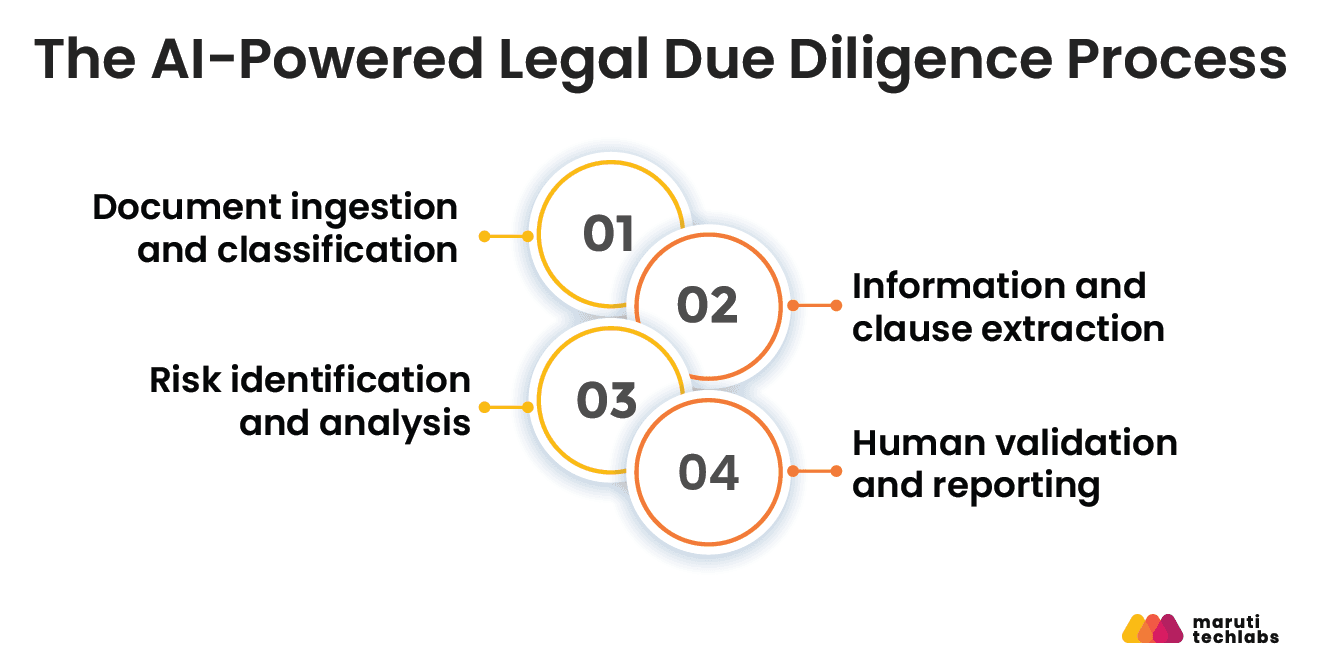
Document ingestion and classification
Documents arrive in mixed formats and quality, scanned PDFs, native Word files, image-based contracts, and the first job of the system is to convert all of it into a consistent, machine-readable structure.
This step matters more than it sounds like it should, since a parser that reads the text but scrambles the underlying structure of a long agreement makes everything downstream unreliable, from clause extraction to risk flagging.
Classification then sorts documents by type, so a lease gets routed and analyzed differently than an employment agreement or a vendor contract.
Information and clause extraction
Once documents are structured, this stage pulls out the specific data points a review actually needs, termination rights, indemnification language, change-of-control provisions, governing law, renewal terms, and similar clauses that recur across contract types.
Risk identification and analysis
Extracted clauses get compared against a playbook or standard, flagging deviations, missing provisions, or unusual language for closer review.
This is also where AI has the clearest track record so far, since roughly 56 percent of lawyers say due diligence is the stage of an mergers and acquisitions (M&A) deal where they are most likely to reach for AI, precisely because it absorbs the repetitive first pass through a large document set.
Human validation and reporting
An attorney reviews the flagged items, makes the actual risk determination, and the findings get compiled into a report or summary that feeds into the broader deal or matter. This step is not optional, since it is the point where legal judgment re-enters the process.
The Techstack Behind Legal AI Due Diligence
A few technical components typically sit underneath this workflow.
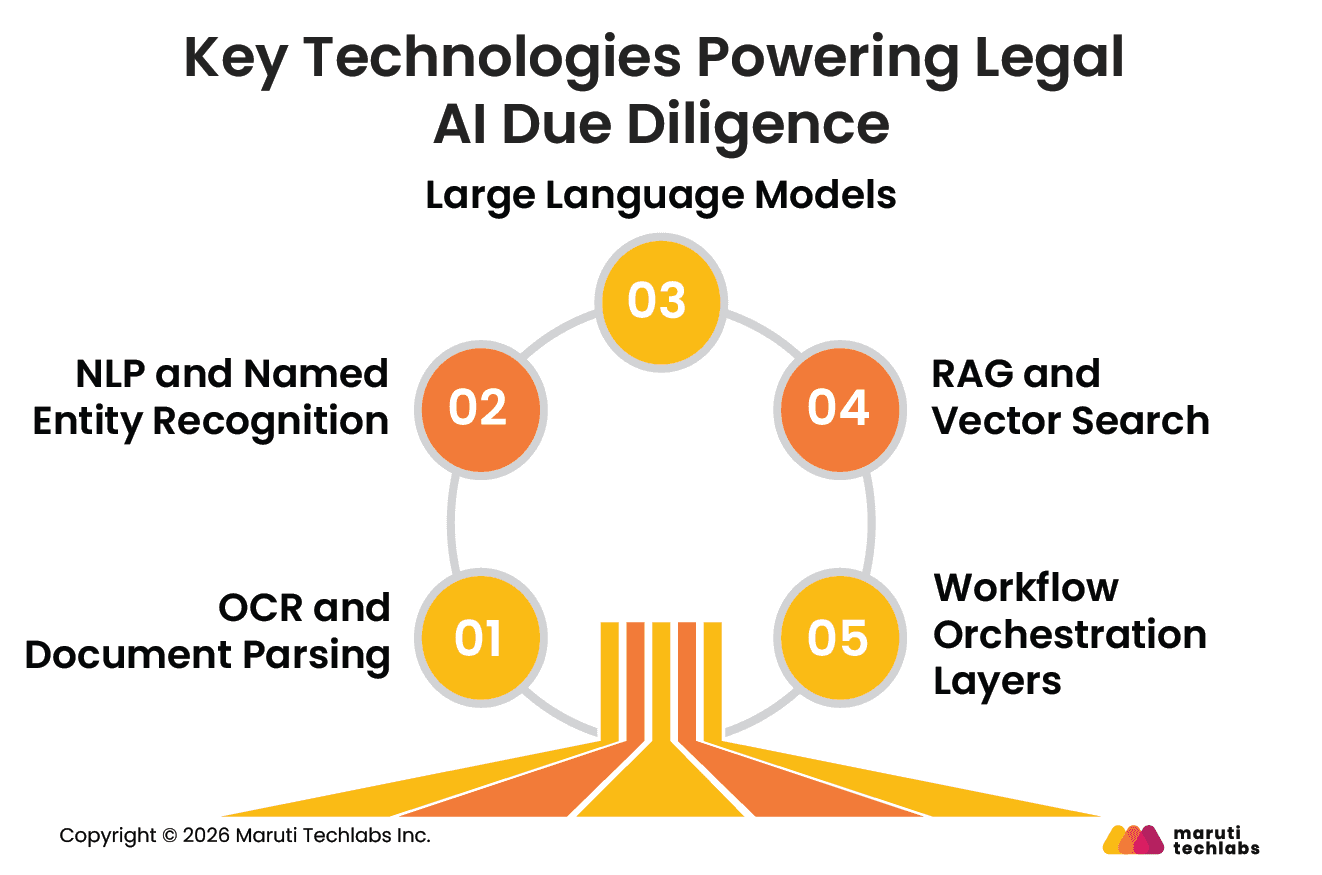
- Optical character recognition (OCR) and document parsing convert scanned and unstructured files into clean text while preserving layout, so tables, exhibits, and multi-column agreements do not lose their structure in the process.
- Natural language processing (NLP) and named entity recognition identify parties, dates, defined terms, and clause boundaries within the parsed text.
- Large language models (LLMs) handle the more nuanced work, summarizing lengthy sections, answering natural-language questions about a document set, and drafting first-pass risk commentary.
- Retrieval-augmented generation (RAG) and vector search let the system pull the specific passage relevant to a query across thousands of pages instead of relying on the model's memory of the document, which keeps outputs grounded and easier to verify.
- Workflow orchestration layers connect these pieces together, route documents to the right reviewer, and track where each item stands, from ingestion through human sign-off.
None of these components replace attorney judgment on their own. They compress the time it takes to get a large document set into a reviewable state, which is where most of the manual effort in traditional due diligence goes.
What Are the Key Use Cases of Legal AI Due Diligence?
Legal teams apply AI-powered due diligence across contract review, deal-stage risk analysis, compliance checks, and portfolio-wide document audits, wherever a large volume of legal paperwork needs to be read, classified, and checked against a standard faster than a manual team could manage.
| Use Case | What It Involves |
| M&A and deal-stage document review | Automatically reading and sorting large volumes of contracts, spotting key terms like termination rights or change-of-control clauses, and flagging unusual provisions before the deal team opens the file. This has the most adoption so far, since due diligence is the M&A stage where lawyers are most likely to reach for AI. |
| Third-party and vendor risk assessment | Checking indemnification terms, data handling obligations, and liability caps across dozens or hundreds of agreements before onboarding a vendor or renewing a major contract. |
| Regulatory and compliance review | Checking internal policies and contracts against changing regulatory requirements, flagging gaps between policy and current regulation, especially in regulated industries like insurance, healthcare, and financial services. |
| Intellectual property (IP) and licensing due diligence | Reviewing patent portfolios, licensing agreements, and open-source dependencies for scope, exclusivity, and expiration. |
| Diligencing AI-enabled targets | Examining a target company's own AI systems during an acquisition, including whether tools are proprietary or licensed, what training data was used, and whether outputs can be legally protected. A newer, more specialized use case as more targets build AI into their core product. |
| Lease and real estate document review | Extracting and comparing recurring but highly specific clauses, renewal terms, rent escalations, assignment rights, across a large property portfolio. |
| Contract lifecycle and renewal monitoring | Ongoing tracking of obligations, upcoming renewal or termination dates, and terms that fall outside standard playbooks over the life of an agreement, beyond one-time deal review. |
Across all of these, the common thread stays the same. AI handles the first pass across a large volume of documents, and a human makes the call on what the flagged findings actually mean for the deal or matter.
What Are the Benefits of Legal AI Due Diligence?
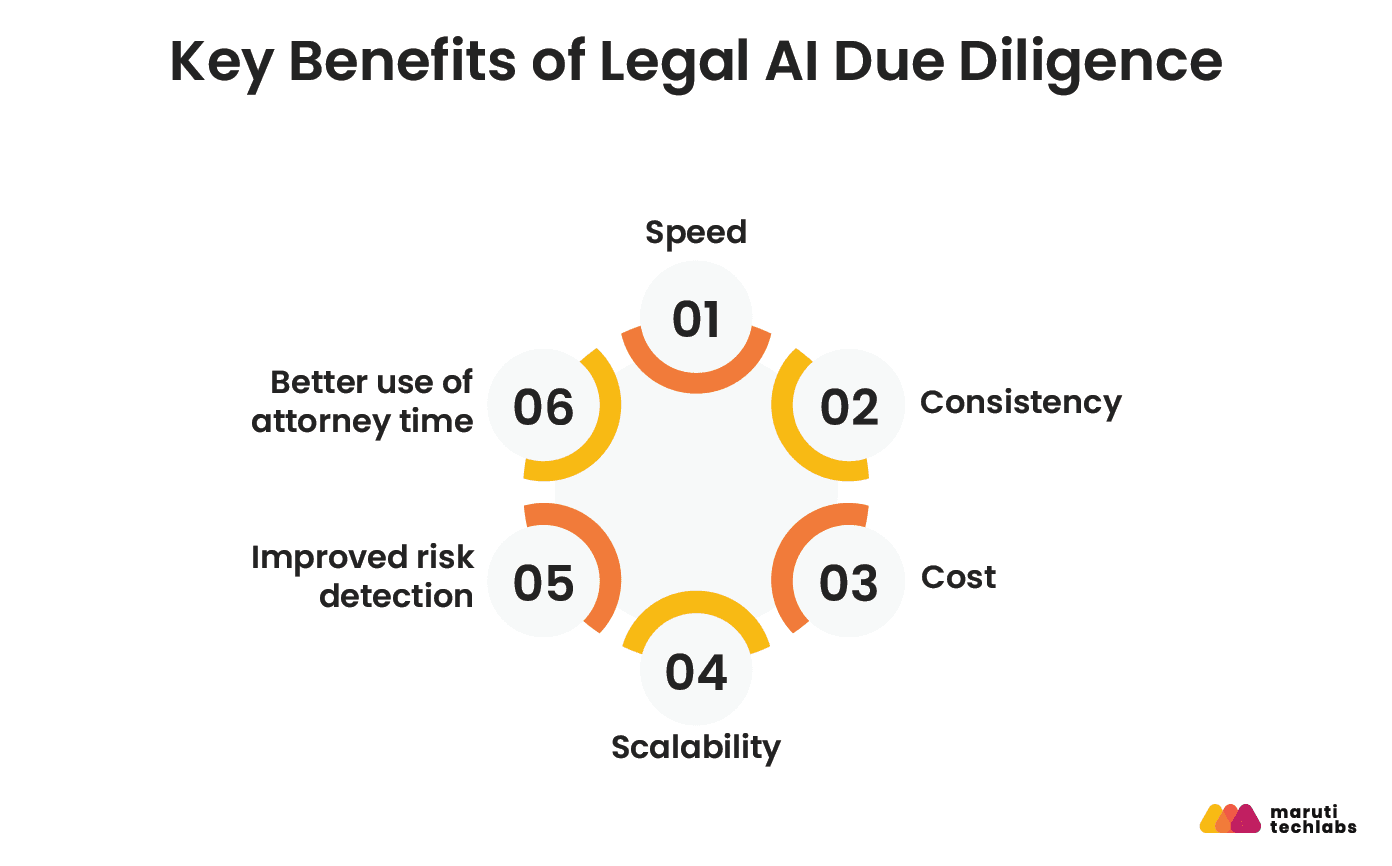
Legal AI due diligence cuts document review time from hours to minutes, reduces manual review effort by more than half, improves consistency across large document sets, and frees attorneys to focus on judgment calls instead of repetitive reading. The main benefits fall into a few categories.
Speed
AI reads and cross-references large document sets far faster than a manual team, which is where most of the time savings in due diligence actually come from.
In one Maruti Techlabs engagement, a national law firm needed to cross-check syndicated loan documents such as Credit Approvals, Term Sheets, and Credit Agreements against each other on every deal, work that previously took a full manual pass through each document set.
Automating that cross-document comparison cut manual review effort by 60 to 70 percent and made deal processing roughly three times faster.
Consistency
A human reviewer's attention varies by the hour, the document, and how many contracts they have already read that day. An AI system applies the same extraction logic and the same playbook criteria to every document in a set, which reduces the variation in what gets caught and what gets missed.
Cost
Less manual review time translates directly into lower cost per deal or per matter, particularly on high-volume work like vendor contract audits or lease portfolio reviews where the document count would otherwise require a large team working for weeks.
Scalability
AI-assisted review does not slow down as document volume grows the way manual review does. A firm can take on a due diligence engagement covering thousands of pages without proportionally scaling up headcount for the first-pass review.
Improved risk detection
AI applies the same criteria across every document without fatigue, it can catch clauses or inconsistencies that a manual reviewer might miss on document two hundred of a five hundred document set. In the same syndicated loan engagement, this translated into a 40 percent reduction in risk exposure and a measurable improvement in review accuracy.
Better use of attorney time
Perhaps the most practical benefit is what AI review frees attorneys up to do instead. Time that would have gone into reading through boilerplate and routine clauses goes toward the analysis that actually requires legal training, like weighing whether a flagged risk is material enough to affect deal terms.
What Are the Risks and Limitations of Legal AI Due Diligence?
The main risks and limitations of legal AI due diligence include hallucinated or inaccurate outputs, data privacy and confidentiality exposure, bias inherited from training data, over-reliance on AI findings without human verification, limited explainability behind flagged risks, and integration challenges with existing legal workflows.
| Risk or Limitation | What It Means in Practice | How Maruti Techlabs Overcomes This |
| Hallucinated or inaccurate outputs | Large language models can generate confident-sounding summaries or clause interpretations that are simply wrong, which is especially dangerous when a reviewer trusts the output without checking it against the source document. | Grounding outputs in retrieval-augmented generation so every flagged clause links back to the exact passage it came from, making it easy for a reviewer to verify a finding against the source rather than take the summary on faith. |
| Data privacy and confidentiality exposure | Feeding sensitive contracts, client data, or deal terms into an AI system raises questions about where that data is stored, who can access it, and whether it could be used to train a model outside the firm's control. | Calibrating the system against the firm's own playbook and document standards, such as Loan Syndications and Trading Association (LSTA)-based benchmarks in loan review, rather than relying on a generic model's default assumptions. |
| Bias inherited from training data | A model trained on a particular body of contracts or case law can carry forward the assumptions and gaps in that data, which can skew how it flags risk in document types or jurisdictions it saw less of during training. | Calibrating the system against the firm's own playbook and document standards, such as Loan Syndications and Trading Association (LSTA)-based benchmarks in loan review, rather than relying on a generic model's default assumptions. |
| Over-reliance on AI findings | Treating an AI-generated flag or summary as the final word, rather than a starting point for review, is where most of the real risk in this technology shows up, since it shifts accountability away from the person who is actually supposed to hold it. | Building human validation directly into the workflow as a required step before any finding is finalized, so the system surfaces findings for review rather than closing them out on its own. |
| Limited explainability | Attorneys often need to justify why a clause was flagged or missed, and some AI systems cannot clearly show the reasoning behind a given output, which makes it harder to defend a finding if it is ever challenged. | Structuring outputs around clause-level comparison against a named standard, so a reviewer can see exactly which provision triggered a flag and why. |
| Integration and workflow friction | AI tools that do not connect cleanly with a firm's existing document management, matter management, or review software end up creating a parallel process instead of a faster one. | Building the platform around the firm's existing tools and review process, such as Chat, Search, and Agents modules, instead of asking attorneys to adopt a separate system. |
| Regulatory and professional responsibility uncertainty | Bar associations and regulators are still working out what disclosure, supervision, and competence obligations apply when AI is part of a firm's due diligence process, which leaves some open questions for firms adopting it early. | Keeping a licensed attorney as the accountable decision-maker at every stage, with AI positioned as a research and first-pass tool rather than a replacement for professional judgment. |
None of these risks argue against using AI in due diligence. They argue for treating it as a tool that accelerates the first pass through a document set, with a human still responsible for verifying, interpreting, and standing behind the final findings.
What to Consider Before Implementing Legal AI Due Diligence?
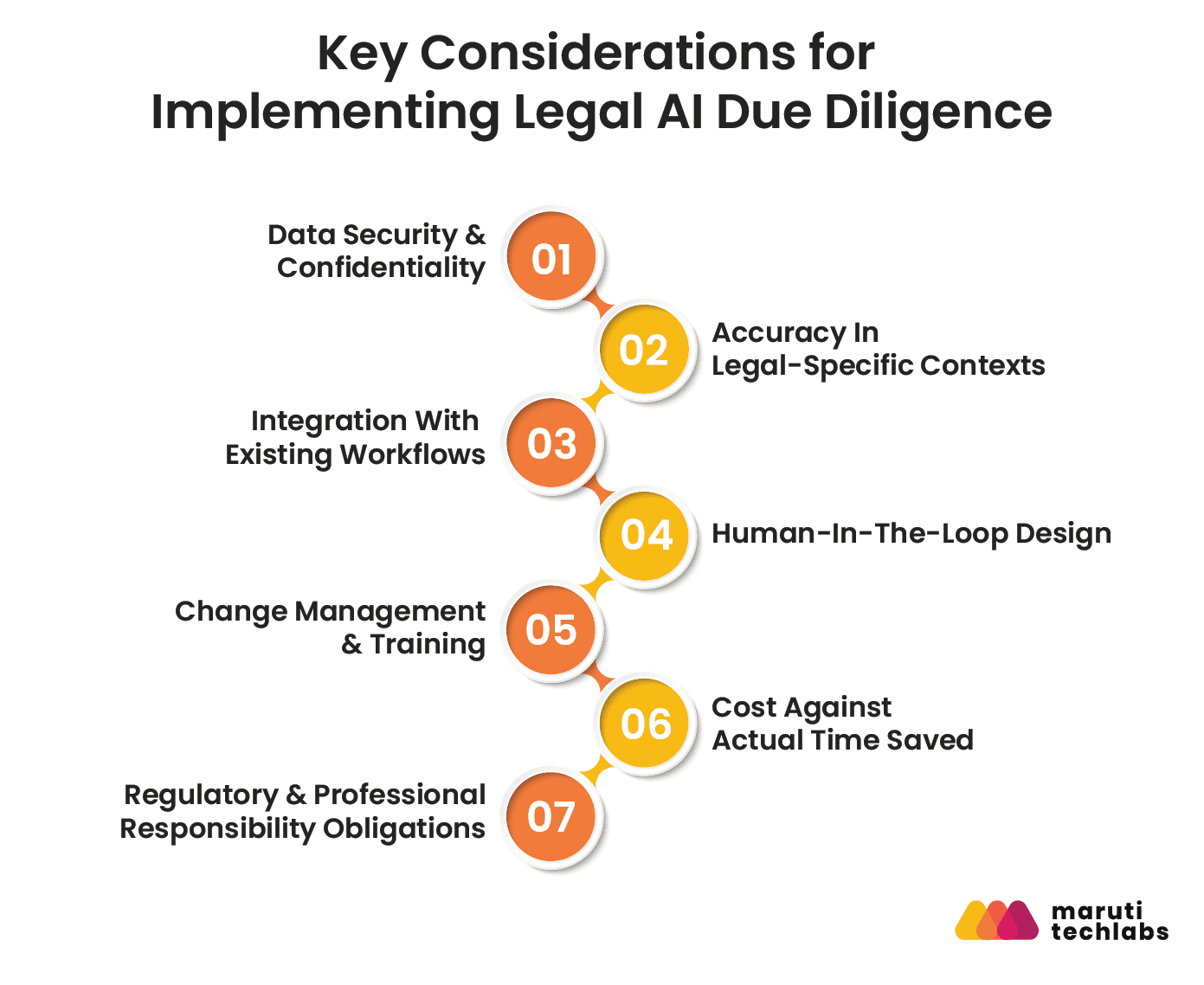
Before implementing legal AI due diligence, firms should evaluate data security and confidentiality safeguards, the vendor's accuracy track record in legal-specific use cases, how well the tool integrates with existing document and matter management systems, how human review is built into the workflow, and the true cost against the time actually saved.
Data security and confidentiality
Legal documents are some of the most sensitive material a firm handles, so the first question is where data goes once it enters the system, whether it is used to train the vendor's models, and what happens to it after a matter closes.
This matters even more for firms bound by client confidentiality obligations or working across regulated industries like healthcare and insurance.
Accuracy in legal-specific contexts
A model that performs well on general document summarization will not automatically perform well on nuanced legal language, so firms should ask for accuracy benchmarks on the specific document types they plan to run through the system, not generic performance claims.
Integration with existing workflows
A tool that cannot connect to the firm's current document management system, matter management software, or review platform ends up creating extra steps rather than removing them. Firms should map out where AI review fits into the existing process before rolling it out, not after.
Human-in-the-loop design
The workflow needs a clear point where a qualified attorney reviews AI-flagged findings before they become part of a final report or decision. This should be a defined step in the process, not an informal habit that depends on who happens to be available that week.
Change management and training
Attorneys and paralegals need enough training to understand what the system is good at, where it tends to make mistakes, and how to verify its output efficiently, otherwise adoption tends to stall or the tool gets used inconsistently across the team.
Cost against actual time saved
The upfront and ongoing cost of a legal AI tool should be weighed against a realistic estimate of hours saved on the specific type of document review the firm handles most, rather than the vendor's general productivity claims.
Regulatory and professional responsibility obligations
Depending on jurisdiction and practice area, there may be disclosure or supervision requirements tied to using AI in client matters, so firms should confirm what their bar association or relevant regulator currently expects before rolling the tool out broadly.
Getting these right before implementation matters more than picking the most feature-rich tool on the market, since a mismatched fit here is what usually causes AI due diligence pilots to stall.
How to Evaluate a Legal AI Due Diligence Solution?
Evaluating a legal AI due diligence solution comes down to checking its accuracy on legal-specific tasks, how it handles data security and confidentiality, whether it shows its sources, how well it fits your existing review workflow, and what independent benchmarks or client evidence back up its claims.
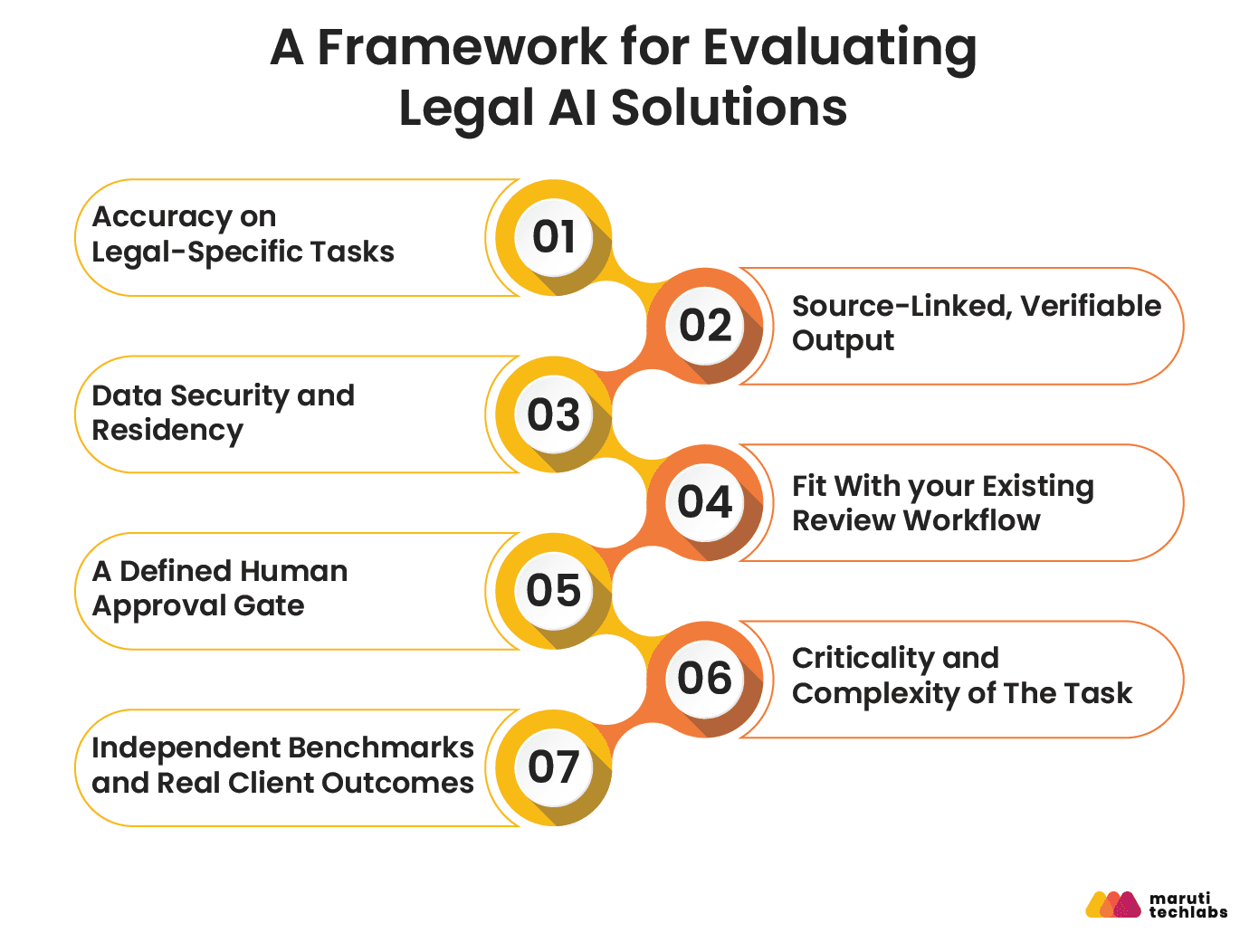
Accuracy on legal-specific tasks, not general benchmarks
A model's general-purpose performance says little about how it handles contract language or case citations specifically. Independent research backs this up.
A 2024 Stanford study on legal hallucinations found that general-purpose LLMs hallucinated in 58 to 88 percent of responses to specific, verifiable questions about federal court cases, while a 2025 Stanford study on legal research tools using retrieval-augmented generation still found hallucination rates of 17 to 33 percent on challenging queries, though narrower tasks like summarization can run as low as 1.8 percent error.
Ask any vendor for accuracy figures on the specific task you plan to use the tool for, not a general capability score.
Source-linked, verifiable output
A due diligence finding is only useful if an attorney can trace it back to the exact clause or page it came from. Tools that anchor every claim to the source document make verification fast. Tools that only produce a summary with no citation trail make every finding a manual re-check.
Data security and residency
Confirm where matter data lives, whether it is used to train the vendor's models, who can access it, and whether encryption and tenant isolation are built in by default rather than offered as an add-on. This matters more for cross-border deals or matters involving regulated data.
Fit with your existing review workflow
The most accurate tool in isolation is still a poor choice if it does not connect to the document management or matter management system your team already uses, since that gap forces a second, parallel process instead of a faster one.
A defined human approval gate
A practical evaluation should include a test set, citation checks, risk-based scoring, a security review, and a clear point where a human signs off before a finding is treated as final, rather than trusting the system's confidence level as a stand-in for review.
Criticality and complexity of the task
Some legal AI vendors frame this as asking what happens if the tool makes a mistake. For high-stakes work like deal-critical clause analysis or regulatory compliance checks, the bar for accuracy and human oversight should be higher than it would be for lower-stakes, routine document sorting.
Independent benchmarks and real client outcomes
Where available, third-party benchmarking studies and documented client results carry more weight than a vendor's own marketing claims, since they show how a tool performs against a consistent standard rather than a cherry-picked demo.
Running a small, bounded pilot on one real workflow, with your own documents, your own review standard, and a fixed comparison against how long the task currently takes, tends to surface more useful information than any feature comparison sheet.
What Does a Legal AI Due Diligence Workflow Look Like in Practice?
A practical legal AI due diligence workflow moves through document intake, automated extraction and classification, AI-driven clause comparison and risk flagging, a structured attorney review queue, and a final report that feeds into the deal or matter. Here is what each step looks like when it runs.
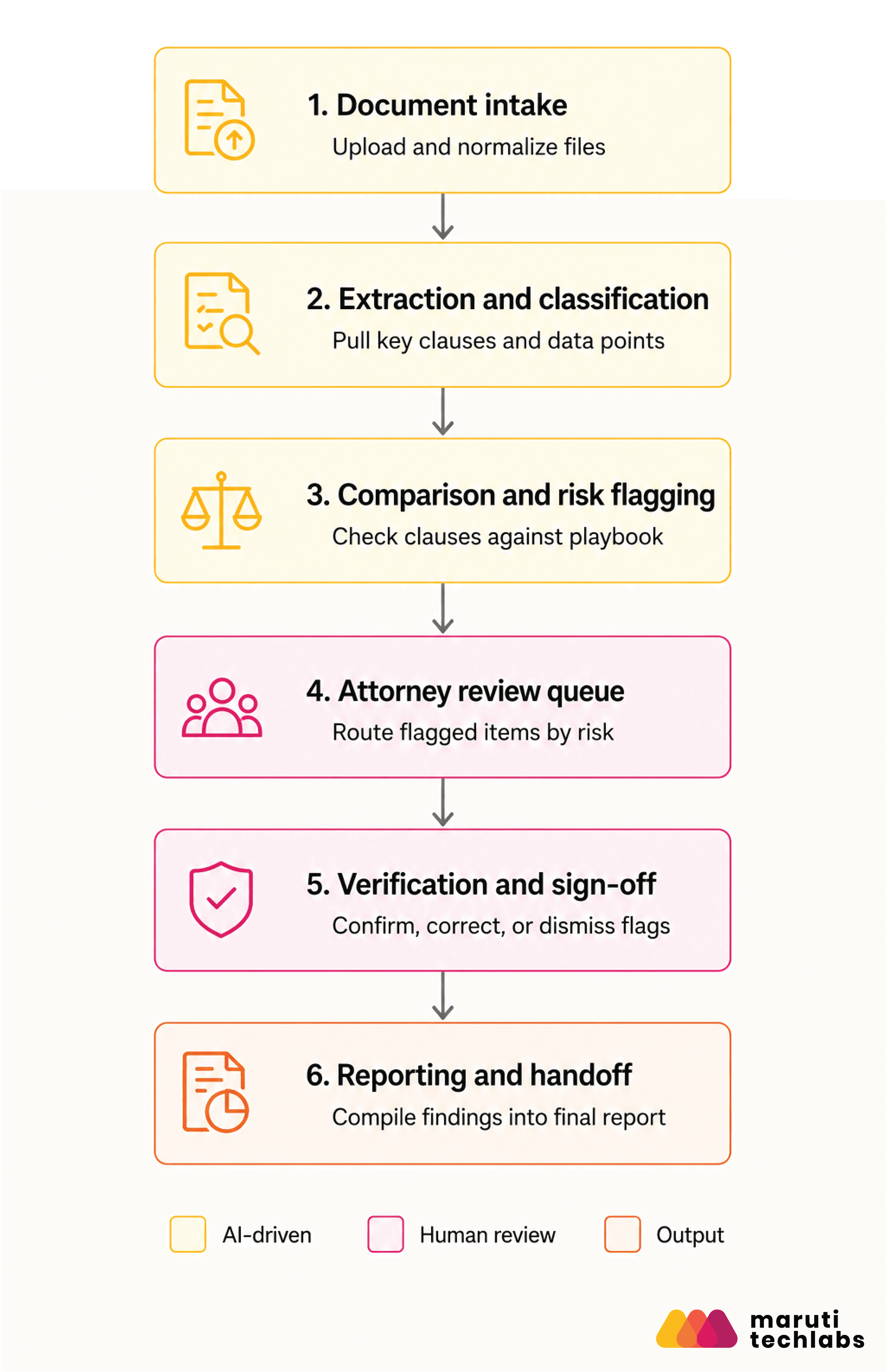
1. Document intake and normalization
The full document set for a deal or matter, contracts, term sheets, disclosures, supporting exhibits, gets uploaded into the system. Mixed formats and scan quality get normalized into a consistent, searchable structure before anything else happens.
2. Automated extraction and classification
The system reads each document, identifies its type, and pulls out the specific data points relevant to that document category, key dates, party names, defined terms, and clause-level content like indemnification or termination language.
3. Cross-document comparison and risk flagging
The system checks extracted clauses against a playbook or standard, and against each other where documents are meant to align. This is where inconsistencies surface, a term sheet that promises something the credit agreement does not actually deliver, a clause that deviates from the firm's standard language, or a missing provision that should be there.
4. Structured attorney review queue
Flagged items get routed to the right reviewer, ranked by risk level or deal significance, rather than handed over as one long undifferentiated list. This is the step that keeps human judgment central. Attorneys are reviewing a curated set of findings instead of reading every page from scratch.
5. Verification and sign-off
The reviewing attorney confirms, corrects, or dismisses each flagged item, and that decision gets recorded, which builds a review trail that shows what was checked and by whom.
6. Reporting and handoff
The verified findings compile into a summary or report that feeds into the broader deal, whether that means informing negotiation points, closing conditions, or a go/no-go recommendation.
In practice, this is close to what we built as a platform for a US law firm managing syndicated loan deals, where:
- The system ingests Credit Approvals, Term Sheets, and Credit Agreements
- Extracts 32 critical data points, checks them against LSTA-based standards, and flags cross-document inconsistencies for the deal team to review
- Cutting manual review effort by 60 to 70 percent
How to Measure the Effectiveness of Legal AI Due Diligence?
The effectiveness of legal AI due diligence is measured through review time reduction, accuracy and error rates, cost per document or per deal, risk detection rate, and attorney hours redirected toward higher-value work. A practical Legal AI ROI Measurement Guide can help teams evaluate each metric and understand what the tool is actually supposed to improve.
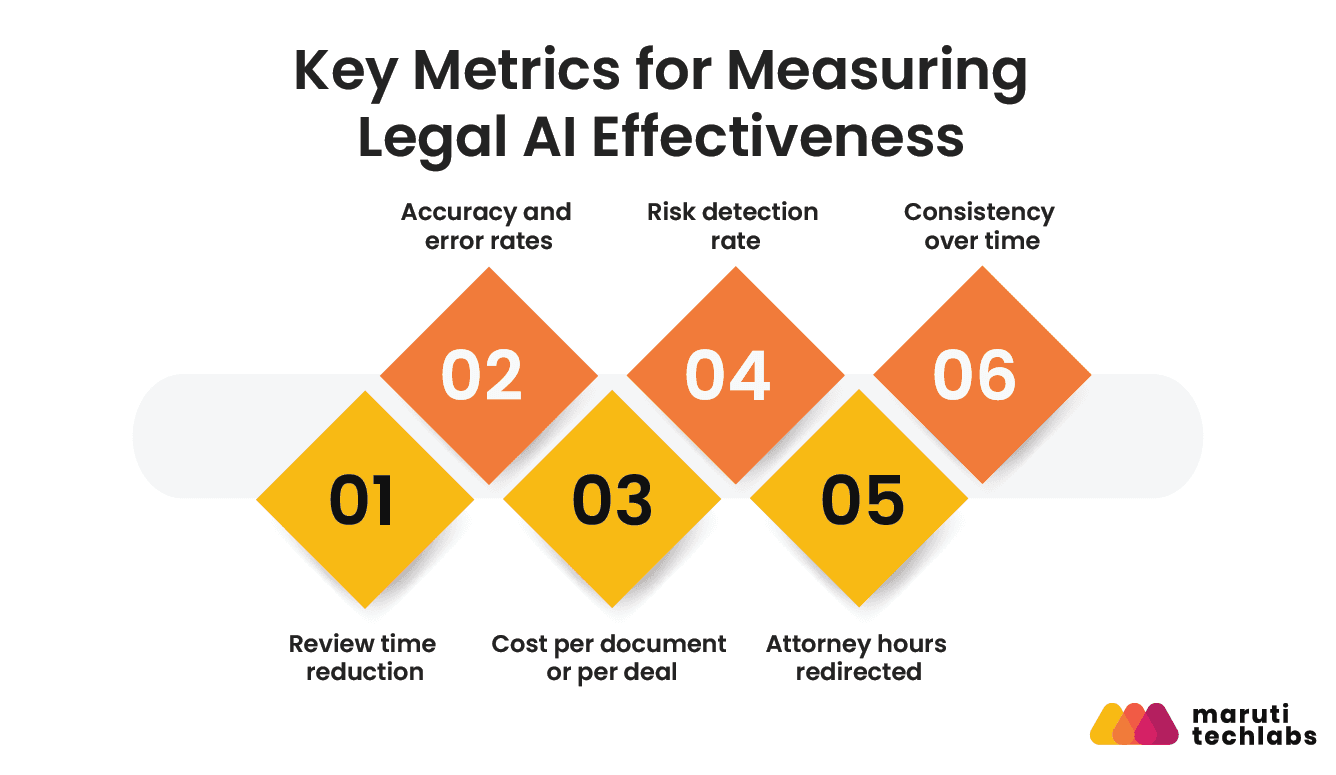
Review time reduction
The most direct metric is how long a document set takes to move from intake to a reviewable state compared to the manual baseline. This is worth tracking per document type rather than as one blended average, since a tool might cut lease review time dramatically while barely moving the needle on more complex credit agreements.
Accuracy and error rates
This means checking the tool's output against a known-correct answer set, not just trusting its confidence score. Precision, how many flagged items are actually real issues, and recall, how many real issues actually get flagged, both matter here, since a tool that flags everything looks accurate on recall but creates more manual work than it saves.
Cost per document or per deal
Once time savings are known, the real financial impact comes from comparing the fully loaded cost of AI-assisted review, including licensing, integration, and the human verification step, against what the same volume of work would have cost under the previous manual process.
Risk detection rate
This tracks whether the tool is catching the same category of issues a manual review would catch, or better yet, issues that manual review tends to miss on the two hundredth page of a long document set. Comparing findings on a sample set reviewed both ways is a practical way to establish this.
Attorney hours redirected
A tool can save review time without actually improving outcomes if that saved time gets absorbed rather than redirected. Tracking what attorneys spend their freed-up time on, more matters handled, deeper analysis on flagged items, faster turnaround for clients, shows whether the efficiency gain is actually being captured.
Consistency over time
Running the same document type through the system periodically and comparing outputs helps catch model drift or degraded performance before it affects a live matter, since AI tool performance is not guaranteed to stay static as vendors update their underlying models.
The firms that get the most reliable read on effectiveness tend to establish these baselines before rollout, on a small pilot, rather than trying to reconstruct a comparison after the tool is already in full use.
How Secure is AI-Powered Legal Due Diligence?
Legal due diligence involves some of the most sensitive information a company handles, including contracts, intellectual property, financial records, litigation documents, employment agreements, and potentially privileged communications. Introducing AI into this workflow therefore creates a fundamental question:
How can legal teams use AI without compromising confidentiality or control over their data?
The answer depends less on the AI model itself and more on the architecture, data-handling policies, access controls, and governance surrounding it.
A secure AI-powered due diligence system should establish clear boundaries around how confidential documents are collected, processed, stored, accessed, and deleted.
Legal teams should also understand whether their data is retained by the AI provider, used for model training, transferred to third-party services, or accessible outside the authorized environment.
Security should therefore be evaluated across several layers:
- Data encryption: Sensitive documents should be protected during transmission and while stored.
- Access control: Only authorized users should be able to access specific documents, projects, or due diligence workspaces.
- Data isolation: Client data should remain logically separated from other customers and workloads.
- Retention and deletion: Organizations should have clear policies governing how long documents, prompts, outputs, and logs are retained.
- Model and data governance: Legal teams need visibility into whether submitted information is used for model training or other purposes.
- Auditability: The system should maintain appropriate records of user activity, document access, and AI-generated actions.
- Human oversight: AI should surface findings and assist with analysis, while qualified legal professionals retain control over legal interpretation and decisions.
The goal is not simply to make an AI system "secure." It is to create an environment where confidential legal information remains controlled throughout the entire AI-assisted due diligence workflow.
How Maruti Techlabs Builds Security Into Legal AI Agents
When developing AI agents for legal due diligence, security needs to be considered at the architecture level rather than added after the agent has been built. Depending on the client's requirements and deployment environment, the solution can incorporate controls such as:
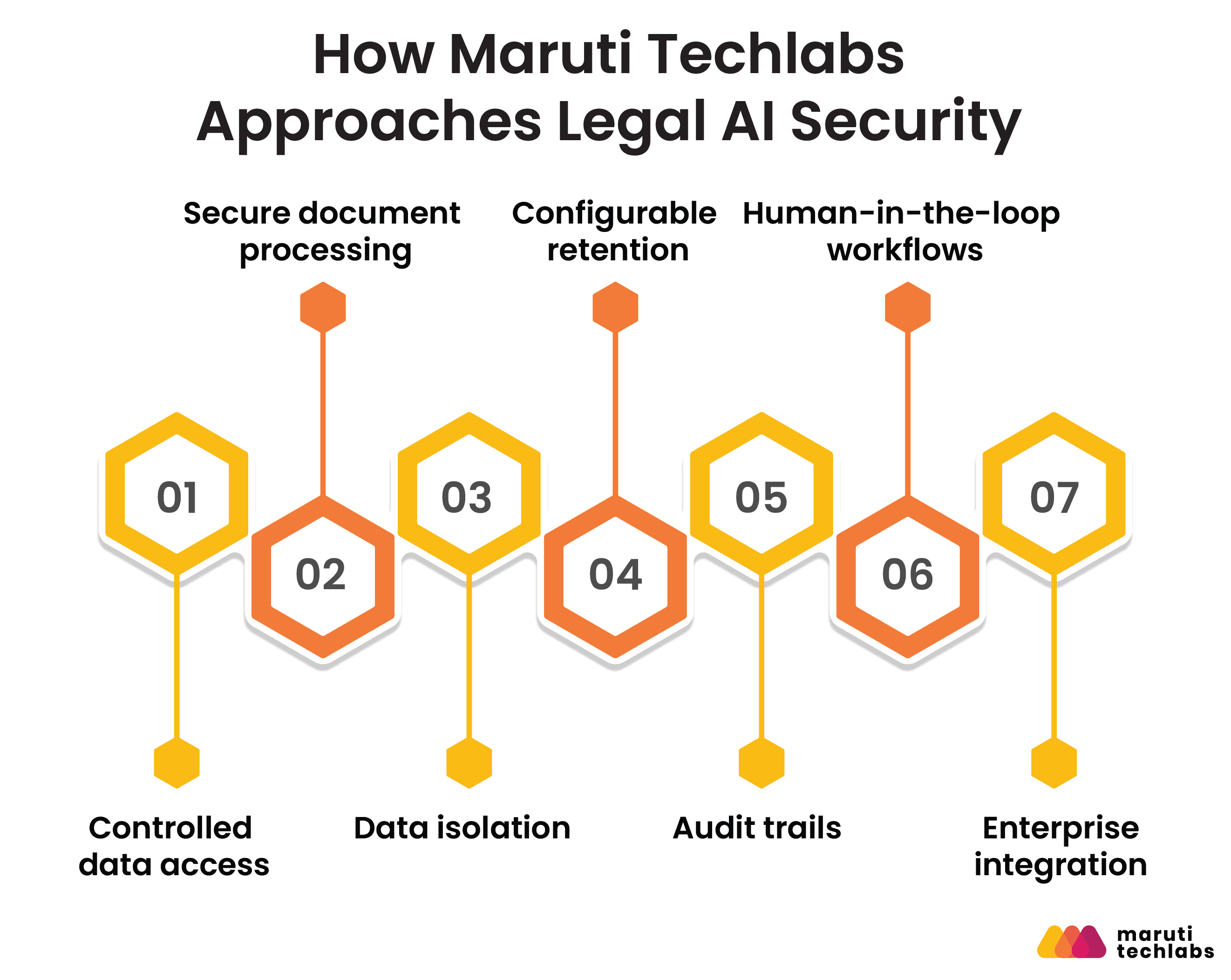
- Controlled data access: AI agents can be designed with role-based permissions so users and agents only access the documents and information required for their specific workflows.
- Secure document processing: Confidential legal documents can be processed within controlled environments with appropriate encryption and data-handling safeguards.
- Data isolation: Client data can be architected to remain separated across tenants, projects, and workflows.
- Configurable retention: Document and AI interaction retention can be aligned with the client's data governance requirements.
- Audit trails: Agent actions and user interactions can be logged to provide greater visibility into how information is accessed and processed.
- Human-in-the-loop workflows: Agents can identify clauses, extract information, flag potential risks, and generate summaries while leaving final legal assessment and decision-making to authorized professionals.
- Enterprise integration: AI agents can be integrated with existing document repositories, identity systems, and enterprise workflows rather than requiring sensitive information to be moved into uncontrolled tools.
The exact controls should be determined by the client's regulatory, contractual, infrastructure, and data-residency requirements.
Our experts don’t follow a standard feature checklist, instead, we always design security architecture by focusing around the sensitivity of the legal workflow your organization deals with.
What Is the Future of Legal AI Due Diligence?
The future of legal AI due diligence is moving toward autonomous multi-step agents that manage entire due diligence workflows rather than single tasks, tighter regulatory oversight requirements, and measurement standards that hold AI investment to the same rigor as any other legal technology spend.
From single-task tools to autonomous agents
Legal teams are already piloting agentic AI systems built specifically to manage due diligence data rooms, not just review individual documents but proactively flag risks, cross-reference clauses across agreements, and generate initial findings reports for human oversight, moving well beyond the document-by-document review that defined earlier AI tools.
This is still early. Less than 20 percent of legal organizations report widespread agentic AI adoption today, though roughly half say they are either planning to use it or actively considering it, which suggests the shift plays out over the next several years rather than all at once.
Mandatory governance and oversight requirements
Regulation is catching up to technology. In the US, the American Bar Association's Formal Opinion 512 requires lawyers to understand what AI can and cannot do and to protect client confidentiality, while the EU AI Act, which takes effect for legal AI systems in August 2026, classifies AI used in legal services as high-risk, requiring transparency, human oversight, and formal risk management.
Firms adopting AI due diligence tools going forward will increasingly need documented oversight processes, not just a functioning tool.
A harder look at return on investment
Independent survey data tells a more grounded story than vendor claims. Bloomberg Law's most recent State of Practice survey found that only 23 percent of in-house lawyers use AI tools daily, while 27 percent haven't used them at all in the past six months, suggesting adoption is still surface-level rather than systemic and making performance gains difficult to quantify or translate into meaningful metrics.
Market consolidation is also underway as adoption matures, with the field separating between purpose-built legal AI platforms and general-purpose tools repackaged with legal templates.
Firms that build their own measurement approach now, rather than relying on a vendor's numbers, will be better positioned when budgets face closer scrutiny.
Auditability as a baseline requirement
As agentic systems take on more of the due diligence process, being able to show exactly what a system checked, what it flagged, and why becomes less of a nice-to-have and more of a requirement for both regulatory compliance and defensibility if a finding is ever challenged.
What's the Bottom Line on Legal AI Due Diligence?
Legal AI due diligence works best as a way to compress the document-heavy first pass of a review, not as a replacement for attorney judgment.
AI reads, extracts, classifies, and flags faster and more consistently than a manual team, but it cannot decide whether a flagged clause is actually a dealbreaker or take responsibility for a finding that turns out to be wrong, so that responsibility stays with the attorney.
The practical path forward is a bounded pilot on one real workflow, measured against a manual baseline, scaling up with clear human oversight built in from the start.

FAQs
1) What is legal AI due diligence?
Legal AI due diligence is the use of machine learning, natural language processing, and optical character recognition to review, extract, and flag information across contracts, filings, and records before a transaction or major legal decision moves forward, compressing the document-heavy first pass of the review while attorneys handle the final judgment calls.
2) How accurate is AI for legal due diligence?
Accuracy varies significantly by tool and task. General-purpose AI models can hallucinate on complex legal questions, while purpose-built legal AI tools tested on narrower tasks like document summarization and clause extraction tend to perform far more reliably, which is why firms should ask vendors for task-specific accuracy figures rather than general capability claims.
3) Can AI replace lawyers in the due diligence process?
No. AI accelerates the document-heavy stages of due diligence, ingestion, extraction, and initial risk flagging, but it does not replace the legal judgment needed to decide whether a flagged issue is material, weigh it against precedent, or take accountability for the final finding.
4) What kinds of documents can AI review during due diligence?
AI-powered due diligence tools can review contracts, term sheets, credit agreements, leases, compliance records, licensing agreements, and regulatory filings, among other legal documents, provided the system can parse the file format and has been set up with the relevant review criteria or playbook.
5) How much does legal AI due diligence cost?
Cost depends on document volume, the vendor's pricing model, and how much integration work is needed with existing systems, so firms typically get a clearer picture by running a small pilot on a real workflow and comparing the total cost, including the human verification step, against what the same volume of manual review currently costs.
6) Is legal AI due diligence secure for confidential documents?
Security depends entirely on the vendor and the implementation, so firms should confirm where data is stored, whether it is used to train the vendor's models, who can access it, and whether tenant isolation and encryption are built in by default before feeding confidential client documents into any AI system.
How Maruti Techlabs Cut Legal Research Time by 60% for a National Law Firm?
A national law firm with 475 attorneys and government relations professionals across 17 offices, serving more than 40 percent of the Fortune 500, was running research through a fragmented workflow spread across disconnected tools and sources.
Complex queries required extensive manual searching and validation, existing AI tools lacked the depth needed for nuanced legal research, and missing citations left teams with low trust in AI-generated outputs, all while research volume kept growing faster than the firm's capacity to maintain consistent quality.
Maruti Techlabs built a customized, agentic AI-powered deep research engine that autonomously handles complex, multi-step legal queries, gathers information from integrated real-time sources, and synthesizes structured insights with minimal human intervention.
The system was designed to understand legal context across cases, jurisdictions, and regulations, and every generated insight is backed by a validation and traceability layer so attorneys can verify the source behind each finding, built on a centralized platform that scales across the firm's offices and teams.
The impact:
- 60 percent reduction in research time, enabling faster case preparation and decision-making
- 3x improvement in insight accuracy, enhancing the quality of legal recommendations
- 40 percent increase in team productivity, freeing attorneys for higher-value work
- Reduced manual verification effort across research workflows
- The firm continues to expand adoption of the platform across additional offices and teams




![[GetPaidStock.com]-65b9d3432ecc1.webp](https://cdn.marutitech.com/small_Get_Paid_Stock_com_65b9d3432ecc1_c1b16b05fb.webp)


