

What Is Contextual AI and How Is It Different from Traditional Machine Learning?
Key Takeaways
- Contextual AI adapts to real-time context, while traditional machine learning relies on fixed training data and predefined inputs.
- Traditional machine learning works best for stable, repeatable tasks, where consistency, predictability, and cost efficiency matter most.
- Contextual AI combines multiple sources of context, including user, session, historical, and environmental data, to produce more relevant responses.
- Contextual AI follows a continuous pipeline of gathering, filtering, reasoning, generating, and learning from feedback, allowing it to stay relevant as conditions change.
- The two approaches can work together, with traditional machine learning handling stable predictions while contextual AI uses those predictions alongside real-time context to make more situational decisions.
Introduction
Ask a traditional machine learning model and a contextual AI system the same question, and you'll often get very different experiences.
A model built using traditional machine learning services applies what it learned from historical training data and returns a fixed prediction. A contextual AI system, by contrast, looks at what's happening right now, who's asking, what they've done before, what device they're on, what's currently true in the business, and shapes its answer around that real-time context.
This distinction matters more than ever, and the market data reflects it. The global context-aware computing market size was valued at USD 83.76 billion in 2025 and is projected to grow from USD 102.18 billion in 2026 to USD 289.83 billion by 2034, registering a CAGR of 13.90% over the forecast period. North America dominated the context-aware computing market with a market share of 45.00% in 2025.
That growth is being driven by enterprises moving beyond single-purpose prediction models toward systems that can reason, retrieve information, and personalize decisions on the fly.
This blog breaks down what contextual AI actually is, how it differs from traditional machine learning, where each approach fits best, and what enterprises need to watch out for as they adopt context-aware systems.

What Is Contextual AI?
Contextual AI refers to AI systems that adjust their output based on live, situational information rather than relying solely on a fixed set of training inputs. Instead of treating every request in isolation, contextual AI factors in the surrounding circumstances: who the user is, what they're trying to accomplish, what happened earlier in the interaction, and what rules or conditions currently apply.
That context generally comes from four sources. User context includes identity, role, and preferences. Session context covers what's happening in the current interaction: the stated goal, recent messages, the device being used.
Historical context draws on past behavior, such as previous purchases or support tickets. Environmental context includes business rules, policies, and real-time conditions like inventory levels or system status.
What Is Traditional Machine Learning?
Traditional machine learning takes a narrower and more disciplined path. A model is trained on a fixed, historical dataset to perform one specific task, classifying an image, predicting churn, forecasting demand, or flagging a fraudulent transaction.
Once training is complete and the model is deployed, its behavior stays static. It applies the same learned patterns to every new input until someone retrains it on new data.
This rigidity isn't a shortcoming. In the right setting, it's exactly what makes traditional machine learning valuable. Machine learning models built this way are predictable, auditable, and efficient, because their inputs and outputs are narrowly scoped.
A credit scoring model, for example, should behave consistently no matter what's happening around the request; that consistency is the point, not a limitation. Traditional machine learning also tends to be cheaper to run at scale, since it isn't pulling in and reasoning over multiple live data sources for every prediction.
How Does Contextual AI Work?
Contextual AI systems generally operate through a four-stage pipeline that gathers relevant signals, filters and prioritizes context, uses that context for reasoning and response generation, and learns from feedback to improve future outputs.
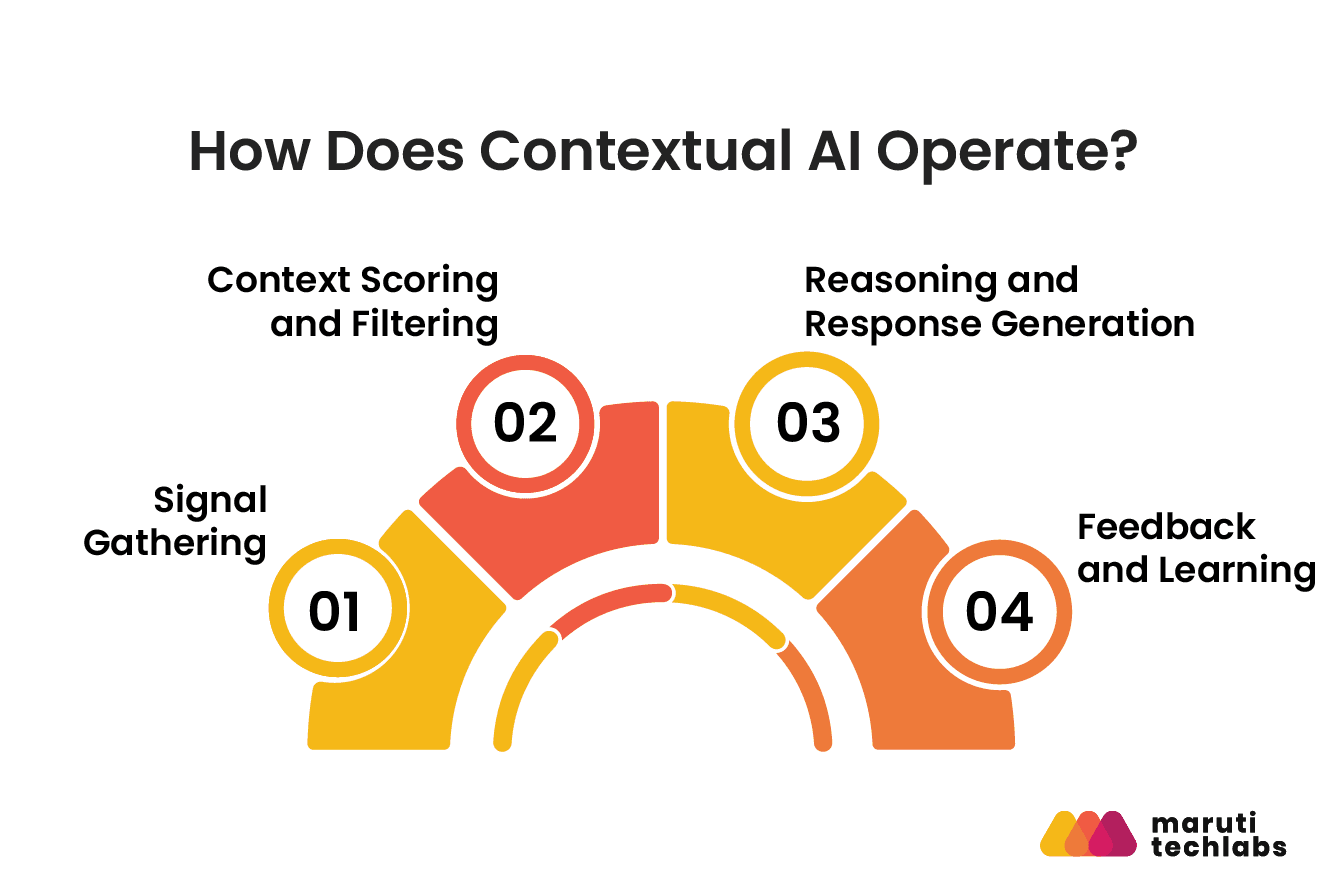
1. Signal Gathering
The system pulls relevant information from wherever it lives: a CRM, session logs, a knowledge base, permissions systems, and normalizes it into a usable format.
2. Context Scoring and Filtering
Not every signal deserves equal weight. A system typically scores real-time context for recency, reliability, and whether it's permitted to be used, since consent and data governance matter heavily at this stage.
3. Reasoning and Response Generation
With relevant context assembled, the underlying model, often a large language model, retrieves supporting facts, reasons through the request, and produces a response or action. In more advanced setups, this can include triggering a real action, such as opening a support ticket or adjusting a price.
4. Feedback and Learning
The loop closes when the system captures which responses worked and which needed human intervention, using that feedback to sharpen future outputs. This pipeline is meaningfully more complex than a traditional machine learning model, which simply ingests fixed features and returns a prediction.
However, this is what allows contextual AI to stay relevant as conditions change.
How Does Traditional Machine Learning Work?
Traditional machine learning works by collecting and preparing historical data, engineering relevant features, and training algorithms to identify patterns between inputs and known outcomes. Once trained, the model applies what it has learned to new data to make predictions or classifications.
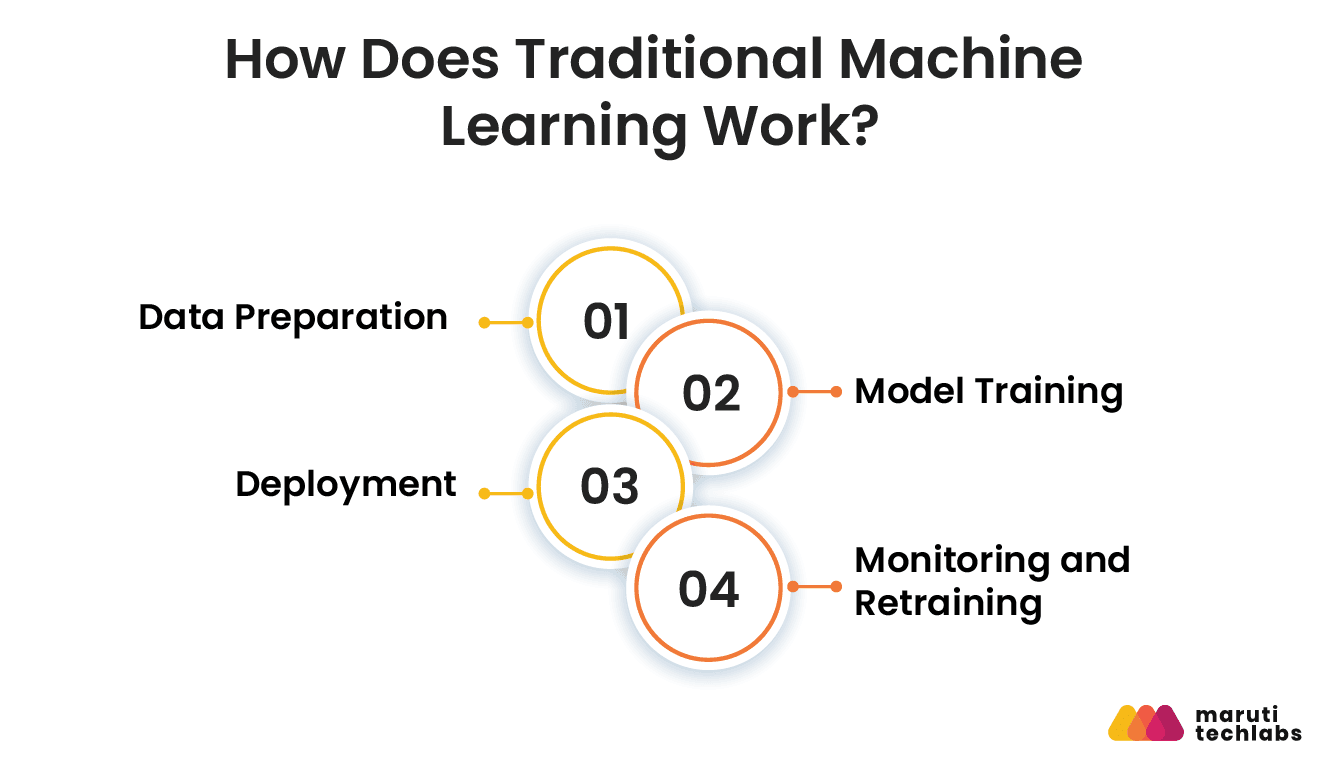
1. Data Preparation
The team collects a fixed, historical dataset relevant to the task, such as past transactions, sales records, or labeled images, and cleans it: handling missing values, correcting errors, and engineering the features the model will learn from. Unlike contextual AI, this data is static once training begins; it doesn't pull in anything live.
2. Model Training
The model is trained on this fixed dataset to recognize patterns and relationships between inputs and known outcomes. Depending on the task, this might mean a regression model learning to predict a number, a classifier learning to sort inputs into categories, or a neural network like an LSTM learning patterns in sequential, time-based data. This stage is where nearly all the model's "intelligence" gets baked in.
3. Deployment
Once trained and validated, the model is deployed to production, where it applies the same learned patterns to every new input it receives. It doesn't reason about the surrounding situation or pull in additional context; it simply maps a given input to the most statistically likely output, the same way every time.
4. Monitoring and Retraining
Over time, real-world conditions drift away from what the model originally learned. A team monitors the model's accuracy and periodically retrains it on fresh data to keep it aligned with current patterns.
This is the traditional machine learning equivalent of contextual AI's feedback loop, except it happens on a scheduled cycle rather than continuously, and it requires deliberately kicking off a new training run rather than the model adjusting on its own.
This is a meaningfully simpler pipeline than contextual AI's four-stage loop of signal gathering, scoring, reasoning, and continuous feedback.
That simplicity is precisely what makes traditional machine learning cheaper to run and easier to audit, but it also means the model stays static between retraining cycles, however much the world around it changes.
Contextual AI vs. Traditional Machine Learning: What Are The Key Differences
Contextual AI and traditional machine learning differ mainly in how they use data, adapt to changing conditions, and make decisions.
Traditional machine learning relies on predefined features and learned patterns to deliver fixed predictions, while contextual AI combines real-time context, historical signals, and retrieval to generate more adaptive, situational responses.
| Dimension | Traditional Machine Learning | Contextual AI |
| Data used | Fixed, predefined features from training data | Real-time data blended with historical signals |
| Adaptability | Static after deployment; needs retraining to change | Adjusts as new context arrives, without retraining |
| Scope | Narrow: built for one task | Broader: reasons across tasks using shared context |
| Decision style | Pattern recognition against learned data | Situational reasoning plus retrieval |
| Explainability | Easier to audit; fewer variables | Harder to audit; more signals involved |
| Best fit | Stable, repeatable, high-volume problems | Personalized, conversational, variable workflows |
Traditional machine learning answers a narrow question: given these fixed inputs, what's the most statistically likely output?
Contextual AI answers a broader one: given everything currently known about this person, moment, and environment, what's the most useful response right now? Neither approach is universally "better". They're built to solve different classes of problems, and most mature enterprise AI strategies end up using both.
What Are the Benefits of Contextual AI and Traditional Machine Learning for Enterprises?
Contextual AI uses real-time context, user intent, and surrounding information to deliver more relevant, adaptive responses. Traditional Machine Learning analyzes historical data to identify patterns and make consistent predictions.
Both approaches help enterprises improve efficiency, reduce costs, and make better decisions, with their strengths often complementing each other across business workflows.
Benefits of Contextual AI
- Improves the relevance and personalization of AI-driven responses, since outputs reflect the actual situation rather than a generic pattern
- Reduces repetitive user input because the system already has the context it needs instead of asking the user to repeat themselves
- Supports better decision-making in workflows that are inherently variable, such as customer support or claims handling
- Improves customer experience and first-contact resolution rates by responding with situational awareness
- Enables adaptive risk and fraud detection that responds to real-time data instead of applying blunt, static rules
- Helps teams act faster by removing manual context-gathering from the workflow
Benefits of Traditional Machine Learning
- Delivers consistent, predictable outputs, which matters for regulated or high-stakes decisions like credit scoring
- Easier to audit and explain, since fewer variables are involved in each prediction
- Runs more cheaply at scale, since it isn't pulling in and reasoning over multiple live data sources per request
- Performs reliably on high-volume, repeatable tasks without the overhead of a live context pipeline
- Requires less ongoing infrastructure (no vector store, retrieval layer, or live signal integration needed)
- Well-suited to latency-sensitive applications where a fast, fixed prediction is more valuable than an adaptive one
Together, these strengths explain the pattern seen across the use cases above: traditional ML often handles the fast, narrow prediction, while contextual AI handles the broader reasoning and personalization layered on top.
What Are the Contextual AI and Traditional Machine Learning Use Cases Across Industries?
Contextual AI combines real-time signals, historical data, and domain-specific context to improve decisions, personalize interactions, and adapt to changing conditions.
Common applications include customer support personalization, clinical decision support, fraud detection, contextual recommendations, dynamic route optimization, and compliance analysis.
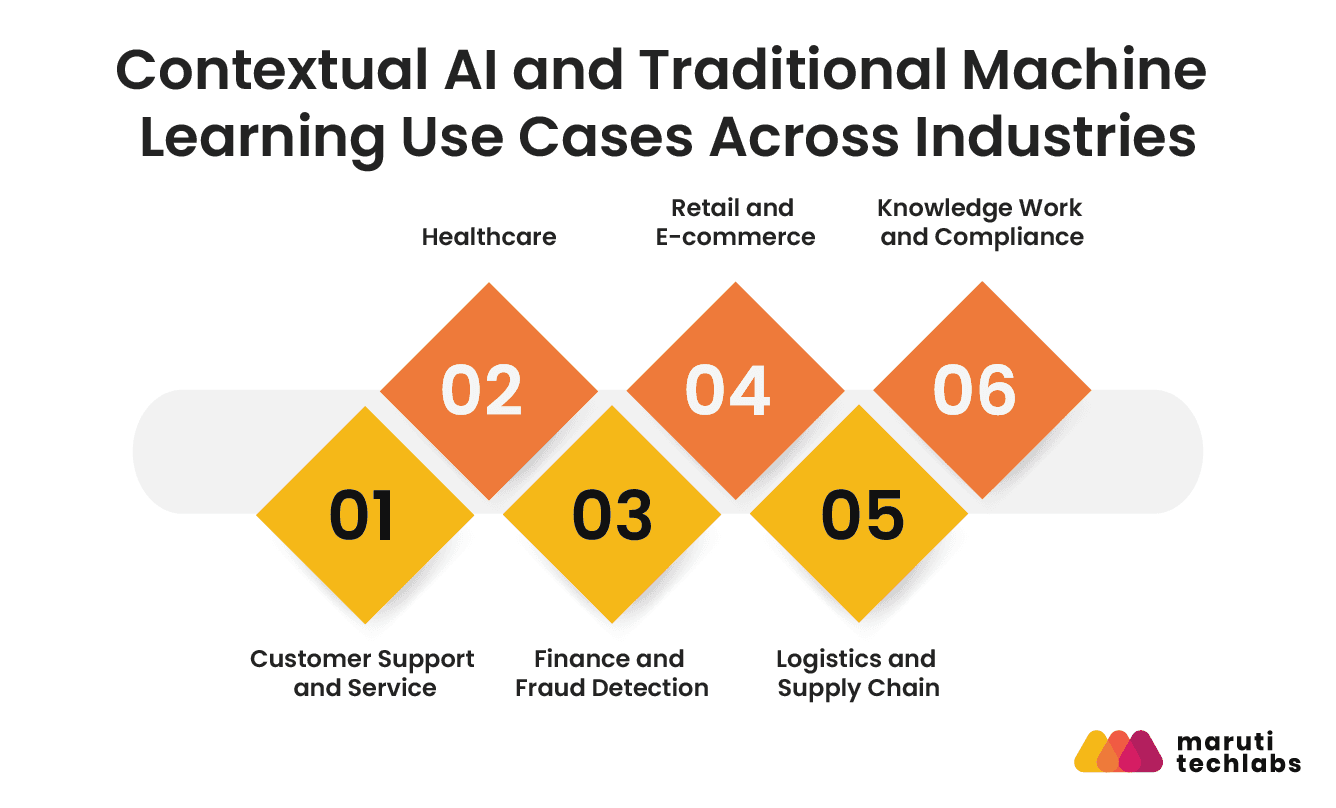
1. Customer Support and Service
Traditional ML
Support teams have long used machine learning to classify incoming tickets, route them to the right queue, and predict priority based on keywords and historical resolution patterns. This works well for high-volume triage but treats every ticket from a given category the same way, regardless of who sent it.
Contextual AI
Luxury retailer Gucci rolled out Salesforce Einstein across Gucci 9, its global client service network, to deliver what the company calls a hyper-personalized experience. Client advisors receive AI-generated conversation replies that stay on-brand while being customized to each shopper's own purchase and interaction history, rather than reading from a generic script.
What traditional ML alone misses
A ticket classifier can tell you a message is about a return; it can't tell you this shopper is a repeat VIP customer who prefers a specific advisor's tone, which is exactly the gap contextual AI closes.
2. Healthcare
Traditional ML
Hospitals commonly use fixed risk-scoring models, such as readmission-risk calculators, trained on historical patient data to flag high-risk cases at a single point in time, typically at admission or discharge.
Contextual AI
Penda Health, a primary care network in Nairobi, Kenya, deployed an LLM-based clinical decision support tool called AI Consult, which contextualizes each patient visit against clinical practice guidelines in real time. In a study spanning nearly 40,000 patient visits across 15 clinics, clinicians using the tool had a 16% lower risk of diagnostic errors and a 13% lower risk of treatment errors compared to standard care.
What traditional ML alone misses
A static risk score is calculated once and doesn't update as new symptoms, test results, or guideline changes emerge mid-visit, which is precisely what a contextual system tracks continuously.
3. Finance and Fraud Detection
Traditional ML
Classic fraud models, often logistic regression or decision-tree based, score transactions against historical fraud patterns learned during training. These models are fast, explainable, and remain the backbone of most banks' first line of defense.
Contextual AI
Mastercard's Decision Intelligence platform blends historical transaction data with real-time behavioral signals such as device posture, location, and spending velocity to generate a live risk score for each transaction. This contextual approach drives more accurate authorization decisions, and Mastercard reports that 83% of surveyed leaders say AI has significantly cut false positives and customer churn over the past year.
What traditional ML alone misses
A model trained on historical patterns alone can't account for the fact that the cardholder is currently traveling abroad on a new device, context that dramatically changes whether a transaction looks suspicious.
4. Retail and E-commerce
Traditional ML
Collaborative-filtering recommendation engines, the classic "customers who bought this also bought that" model, have driven e-commerce personalization for years, based entirely on aggregated historical purchase data.
Contextual AI
Amazon Personalize, AWS's recommendation engine, adjusts suggestions using contextual metadata such as device type, location, and time of day, layered on top of a shopper's browsing and purchase history. AWS's own engineering blog notes that adding this kind of real-time context to a recommendation strategy measurably increases user engagement and the revenue influenced by recommendations.
What traditional ML alone misses
A collaborative-filtering model doesn't know the shopper is browsing on a phone during a commute at 8 a.m. versus on a laptop at midnight, two moments that call for very different recommendations.
5. Logistics and Supply Chain
Traditional ML
Many logistics operations still plan routes using fixed formulas or static optimization models built from historical delivery data, recalculated periodically rather than continuously.
Contextual AI
UPS's ORION system (On-Road Integrated Optimization and Navigation) continuously optimizes delivery routes using live and historical data instead of static, pre-planned paths. UPS's own newsroom describes how its UPSNav upgrade builds on ORION to optimize routes based on changing conditions in real time, reducing excess miles for drivers.
What traditional ML alone misses
A route planned the night before can't account for a traffic accident, a canceled delivery, or a new pickup added that morning, all of which a contextual system factors in as they happen.
6. Knowledge Work and Compliance
Traditional ML
Document intelligence platforms have used machine learning and natural language processing for years to classify and extract data from contracts. JPMorgan Chase's Contract Intelligence platform, known as COIN, reads and classifies commercial credit agreements, work that previously consumed roughly 360,000 hours of legal review annually and now takes seconds.
Contextual AI
Contextual layers built on top of this kind of document intelligence can now weigh a contract against the specific regulatory requirements in effect at the time of review, rather than applying one fixed rule set.
What traditional ML alone misses
A classifier trained on last year's regulations doesn't know a rule changed last month; a contextual layer checks the contract against what's currently in force.
Contextual AI vs. Traditional ML: Which Is the Right Choice for Your Business?
Before choosing between contextual AI and traditional machine learning, it helps to ask a few practical questions about the problem you're solving:
Choose traditional machine learning if:
- The task is narrow and repeatable (fraud flagging, demand forecasting, image classification)
- You need consistent, auditable outputs for compliance or regulatory reasons
- Inputs are structured and don't change moment to moment
- Cost efficiency at high volume matters more than personalization
- Explainability is a hard requirement (e.g., credit decisions, medical diagnostics with strict audit trails)
Choose contextual AI if:
- The task is conversational, variable, or highly personalized (support, recommendations, clinical decision support)
- Useful signals live in multiple systems (CRM, session data, inventory, policy databases)
- The "right answer" depends on who's asking and what's happening right now
- You're willing to trade some explainability and higher compute cost for relevance
- The workflow benefits from reasoning across tasks, not just one fixed prediction
Choose both (the common enterprise pattern) if:
- A traditional ML model can generate a fast, reliable score or prediction in the background
- A contextual AI layer then takes that score and blends it with real-time context to decide the final action or response
- Example: a fraud model scores a transaction (traditional ML), then a contextual layer weighs that score against device posture, location, and spending velocity to make the final call (contextual AI)
There's no universal winner here. The organizations getting the most value typically start by mapping their workflows into "stable and repeatable" versus "variable and personal," then apply the matching approach, often running both side by side within the same system.
Conclusion
Contextual AI and traditional machine learning aren't competing for the same job; they're built to solve different problems. Traditional machine learning optimizes for consistency and precision on a narrow, well-defined task, and it remains the right tool for stable, high-volume predictions where explainability and cost efficiency matter most.
Contextual AI optimizes for relevance in situations that are too fluid and personal for a fixed model to handle well, which is exactly why enterprise AI teams are investing in it for support, personalization, and decision-heavy workflows. The organizations getting the most value aren't choosing one over the other. They're matching the approach to the use case, and increasingly running both side by side.
How Maruti Techlabs Built an ML-Based Sales Forecasting Model for Auto Parts
Maruti Techlabs partnered with A20 Motors, one of the largest manufacturers and distributors of aftermarket car and truck parts across North and South America, Europe, Asia, Australia, and the Caribbean, to solve a forecasting problem that traditional methods couldn't keep up with.
A20 Motors relied on a fixed mathematical formula to forecast sales across more than 10,000 spare parts. As their catalog and markets grew, the formula's accuracy declined, leading to chronic overstocking and understocking, missed sales opportunities, and strain across inventory management, warehousing, and shipping.
Maruti Techlabs built a machine learning model using the Long Short-Term Memory (LSTM) algorithm, chosen for its strength in forecasting from sequential, time-based data. The team ran a feasibility study to map data correlations, built custom APIs to correct for skewed and incomplete data, and extended the model to predict sales for new parts by matching them against the characteristics of existing ones.
The Impact
- Prediction errors for high-selling parts narrowed to within ±20%
- Inventory tracking and restocking processes improved significantly
- Storage allocation and operational efficiency were streamlined across the supply chain
- The model enabled scalable, data-driven growth instead of manual, formula-based guesswork
- Higher demand fulfillment and profitability followed from more reliable forecasts

FAQs
1. Does contextual AI cost more to implement than traditional machine learning?
Generally, yes. Contextual AI systems pull from multiple live data sources and often run a reasoning model per request, which adds compute and integration costs that a single-purpose traditional machine learning model doesn't carry.
2. Can smaller businesses realistically use contextual AI, or is it only for large enterprises?
Smaller businesses can adopt contextual AI, particularly through pre-built platforms and APIs that handle the context layer and retrieval infrastructure, rather than building the pipeline from scratch, as large enterprises often do.
3. How long does it typically take to deploy a contextual AI system in production?
Timelines vary by scope, but a focused contextual AI use case built on retrieval and in-context prompting can often reach production faster than a system that also requires custom fine-tuning or new data infrastructure.
4. What skills does a team need to build and maintain contextual AI, compared to traditional ML?
Beyond standard data science skills, teams typically need experience with retrieval systems, vector databases, prompt design, and data governance, since contextual AI depends on infrastructure that traditional machine learning pipelines don't require.
5. Does contextual AI work alongside existing traditional machine learning models, or does it require replacing them?
It can work alongside them. A common pattern is for a traditional machine learning model to generate a prediction or score in the background, which a contextual AI layer then uses as one more signal when deciding how to respond to a specific person or situation.
6. What Are the Popular Approaches and Techniques Behind Contextual AI?
RAG and In-Context Prompting: RAG retrieves relevant, up-to-date information at the time of a request, while in-context prompting guides the model using situation-specific information without retraining.
Fine-Tuning and Tool Use: Fine-tuning supports stable, high-volume tasks, while tool use or function calling enables AI to take actions. These capabilities also support agentic AI, which can plan and execute multi-step tasks. A context layer, often powered by a vector store, connects and retrieves relevant enterprise data across systems.