Step-by-Step Guide To Successfully Hiring a .Net Developer
Hiring a workforce can be a highly stressful process. Find out how to hire a .NET developer successfully.
Software Development Practices
Step-by-Step Guide To Successfully Hiring a .Net Developer
Hiring a workforce can be a highly stressful process. Find out how to hire a .NET developer successfully.
Table of contents
Table of contents
Benefits of ASP.NET – Why Opt For It?
What Does an ASP.NET Developer Do?
Why Hire a Dedicated ASP.NET Developer?
6 Steps To Successfully Hire ASP.NET Developer
Skill Sets ASP.NET Developer Must Have
Where to Hire ASP.NET Developers?
FAQs
Without a doubt, adding skilled application developers to your workforce can make all the difference in making your organization successful. And as the IT outsourcing industry continues to register tremendous growth, it has become more pressing for enterprises to hire skilled developers, especially ASP.NET developers.
Of the different programming languages in vogue today, the demand for ASP.NET, developed and owned by Microsoft, remains right at the top of the line. That’s because .NET has emerged as the most widely used language for programming. 28.1% of all web applications are developed using .NET, according to WhiteHat Security.
It is only natural then that you’d like to capitalise on that trend, for which you need to rope in the best ASP.NET developers. The process of putting together a development team must be thorough, as skilled, efficient, and affordable developers are hard to come by. You have to be prepared to put in the hard work and go through the rigmarole of an elaborate hiring process. But we can assure you that this effort to hire ASP.NET developers will be well worth your while and yield results in helping bolster your online presence.
Before we get to what you need to do to hire ASP.NET developers, let’s try to understand the workings and benefits of ASP.NET –
Benefits of ASP.NET – Why Opt For It?
ASP.NET is a leading framework for developing web-based applications. The technical architecture of this framework rests on a unified development model. This, when integrated with the .NET framework, proves instrumental in creating web-based applications that are dynamic and easily scalable.
Just considering these top benefits of ASP.NET will make it abundantly clear why this programming language will hold your business in good stead:
The program inconveniences in the .NET framework are minimised with a separation of program logic and content.
One of the distinguishing features of the .NET framework is its built-in dedicated caching feature.
It sets your web-based application for optimal performance with the help of features such as native optimisation support, early binding, JIT compilation, and of course, the aforementioned caching abilities.
The web servers supporting the framework are capable of monitoring web pages, along with its components and multiple applications.
The applications developed using this framework are capable of handling and processing multiple requests, as they are closely monitored and micromanaged.
The inherent pre-application configuration feature, along with Windows authentication, enhances the security of applications manifolds.
Any application developed with .NET comes with configuration information built-in, which makes it easy to deploy. This contributes to the user-friendliness of these applications and their popularity.
Creating dynamic web pages with .NET is a seamless and smooth process.
The framework is designed to spot any memory leaks, unbounded loops and other glitches as soon as they appear, and then send quick alerts to the user. This way any malfunction can be stopped in its tracks.
There is no elaborate coding involved in developing applications on this framework, which makes the process of launching even large apps quicker and hassle-free.
The framework operates independently of programming languages, which means your developers can choose the language they think is best-suited for developing particular applications.
Don't settle for off-the-shelf solutions. Our custom web application development services are designed to help you stand out from the competition and achieve your business goals with ASP.NET.
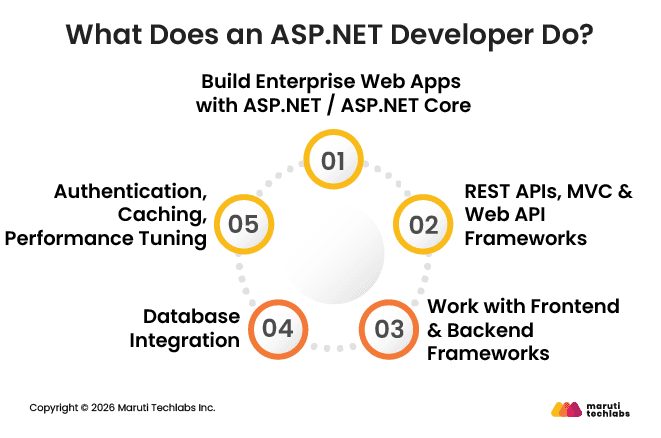
What Does an ASP.NET Developer Do?
An ASP.NET developer designs, builds, and maintains scalable web applications using Microsoft’s .NET ecosystem, delivering secure, high-performance enterprise solutions aligned with business, architectural, and operational requirements.
1. Build Enterprise Web Apps with ASP.NET / ASP.NET Core
ASP.NET developers architect and develop enterprise-grade applications using ASP.NET and ASP.NET Core. They implement layered architectures, dependency injection, middleware pipelines, and configuration management to ensure scalability, maintainability, and cross-platform compatibility across Windows, Linux, and cloud-hosted environments.
2. REST APIs, MVC & Web API Frameworks
Developers build RESTful services using MVC patterns and Web API frameworks within ASP.NET Core. They structure controllers, routing, model binding, and middleware to expose clean endpoints, enforce validation, handle serialization, and maintain separation of concerns across presentation, application, and domain layers.
3. Work with Frontend Frameworks + Backend
ASP.NET developers integrate backend services with frontend frameworks such as Angular, React, or Vue.js. They design APIs optimized for SPA architectures, manage CORS policies, and ensure secure, efficient communication between UI components and server-side logic.
They implement data persistence layers that connect applications to relational databases such as Microsoft SQL Server and PostgreSQL, as well as NoSQL systems. Responsibilities include schema design, query optimization, indexing strategies, and transaction management for performance and integrity.
5. Authentication, Caching, Performance Tuning
ASP.NET developers implement authentication and authorization mechanisms using identity frameworks, OAuth flows, and token-based security. They configure distributed caching, optimize memory usage, reduce latency, and profile applications to maintain throughput under production workloads.
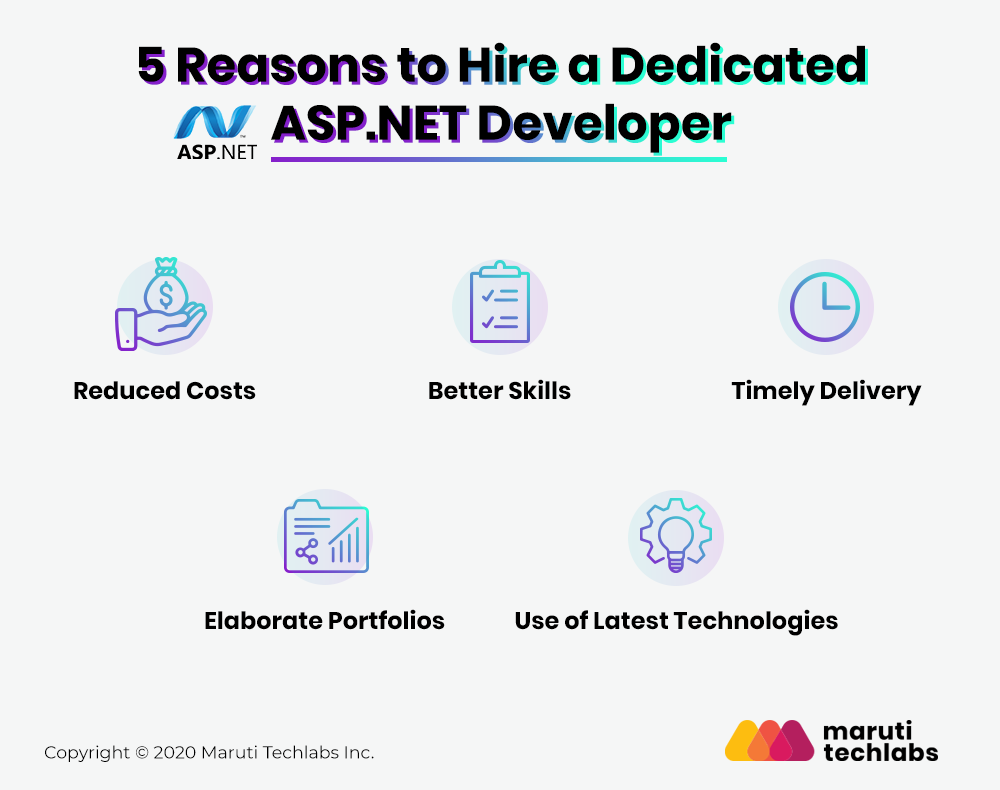
Why Hire a Dedicated ASP.NET Developer?
Considering the wide-ranging benefits of ASP.NET, hiring a developer trained to use this framework to build your web presence seems like the obvious thing to do. However, with the demand for these professionals growing, you have to focus on one that adds the most value to professional outcomes in the most cost-effective manner. That’s when the decision to hire ASP.NET developers in India full-time can pay off in the following ways –
Reduced Costs
India has emerged as a world leader when it comes to the web development vertical. With so many MNCs operating out of the country now, it boasts of not just enviable web development expertise but also digital infrastructure. That’s why employing ASP.NET developers from India in full-time roles, can help you cut back on recurring costs. The difference in salary structures in India compared to many other western countries, as it is, results in cost reduction. If you factor in the quality of outcome based on the candidates’ proficiency and experience, the savings can be significant.
Better Skills
Considering that a large chunk of web development projects from across the world are being executed in India today, the homegrown crop of present-day ASP.NET developers have a clear edge over their competitors elsewhere in the world in terms of experience, resources, skill and expertise. You can also leverage the tier design services there for top-notch web pages.
Timely Delivery
Anyone who has worked with web developers in the past knows that timelines get pushed back all the time, and the resulting delays can lead to loss of resources, revenue and capital. Needless you say, any business would want to hire ASP.NET developers who can deliver on the pre-agreed upon timeline. With their vast experience to fall back on, sticking to delivery deadlines is mostly not an issue with experts in this part of the world. You can bank on them to get highly intuitive products delivered on time.
Elaborate Portfolios
Having dealt with a wide range of projects, these ASP.NET developers are equipped with diverse skills and have a credible portfolio to show for it. Before you hire one, you have the option to review their past work and hire a dedicated ASP.NET developer who is most in sync with your objectives and requirements.
Use of Latest Technology
As mentioned before, these ASP.NET developers have access to some of the most advanced digital infrastructure, which means they’re well-versed with the latest tech tools and trends. Research and development, and consequent upgrades, are a key part of the web development culture in this part of the world. So, you can rest assured that when you hire ASP.NET developer in India, you will get a product built on the latest version of the .NET framework that is compatible with all the trending technologies and tools.
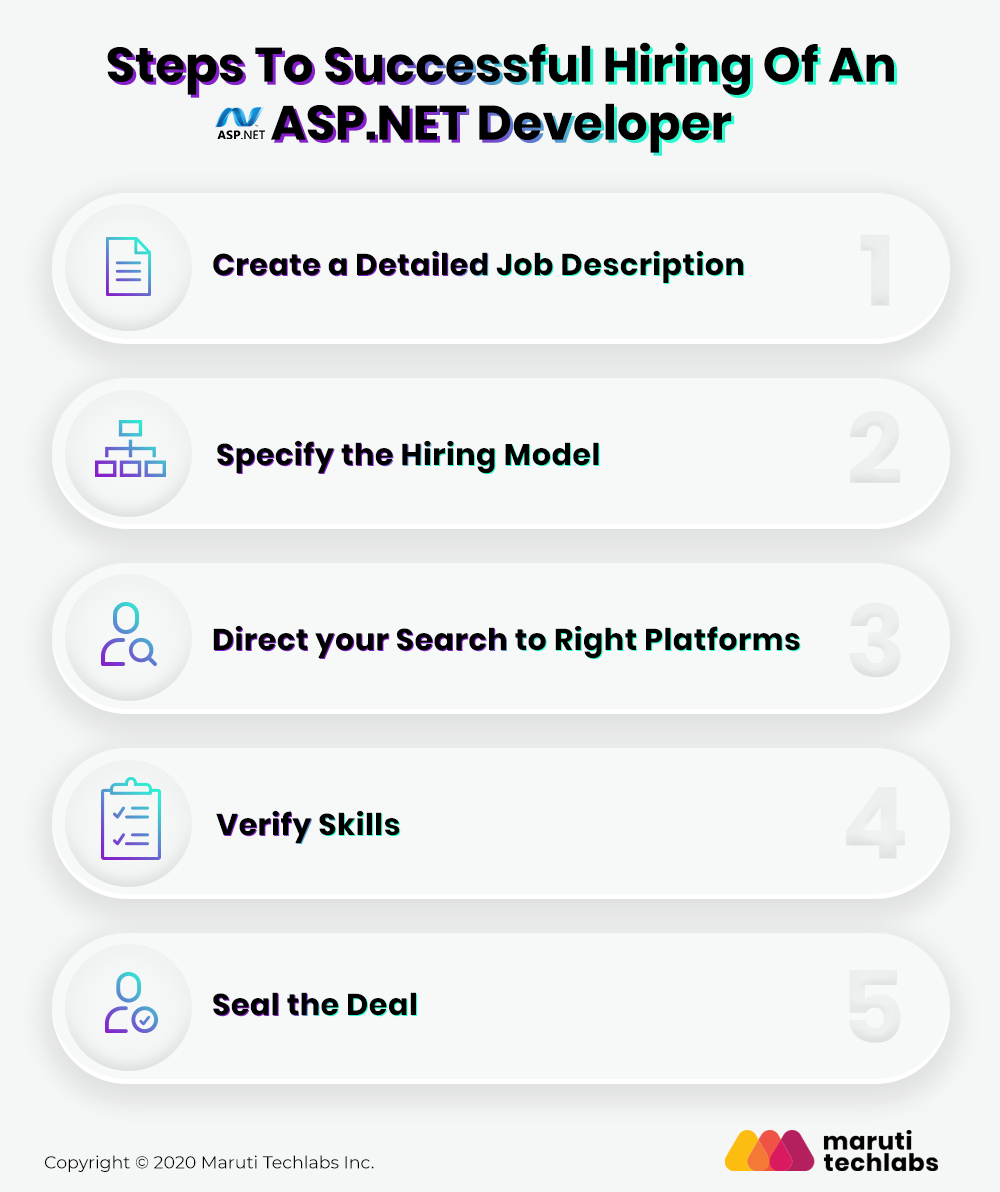
6 Steps To Successfully Hire ASP.NET Developer
The process to hire ASP.NET developers has to be such that it enables you to find an expert who can deliver on your goals and expectations in the most cost-effective manner. Here are a few steps that’ll help you make a correct selection:
Step 1: Create a detailed job description
ASP.NET developers come with different skill sets and expertise. To be able to navigate the world of sourcing successfully to find a talent that is the right fit for your organisation, you must create a well-structured and detailed job description. The focus here should be on effectively communicating your requirements and the scope of the job. You can get creative and rely on an out-of-the-box approach to attract attention to the job listing, but make sure the emphasis on creativity doesn’t take away from the content of the description.
Step 2: Specify the hiring model
Enterprises typically rely on the following three models when employing the services of a developer:
Fixed Cost – Where you pay the professional a fixed sum for the completion of a project. This model works best when you have a one-time project with extremely specific requirements.
Full Time – This means you hire the developer in a full-time capacity, and they’ll be working from your office premises as the rest of your staff. If you have ongoing, long-term requirements, this model proves most cost-effective.
Freelance – You hire an ASP.NET developer as a freelancer and pay them on an hourly basis. This model is best suited for immediate requirements when you don’t have the time to go through an elaborate hiring process.
Depending on your requirement, zero-in on a model that works best for you and specify it in the job description.
Step 3: Direct your search on the right platforms
The most crucial part of hiring top Dot Net developers and programmers is knowing where to look for them. Do some research to find out which job platforms or boards do .NET developers frequent the most, and then direct your talent hunt to these sources. By investing some time in understanding where the big fish are, you can cast your net more strategically and land some promising talent.
Step 4: Verify skills
Once you start receiving applications, the process of screening the candidates based on their skill, experience, and expertise begins. It’d be naïve to just take the claims made on the applicants’ resumes at face value. We all know that resumes can be hyperbole of one’s actual abilities. To hire dedicated ASP.NET developers, you must put in place an effective test run to screen and filter out the most promising candidates.
If you’re a non-techie, rope in senior members from your tech team to set up and analyse the test run for the applicants. This is a time-tested procedure to make sure you don’t miss out on a promising candidate just because their resume lacks luster or hire one with subpar abilities just on the basis of a dazzling CV.
Step 5: Conduct interviews
Once the cream from the vast pool of candidates has been filtered out, it is time to get the interview phase to hire ASP.NET developers started. The first step in this process is a general interview that your hiring team can set up and conduct for you. Of course, you can sit in, if you’ve invested in the process.
The candidates who make it through this first round of interviews have to then face a technical interview where the focus is on assessing the candidates’ grasp on their area of expertise. Make sure senior members from your tech team, such as the senior architect or the tech officer, are part of the panel for this interview.
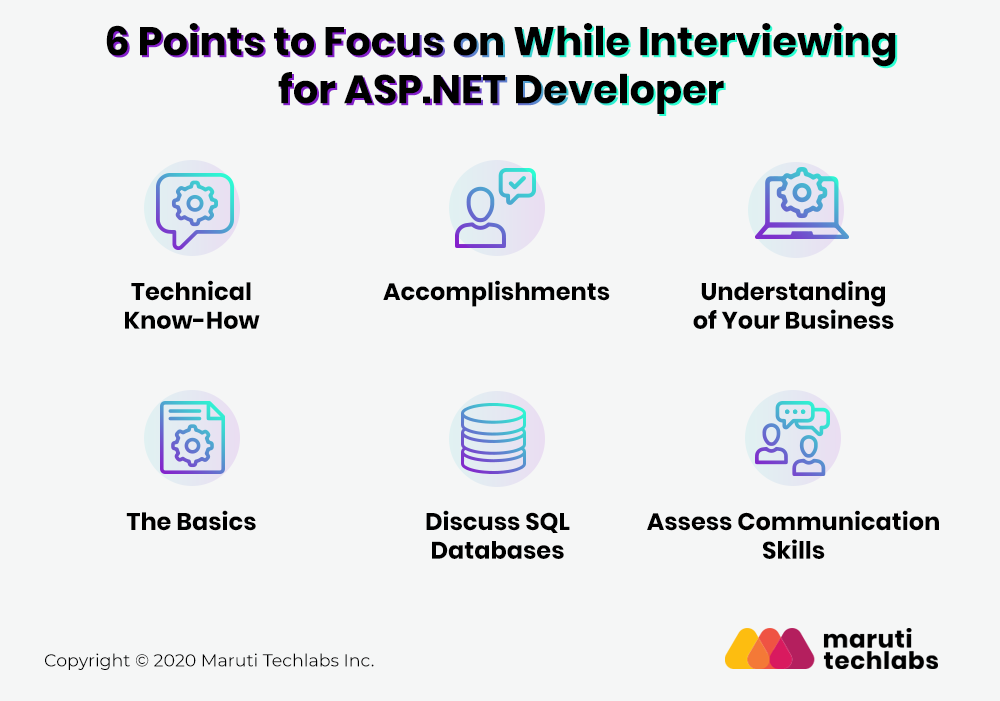
The focus of this interview should be on the following:
Accomplishment – Talk about a candidate’s past work experience and ask them in detail about the projects they’ve worked on and the tools, processes, and approaches used for different products. This is a crucial determining factor on whether or not a candidate is a right fit for the job. After all, the experience is key to honing one’s skills and only a developer with considerable experience to back up their abilities is truly equipped to handle the complex intricacies of the .NET development process.
Technical Know-How – Check their level of understanding of the latest trends in the realm of technology. A good developer is one who stays updated on new languages and upgrades in their field of work and tries to incorporate them in their body of work.
Understanding of Your Business – Does the candidate understand your business ethos? Can they co-relate the scope of the job they are interviewing for with your business goals? This is important to ensure that the person you select for the job is in sync with the goals and deliverables you have in mind.
The Basics – To know the real depth of a candidate’s understanding of their field of work, go back to the basics. Talk in detail about the framework and different aspects of the .NET application development process.
Discuss SQL Databases – These are crucial components that govern the outcome of application development processes in the present milieu. To make sure you hire a dedicated ASP.NET developer who is up for the task at hand, discuss advanced database techs such as MySQL, Microsoft SQL, .NET developer Oracle and so on.
Assess Communication Skills – Communication skills aren’t often a strong suit of people with a tech background yet it is an important part of their job, as they’d be required to not only communicate with other team members but also with people outside the tech team to understand the requirements of a project. In some cases, your .NET developer may even have to interact with third-party clients regularly, so communication skills count.
Step 6: Seal the Deal
At the end of this interview and selection process, you’d have shortlisted at least two to three potential candidates to hire as ASP.NET developers. Now is the time to spell out the details such as expected pay, total working hours, delivery timelines, and so on.
Keeping two to three candidates in the mix at this stage saves you the hassle of going through the entire hiring process all over again should your terms not be agreeable to your top choice. In that case, you can just move on to the next person on the shortlist.
Once you and the selected person are on the same page regarding the terms of the job, your journey to hiring a dedicated ASP.NET developer has reached its logical conclusion. Seal the deal by signing the contract.
However, at times, hiring a full-time .Net developer may not be feasible for your project. This is particularly true if your requirement is temporary or you need a team of expert developers on a stringent budget. In such situations, you can reach out to the best staff augmentation firm and request the most skilled ASP .Net developers.
At Maruti Techlabs, we ensure that your project has the best resources. Our extensively experienced developers use the best-in-class tools and processes to scale up your business. Talent combined with seamless communication and precise execution make sure our clients enjoy peace of mind and business growth. Simply drop by here.
Whether you're looking for remote talent or local support, our experience with software development in Los Angeles enables us to deliver tailored solutions that meet your business needs.
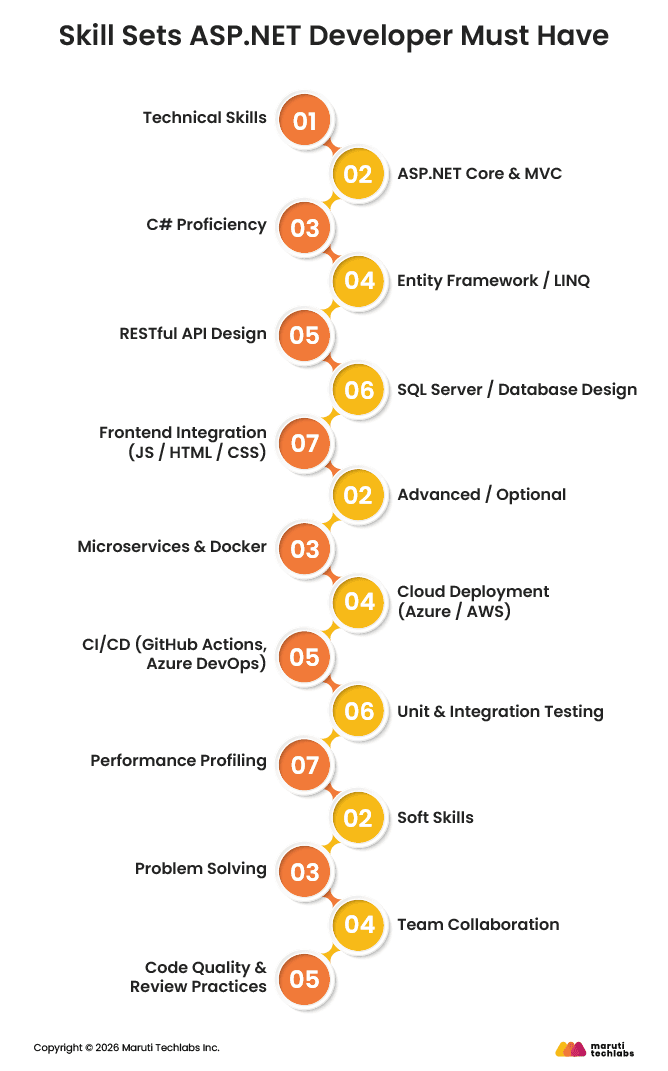
Skill Sets ASP.NET Developer Must Have
Effective ASP.NET developers combine backend engineering expertise, database proficiency, frontend integration knowledge, and operational skills to build scalable, secure, and maintainable enterprise web applications.
1. Technical Skills
Core technical competency includes understanding the .NET runtime, middleware pipelines, dependency injection, asynchronous programming, REST principles, and layered architecture. Developers must be proficient in debugging, performance diagnostics, and structured logging to support production-grade applications.
2. ASP.NET Core & MVC
Strong command of ASP.NET Core MVC includes routing, model validation, filters, middleware configuration, and API versioning. Developers should understand application lifecycle management, configuration providers, and cross-platform hosting models for scalable deployment.
3. C# Proficiency
Advanced knowledge of C# includes object-oriented programming, LINQ queries, async/await patterns, generics, delegates, exception handling, and memory management. Clean coding practices and SOLID principles are essential for maintainable, testable systems.
4. Entity Framework / LINQ
Experience with Entity Framework Core and LINQ enables developers to abstract database interactions efficiently. Skills include migrations, relationship mapping, tracking behavior, query optimization, and preventing performance issues such as N+1 query problems.
5. RESTful API Design
Developers must design REST-compliant APIs with proper HTTP methods, status codes, versioning strategies, and consistent resource naming. Implementing validation, pagination, rate limiting, and secure authentication is essential for scalable API ecosystems.
6. SQL Server / Database Design
Proficiency in relational database modeling includes normalization, indexing, stored procedures, transactions, and performance tuning. Developers must optimize execution plans and ensure data integrity, availability, and scalability across enterprise workloads.
7. Frontend Integration (JS / HTML / CSS)
Developers should understand core JavaScript, semantic HTML, and modern CSS practices. Experience integrating REST APIs with SPA frameworks ensures smooth user experiences, proper state management, and responsive UI behavior.
8. Advanced / Optional
Advanced competencies include distributed systems design, event-driven architecture, message queues, containerization, and observability tools. These skills support scalable, cloud-native application architectures.
9. Microservices & Docker
Experience designing microservices using domain-driven design and containerizing applications with Docker enables independent deployment and horizontal scaling. Developers should understand service discovery, API gateways, and inter-service communication patterns.
10. Cloud Deployment (Azure / AWS)
Deployment experience on Microsoft Azure or Amazon Web Services includes configuring app services, storage, networking, and monitoring. Developers must manage scalability, security groups, and cost optimization in cloud environments.
11. CI/CD (GitHub Actions, Azure DevOps)
Hands-on experience with GitHub Actions and Azure DevOps enables automated builds, testing, and deployments. Developers should implement branching strategies, artifact management, and release pipelines for continuous delivery.
12. Unit & Integration Testing
Testing proficiency includes writing unit tests, mocking dependencies, and validating integration points. Familiarity with testing frameworks, coverage analysis, and automated pipelines ensures the reliability and regression resistance of systems.
13. Performance Profiling
Developers use profiling tools to detect memory leaks, thread contention, and database bottlenecks. Monitoring application metrics and analyzing logs ensures optimal throughput, reduced latency, and efficient resource utilization.
14. Soft Skills
Beyond technical expertise, developers require clarity in communication, stakeholder alignment, and documentation discipline. They must translate business requirements into technical architecture while maintaining delivery timelines and quality standards.
15. Problem Solving
Analytical reasoning enables developers to debug complex runtime issues, optimize queries, and refactor inefficient code. Structured troubleshooting and root-cause analysis are critical in production environments.
16. Team Collaboration
Effective collaboration includes participating in agile ceremonies, aligning with DevOps workflows, and coordinating with frontend engineers, QA teams, and architects to ensure consistent delivery and system integration.
17. Code Quality & Review Practices
Adhering to coding standards, performing peer reviews, and implementing static code analysis ensures maintainability. Developers should follow SOLID principles, maintain documentation, and enforce automated linting and testing standards.
Where to Hire ASP.NET Developers?
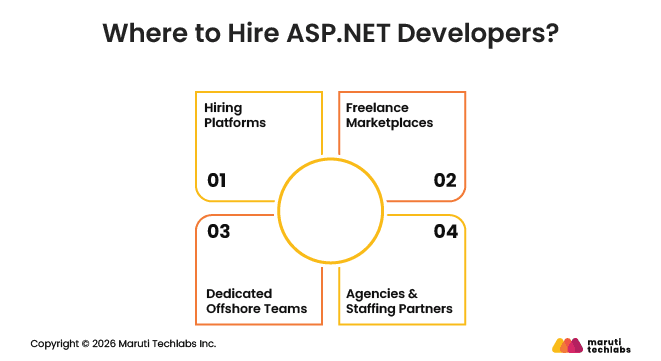
Hiring ASP.NET developers requires evaluating technical proficiency, domain expertise, and cultural fit. Organizations can source talent through professional networks, freelance marketplaces, offshore teams, or specialized staffing agencies, depending on project complexity and budget.
Professional platforms like LinkedIn, Indeed, Naukri.com, and Stack Overflow provide access to vetted developer profiles. These channels allow direct outreach, technical filtering, and job postings targeting experienced .NET professionals.
Advanced search filters, endorsements, and portfolio reviews help identify candidates with enterprise experience, relevant certifications, and demonstrated backend architecture expertise.
2. Freelance Marketplaces
Platforms such as Upwork, Toptal, Freelancer.com, and PeoplePerHour enable hiring contract-based ASP.NET developers. These marketplaces offer flexible engagement models, hourly billing, and global talent pools.
They are suitable for short-term projects, MVP development, or performance optimization tasks requiring specialized technical skills without long-term commitments.
3. Dedicated Offshore Teams
Hiring dedicated teams in regions such as India, Eastern Europe, and Latin America provides cost advantages and scalable engineering capacity. Offshore engagement models include dedicated developers, managed teams, or build-operate-transfer structures.
Organizations benefit from time-zone alignment options, robust technical education ecosystems, and lower development costs than in domestic hiring markets.
4. Agencies & Staffing Partners
Technology staffing agencies and consulting firms specialize in sourcing pre-vetted ASP.NET professionals for contract, contract-to-hire, or permanent roles. They handle candidate screening, technical evaluation, compliance, and onboarding support.
This model reduces recruitment overhead and accelerates time-to-hire, particularly for enterprise projects requiring niche expertise, architectural leadership, or rapid scaling of development teams.
FAQs
1. Why should I hire a dedicated .NET developer for my project?
Hiring a dedicated .NET developer ensures consistent quality, faster development, and better alignment with your long-term technical goals. They bring specialized expertise in Microsoft technologies and frameworks.
2. What skills should I look for when hiring a .NET developer?
A skilled .NET developer should have strong knowledge of C#, ASP.NET Core, MVC architecture, RESTful APIs, SQL Server, and experience with Azure or cloud integration.
3. What are the benefits of using the .NET framework for development?
The .NET framework offers cross-platform compatibility, high security, scalability, and fast performance, making it ideal for enterprise-grade web and mobile applications.
4. What industries benefit the most from .NET development?
Industries like finance, healthcare, retail, manufacturing, and logistics use .NET for building secure, scalable, and high-performance enterprise applications.
Mitul Makadia is the Founder and CEO of Maruti Techlabs, a custom software and AI engineering company he built from the ground up in 2009. Over 20+ years, he has led product development, business strategy, and engineering teams across startups to Fortune 500 clients.
Stuck with a Tech Hurdle?
We fix, build, and optimize. The first consultation is on us!