

AI Agents for Insurance Claims: A CTO-Focused Architecture, Integration, and Deployment Guide
Key Takeaways
- An AI agent for insurance claims perceives, reasons, and acts on a claim, which is what separates it from RPA scripts and rule-based chatbots
- A working claims agent system separates LLMs for language tasks from deterministic models for scoring, since scoring needs to be reproducible for an audit
- Specialized agents handling narrow tasks, coordinated by an orchestration layer, outperform one generalist agent trying to handle a whole claim
- Legacy claims platforms do not need to be rebuilt; an orchestration layer sitting above core systems can integrate through existing APIs and events
- Only about 7% of insurers have scaled AI past the pilot stage, and the gap usually comes down to missing rollback criteria, not the technology itself
- A hybrid approach, buying commodity components and building what touches compliance and claims logic, is what most successful deployments actually look like
Introduction
Lisa has been VP of Engineering at a mid-size insurance firm for three years. Her claims team keeps asking for "an AI agent." What lands on her desk instead is a stack of vendor decks, a Guidewire instance nobody wants to touch, and a compliance team that needs every automated decision explainable to a state regulator.
The challenge isn't deciding whether to use an AI agent. It's defining its decision scope, system access, human approval points, and audit trail. Those are the questions vendor demos rarely answer.
Most insurance AI initiatives don't stall at the idea stage. They stall when "agents" have to become a data flow, an integration plan, and a deployment sequence. Claims teams still spend significant time on administrative work, data gathering, and system handoffs, creating a clear opportunity for targeted automation.
McKinsey quantifies the upside: a domain-based approach to claims automation can cut claims handling expenses by 25 to 30%.
RPA moves data between systems on a fixed script. A chatbot answers questions but can't act. An AI agent reads a claim packet, checks it against policy terms and fraud signals, and routes it, chaining decisions a claims team already makes, without waiting on a human for every handoff.
This CTO-focused guide covers the architecture, integration, and deployment decisions involved in building AI agents for insurance claims. If you are evaluating an implementation partner, our AI agent development services cover the engineering required to take these systems from architecture to production.
What AI Agents for Insurance Claims Are, and Where They Differ From RPA and Chatbots
An AI agent for insurance claims can perceive information from a claim, such as a policy document, a photo of vehicle damage, or an intake form. It can reason about that information by assessing it against policy terms and potential fraud signals.
It can then take actions such as routing the claim, flagging it, or requesting additional documentation, without requiring human approval for every individual step.
That last part is what separates an agent from the automation insurers already run. RPA and chatbots both show up in claims workflows today, but neither one reasons or acts the way an agent does.
| Capability | RPA | Chatbot | AI Agent |
| How it works | Follows a fixed script across systems | Answers questions in natural language | Perceives, reasons, and acts toward a goal |
| Decision authority | None, executes predefined rules | None, responds but does not decide | Can make and act on a decision within a defined scope |
| System reach | Moves data between systems it is configured for | Usually limited to a single interface | Can call APIs, query multiple systems, and hand off to other agents |
| State across a claim | Stateless, each run is independent | Stateless beyond a single conversation | Can hold state across a multi-day claim and resume where it left off |
| Example in claims | Copying intake data from a web form into a policy admin system | Answering "What is my deductible" | Validating a claim against policy terms and routing it to the right adjuster |
The practical boundary that matters for a CTO evaluating this technology is simple to state and hard to build.
- Can the system call the APIs it needs to complete a task, not just retrieve information
- Can it hold state across a claim that spans several days, so it does not lose context between an intake step and a fraud check three days later
- Can it escalate to a human when it hits a decision outside its defined authority, rather than guessing or stalling
A system that fails any of these three tests is not really an agent yet, whatever the vendor calls it.
The shift toward this kind of system is moving faster than most legacy claims platforms were built to accommodate. Market Research Future puts the global AI in insurance market at 14.99 billion USD in 2025, growing to 246.3 billion USD by 2035, a 32.3% compound annual growth rate.
Other research firms size the same market differently, with 2035 estimates ranging from under 200 billion USD to over 300 billion USD, depending on what gets counted as AI spend. The direction is consistent even when the dollar figures aren't, and that inconsistency is worth naming rather than picking whichever number sounds most impressive.
Adoption on the insurer side is moving just as fast. InsuranceNewsNet reported that the share of insurers with AI fully adopted into their value chain jumped from 8% in 2024 to 34% in 2025, based on Conning's annual industry survey.
Where Do AI Agents Create the Most Impact Across the Claims Lifecycle?
The impact of AI agents on claims is not evenly spread across the workflow. It concentrates at the points where high claim volume meets manual document review, subjective judgment calls, and repeated back-and-forth communication.
BCG has found that AI can reduce claim resolution costs by 20 to 50%, and Bain estimates it can lift claim specialists' productivity by up to 50%.
On the processing side, AI-powered claim management systems can handle 70 to 90% of simple claims in a straightforward manner, with decisions delivered in minutes rather than weeks.
Here is where that impact actually shows up across a claim's lifecycle.
Claim Intake and Triage
An intake agent collects the FNOL and supporting evidence from customer portals, mobile apps, and TPA platforms, then checks the submission package for completeness and flags gaps before the claim moves forward.
A separate triage agent analyzes the validated submission against claim handling policy, urgency, injury severity, and damage extent, and sets priority and routing accordingly. This is the stage that determines whether everything downstream moves fast or slow.
Document- and Photo-Based Damage Assessment
Computer vision models evaluate submitted photos or videos of vehicle or property damage and generate a structured damage estimate, without waiting on a field inspection. The same underlying approach, computer vision paired with document intelligence, already has a proven track record on the document side of claims.
Maruti Techlabs built a Python-based pipeline for a major US insurance broker that combined Tesseract for document preprocessing, YOLOv5 for text detection, and PyTorch for character recognition, applied specifically to FNOLs, bank statements, and credit scores that used to require manual, document-by-document verification.
The result cut underwriting processing time by 40% and improved fraud and risk scoring signals. Extending that same computer vision foundation from reading documents to reading damaged photos is a smaller technical step than it sounds; the pattern of automated visual analysis feeding a structured output is the same one, just pointed at a different kind of image.
Coverage and Eligibility Verification
An eligibility agent checks the claim against policy limits, deductibles, exclusions, and utilization rules, and identifies claims that fall outside coverage before an adjuster spends time on them.
It can also generate a plain language eligibility explanation for the claimant, which matters as much for customer experience as for internal efficiency.
Fraud Signal Detection Throughout the Claim, Not Only At the End
Fraud checks work best running in parallel with intake and adjustment, not as a single gate before payout. Specialized agents validate document authenticity, compare the FNOL narrative against submitted evidence, and cross-reference third-party sources like telematics and weather data, then produce a consolidated fraud risk score.
Settlement Recommendation and Reserve Estimation
Once a claim is validated, eligible, and cleared of fraud signals, a decision support agent analyzes the claim against policy and compliance rules, checks vendor network costs, and produces an evidence-backed settlement suggestion and reserve estimate.
The agent flags inconsistencies and risks. The human adjuster keeps final decision authority, which is the design choice that keeps this stage defensible to a regulator.
Customer Communication and Status Updates
AI in insurance handles the routine communication load, requesting missing documents, explaining a coverage decision, and providing status updates around the clock, freeing claim specialists to focus on the cases that actually need judgment.
What Does a Reference Architecture for a Claims AI Agent System Look Like?
A reference architecture for a Claims AI Agent System is a modular blueprint that connects enterprise data sources, specialized AI agents, deterministic models, computer vision, and human oversight through a centralized orchestration layer.
The diagram below is the piece every competing article treats as an afterthought. Data enters through an ingestion layer that pulls from policy admin systems, claims platforms, documents, images, and third-party feeds.
It lands in a data lake, gets routed by an orchestration layer to the right specialized agent, and moves through a model layer built from three distinct components rather than one generalist model.
An integration layer writes decisions back into the systems claims teams already use. An audit and compliance logging layer wraps the entire pipeline, not as a bolt-on at the end, but as a layer every other component writes to continuously.
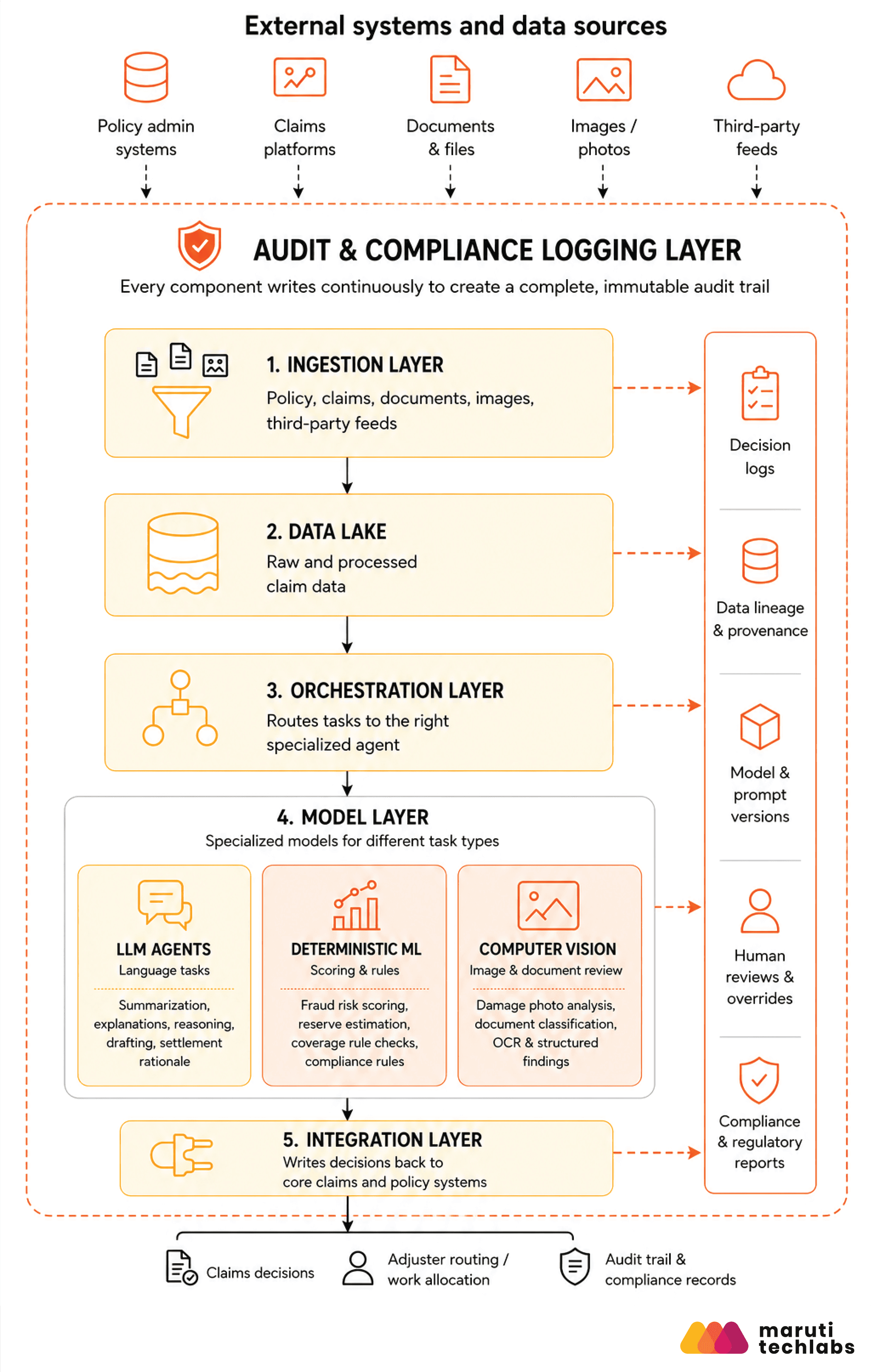
The separation inside the model layer is what detail engineering leads ask about most, and what most architecture write-ups skip.
- LLM agents handle language tasks, reading claim narratives, summarizing case files, drafting eligibility explanations, and generating settlement rationale in plain language
- Deterministic ML handles scoring, the fraud risk models, reserve estimation, and coverage rule checks that need a repeatable, auditable output every time, not a generated one
- Computer vision handles damage photo and document image review, producing structured findings a downstream agent or adjuster can act on
Keeping these three separate matters for reasons beyond architectural cleanliness. An LLM's output can vary between runs on the same input, which is fine for drafting a summary but not for a fraud score a regulator might ask to reproduce.
Routing scoring and compliance checks through deterministic models, and reserving the LLM for language and reasoning tasks, is what keeps the system explainable when a decision gets challenged.
Maruti Techlabs has already built a real version of the ingestion and model layer pieces of this pattern for an insurance client.
Our AI experts built a Python-based pipeline that combined document preprocessing, text detection, and character recognition to turn unstructured FNOLs and supporting documents into structured, usable data, which is exactly what the ingestion and model layer needs to hand off cleanly to everything downstream.
The outcomes helped the client cut underwriting processing time by 40%, a concrete result from the same kind of foundation this architecture depends on.
Why Does Multi-Agent Orchestration Work Better Than One Generalist Agent?
Multi-agent orchestration divides complex claims workflows into focused, parallel, and specialized sub-roles, allowing each agent to handle a specific task while improving accuracy, traceability, and control.
Building one big AI agent to handle a claim from start to finish sounds easier. It is not the safer choice. Claims work involves different kinds of decisions, triage, fraud checks, coverage rules, settlement math, and each one needs different data, different accuracy standards, and carries different risk if it goes wrong.
Splitting the work across specialized multi-agents that hand off to each other is not extra complexity for no reason. It is what lets you trace every decision back to one model, one input, and one rule set. That is exactly what a regulator or an internal auditor will ask for later.
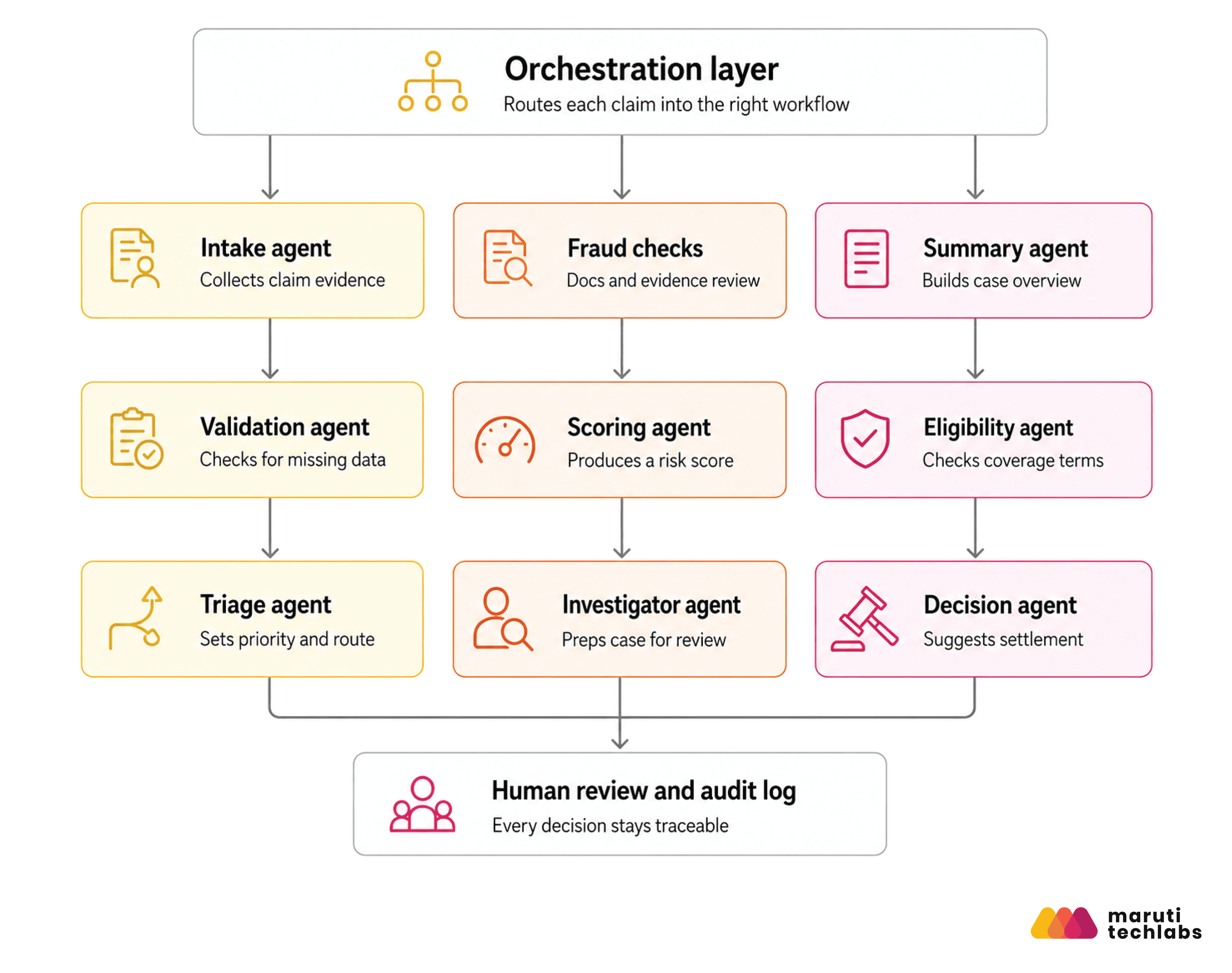
Here is what this pattern typically looks like across three common claims workflows.
| Workflow | Agents involved | What triggers a handoff |
| Claim intake and triage | Intake agent, data validation agent, triaging agent | Intake hands off once the package is complete; triage hands off once priority and routing are set |
| Fraud detection | Document check, evidence comparison, and third-party verification agents running side by side, then a fraud scoring agent, then an investigation support agent | The side-by-side agents pass their findings to the scoring agent, which passes a risk score to investigation support |
| Adjustment decision support | Claim summary agent, eligibility check agent, adjuster decision support agent | Summary hands off a case overview, eligibility hands off a coverage decision, decision support gives the final settlement suggestion |
Three workflows, eleven separate agent roles between them, each doing one job well. That is what claims agent orchestration actually looks like in production. It is not one model trying to do everything.
What to think about before you pick an orchestration approach
The specific tool matters less than whether it can answer these four questions well. Most generic agent tutorials skip all four, but claims work needs answers to every one of them.
- If the fraud scoring agent crashes halfway through, does the system pick up where it left off, or does it start the whole claim over
- A claim can stay open for weeks. Can the system remember what happened at intake three weeks ago when it runs a fraud check today?
- Can a compliance reviewer look back six months later and see exactly what each agent saw and why it made the call it made
- Where does the system stop and ask a human for a decision, and can you change that rule for different claim types or risk levels
If a tool cannot answer the third and fourth question clearly, it is not ready for claims work yet, no matter how good it looks in a demo.
Maruti Techlabs built a system like this for a US law firm, a different industry, but the same shape of problem: large volumes of unstructured documents and decisions that need to hold up to scrutiny. Instead of one generalist agent, the platform ran on three modules working alongside each other.
- A conversational interface for research and drafting
- A retrieval layer grounded in the firm's own documents
- Task-specific agents for high-volume work like drafting, due diligence, and data extraction
The result held up under real scrutiny. Work that took 7 to 8 hours dropped to a few minutes, at over 95% accuracy on complex reasoning tasks.
The same principle applies to claims. Specialized agents handling narrow jobs, coordinated by one layer above them, beat one model reasoning across a whole claim. A fraud scoring agent's output needs a different kind of review than a customer communication agent's output, and keeping them separate is what makes both easier to trust.
Should You Build, Buy, or Go Hybrid?
The choice between building in-house, buying an off-the-shelf solution, or taking a hybrid approach depends on three factors: your data, your team’s capabilities, and how quickly you need results.
Each option has trade-offs in terms of cost, control, scalability, and time to value, so there is no universally right answer. The right approach best fits your technical requirements and business priorities.
Six things to weigh before you decide
- How sensitive is your data, and does it need to stay in a specific region or on your own infrastructure
- How strong is your in-house engineering and ML team right now, not six months from now
- How complex is the integration with your existing claims and policy systems
- How much pressure do you have to show results fast
- What does this cost over three years, not just at launch
- How much are you willing to depend on one vendor long term
Score each option against these six points for your own situation. There is no universal winner here. A carrier with a strong platform team and sensitive health data will land in a very different place than a smaller MGA that just wants something working in a quarter.
What insurers are actually spending
BCG's Build for the Future study breaks the industry into three rough tiers, and the gap between them says more about commitment than technology.
| Tier | Annual AI budget | What it typically buys |
| Pilot stage | Under $5 million | Siloed experiments that rarely reach production |
| Scaled | Scaled | Full deployment across at least one core function; only about 7% of insurers reach this tier |
| Strategic leader | $50 to $100 million | Entire business processes redesigned around AI, not just automated |
This describes company-wide AI investment, not the cost of one claims agent project. Your actual project cost depends on scope, region, and who does the work. Treat any specific dollar figure a vendor gives you as a starting point for negotiation, not a market rate.
Buy, build, or hybrid, at a glance
| Approach | Fits best when | Tradeoff |
| Buy or managed platform | Data is highly sensitive, team is small, speed matters most | Less control over how decisions get made and audited |
| Build in-house | Strong engineering team, complex integrations, need full control | Costs more and takes longer to launch |
| Hybrid | Most carriers land here | Buy the commodity pieces, build what touches your compliance rules and claims logic |
Maruti Techlabs' own underwriting automation work followed the hybrid path, off-the-shelf computer vision models combined with a pipeline built specifically around one client's document types and compliance needs.
How Do AI Agents Integrate With Legacy Claims Systems?
AI agents can integrate with legacy claims systems through APIs, middleware, and integration layers without requiring insurers to replace their core platforms.
Most claims teams rely on systems such as Guidewire, Duck Creek, or Sapiens, which were not designed for AI agents but can still serve as the system of record.
The key is to add an orchestration layer that allows agents to interact with these systems while preserving existing workflows and controls. As Maruti Techlabs' own legacy insurance application modernization work demonstrates, rebuilding the underlying platform is rarely the right first move.
Where agents actually need to connect
- Policy admin, to check coverage, limits, and exclusions
- Claims management, where the claim lives and gets tracked
- CRM, so customer history stays in sync
- Document repositories, for policies, forms, and evidence
- Third-party feeds, like telematics or fraud databases
Two ways to connect
API-first works when the agent needs something right away, and the response has to come back fast, like checking a policy limit during a live intake call. Event-driven works for steps that do not need to happen instantly, like a fraud check that runs a few minutes after intake. Most real deployments use both: fast checks through APIs, background work through events.
For older, tightly coupled systems
Do not rebuild core systems to fit agents in. Put an orchestration layer on top instead. It talks to existing systems the way they already expect, and it is where the agents actually live and make decisions.
Your policy admin and claims platform keep doing what they already do; the orchestration layer just reaches in when it needs something specific. AWS points to this same pattern in its own guidance on building claims workflows with Bedrock Agents.
This lets you start small, prove the agent on one workflow, and expand from there, without a multi-year replatforming project standing between you and your first result.
How Do You Build Compliance and Explainability Into a Claims AI Agent From the Start?
Building compliance and explainability into an insurance claims AI agent from day one requires moving beyond single-prompt “black box” models toward structured, multi-agent architectures where reasoning, policy validation, and data handling operate as independent, auditable processes.
A model that works well in testing but cannot explain itself to a regulator will not survive a real audit, and in insurance, that audit is not optional.
A claims decision can get reviewed months or years later, in a dispute, a regulatory exam, or litigation. If your system cannot show why it flagged a claim as fraud or recommended a certain settlement, that is a real problem, not just a technical one. Every agent needs to log what it saw, what it decided, and why, in a way a person outside engineering can follow.
The frameworks you need to design against
You do not need to treat compliance as something bolted on after the system works. Build it in from the start, and design each agent's decision points directly against these frameworks.
- The NAIC Model Bulletin on the Use of Artificial Intelligence Systems by Insurers, adopted in December 2023, which requires insurers to run a documented AI governance program covering underwriting, rating, claims, and fraud detection. More than 20 states have adopted it as of 2026, with few to no changes in most.
- State-level AI laws go further than the NAIC bulletin; Colorado's AI Act is the clearest example, adding specific requirements around consumer notice and the right to appeal an automated decision.
- The NIST AI Risk Management Framework, a voluntary framework built around making AI systems valid, reliable, safe, accountable, and explainable, is useful even where it is not legally required because examiners increasingly expect to see it.
- GLBA, for how you handle nonpublic financial information tied to a policyholder.
- HIPAA, if any part of your claims data touches health information, which is common in auto and workers' comp claims involving injury.
- GDPR and the EU AI Act, if you operate or plan to operate in the EU, since the EU AI Act treats several AI insurance use cases as higher risk and subject to stricter documentation.
- SOC 1 and SOC 2, for the underlying security and operational controls your agent platform runs on.
Where does human review need to sit in the process?
Not every decision needs a human in the loop, but the ones with real consequences for a policyholder do. Set your checkpoints by risk tier instead of applying one blanket rule everywhere.
- Low-risk, routine decisions, like a straightforward small claim with no fraud signals, can move through with light or no human review
- Medium-risk decisions, like anything touching a coverage dispute, should get a human check before the decision goes final
- High-risk decisions, like a fraud flag that could lead to a denied claim or an investigation, always need a person to sign off before anything happens to the policyholder
What Are the Six Stages for Deploying AI Agents in Insurance Claims?
Deploying AI agents in insurance claims requires a structured, multi-phase roadmap that aligns business objectives, establishes risk boundaries, prepares data, and implements rigorous governance, testing, integration, and continuous monitoring.
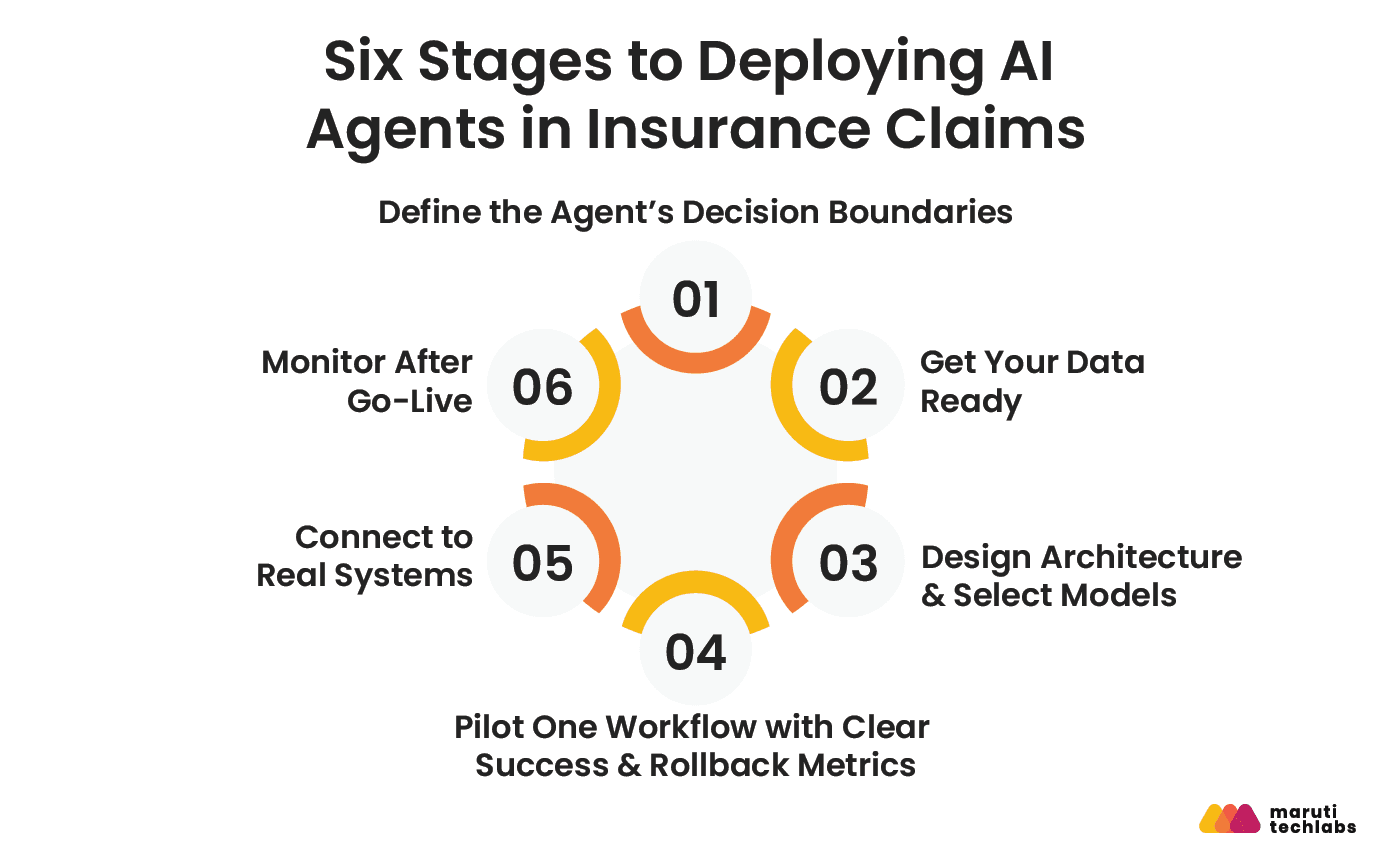
Here is a six-stage plan that actually gets you there, with a clear stop sign built into every stage.
Stage 1 - Agree on what the agent can and cannot decide on its own
Before anyone writes a line of code, get your business and compliance teams to agree on the boundary. What can the agent decide by itself, and what always needs a human to sign off? Write this down. It becomes your rulebook for every stage after this one.
Go/No-Go Gate - If your business and compliance teams cannot agree on where that boundary sits, stop here. Building the system before you have this answer just means rebuilding it later.
Stage 2 - Get your data actually ready
This is the unglamorous stage most teams want to skip, and it is the one that breaks projects later if you do. Map out where your claims data actually lives, how clean it is, and whether you can trace a data point back to its source. Your agents are only as good as this foundation.
Go/No-Go Gate - If you cannot trace a claim decision back to the data it was based on, your data is not ready yet, no matter how excited everyone is to start building.
Stage 3 - Design the architecture and pick your models
This is where you decide what runs through an LLM and what runs through a deterministic model, following the split covered earlier in this guide. Pick your orchestration approach here too, based on the four questions from the orchestration section, not based on whichever tool is trending this quarter.
Go/No-Go Gate - If your architecture cannot answer the replay and audit question from the orchestration section, redesign it now. It is much cheaper to fix on paper than after launch.
Stage 4 - Run one pilot, on one workflow, with success and rollback numbers written down in advance
Pick one workflow. Fraud detection or intake triage are common starting points because the impact is easy to measure. Set your success numbers before you start, not after you see the results. Decide exactly what would make you shut the pilot down, and write that down too.
Pilot Stop Trigger - Agree on this in advance so nobody has to make the call emotionally in the middle of a live pilot. A common example: if the agent's decisions cannot be explained clearly to a human reviewer at least 95% of the time, that is a stop, not a tweak.
Stage 5 - Connect it to your real systems
Once the pilot proves out, wire the agent into your actual policy admin and claims platforms. This is also where insurance workflow automation becomes important, particularly for routing claims, triggering downstream actions, and reducing manual handoffs.
Use API calls for anything that needs to happen instantly and event-based triggers for everything else.
Production Rollback Trigger - If the integration breaks anything in your existing claims workflow, even something small, pause and fix it before expanding to more claims or more workflows.
Stage 6 - Keep watching it after it goes live
This is the stage most guides skip entirely, and it is arguably the most important one. Set up monitoring for model drift, meaning your agent slowly gets less accurate as claims patterns shift over time. Set a review cadence with your compliance team, not just a one-time sign-off.
Production Rollback Trigger - If accuracy drops below your agreed threshold and stays there for more than a defined window, pull the agent back to human review until you retrain or fix it.
What separates the 7% who actually scale?
Only about 7% of insurers have actually scaled AI past the pilot stage, according to BCG's research referenced earlier in this guide. The gap between that 7% and everyone else is rarely the technology.
It is whether a team built rollback criteria into every stage instead of finding out the hard way, in production, that nobody had agreed on where the stop signs were.
How Do You Measure ROI From AI Agents in Claims Processing?
Measuring ROI from AI agents in claims processing requires tracking operational efficiency, cost savings, productivity, fraud detection accuracy, and customer retention to determine whether automation delivers measurable business value.
Here is what to track, and what the real, independently sourced numbers look like so far.
The five things worth tracking
Metric | What to actually measure | Why it matters |
| Cycle time | Time from FNOL to final decision, by claim type | Shows where automation is genuinely working, not just where volume is high |
| Cost per claim | Total cost divided by claims handled, split by claim type | Ties agent performance directly to the budget conversation |
| Team productivity | Hours specialists spend on claims that turn out to be clean | Shows whether agents are cutting wasted effort, not just adding alerts |
| Fraud accuracy and false positives | Both catch rate and false alarm rate, tracked together | Too many false positives burns out your investigation team as fast as missed fraud does |
| Claims-specific retention | Satisfaction and renewal rate for people who just went through a claim | The moment that actually decides whether someone renews |
Why Do AI Agent Pilots Fail to Scale?
AI agent pilots often fail to scale because the conditions that make a single workflow successful do not hold across the wider enterprise. Scaling introduces higher costs, integration complexity, unclear business value, and stronger requirements for governance and risk controls.
Gartner predicts over 40% of agentic AI projects will be canceled by the end of 2027, highlighting that the challenge is less about whether an agent can work and more about whether it can deliver reliable value at scale.
Where these projects usually break
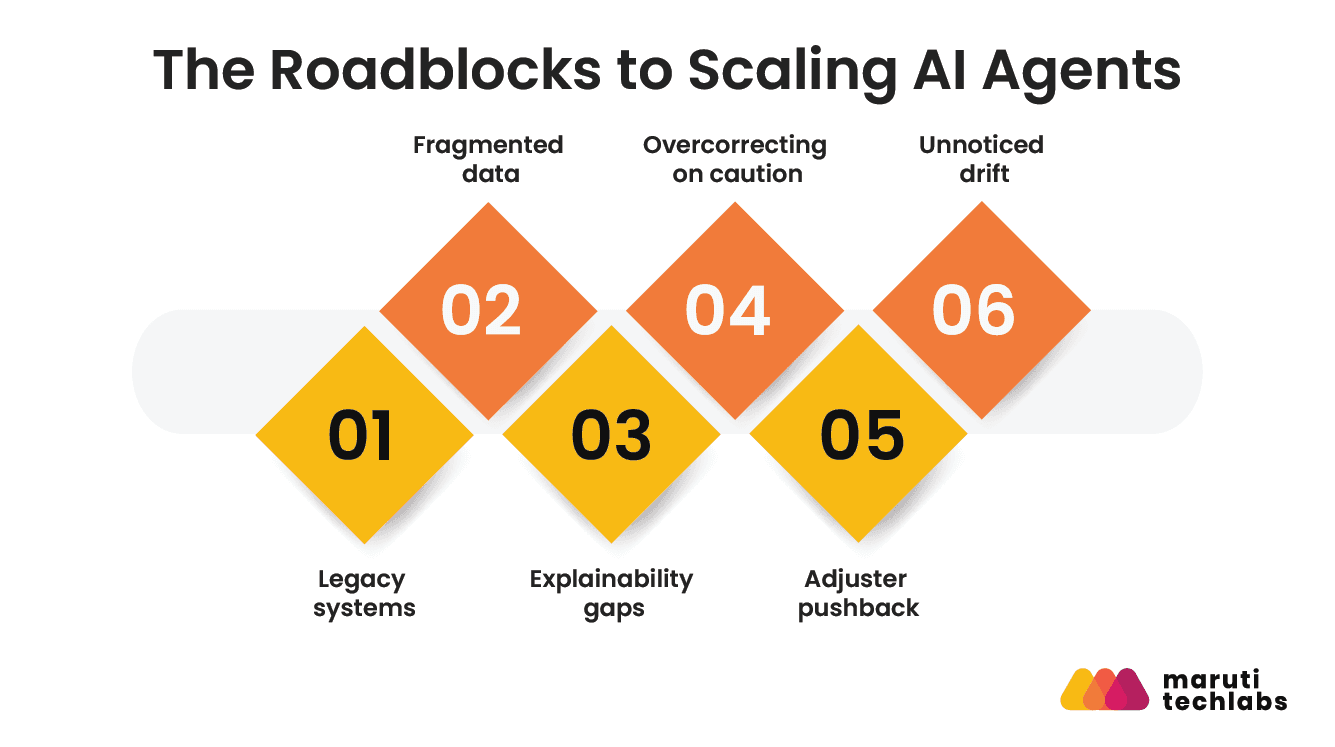
- Legacy systems. Your claims platform was not built for agent handoffs, and it shows once several agents need the same aging system at once
- Fragmented data. Policy, claims, and third-party data sitting in systems that do not talk to each other produces inconsistent agent decisions, invisible in a small pilot, obvious at scale
- Explainability gaps. An agent that cannot clearly show why it decided something gets stuck in review the moment compliance looks past the first pilot
- Overcorrecting on caution. Restricting an agent so heavily that it barely acts without sign-off kills the value case that funded it in the first place
- Adjuster pushback. People who see an agent as a threat will work around it, whether or not that is the intent
- Unnoticed drift. Claims and fraud patterns shift over time, and a model accurate at launch quietly gets worse without a monitoring cadence in place
What it looks like when it works
McKinsey documented one insurer that rolled out more than 80 AI models across claims, cutting complex case assessment time by 23 days, improving routing accuracy by 30%, and cutting customer complaints by 65%. That happened because they solved these failure points on purpose, not after launch.
How Maruti Techlabs Protected Up to 80% of Commission Revenue for a Medicare Insurance Broker
A Medicare insurance broker managing more than 250,000 active policies was relying on manual checks to verify policy records against source systems.
At that volume, manual verification meant discrepancies, lapsed policies, incorrect commission data, and mismatched enrollment records went uncaught for long stretches, putting a meaningful share of commission-linked revenue at risk with every verification cycle that fell behind.
Maruti Techlabs built an automated verification and reconciliation system that cross-checks policy records against source systems at scale, flags discrepancies as soon as they appear instead of waiting for a periodic manual audit, and routes flagged records to the right team for review.
The system was built to handle more than 1,000 policies per run, replacing a process that previously depended on staff working through records one at a time.
The impact
- Verified more than 1,000 policies per run, at a volume manual review could not sustainably match
- Cut manual verification effort by 20%, freeing staff time for the discrepancies that actually needed judgment
- Protected up to 80% of commission-linked revenue that was previously exposed to unflagged errors
- Maruti Techlabs continued as the broker's long-term automation partner as additional policy lines were brought into the system

FAQs
1. How much does it cost to build AI agents for insurance claims?
Cost depends heavily on scope, region, and whether you build, buy, or go hybrid. BCG's research on insurer AI investment found most pilots run under 5 million USD, while the roughly 7% of insurers who have scaled AI spend 25 million USD or more, with the most advanced group reaching 50 to 100 million USD. A single project's cost will typically fall well below those enterprise-wide figures.
2. How do AI agents integrate with legacy claims platforms like Guidewire, Duck Creek, or Sapiens?
Most carriers do not need to rebuild their core systems. An orchestration layer sits above the existing claims and policy admin platforms, connecting through API calls for anything that needs to happen instantly and event-based triggers for background work, so the agents live in that layer rather than inside the legacy system itself.
3. What compliance regulations apply to AI agents used in insurance claims?
The main frameworks to design against are the NAIC Model Bulletin on the Use of Artificial Intelligence Systems by Insurers, state-level laws like Colorado's AI Act, the NIST AI Risk Management Framework, GLBA, HIPAA where health data is involved, and GDPR or the EU AI Act for carriers operating in the EU.
4. How long does it take to deploy AI agents for insurance claims?
There is no fixed timeline, but a responsible rollout moves through six stages: defining decision boundaries, getting data ready, designing the architecture, running a single pilot with success and rollback criteria set in advance, integrating with core systems, and ongoing monitoring after launch.
Skipping any of these stages is the most common reason a working pilot never reaches production.
5. What kind of ROI can insurers expect from AI agents in claims processing?
BCG has found AI can reduce claim resolution costs by 20 to 50%, and Bain estimates it can lift claim specialist productivity by up to 50%. Bain separately sizes the total opportunity in P&C claims at 100 billion USD, split between a 20 to 25% cut in loss adjusting expenses and a 30 to 50% cut in claims leakage.