

How Technical Debt Impacts Software Growth and Scalability
Key Takeaways
- Technical debt refers to the future maintenance and development problems created by temporary fixes, shortcuts, or outdated systems.
- If it is not managed well, it can slow down development, increase maintenance effort, and make it harder to scale the system over time.
- Legacy systems, poor documentation, rushed timelines, and outdated dependencies are some of the most common causes of tech debt.
- Regular refactoring, testing, modernization, and better engineering practices help reduce technical debt early.
- Managing technical debt consistently helps businesses build more stable, scalable, and reliable software systems.
Introduction
Technology plays a major role in business growth today. In fact, nearly 71% of the value created from business transformation depends on technology. But many companies struggle to achieve that value because of technical debt. Also known as tech debt, it refers to the extra cost, effort, and time required to maintain outdated systems, rushed code, or short-term development decisions.
As Ward Cunningham, who introduced the concept, explains:
“Shipping first time code is like going into debt… A little debt speeds development so long as it is paid back promptly… Every minute spent on not-quite-right code counts as interest on that debt.”
Technical debt in software development is often called the “silent company killer” because the impact is not always visible at first. Over time, it slows development, creates delays, and increases software maintenance work. Teams spend more time fixing old issues or dealing with system limitations instead of building new features. In many organizations, nearly 40% of IT budgets go into managing technical debt instead of supporting innovation and growth.
Today, technical debt is no longer limited to code alone. It also affects infrastructure, cloud systems, legacy platforms, and other business-critical technologies. As systems become more complex, the cost of handling technical debt and managing outdated technology keeps rising. Reports estimate that technical debt costs U.S. organizations around $2.41 trillion every year, while fixing and modernizing these systems could require nearly $1.52 trillion.
What is Technical Debt?
Technical debt refers to the future work and maintenance created when development teams rely on quick fixes or temporary solutions to meet short-term goals.
“Technical debt happens when teams prioritize speed over long-term code quality. Like financial debt, these shortcuts eventually need to be “paid back” through additional debugging, refactoring, maintenance, and system improvements later.” Mitul Makadia, CEO of Maruti Techlabs |
According to IBM, technical debt in software development usually builds up because of rushed development, outdated code, poor documentation, temporary fixes, or inefficient engineering practices. While these approaches may help teams release products faster, they often make systems harder to maintain, update, and scale over time.
It can affect different parts of the software development process depending on how systems are built and maintained.
Main Types of Technical Debt
Technical debt in software development can be divided into several categories depending on which part of the system it impacts, from code quality and architecture to testing and documentation:
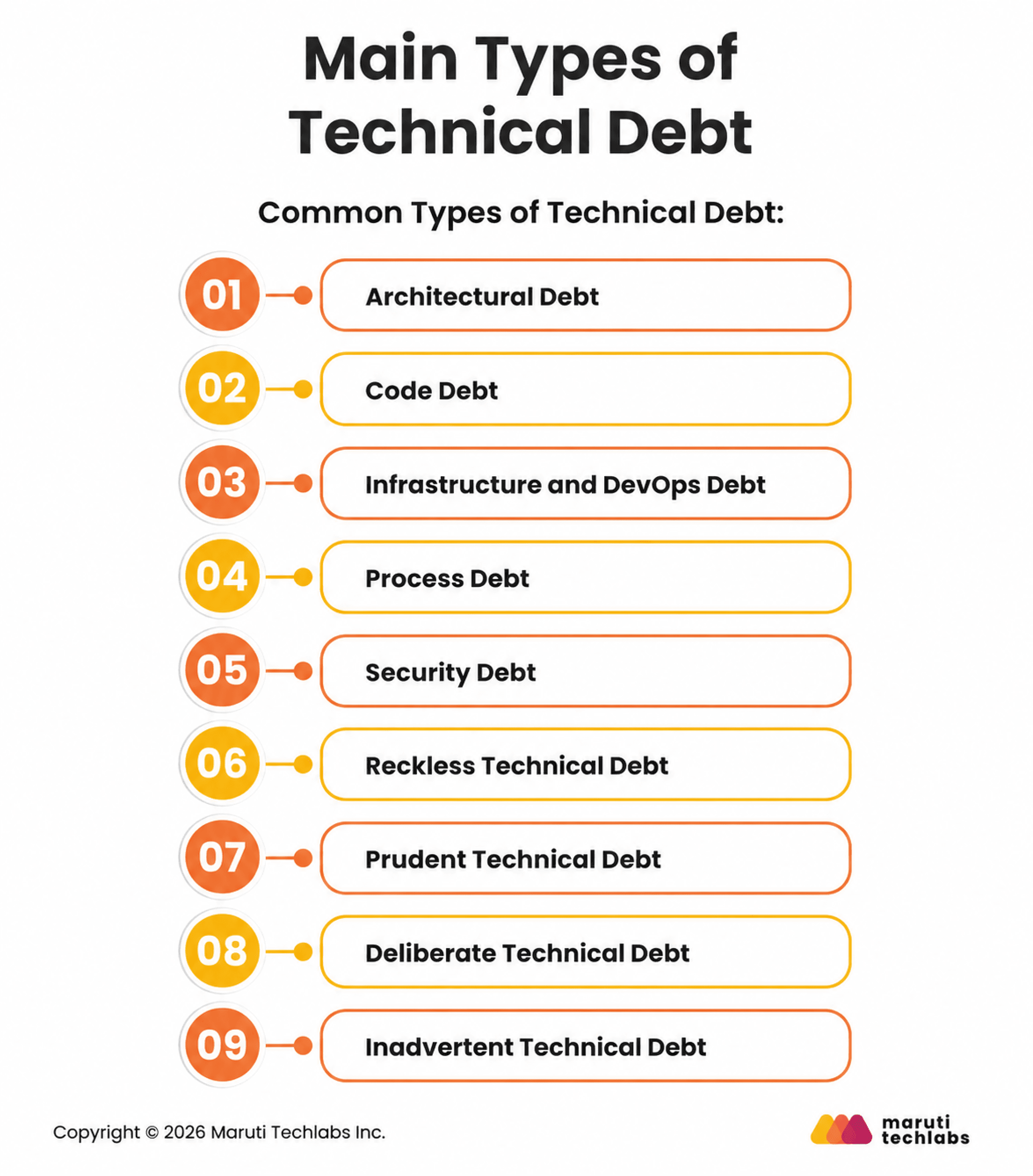
- Architectural Debt: This happens when the foundation of a software system is not built to support future changes, scaling, or growing business needs.
- Code Debt: Happens when developers rush code changes, skip documentation, or add temporary fixes just to meet deadlines.
- Infrastructure and DevOps Debt: Starts building up when older systems, manual deployments, or outdated DevOps processes are left unchanged for too long.
- Process Debt: Usually comes from unclear communication, missing documentation, or inefficient workflows that slow teams down.
- Security Debt: Occurs when security patches, system updates, or compliance fixes are delayed while teams focus on other priorities.
- Reckless Technical Debt: Happens when teams make careless decisions or ignore best practices just to speed up development.
- Prudent Technical Debt: A conscious short-term decision where teams accept some debt to achieve faster delivery or meet urgent business goals.
- Deliberate Technical Debt: Introduced intentionally with the understanding that the issue will need to be resolved later.
- Inadvertent Technical Debt: Builds up unknowingly over time because of changing requirements, lack of experience, or increasing system complexity.
Why Technical Debt Matters for Growing Businesses
Technical debt matters for growing businesses because it can limit scalability and slow long-term growth. Quick fixes and rushed code changes may help teams release things faster, but over time they usually create systems that are harder to maintain, scale, and improve.
The Business Impact of Technical Debt
As technical debt grows, it starts affecting different parts of the business, from development speed and system performance to scalability and operational costs.
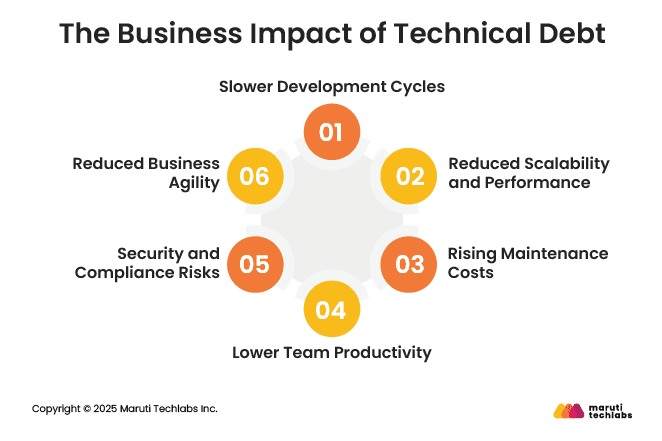
- Slower Development Cycles: Developers spend more time fixing old issues, debugging unstable systems, and handling rework instead of building new features.
- Reduced Scalability and Performance: Systems built on temporary fixes often struggle to handle growing traffic, larger workloads, and expanding business requirements.
- Rising Maintenance Costs: Maintaining older systems and resolving recurring issues gradually increases engineering and infrastructure costs.
- Lower Team Productivity: Development teams may feel less motivated when most of their time goes into maintaining outdated systems and repetitive fixes.
- Security and Compliance Risks: Older systems and delayed updates can leave applications more vulnerable to security issues and compliance risks.
- Reduced Business Agility: Businesses may find it harder to adapt quickly to changing customer expectations, market demands, or new technologies.
Common Causes of Technical Debt in Modern Digital Systems
Common causes of technical debt include rushed development timelines, poor system architecture, legacy technologies, inadequate documentation, changing business requirements, and lack of testing or refactoring. Identifying these factors can help teams maintain better software quality and reduce long-term maintenance challenges:
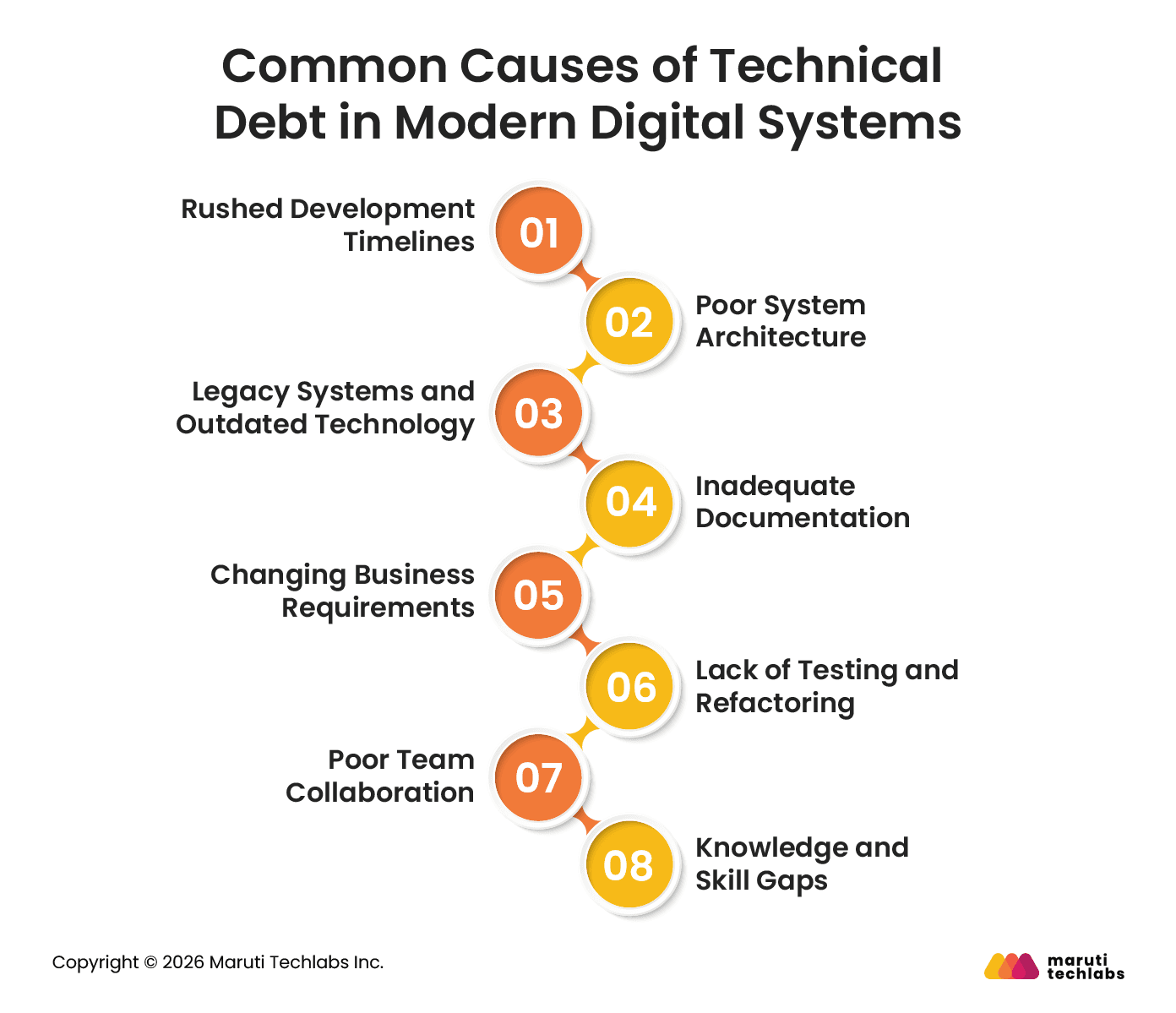
1. Rushed Development Timelines
Tight deadlines often push development teams to focus on speed instead of clean architecture, testing, or documentation.
- Why this becomes a problem: Quick code changes and temporary fixes may help teams meet release deadlines faster but can weaken software quality over time.
- How it affects the system: Teams later spend more time debugging issues, fixing bugs, and stabilizing the codebase.
2. Poor System Architecture
Weak architectural decisions can make systems difficult to scale, update, or integrate with newer technologies.
- Why this becomes a problem: Without a strong technical foundation, systems become more difficult to manage as the business grows.
- How it affects the system: Development slows down and modernization projects become more expensive and time-consuming.
3. Legacy Systems and Outdated Technology
Many businesses continue using older platforms, frameworks, or infrastructure because replacing them through legacy application modernization can seem costly or disruptive.
- Why this becomes a problem: Legacy systems often do not work smoothly with modern tools, APIs, or cloud environments.
- How it affects the system: Maintenance costs increase and businesses struggle to innovate or scale efficiently.
4. Inadequate Documentation
Missing or outdated documentation makes it difficult for teams to understand existing systems and codebases.
- Why this becomes a problem: Developers may face confusion while making updates or troubleshooting issues.
- How it affects the system: This can lead to repeated mistakes, slower onboarding, and additional maintenance work.
5. Changing Business Requirements
Frequent requirement changes often force teams to repeatedly modify existing code and workflows.
- Why this becomes a problem: Continuous updates can make applications inconsistent and difficult to manage.
- How it affects the system: Systems become harder to maintain, test, and scale over time.
6. Lack of Testing and Refactoring
Skipping automated testing or delaying code refactoring can gradually reduce software quality.
- Why this becomes a problem: Small inefficiencies and hidden code issues continue building up inside the system.
- How it affects the system: Bugs, performance issues, and maintenance efforts increase over time.
7. Poor Team Collaboration
Lack of communication between teams can create inconsistencies in development practices and technical decisions.
- Why this becomes a problem: Teams may unknowingly duplicate work or follow different coding standards.
- How it affects the system: This adds unnecessary complexity and slows down future development.
8. Knowledge and Skill Gaps
Technical debt can also build up when teams lack experience with modern development practices or newer technologies.
- Why this becomes a problem: Developers may follow outdated coding approaches or make decisions that are not suitable for long-term system growth.
- How it affects the system: Over time, systems become harder to scale, maintain, and update efficiently.
3 Real-World Technical Debt Examples and Their Business Impact
Technical debt can directly affect software performance, customer experience, operational stability, and long-term business growth. Here are some real-world technical debt examples and the impact they created.
1. eBay Dealing With Legacy Infrastructure
- What Caused the Problem: While eBay kept growing, many of its core systems still depended on older infrastructure and monolithic architecture. Over time, managing and scaling these systems became more difficult.
- How It Affected the Business: As the platform became more complex, checkout and payments started feeling slow for users. To improve this and handle growth better, eBay later moved its systems to a microservices and API-based setup.
2. Knight Capital Group’s Testing and Deployment Failure
- What Caused the Problem: The company released trading software into production without properly testing it across all systems. Gaps in testing and unmanaged code issues eventually created serious problems within its trading platform.
- How It Affected the Business: A software deployment issue triggered a large number of automated stock trades within minutes. In just 45 minutes, Knight Capital Group lost nearly $460 million, making it one of the most widely known examples of technical debt failure in the financial industry.
3. European Fintech Companies Facing Outdated Software Dependencies
- What Caused the Problem: Several European fintech companies continued using legacy systems and outdated software dependencies for critical operations. Over time, delayed updates increased system complexity and security risks.
- How It Affected the Business: New financial regulations made compliance more difficult for these companies, while outdated systems also increased security vulnerabilities. Many businesses later had to spend heavily on urgent modernization and infrastructure upgrades.
How Technical Debt Affects Growth, Performance, and Scalability
Technical debt affects systems when teams focus more on quick development and short-term fixes instead of building clean, long-term solutions. At first, it may feel like a faster way to deliver, but over time it slows down development, adds extra maintenance work, and makes the system less stable and harder to scale.
Here are some common ways technical debt affects software systems and business growth:
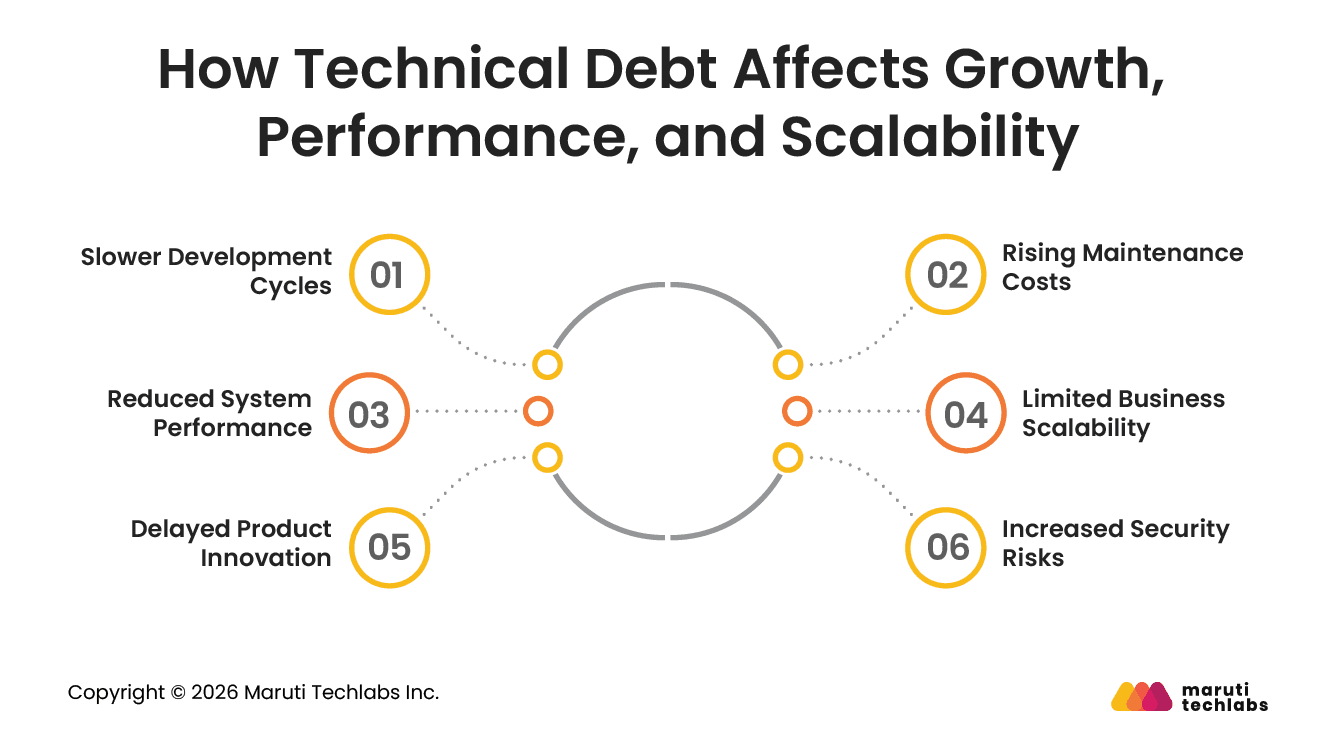
1. Slower Development Cycles
Development teams spend more time fixing bugs, updating old code, and handling recurring issues before new features can be released.
2. Rising Maintenance Costs
Older systems often need regular fixes, infrastructure improvements, and ongoing maintenance to keep applications stable.
3. Reduced System Performance
Outdated codebases and inefficient system architecture can slow applications down and create performance issues for users.
4. Limited Business Scalability
Systems built with too many temporary fixes can struggle to support growing traffic, users, and business operations.
5. Delayed Product Innovation
Teams busy fixing bugs and maintaining older systems often get less time to work on new features and product improvements.
6. Increased Security Risks
Outdated dependencies and delayed system updates can make applications more vulnerable to security and compliance issues.
Over time, technical debt can also increase cloud costs, slow releases, and create problems for users. Fixing these issues early makes systems easier to maintain and scale in the long run.
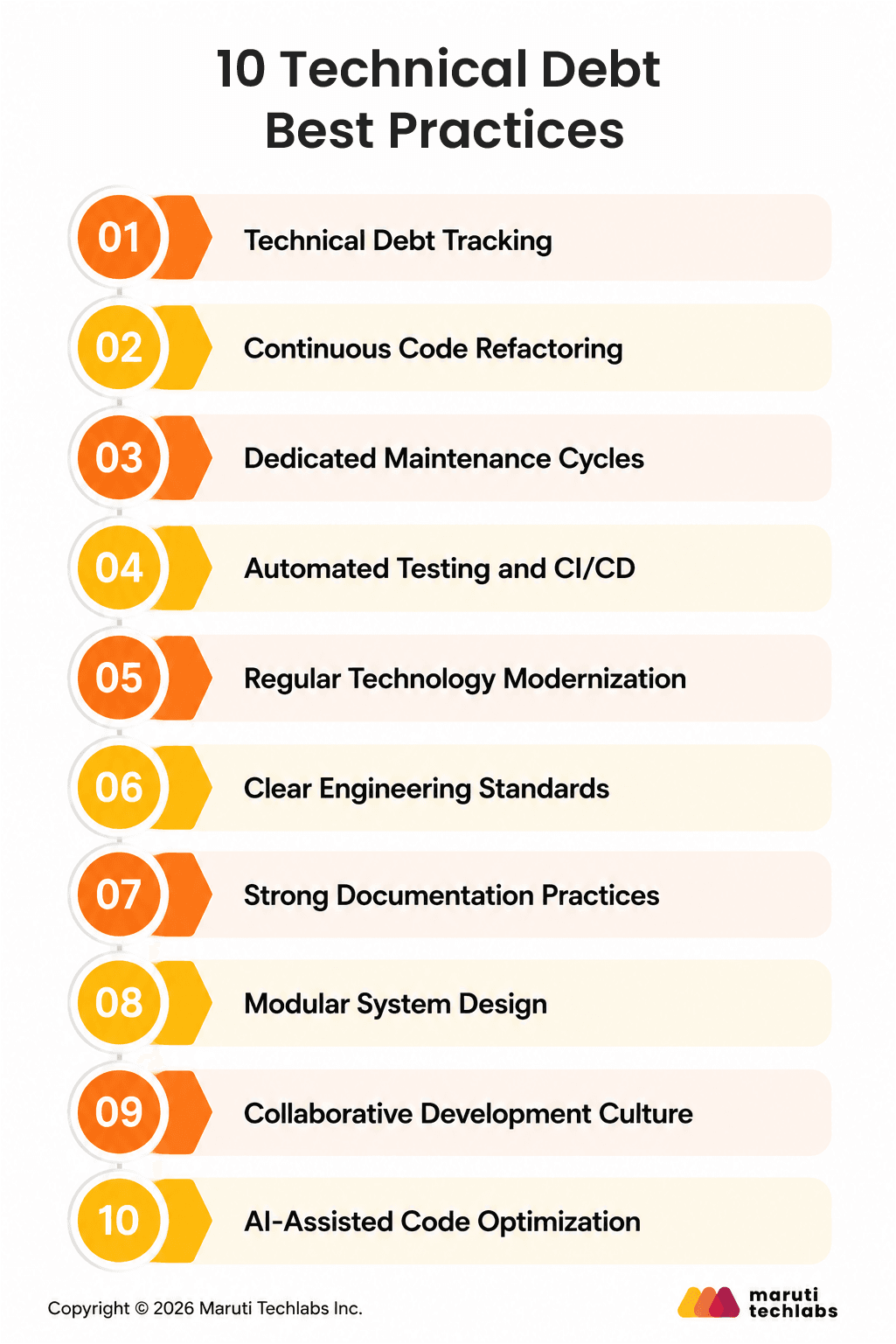
10 Technical Debt Best Practices
Managing technical debt requires teams to fix issues regularly instead of leaving them for later. Many businesses set aside development time for maintenance, refactoring, and cleanup work so systems do not become harder to manage and future releases do not slow down.
1. Technical Debt Tracking
Teams should review technical debt regularly instead of delaying fixes for later. Tools like SonarQube, CodeScene, ESLint, and technical backlogs can help teams identify issues early and prioritize important fixes before they become harder to manage.
2. Continuous Code Refactoring
Regular code refactoring helps teams clean up older code before it becomes too difficult to manage. Making small improvements during day-to-day development keeps the codebase easier to maintain over time.
3. Dedicated Maintenance Cycles
Many engineering teams set aside time in every sprint to fix bugs, improve system performance, and handle technical debt before it starts slowing development down.
4. Automated Testing and CI/CD
Automated testing and CI/CD pipelines help teams catch issues early and make deployments safer. They also give developers more confidence while refactoring existing code.
5. Regular Technology Modernization
Keeping frameworks, libraries, APIs, and infrastructure updated helps businesses avoid problems caused by unsupported technologies and outdated dependencies.
6. Clear Engineering Standards
Well-defined coding standards and architecture guidelines help teams write cleaner and more consistent code across projects.
7. Strong Documentation Practices
Clear documentation makes systems easier to understand, maintain, and update, especially when new developers join the team.
8. Modular System Design
Modular architecture and loosely connected services make applications easier to scale and update without affecting the entire system.
9. Collaborative Development Culture
Code reviews, pair programming, and better communication between teams help catch issues early and improve software quality.
10. AI-Assisted Code Optimization
AI-powered testing tools and coding assistants can help identify bugs, improve code quality, and support refactoring tasks. However, human reviews are still important before making production-level changes.
Conclusion
Technical debt is common in software development, especially when teams are working under tight deadlines or trying to release features quickly. While quick fixes may help in the short term, unmanaged tech debt can slowly create problems across the system. Applications become harder to maintain, development slows down, and scaling the infrastructure becomes more expensive and complicated over time.
Development teams also end up spending more time fixing bugs, handling rework, and maintaining legacy code instead of focusing on new features or product improvements.
This is why businesses should not ignore technical debt for too long. Regular code refactoring, testing, infrastructure updates, and system modernization help keep applications stable and easier to scale. Following better engineering practices and addressing issues early can help businesses build more reliable software systems and support long-term growth.
FAQs
1. What is technical debt in software development?
Technical debt in software development refers to the future effort required to fix shortcuts, temporary solutions, or outdated code added during development. Teams often take these approaches to release products faster or meet deadlines. Over time, unmanaged technical debt can make systems harder to maintain, slow development, increase bugs, and create scalability or performance issues across applications.
2. How to manage technical debt?
Managing technical debt requires teams to keep fixing issues regularly instead of letting them pile up. This usually includes code reviews, refactoring old parts, testing, and general system upkeep. Many teams also keep a technical backlog and set aside time in each sprint to handle these fixes. Updating older frameworks and keeping coding standards in place also helps avoid long-term maintenance problems and keeps the system more stable.
3. What is the impact of technical debt on software quality?
Technical debt can reduce software quality by increasing bugs, slowing application performance, and making systems harder to maintain. Development teams often spend more time fixing recurring issues instead of improving products or building new features. Over time, unmanaged tech debt can also affect scalability, security, customer experience, and overall system reliability.
4. How to identify technical debt in coding practices?
Technical debt often appears as duplicated code, poor documentation, outdated dependencies, unstable releases, or code that is difficult to update and maintain. Frequent bugs, longer debugging cycles, and delays in feature releases are also common signs. Code review processes, static code analysis tools, and regular testing can help teams identify technical debt early.
5. What tools help measure technical debt?
Tools like SonarQube, CodeScene, ESLint, and PMD are commonly used to measure technical debt and code quality. These tools help teams identify code complexity, security vulnerabilities, duplicated code, and maintainability issues. Many development teams also use CI/CD pipelines and automated testing tools to monitor software quality throughout the development lifecycle.
6. Can technical debt be beneficial in programming?
Yes, technical debt can sometimes be beneficial in programming when teams need to release products faster or meet urgent business deadlines. These temporary fixes may help in the short term, but if they are not resolved later, they can create maintenance, performance, and scalability problems over time.
7. How is technical debt different from code smells?
Technical debt is the bigger long-term problem caused by shortcuts, delayed fixes, or outdated systems. Code smells are smaller signs inside the codebase, like repeated logic, large functions, or unclear naming, that usually point to deeper technical issues.
How We Helped a Client Fix Technical Debt and Speed Up Delivery
One of our client projects involved a media management platform that was struggling with technical debt, incomplete code, and inefficient workflows that were slowing down product development.
Our team reviewed the existing architecture, fixed code inconsistencies, and improved maintainability with reusable code and database optimization. This helped deliver the product’s first version within 12 weeks, reduce drop-off rates by 50%, and support future product scaling.
Maruti Techlabs helps businesses build scalable, modern, and reliable software products. With experience across SaaS, enterprise applications, cloud, AI, DevOps, and quality engineering, the team focuses on developing systems that are easier to maintain, improve, and scale as business needs grow.
Explore our Software Product Engineering Services and Quality Engineering Services to learn how we help businesses modernize systems, improve software quality, and build scalable digital products.