Software Architecture Patterns: Driving Scalability and Performance
Key Takeaways
- Software architecture patterns deliver proven ways to build applications that are scalable, maintainable, and resilient.
- There's no one-size-fits-all architecture; the right choice relies on your application's size, complexity, and long-term business goals.
- Patterns such as microservices, event-driven, and space-based architecture are ideal for applications that need to handle rapid growth and high traffic.
- Recognizing the differences between monolithic, microservices, and MVC architectures helps you make better design decisions at every stage of development.
- Choosing the right architecture early can reduce future rework, simplify maintenance, and improve your application's ability to scale as business needs evolve.
Introduction
As Slack expanded to support larger enterprise workspaces in late 2024, it encountered an unexpected challenge. While its compute infrastructure continued to perform well, the metadata layer became a bottleneck. This slowed queries, delayed real-time message processing, and temporarily prevented some users from accessing active channels. Slack resolved the issue by redesigning how metadata was organized and queried.
This was not a hardware problem. It was an architectural one. As applications grow, designs that work well at a smaller scale can become bottlenecks, affecting performance, reliability, and user experience.
Choosing the right software architecture early helps avoid these challenges. The right pattern makes applications easier to scale, maintain, and adapt as business needs change.
In this blog, we'll explore the most common software architecture patterns, compare monolithic and microservices architectures, explain where the MVC architecture fits, and share practical guidance for choosing the right approach for your application.

What is a Software Architecture Pattern? Why is It Important?
A software architecture pattern is a proven way to organize an application's structure. It provides a reusable blueprint for arranging components, defining their interactions, and solving common architectural challenges. Instead of starting from scratch, development teams can build on approaches that have already been tested in real-world applications.
Every software architecture pattern addresses a different type of challenge. Some are built for applications that need to scale quickly, while others work better for real-time processing, modular development, or distributed systems. The right choice depends on how your application is expected to perform today and grow over time.
Choosing the right pattern early can save a lot of effort later. As your application grows, it becomes easier to scale, add new features, and make changes without affecting the entire system.
Importance of Software Architecture
Software architecture gives development teams a clear direction before coding begins. It plays an important role in building scalable web applications by reducing design risks and supporting better technical decisions. A well-planned architecture also makes it easier to extend the application as requirements change.
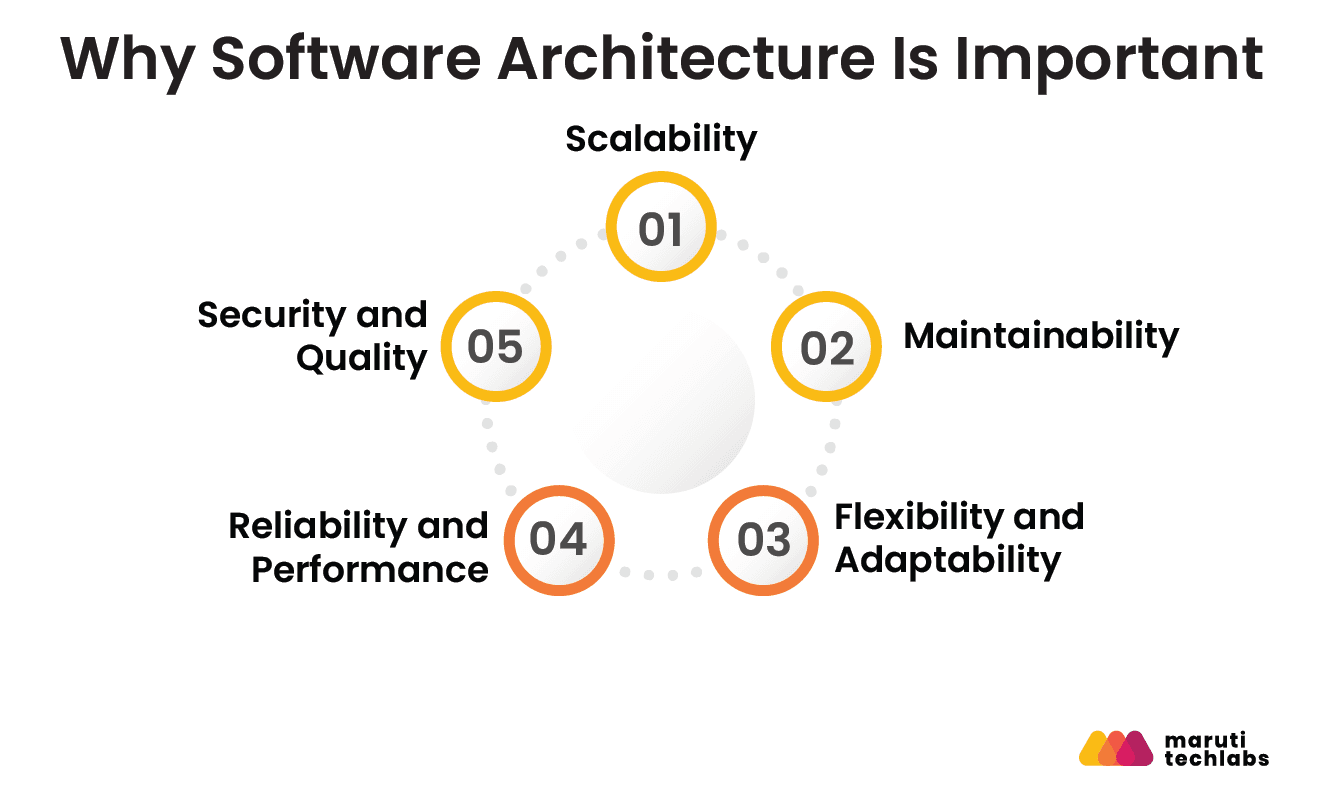
Here are some of the reasons that make software architecture patterns vital for developing sustainable applications:
1. Scalability
When an application can't keep up with growing demand, users notice it first. Slack's recent metadata bottleneck is a good example of how architectural limitations can affect performance even when the infrastructure is capable. Choosing the right software architecture pattern is critical for building scalable applications that continue to perform as traffic grows.
2. Maintainability
Building the application is only the beginning. Most of the effort comes from maintaining and improving it over time. A well-organized architecture helps teams make changes with confidence instead of worrying about breaking unrelated parts of the system.
3. Flexibility and Adaptability
It's common for applications to change as products evolve and customer needs shift. A flexible architecture gives developers room to add new features and integrations without making unnecessary changes across the system.
4. Dependability and Performance
No business wants an application that slows down when traffic increases. Choosing the right architecture helps the system stay responsive and keeps isolated issues from affecting the rest of the application.
5. Security and Quality
Security shouldn't be an afterthought. A well-planned architecture makes it easier to build security into the application from the beginning and spot probable risks early. It also supports better testing, resulting in more reliable software.
What's the Difference Between Software Architecture and Design Patterns?
The terms software architecture and design patterns are often used interchangeably. However, there is a slight difference between the two. Architecture patterns address higher-level concerns and provide a framework for organizing the system, while design patterns offer solutions to specific design challenges within that framework.
Here is a detailed outlook on software architecture patterns vs design patterns:
Key Differentiations | Software Architecture Patterns | Design Patterns |
| Scope | Software architecture is decided in the design phase. | Design Patterns are dealt with in the building phase. |
| Abstraction | Software architecture is like a blueprint - a high-level idea of the data flow, components, and interactions between them. | A more detailed design pattern focuses on solving specific design problems within a component. |
| Granularity | It provides a broad view of the system and addresses large-scale components and their interactions. | A design pattern addresses small-scale design issues within a component or a class. |
| Reusability | An architectural pattern can be reused across different projects with similar requirements. | It can be reused within the same project to solve recurring design problems. |
| Relationship | It defines the overall structure, and communication patterns, and organization of components. | It solves common design problems like object creation, interaction, and behavior. |
| Time of Application | An architectural pattern is implemented at a very early stage of the SDLC. | A design pattern is implemented during the coding phase of software development. |
| Examples | Layered Architecture, Client-Server Architecture, Microservices, MVC, etc. | Singleton, Factory Method, Observer, Strategy, etc. |
What Are the 9 Types of Software Architecture Patterns?
Software architecture patterns are proven approaches to designing and organizing software applications. Instead of starting from scratch, development teams use these accepted patterns to solve common difficulties such as scalability, maintainability, performance, and fault tolerance. However, there’s no one-size-fits-all approach. The right choice relies on factors such as your application’s complexity, expected traffic, business goals, and extended long-term growth plans.
The following software architecture patterns are among the most widely used across current software development. Each serves a different purpose and is suited to specific types of applications.
All 9 Software Architecture Patterns at a Glance
| Pattern | How It Works | Best Suited For |
| Layered (N-Tier) | Separates the application into layers such as presentation, business logic, and data access. Each layer communicates only with the one below it. | Enterprise applications, business systems, websites, and CRUD applications |
| Microservices | Breaks an application into small, independent services that can be developed, deployed, and scaled individually. | Large-scale applications, SaaS platforms, streaming services, and eCommerce |
| Event-Driven | Provides a lightweight core with additional features added as independent plug-ins. | IDEs, application suites, antivirus software, and customizable platforms |
| Microkernel (Plug-in) | Provides a lightweight core with additional features added as independent plug-ins. | IDEs, application suites, antivirus software, and customizable platforms |
| Client-Server | Clients send requests to a centralized server, which processes requests and manages data. | Email platforms, document management systems, banking applications, and web applications |
| Space-Based | Distributes processing and data across multiple nodes to eliminate database bottlenecks during heavy traffic. | Large eCommerce platforms, ticket booking systems, and applications with unpredictable traffic spikes |
| Master-Slave | A primary node distributes tasks to multiple secondary nodes to improve availability and balance workloads. | Database replication, parallel processing, and load-balancing systems |
| Pipe-Filter | Uses a central broker to route messages and coordinate communication between distributed services. | Enterprise integrations, distributed systems, and microservices using messaging platforms like Kafka or RabbitMQ |
| Broker | Uses a central broker to route messages and coordinate communication between distributed services. | Enterprise integrations, distributed systems, and microservices using messaging platforms like Kafka or RabbitMQ |
The table gives you a quick overview, but every pattern comes with its own strengths, trade-offs, and ideal use cases. Let’s take a closer look at each one.
1. Layered (N-Tier) Architecture Pattern
How it works
The layered architecture pattern organizes an application into separate layers, typically presentation, business logic, and data access. Each layer has a well-defined responsibility and interacts only with the layer directly below it, making the application easier to develop and maintain.
Best suited for
- Enterprise business applications
- CRM and ERP systems
- Business websites
- Applications with simple business logic
Advantages
- Easy to understand and maintain
- Simplifies testing and debugging
- Clear separation of responsibilities
- Well-supported by popular frameworks
Limitations
- Performance can suffer because every request passes through multiple layers.
- Less suitable for highly distributed or rapidly scaling applications.
2. Microservices Architecture Pattern
How it works
Microservices architecture divides an application into multiple independent services, with each service handling a specific business capability. Every service can be developed, deployed, updated, and scaled without affecting the rest of the application.
Best suited for
- Large enterprise applications
- SaaS products
- Streaming providers
- Global eCommerce systems
Advantages
- Independent deployments speed up releases
- Individual services scale based on demand
- Better fault isolation
- Teams can work on services independently
Limitations
- Managing multiple services increases operational complexity.
- Monitoring, testing, and service messaging require additional effort.
3. Event-Driven Architecture Pattern
How it works
In an event-driven architecture, services communicate through events instead of direct requests. When an event occurs, such as a customer placing an order, other services react independently without waiting for an immediate response.
Best suited for
- Real-time analytics
- IoT applications
- Payment processing
- Stock trading platforms
Advantages
- Highly scalable
- Loose coupling between services
- Supports live processing
- Easy to extend with new event consumers
Limitations
- Event tracking and debugging can be difficult.
- Keeping data consistency among services calls for careful planning.
4. Microkernel (Plug-in) Architecture Pattern
How it works
The microkernel architecture keeps only the essential functionality in the core application. Additional capabilities are added as plug-ins, allowing the application to evolve without changing its foundation.
Best suited for
- IDEs
- Antivirus software
- Business platforms with optional modules
- Product suites requiring customization
Advantages
- Highly modular
- Easy to extend with new features
- Better fault isolation
- Simplifies product customization
Limitations
- Plug-in management can become complex.
- Changes to the core system entail careful planning.
5. Client-Server Architecture Pattern
How it works
The client-server pattern separates the application into clients that request services and a central server that processes requests, stores data, and manages business logic.
Best suited for
- Email applications
- Banking systems
- Document management
- Shared business applications
Advantages
- Centralized data management
- Easier security and access control
- Supports multiple clients simultaneously
- Simplifies system administration
Limitations
- The server can become a single point of failure.
- Heavy traffic may overload the server if not scaled properly.
6. Space-Based Architecture Pattern
How it works
Space-based architecture distributes both processing and data through several nodes instead of relying on a single centralized database. This helps eliminate database bottlenecks during sudden traffic spikes.
Best suited for
- High-traffic eCommerce platforms
- Ticket booking systems
- Gaming platforms
- Social networking applications
Advantages
- Handles unpredictable traffic smoothly
- Delivers high performance
- Reduces database bottlenecks
- Supports horizontal scalability
Limitations
- Designing and maintaining distributed data can be challenging.
- Requires careful coordination between processing units.
7. Master-Slave Architecture Pattern
How it works
A master node manages write operations and distributes tasks to multiple slave nodes, which typically handle read operations or parallel workloads. If one node fails, workloads can be shifted to another.
Best suited for
- Database replication
- Parallel computing
- Load balancing
- High-availability systems
Advantages
- Improves reliability
- Supports read scalability
- Enables automatic data replication
- Balances workloads efficiently
Limitations
- The master node stays a potential bottleneck.
- Replication delays may occasionally occur.
8. Pipe-Filter Architecture Pattern
How it works
The pipe-filter pattern processes data through a sequence of independent filters. Each filter performs a specific task and passes its output to the next stage until the final result is produced.
Best suited for
- ETL workflows
- Data processing pipelines
- Compilers
- Image and signal processing
Advantages
- Highly modular
- Easy to reuse filters
- Supports parallel processing
- Eases maintenance
Limitations
- The slowest filter affects the entire pipeline.
- Not ideal for highly interactive applications.
9. Broker Architecture Pattern
How it works
The broker architecture features a central broker that manages communication between distributed clients and servers. Instead of communicating directly, components exchange messages through the broker, keeping the system loosely coupled.
Best suited for
- Enterprise integrations
- Distributed applications
- Microservices communication
- Event messaging platforms
Advantages
- Reduces dependencies between services
- Simplifies communication over distributed systems
- Supports asynchronous messaging
- Makes systems easier to scale
Limitations
- The broker can become a performance bottleneck if not designed properly.
- Adds another component to deploy, monitor, and maintain.
Monolithic vs. Microservices: What's the Difference?
Monolithic and microservices are two of the most common approaches to building software applications. A monolithic architecture brings all the application's components together in a single codebase, making it easier to build and deploy during the early stages of development. As the application grows, however, updating and scaling individual features can become more challenging.
Microservices architecture takes a different approach by splitting the application into smaller, independent services. Each service handles a specific function and communicates with others through APIs. This gives development teams greater flexibility to scale, update, and maintain different parts of the application without affecting the entire system.
The table below highlights the key differences between the two approaches.
| Feature | Monolithic Architecture | Microservices Architecture |
| Structure | A single codebase with all application components and a shared database. | Multiple independent services, each responsible for a specific business function and often using its own database. |
| Scalability | The entire application must be scaled, even if only one feature needs additional resources. | Individual services can be scaled independently based on demand. |
| Technology Stack | Typically built using a single technology stack. | Different services can use different programming languages, frameworks, or databases. |
| Deployment | Even small updates usually require redeploying the entire application. | Services can be updated and deployed independently, reducing downtime. |
| Development Complexity | Easier to develop and manage initially, but the codebase can become difficult to maintain as it grows. | Requires more planning and operational effort, but is easier to manage as applications become larger and more complex. |
| Reliability | A failure in one component can affect the entire application. | Issues are generally isolated to the affected service, allowing the rest of the application to continue running. |
Neither architecture is inherently better than the other. A monolithic architecture works well for small to medium-sized applications or products that need to be launched quickly. Microservices are often a better choice for large, complex applications that require independent scaling, frequent updates, and support from multiple development teams. The right choice depends on your application's current needs and how you expect it to grow over time.
How Is the Model-View-Controller (MVC) Architecture Pattern Used?
The Model-View-Controller (MVC) architecture pattern is one of the most widely used approaches for building web and mobile applications. Instead of placing all the application logic in one place, MVC separates it into three components, each with a specific responsibility. This separation makes applications easier to develop, maintain, test, and scale as they grow.
Core Components of MVC
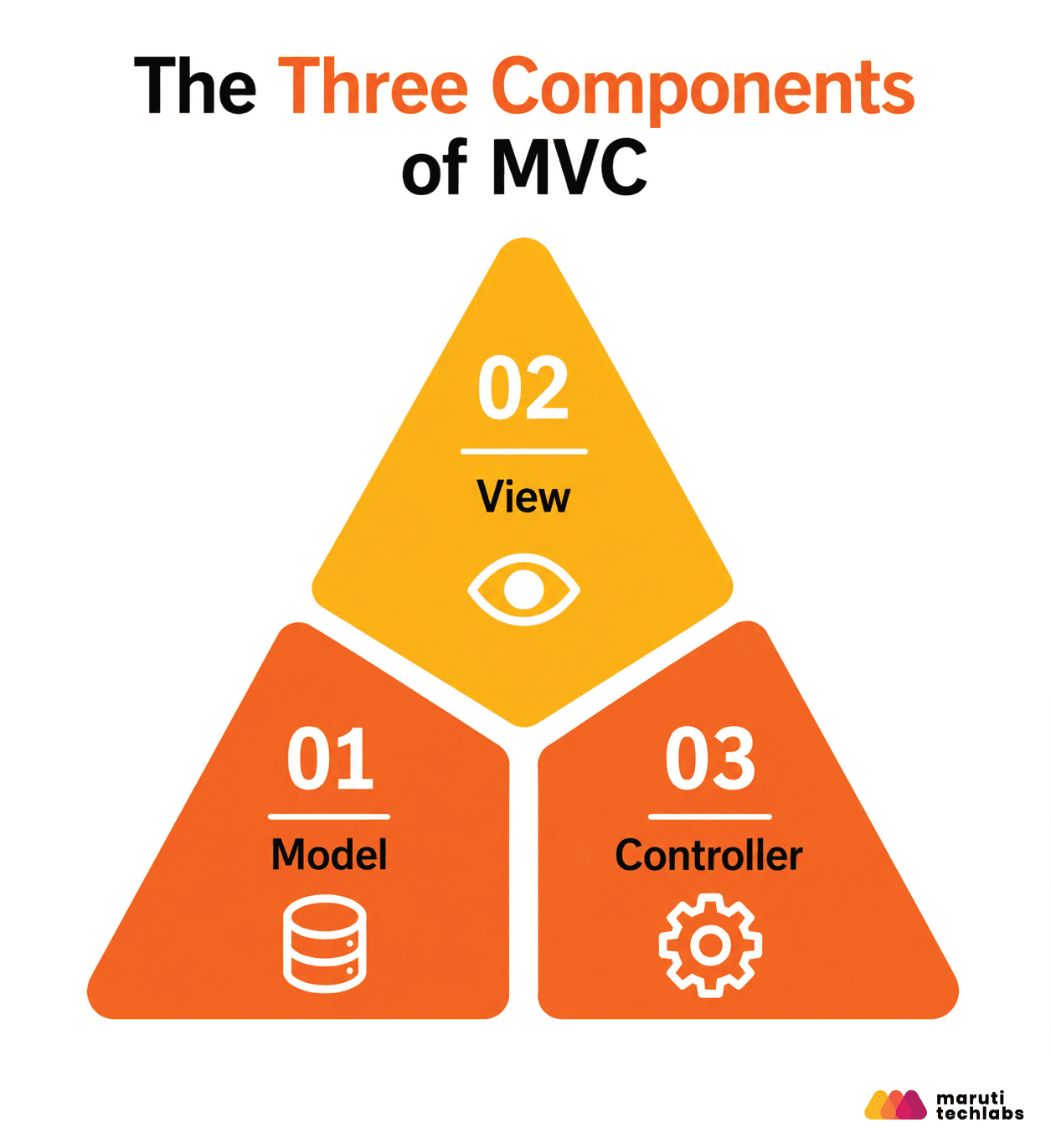
The MVC architecture is built around three core components, each with a specific responsibility in managing application data, user interactions, and business logic.
1. Model
The Model manages the application’s data and business logic. It interacts with the database, processes data, and applies business rules before passing the required information to the rest of the application.
2. View
The View is responsible for presenting information to users. It displays the data received from the Model through web pages, mobile screens, or APIs, without handling business logic itself.
3. Controller
The Controller acts as the link between the Model and the View. It receives user requests, processes the input, communicates with the Model when needed, and determines which View should display the response.
The biggest advantage of MVC is that it keeps responsibilities separate. As your application grows, updating one part of the system is less likely to affect the others, making development, testing, and maintenance much easier.
When to Use Which Software Architecture Pattern?
There's no single software architecture pattern that works for every application. The right choice depends on what you're building, how quickly you expect it to grow, the size of your development team, and your performance and scalability requirements. Understanding the strengths and trade-offs of each pattern can help you make a more informed decision.
| Architecture Pattern | Best Suited For | Things to Consider |
| Microservices | Large, complex applications that require independent deployments and frequent updates. | Offers excellent scalability but requires mature DevOps practices and adds operational complexity. |
| Event-Driven | Real-time systems, IoT applications, financial platforms, and event-based workflows. | Enables highly responsive applications, but debugging and maintaining event consistency can be challenging. |
| Layered (N-Tier) | Business applications, internal tools, and projects with clearly defined application layers. | Easy to develop and maintain, though scaling individual components isn't always straightforward. |
| Model-View-Controller (MVC) | Web and mobile applications that benefit from separating the user interface, business logic, and data handling | Keeps code organized but may add unnecessary complexity to very small projects. |
Which Architecture Is Best for Scalability?
If your application is expected to support rapid growth or unpredictable traffic, choosing a scalable architecture from the beginning can save significant time and effort later. While several patterns support scalability, each addresses a different type of challenge.
- Microservices Architecture is a strong choice for large applications where different features need to scale independently. For example, if your payment service receives significantly more traffic than other modules, it can be scaled without affecting the rest of the application.
- Event-Driven Architecture works well for applications that process large volumes of real-time events. Since services communicate asynchronously, the system can continue handling thousands of requests without creating unnecessary bottlenecks.
- Space-Based Architecture is designed for applications that experience sudden traffic spikes. By distributing processing and data across multiple nodes instead of relying on a centralized database, it helps maintain performance even under heavy loads.
Ultimately, the best architecture is the one that aligns with your application's current requirements while leaving enough room for future growth. Rather than choosing the most popular pattern, focus on selecting one that matches your business goals, technical constraints, and expected scale.
Conclusion
Every application is different, which is why there’s no single architecture pattern that’s right for every project. Some patterns are better suited for handling rapid growth, while others make development, maintenance, or communication between different parts of the system much easier. Taking the time to understand where each pattern fits can help you make architectural decisions with confidence and build software that continues to perform well as your requirements change.
At the same time, there’s no fixed formula for building scalable software. The best approach depends on factors like your application’s size, expected traffic, business goals, and future plans. Understanding different software architecture patterns and scalability patterns early in the development process can help you avoid costly redesigns later. As your application evolves, choosing the right combination of architecture and scalability patterns makes it easier to support higher workloads, introduce new features, and keep the system easier to maintain over time.
FAQs
1. What is an architectural pattern?
An architectural pattern is a reusable solution addressing a recurring software architecture design problem. It delivers a structured approach to organizing a software system's components, modules, and interactions. Different software architecture patterns are designed to meet specific system requirements.
2. How do I choose the right software architecture pattern?
Choose a pattern based on what your application needs to do now and how you expect it to grow. For some projects, a simple layered architecture is enough. Others may need microservices or event-driven architecture to support higher traffic and independent scaling.
3. What is the difference between monolithic and microservices architecture?
The biggest difference is how the application is organized. A monolithic architecture keeps everything in one codebase, while microservices split the application into smaller, independent services. Monoliths are simpler to build at first, whereas microservices make it easier to scale and update individual services.
4. When should I use the MVC architecture pattern?
MVC is a good fit for applications with a user interface, especially web and mobile applications. It separates the application's data, business logic, and presentation layer, making the code easier to manage as the project grows. Many modern web frameworks are built around this pattern.
5. Which software architecture pattern is best for scalability?
Microservices are often the preferred choice for applications that need to scale rapidly. They let you scale individual services instead of the entire application. For real-time systems with heavy event processing, an event-driven architecture is also a strong option.
6. Can I switch to a different architecture pattern later?
Yes, but it's usually more complex than getting it right from the start. Many organizations begin with a monolithic application and move to microservices as their product and user base grow. Planning the transition carefully helps reduce downtime and unnecessary rework.
How We Implemented an Event-Driven Microservices Architecture for a Car Selling Company
One of our clients, a leading U.S.-based used car marketplace, had reached a point where its monolithic application was becoming difficult to scale. As traffic continued to grow, especially during peak buying seasons, adding new features and managing higher workloads became increasingly challenging.
Our engineering team helped the client transition to an event-driven microservices architecture built on Docker and Kubernetes. This scalability pattern allowed the platform to scale individual services based on demand instead of scaling the entire application. It also gave product teams greater deployment flexibility while improving fault tolerance, load balancing, and overall platform performance.
Designing scalable applications starts with choosing the right architecture, but successful implementation is equally important. Our Software Engineering Services help businesses build, modernize, and scale applications that are designed for long-term growth.
Delivering reliable software also requires continuous testing and validation. Through our Quality Engineering Services, we help ensure every release meets performance, reliability, and quality standards before it reaches end users.