What is Shift Left Security? Implementation Steps & Best Practices
Master shift left security to reduce risks, increase delivery speed, & build secure software faster.
Software Development Practices
What is Shift Left Security? Implementation Steps & Best Practices
Master shift left security to reduce risks, increase delivery speed, & build secure software faster.
Table of contents
Table of contents
Key Takeaways
Introduction
What is Shift Left Security?
Risks of Right-Shifted Security
3 Advantages of Shift Left Security
Implementing Shift Left Security in 7 Simple Steps
Real World Value of Shift Left Testing
6 Shift Left Security Best Practices
Conclusion
FAQs
Key Takeaways
Addressing security early builds confidence, reduces rework, and prevents costly surprises near release.
Teams that share security responsibility create stronger applications without slowing everyday development efforts.
Early visibility into risks allows smoother releases and avoids last-minute pressure on engineering teams.
Automation and collaboration help security blend naturally into development rather than feeling like a blocker.
A shift left mindset turns security into a long-term advantage, not a final hurdle.
Introduction
In a world where high-profile cyber attacks continue to disrupt businesses and erode trust, teams can no longer wait until the end of a development cycle to address security risks.
Increasing threats to the software supply chain and growing pressure from compliance standards are forcing organizations to rethink how they build and protect software.
One effective way to address these challenges is through a shift-left security approach, which brings security earlier into the development process rather than tagging it on at the end.
This method helps teams find and fix issues sooner, reduce costly late changes, and meet compliance needs without slowing down feature delivery. By embedding security throughout the development lifecycle and working collaboratively across teams, organizations can build more secure software with fewer surprises.
In this blog, we explore the basics of shift-left security, its benefits, implementation, and best practices for a smooth transition.
What is Shift Left Security?
Shift-left security is an approach in which security is considered from the very beginning of application development, rather than being checked at the end. It helps teams identify risks early, reduce rework, and build safer applications as they grow.
In practice, shift-left security involves integrating simple security checks into everyday development activities. As developers write code, basic reviews and automated checks help catch common issues early.
During planning and design, teams discuss possible risks and decide how to avoid them before development even begins. This prevents last-minute fixes that often delay releases and increase costs.
This approach also changes how teams work together. Developers are no longer expected to fix security problems at the end alone. Security teams guide developers with clear rules and practical feedback.
In addition, quality assurance teams support this process by validating that security checks are working as intended. Operations teams ensure that what is built remains secure when it runs in real environments.
Shift left security encourages shared responsibility. Everyone involved in building an application plays a role in keeping it secure. By addressing security early and collaboratively, organizations create more reliable software while maintaining speed and confidence throughout the development process.
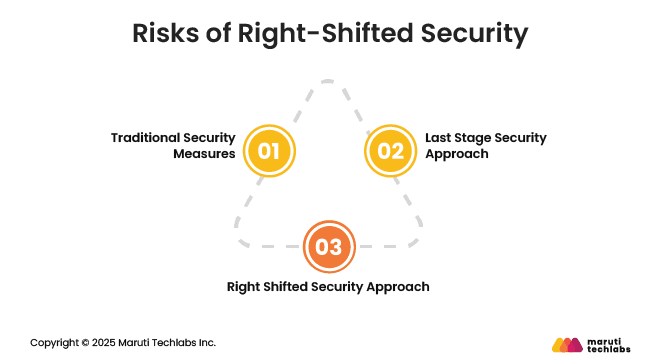
Risks of Right-Shifted Security
Right-shifted security refers to the practice of addressing security only at the final stages of the development lifecycle, after most of the application has already been built and prepared for release.
Here are the top 3 risks of following this approach.
1. Traditional Security Measures
In traditional development models, security reviews were often performed after coding was completed. Teams relied on final audits, manual testing, or post-development assessments to identify risks.
While this approach worked in slower release cycles, it left little room to fix deeper issues without major rework.
As applications became more complex and release timelines shortened, these late security checks struggled to keep up with growing threats.
2. Last Stage Security Approach
When security is treated as a last step, problems tend to surface when deadlines are already tight. Fixing vulnerabilities at this point often requires code changes, redesigns, or delayed launches.
This increases costs and puts pressure on development teams. In some cases, known risks are pushed into production just to meet timelines, exposing the application to potential attacks and compliance concerns.
3. Right Shifted Security Approach
A right-shifted security approach also affects collaboration. Security teams often work separately from developers, leading to unclear expectations and slower issue resolution.
Developers may see security feedback as an obstacle rather than guidance. This separation weakens overall protection and makes it harder to build secure applications consistently over time.
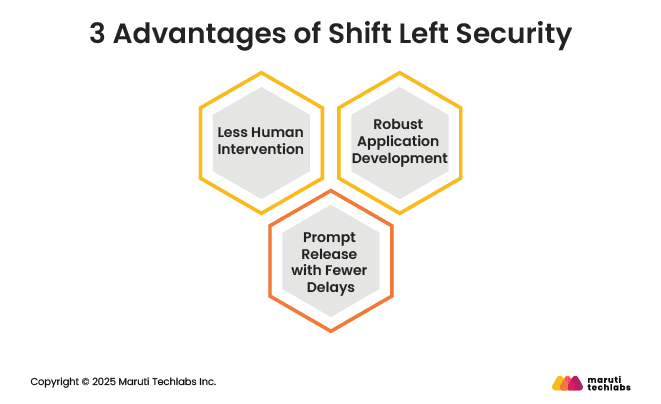
3 Advantages of Shift Left Security
A shift left approach to security helps organizations build safer applications while maintaining development speed. By addressing security early and consistently, teams can avoid many of the challenges that arise when security is treated as a final step.
Let’s observe the top advantages this approach offers.
1. Less Human Intervention
When security is introduced early in the development process, much of the repetitive checking can be handled automatically. Regular security checks run alongside development activities, helping teams identify issues as soon as they appear.
This early visibility prevents small problems from turning into larger risks later. As a result, developers spend less time revisiting completed work, and security teams can focus on guiding improvements instead of chasing last-minute fixes.
2. Prompt Releases With Fewer Delays
Fixing security issues early removes the delays that often occur near release deadlines. When problems are found at the end of development, teams are forced to pause releases or rush changes under pressure.
A shift left approach avoids these roadblocks by resolving issues during development. This leads to smoother workflows, fewer disruptions, and more predictable release timelines. Over time, teams gain confidence in shipping updates faster without compromising safety.
3. Robust Application Development
Embedding security into daily development practices results in applications that are more resistant to threats. Developers become familiar with common risks and learn how to avoid them while writing code.
This shared responsibility strengthens the overall development process and reduces reliance on last-stage security reviews. A consistent focus on security also builds awareness across teams, creating a culture where protecting applications becomes a natural part of how software is built and maintained.
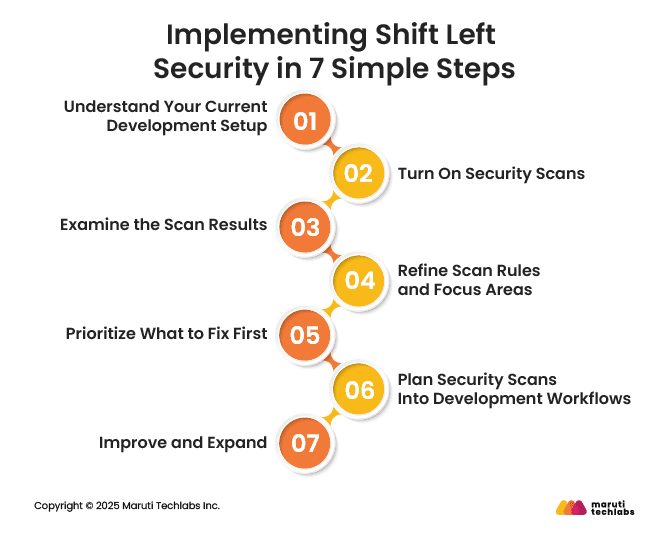
Implementing Shift Left Security in 7 Simple Steps
Shift-left security works best when it fits naturally into existing engineering workflows. These seven steps show how to implement shift-left security without disrupting engineering teams.
Step 1: Understand Your Current Development Setup
Before adding security scans, you must understand how your applications are built and used. The right approach depends on your industry, customers, and the technologies used for your products.
For example, an embedded device faces different risks than a SaaS platform. Bring together technology leaders, security teams, and stakeholders to identify compliance standards and the most likely security risks based on your application design.
This helps you clearly see your threat landscape. If you manage multiple applications, start with a few critical ones first. Use them as pilots to test scanning tools, gather feedback, and decide which security checks make the most sense to enable first.
Step 2: Turn On Security Scans
Start by running security scans on the pilot applications selected in the first step. Conduct these first scans outside active development so teams can stay focused on building and fixing features.
Schedule scans on the main code branch to ensure consistent results. Enable only the most important scans based on your risk areas. Most teams begin with checking for exposed secrets and vulnerable dependencies, as these issues are common and easy to address early.
Step 3: Examine the Scan Results
After running the initial scans on your pilot applications, review the findings carefully. Some issues may not truly apply to your setup, such as alerts tied to tools used only during testing and not in live systems.
Others may be low-impact items that add clutter without posing real risk. Focus on what actually matters for your applications and users. At the same time, think about what the scans might have missed.
Use your understanding of the system and earlier risk discussions to spot gaps. This step helps you decide what to ignore, what to fix first, and whether you need more scans or manual reviews to improve coverage.
Step 4: Refine Scan Rules and Focus Areas
Use what you learned from the early scan results to set clear steps for reviewing and fixing issues. Then update the scan rules so they highlight only what truly matters.
This helps teams stay productive instead of sorting through large numbers of low-value alerts. Some findings may not pose a real risk because other controls already protect the application, and those checks can be turned off.
On the other hand, recurring issues such as sensitive test data being added to code should be flagged with custom rules. Make sure all rule changes are clearly documented, including why they exist, and review them from time to time to keep them relevant and effective.
Step 5: Prioritize What to Fix First
Leaders across business, product, and engineering teams should agree on which security issues matter most and clearly share those priorities with developers. High-risk problems that have a real chance of being exploited should be scheduled alongside regular feature work and added to the backlog.
This ensures security fixes are not delayed or ignored. Issues that do not pose immediate risk can remain open or be marked as acceptable, as long as the reason is clearly recorded for future review or audits. Having a shared and practical approach to prioritization helps teams stay focused, address real threats, and continue delivering features without unnecessary slowdowns.
Step 6: Plan Security Scans Into Development Workflows
Once the earlier steps are complete, gradually add security scans to development pipelines. Begin with the most important scans and use the settings refined during earlier testing. Run scans alongside existing build jobs so they do not slow down the build.
Keep an eye on pipeline speed and schedule slower checks to run separately. At first, focus on giving developers visibility into issues rather than blocking their work. Show new findings during code reviews and add approval checks only for serious risks if needed.
Support this with simple guidance and training so teams understand how to fix issues early. Strong collaboration between development, security, and operations helps teams address risks faster while still delivering new features on time.
Step 7: Improve and Expand
You now have security scans working for your pilot teams, but this is just the start. Learn from their feedback, refine your approach, and apply the same steps to the next set of teams. Roll out gradually until all key applications are covered.
Real World Value of Shift Left Testing
Shift left testing proves its importance through real security incidents. One common threat is Broken Object Level Authorization (BOLA), a leading API security risk. When access control logic is weak, users can view data they should not access. In a USPS case, flawed authorization exposed customer information.
Shift left testing reduces this risk by validating business logic and access rules as soon as code is written. Security checks run early, not after deployment. This prevents vulnerable APIs from reaching production and reduces remediation effort.
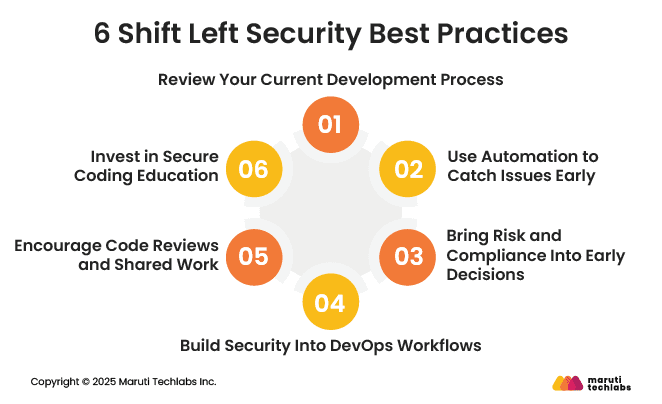
6 Shift Left Security Best Practices
Adopting shift-left security requires more than tools. It needs the right practices in place.
Here are some of the most renowned best practices for implementing shift-left security.
1. Review Your Current Development Process
Start by understanding how your software is currently designed, built, tested, and released. Identify points where security checks can be added without slowing teams down.
Review existing tools and workflows to ensure they can support early security checks. This creates a clear foundation for introducing security naturally into everyday development work.
2. Use Automation to Catch Issues Early
Automated security checks help find problems quickly without relying on manual reviews. Adding these tools early allows teams to spot common issues as code is written and tested.
Automation also creates consistency, ensuring all projects follow the same security rules and reducing the chance of human error across teams.
3. Bring Risk and Compliance Into Early Decisions
Security rules and compliance needs should be considered from the very beginning of a project. Addressing them early avoids costly fixes later and reduces legal or operational risks.
This approach helps developers think about safety and responsibility throughout the design and development process, not just at the final release stage.
4. Build Security Into DevOps Workflows
Building security into DevOps workflows makes it part of everyday development and deployment tasks. By checking applications and environments before release, teams can fix issues earlier and faster.
This approach allows developers to resolve issues within their normal workflow and ensures systems are set up securely from the start.
5. Encourage Code Reviews and Shared Work
Regular code reviews help teams spot mistakes and security gaps before they reach production. Working together on code builds shared responsibility and improves overall quality.
When developers collaborate closely, they learn from each other and develop stronger habits for writing safe, reliable code.
6. Invest in Secure Coding Education
Developers need ongoing training to understand common security risks and how to avoid them. Teaching secure coding principles helps teams prevent issues rather than react to them later.
Regular learning opportunities keep developers aware of new threats and build confidence in writing safer code every day.
Conclusion
Shift-left security is about making security a natural, early part of how software is built, not something checked only at the end. By introducing security checks, risk thinking, and automation early in the development process, teams detect and fix vulnerabilities sooner, reduce costly late-stage changes, and improve delivery speed and quality.
Tools that support static and dynamic analysis, dependency checks, and continuous security testing help make this possible. Equally important are strong collaborations across development, security, and operations, and giving developers the skills and visibility to own security.
This proactive and integrated approach builds more secure software, streamlines workflows, and strengthens trust in your applications long term.
Ready to shift security left without slowing teams down? Connect with Maruti Techlabs today, and let us guide you through your questions and concerns, creating a clear roadmap for integrating shift-left security into your development workflows.
FAQs
1. What is the best tool for shift left security?
Some of the commonly used tools for shift-left security:
SAST tools (Semgrep, SonarQube, CodeQL) to catch code issues early
Dependency scanning (Snyk, Trivy) to detect vulnerable libraries
IaC scanning (Checkov, Terraform scanners) to secure infrastructure before deployment
DAST tools (OWASP ZAP, Burp) for early runtime testing
CI/CD integrations to run security checks automatically in pipelines
2. How does automation help shift-left security?
Automation helps shift-left security by running security checks automatically during development and CI/CD workflows. It catches issues early, gives developers fast feedback where they work, and reduces manual reviews and late-stage fixes, making security consistent and low friction.
3. How can shift-left security be integrated into CI/CD pipelines?
Shift-left security can be integrated into CI/CD pipelines by adding automated security checks at each stage of development. This includes static code analysis (SAST) during commits, dependency scanning for vulnerable libraries, infrastructure-as-code (IaC) validation before deployment, and dynamic testing (DAST) in staging environments.
4. How do you measure the success of shift-left security?
The success of shift-left security can be measured by tracking how early vulnerabilities are detected and fixed, the coverage and effectiveness of automated security checks, adoption by development teams, the number of issues reaching production, and the reduction in costly late-stage fixes.
Mitul Makadia is the Founder and CEO of Maruti Techlabs, a custom software and AI engineering company he built from the ground up in 2009. Over 20+ years, he has led product development, business strategy, and engineering teams across startups to Fortune 500 clients.
Stuck with a Tech Hurdle?
We fix, build, and optimize. The first consultation is on us!