Boosting Project Delivery: The Power of Combining SAFe and DevOps
Key Takeaways
- SAFe and DevOps work well together when multiple teams need to build, test, and release software without losing coordination.
- A Continuous Delivery Pipeline helps reduce the delays that often occur between development, testing, and deployment.
- Automating routine tasks such as testing and deployments gives teams more time to focus on building and improving products.
- Bringing security checks into the development process helps catch issues earlier instead of dealing with them right before a release.
- Measuring things like release frequency, delivery time, and recovery time can help teams understand where their delivery process is working well and where it needs improvement.
Introduction
As organizations grow, delivering software quickly and efficiently becomes more challenging. Many businesses find it difficult to maintain agility, improve collaboration, and keep operations functioning well while adjusting to evolving customer needs and market changes.
This growing focus on faster software delivery is reflected in the DevOps market, which is projected to grow from USD 13.29 billion in 2024 to USD 108.26 billion by 2035. As a result, enterprises are progressively adopting frameworks and practices that help them scale without sacrificing quality or speed.
SAFe DevOps combines the strengths of SAFe and DevOps to help growing organizations manage software development more effectively. It helps teams work better together, reduces bottlenecks in the development process, and makes it easier to deliver quality software to customers faster and more consistently.
In this blog, we'll explore how DevOps in SAFe helps organizations accelerate delivery, improve collaboration, and scale agile development successfully.

What is DevOps?
DevOps is a software development approach that helps development and operations teams work together more effectively. Instead of handling development and deployment as separate activities, DevOps encourages teams to collaborate throughout the entire software lifecycle, from coding and testing to deployment and maintenance.
| According to AWS, DevOps is a combination of cultural philosophies, practices, and tools that helps organizations deliver applications and services faster than traditional software development methods. This allows businesses to release updates more frequently, improve reliability, and respond to customer needs more quickly. |
What Are the Core Elements of DevOps?
DevOps is made up of several practices that help teams improve the way software is developed and delivered. Let's look at the key elements that support a successful DevOps culture and workflow.
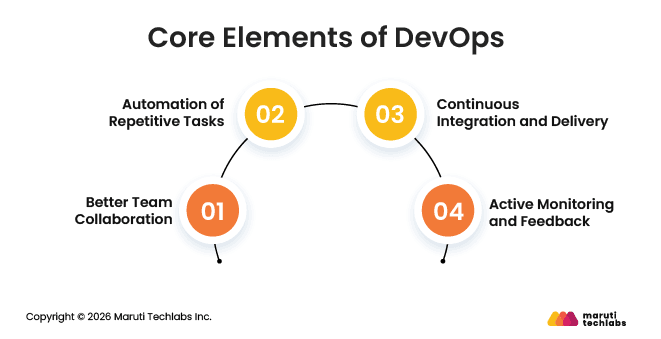
- Better Team Collaboration
DevOps breaks down the gap between development and operations teams. Instead of working independently, both teams share responsibility for delivering stable and reliable software. - Automation of Repetitive Tasks
Tasks such as code builds, testing, infrastructure setup, and deployments can be automated. This decreases manual work, saves time, and helps avoid common errors. - Continuous Integration and Delivery
Developers can merge code changes regularly, while automated testing and deployment workflows help move those changes through the release process faster and with fewer issues. - Active Monitoring and Feedback
Monitoring tools provide visibility into application performance and system health. This helps teams identify problems early and make improvements based on real-world usage.
Automation and Continuous Delivery in DevOps
A lot of time in software development can be lost on manual tasks such as building code, running tests, and deploying applications. DevOps helps reduce that effort through automation, making the development process faster and more consistent.
The Continuous Delivery Pipeline (CDP) is a key part of this process. It moves code through development, testing, and deployment stages using automated workflows and checks. In a SAFe environment, this helps teams release updates more frequently, find issues earlier, and keep delivery moving as projects become larger and more complex.
DevOps Concept in SAFe
In SAFe, DevOps helps connect development and operations teams so that ideas can move from planning to production more smoothly. Rather than treating development, testing, deployment, and operations as separate activities, SAFe encourages teams to work together throughout the entire delivery process. The goal is to improve the flow of value, reduce delays, and help organizations deliver software more efficiently.
SAFe supports DevOps through two key components: the CALMR framework and the Continuous Delivery Pipeline (CDP).
1. The CALMR Framework
CALMR provides a practical foundation for implementing DevOps within SAFe. It focuses on the main areas that help teams deliver software more efficiently and reliably.
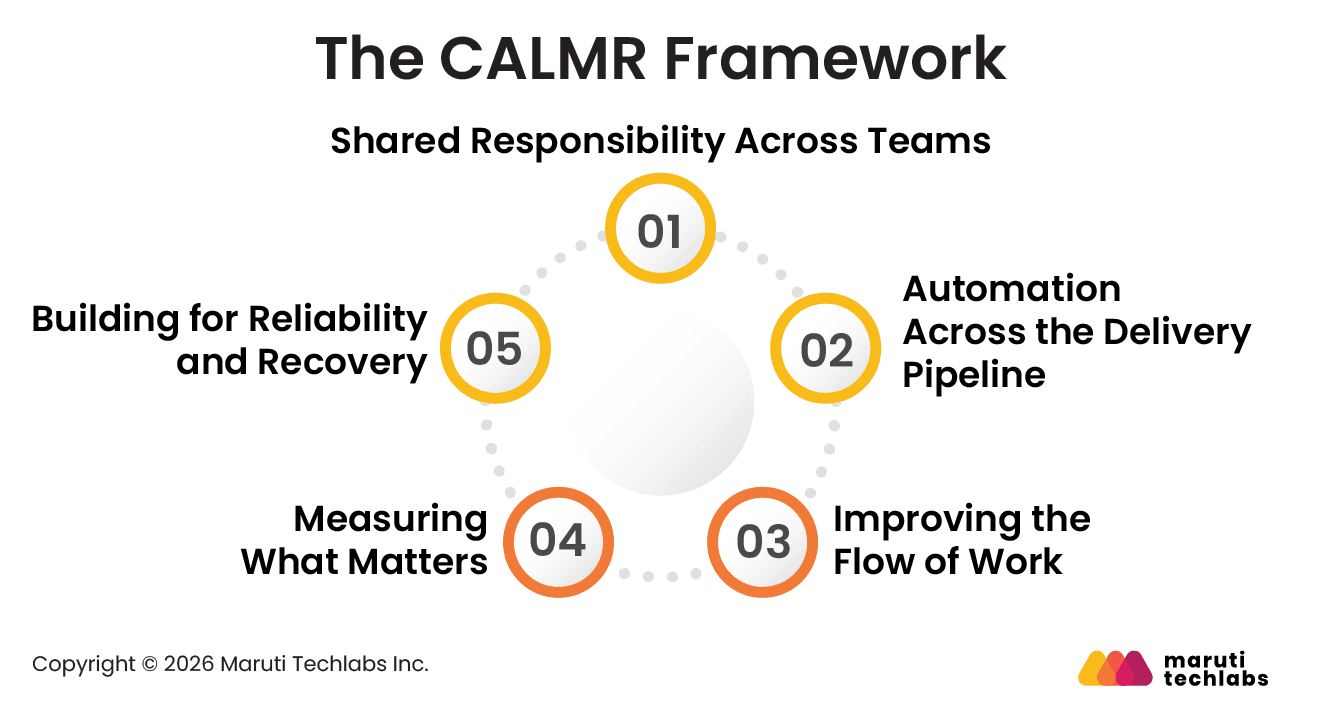
- Shared Responsibility Across Teams
SAFe promotes a shared responsibility model where development, testing, security, and operations teams work toward common delivery goals.
- Automation Across the Delivery Pipeline
Automating tasks across the delivery pipeline helps reduce manual effort, improve consistency, and speed up releases.
- Improving the Flow of Work
Teams focus on decreasing bottlenecks, limiting work in progress (WIP), and delivering smaller batches of work more frequently.
- Measuring What Matters
Performance is tracked utilizing metrics, telemetry data, and feedback channels to discover areas for improvement and measure business outcomes.
- Building for Reliability and Recovery
Systems are built to handle failures more effectively, allowing faster recovery through rollback strategies and rapid fixes.
2. The Role of the Continuous Delivery Pipeline
The Continuous Delivery Pipeline is the framework SAFe uses to move ideas from concept to production and support Release on Demand. It consists of three connected stages:
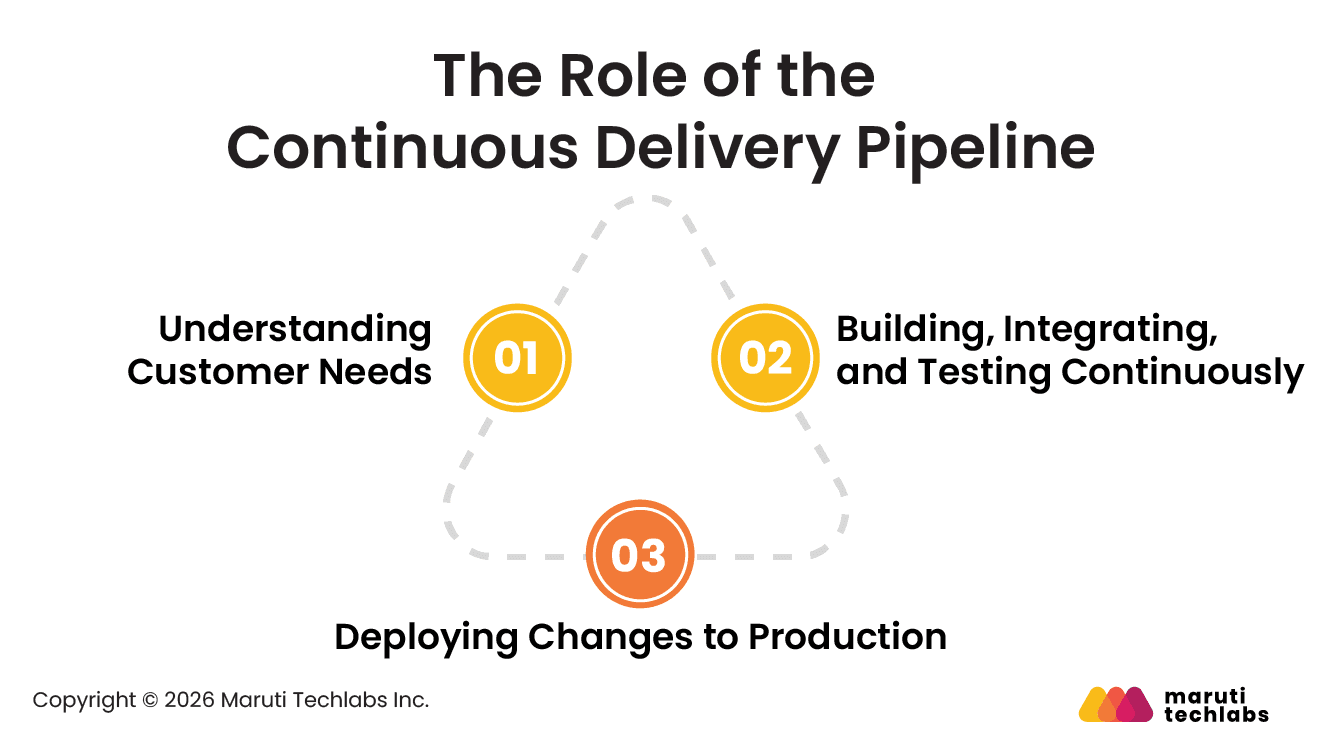
- Understanding Customer Needs
Teams identify customer needs, evaluate opportunities, and define features through research, planning, and feedback.
- Building, Integrating, and Testing Continuously
Code is developed, integrated, tested, and validated in a production-like environment to ensure it is ready for release.
- Deploying Changes to Production
Validated changes are deployed to production using automated processes, making new features available to users more quickly and reliably.
3. Why DevOps Matters in SAFe
DevOps helps organizations get more value from SAFe by improving collaboration and streamlining software delivery. Together, they help reduce lead times, increase deployment frequency, improve software quality, and enable teams to respond more quickly to changing business requirements.
Benefits of DevOps in SAFe
By bringing development and operations teams together, DevOps helps SAFe organizations deliver software more competently without undermining quality, reliability, or security. It supports a continuous flow of work from idea to deployment, helping teams to respond faster to business and customer needs.
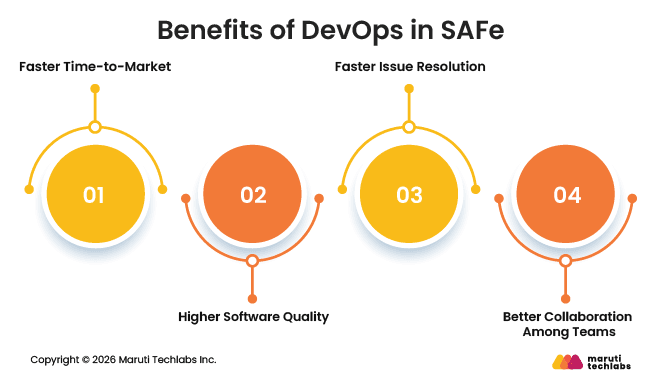
1. Faster Time-to-Market
One of the biggest advantages of DevOps in SAFe is the ability to release new features and updates more frequently. Through Continuous Exploration, Continuous Integration, and Continuous Deployment, organizations can deliver value to users on demand instead of waiting for large release cycles.
How to Measure Progress
- Release Frequency: It measures how often teams successfully push new code and updates into the production environment.
- Time to Production: It tracks how long it takes for a code change to move from development to a live production release.
2. Higher Software Quality
DevOps helps teams find and fix issues earlier in the development process. With regular testing and security checks built into the workflow, there are fewer chances of problems reaching production, which leads to more stable software releases.
How to Measure Progress
- Automated Testing Success Rate: It shows the percentage of automated tests that pass during the CI/CD process.
- Release Failure Rate: It measures how often deployments result in production issues that require fixes, patches, or rollbacks.
3. Faster Issue Resolution
No matter how well a system is built, issues can still arise. DevOps helps teams spot problems early and address them before they affect too many users. With better monitoring and speedier response processes, teams can resolve issues more quickly and keep applications running with minimal interruption.
How to Measure Progress
- Average Recovery Time: A useful indicator of how efficiently services are restored following an outage or system failure, helping reduce downtime and business disruption.
- Issue Detection Time: An indicator of how quickly incidents are identified, supporting faster response times while reducing the impact on users.
4. Better Collaboration Among Teams
DevOps encourages teams to work together throughout the software development process. With better communication and collective ownership, teams can resolve challenges more quickly and keep projects moving forward free of unnecessary roadblocks.
How to Measure Progress
- Team Engagement Score: Reflects how well teams collaborate, communicate, and stay in agreement with project goals.
- Issue Resolution Speed: Measures how quickly teams can identify and resolve issues that may affect delivery.
Why DevOps Is Essential for SAFe at Scale
As more teams become involved in software development, keeping everyone aligned can get difficult. Different teams may be working on related features at the same time, which can make coordination, testing, and releases more complex. DevOps helps bring structure to the process by automating routine tasks and making it easier for teams to work together and deliver software smoothly.
In large SAFe environments, teams are constantly making changes and adding new features. Without a clear process, integrating all that work can quickly become complicated. DevOps helps keep things organized by making testing, integration, and releases a regular part of the workflow rather than a last-minute effort.
With DevOps, quality is not something teams check only before a release. Testing, security reviews, and other checks happen throughout development, making it easier to spot issues early and avoid problems later on.
Real-World Example: Standard Bank used SAFe and DevOps together to make software delivery smoother across its teams. With more automation in place, releases that once required significant time and effort could be completed much faster. The result was a faster delivery process, improved team efficiency, and a more consistent customer experience.
Why the Continuous Delivery Pipeline Matters in SAFe DevOps
The Continuous Delivery Pipeline (CDP) is a core part of SAFe DevOps that helps organizations move software from idea to production in a faster and more reliable way. It supports the entire delivery process through four stages: Continuous Exploration, Continuous Integration, Continuous Deployment, and Release on Demand.
Here’s why the CDP is important:
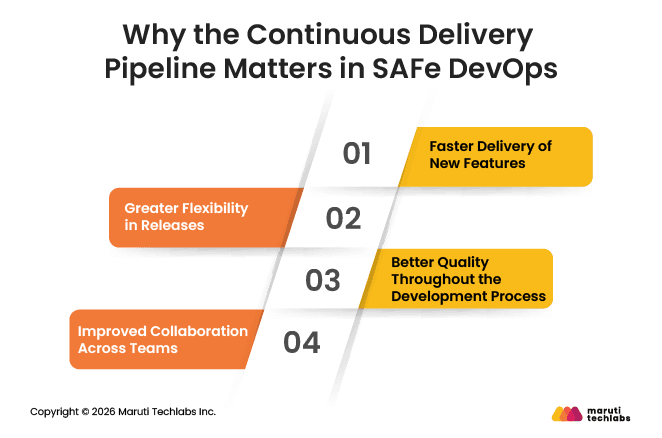
1. Faster Delivery of New Features
The CDP helps teams release features and updates as soon as they are ready, allowing businesses to respond more quickly to customer needs and changing market conditions.
2. Greater Flexibility in Releases
With the CDP, deployment and release are treated as separate activities. Teams can deploy updates to production environments ahead of time and make them available to users when the business decides the timing is right.
3. Better Quality Throughout the Development Process
Finding issues early is always easier than fixing them at the last minute. With regular testing and continuous integration built into the process, teams can catch problems sooner, make fixes faster, and avoid unexpected challenges when it's time to release software.
4. Improved Collaboration Across Teams
The Continuous Delivery Pipeline encourages teams to stay aligned throughout the development and release process. When everyone is working together and has visibility into what's happening, there are fewer surprises and releases tend to run more smoothly.
How the Continuous Delivery Pipeline Works
To support continuous software delivery, the CDP follows four stages. Each stage plays a specific role in moving an idea from planning to production while maintaining quality and reliability.
CDP Stage | What Happens in This Stage | Tools That Support This Stage |
| Continuous Exploration (CE) | Teams explore customer needs, business goals, and market opportunities to determine what should be built next. | Jira, Mural, Figma, Amplitude |
| Continuous Integration (CI) | New features and code changes are developed, integrated, and tested to ensure they work as expected. | Jenkins, GitHub Actions, GitLab CI/CD, SonarQube |
| Continuous Deployment (CD) | Tested code is moved into production environments and prepared for release. | Kubernetes, Docker, Ansible, Terraform |
| Release on Demand (ROD) | New functionality is made available to users when the business decides the timing is right. | LaunchDarkly, Harness, AWS CodeDeploy |
How DevSecOps Fits into SAFe DevOps
DevSecOps extends DevOps by making security a continuous part of the software development process. Instead of treating security as something that happens just before release, it becomes part of every stage of development. This approach assists teams in recognizing vulnerabilities earlier, reducing security risks, and maintaining delivery speed without creating additional bottlenecks.
Building Security into the Development Process
Rather than waiting until a project is almost finished, DevSecOps brings security into every stage of development. Teams can identify potential vulnerabilities early, fix them faster, and reduce the chances of security issues making their way into production.
Security checks are carried out throughout the development process to help teams identify potential vulnerabilities early. This can include reviewing source code, scanning third-party dependencies, and testing running applications for security weaknesses. Infrastructure, containers, and cloud environments are also regularly checked to help prevent configuration errors and compliance-related issues.
Protecting sensitive information is also an important part of DevSecOps. Details such as API keys, passwords, and access credentials are kept separate from the code and stored securely using dedicated tools.
DevSecOps in Practice
Many organizations have adopted DevSecOps to strengthen security without slowing software delivery.
- Financial Services: Banks and fintech companies often use automated security testing to spot vulnerabilities before applications are released, helping guard sensitive customer and transaction data.
- Cloud-Native Organizations: Many cloud-native companies, including Netflix, make security part of the everyday development process rather than treating it as a separate step. By using automated testing and built-in security checks, teams can move quickly while ensuring applications remain secure and reliable.
- Highly Regulated Industries: Industries such as healthcare and finance use automated security and compliance tools to help protect applications, monitor systems, and meet requirements like PCI DSS, HIPAA, and GDPR.
A Paradigm Shift of DevOps in IT Organizations
As software projects became more complex and release cycles grew shorter, many organizations found that traditional ways of working could not keep up. DevOps helped address this challenge by improving collaboration between teams and making software delivery faster, smoother, and more reliable.
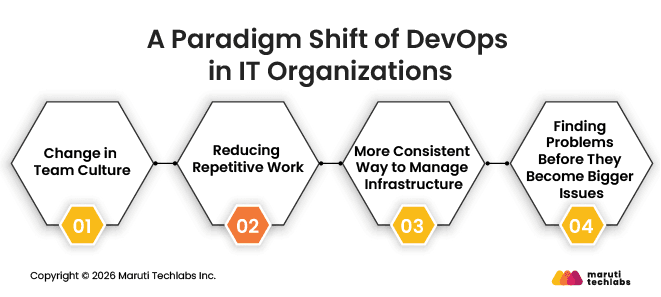
1. Change in Team Culture
DevOps encourages development and operations teams to work more closely throughout the software delivery process. With better communication and shared ownership, teams can resolve challenges faster and avoid many of the delays caused by working in silos.
2. Reducing Repetitive Work
Development teams often spend a surprising amount of time on repetitive tasks such as running tests, preparing builds, and handling deployments. DevOps helps take much of this work off their plate through automation, making the delivery process smoother and giving teams more time to focus on building and improving products.
3. More Consistent Way to Manage Infrastructure
Setting up and maintaining infrastructure manually can be time-consuming and often leads to inconsistencies between environments. DevOps addresses this through Infrastructure as Code (IaC), allowing teams to manage infrastructure using code so environments can be created, updated, and scaled more reliably.
4. Finding Problems Before They Become Bigger Issues
Fixing bugs late in the development process can delay releases and increase costs. DevOps encourages regular testing and validation throughout development, helping teams catch issues earlier when they are easier and faster to resolve.
Measuring and Managing DevOps Maturity
Tracking the impact of DevOps is just as important as implementing it. DORA (DevOps Research and Assessment) metrics help organizations measure delivery performance and system reliability, providing a clear view of how DevOps practices are improving software delivery over time.
Key Metrics Used to Measure DevOps Performance
Focus Area | Metric | What It Helps You Understand | Why It Matters in SAFe |
| Delivery Speed | Release Frequency | How often new code, features, or updates are successfully released to production. | Frequent releases help organizations respond more quickly to customer needs and changing business priorities. |
| Delivery Speed | Time to Production | The time it takes for a code change to move from development into production. | Shorter delivery cycles indicate a more efficient pipeline and faster delivery of business value. |
| System Reliability | Deployment Failure Rate | How often releases result in issues that require fixes, rollbacks, or additional work. | Helps teams maintain quality while continuing to deliver software at a faster pace. |
| System Reliability | Service Recovery Time | How quickly systems can be restored after an outage, failure, or production issue. | Faster recovery improves system resilience and reduces the impact of disruptions on users and the business. |
Conclusion
Combining SAFe and DevOps helps organizations deliver software faster while improving collaboration, quality, and reliability. As businesses grow and software delivery becomes more complex, this combination provides a structured way to keep teams aligned and releases moving smoothly.
With teams working more closely together and fewer manual tasks slowing things down, organizations can deliver software more efficiently and adapt faster when customer expectations or business priorities change.
More importantly, SAFe DevOps is not just about speeding up releases. It helps create a delivery process that can scale with the business, making it easier to support long-term growth, continuous improvement, and ongoing innovation.
FAQs
1. What is the difference between SAFe DevOps and standard DevOps?
Standard DevOps helps development and operations teams work together more effectively and automate software delivery. SAFe DevOps uses the same ideas but applies them in larger organizations where multiple teams need to stay aligned. It helps coordinate software delivery across the enterprise while supporting Agile at scale.
2. What are the four stages of the SAFe Continuous Delivery Pipeline?
The SAFe Continuous Delivery Pipeline consists of four stages: Continuous Exploration, Continuous Integration, Continuous Deployment, and Release on Demand. Together, these stages help organizations move from identifying customer needs to delivering new features in production quickly, reliably, and with greater flexibility.
3. How does SAFe DevOps relate to DevSecOps?
DevSecOps builds on SAFe DevOps by making security part of the development process from the beginning. Rather than waiting until a release is almost complete, teams check for security issues throughout development. This helps catch problems earlier and makes it easier to deliver software without compromising security.
4. What is the CALMR approach in SAFe DevOps?
CALMR is a framework used in SAFe DevOps that focuses on five areas: Culture, Automation, Lean Flow, Measurement, and Recovery. These principles help organizations improve collaboration, streamline delivery processes, measure performance, and recover more quickly when issues occur.
5. How long does SAFe DevOps implementation typically take?
The timeline varies depending on the size of the organization and the complexity of its existing processes. While some teams start seeing improvements within a few months, a full SAFe DevOps implementation across multiple teams and departments can take longer as processes, tools, and team practices evolve.
6. What certifications are available for SAFe DevOps practitioners?
One of the most recognized certifications is the SAFe DevOps Practitioner (SDP) certification offered by Scaled Agile. It covers key topics such as the Continuous Delivery Pipeline, CALMR, automation, and Release on Demand within a SAFe environment.
How Maruti Techlabs Helped an Insurance Provider Reduce Infrastructure Costs by 50%
One of our insurance clients was struggling with infrastructure performance, growing operational costs, and limitations in scaling its environment. Our team helped modernize its cloud setup by migrating to AWS, separating production and staging environments, implementing automated backups, and enabling autoscaling to improve efficiency and reliability.
As a result, the organization achieved a 300% improvement in application performance, reduced server and database management costs by 50%, improved system reliability, and established a more secure infrastructure with automated backup and recovery capabilities.
At Maruti Techlabs, we help businesses improve software delivery through DevOps services such as CI/CD implementation, infrastructure automation, cloud optimization, monitoring, and continuous delivery. Our goal is to help teams release software more efficiently while maintaining reliability at scale.
We also offer DevSecOps services to help organizations make security a part of the development process. By integrating security testing, compliance checks, vulnerability management, and secure deployment practices into CI/CD workflows, we help teams identify risks early without slowing down delivery.