

How to Deploy a Private LLM for Regulated Industries
Key Takeaways
- Private LLMs help regulated organizations use AI while keeping control over sensitive business data.
- Choosing the right deployment approach depends on security needs, compliance requirements, and existing infrastructure.
- A private LLM requires more than a model; it needs secure data access, governance, and proper monitoring.
- RAG and fine-tuning help organizations adapt LLMs to their specific workflows and internal knowledge.
- Secure deployment practices, including access controls and data protection measures, are essential for enterprise AI adoption.
- A well-planned private LLM strategy helps businesses adopt AI without compromising privacy, security, or compliance.
Introduction
For regulated organizations, adopting an LLM is about more than response quality. They also need to know where the model runs, what data it can access, and how it handles that information. When AI works with sensitive data, organizations need confidence that their information stays within approved environments. Private LLMs and self-hosted deployments provide more control over how AI systems handle enterprise data.
This concern is influencing how enterprises think about AI adoption. A Forbes survey of 2,567 senior executives across 35 countries found that 95% consider private or sovereign AI important. However, fewer than half are confident they can meet AI data sovereignty requirements. This shows that many organizations still have concerns about managing AI data responsibly.
This is why deploying a private LLM involves more than simply hosting an open-source model internally. Organizations need to decide how the model will run, what data it can access, how it connects with enterprise systems, and what security controls are required before it can be used in production.
This guide explains what a private LLM is, why regulated industries are adopting it, and how to select the right deployment approach. It also covers how to build and deploy a private LLM while tackling security, governance, and compliance requirements.

Whether you're exploring a private LLM or planning a production deployment, our experts can help you design and implement a solution that aligns with your security, compliance, and business requirements.
What Is a Private LLM?
A private LLM (Large Language Model) is an AI model deployed within an organization's own infrastructure instead of a third-party environment. Unlike public LLMs, it keeps prompts, enterprise data, and AI processing within controlled environments such as on-premises data centers, private clouds, or Virtual Private Clouds (VPCs). This gives organizations greater control over security, compliance, and how their data is used.
The need for a private LLM usually comes down to one question: Can sensitive data leave the organization? If the answer is no, relying on a public LLM may not be an option. Running the model in a controlled environment gives organizations visibility into where data goes, who can access it, and how it is handled.
How does a private LLM work?
Most organizations don't build a large language model from scratch. They start with an open-weight foundation model such as Llama, Mistral, Gemma, or Qwen and deploy it inside their own infrastructure. Every prompt, inference request, and generated response stays within that environment instead of being routed through an external API.
A private LLM is rarely used as a standalone model. Organizations typically connect it to internal data sources through RAG or fine-tune it with domain-specific datasets to improve performance for specific use cases. The surrounding security layer controls user access, document permissions, logging, and monitoring across the AI workflow.
Private LLM vs. Public LLM: What's the difference?
The choice between a public and private LLM depends on how much control an organization needs over its data, infrastructure, and AI operations.
| Where the model runs | On infrastructure managed by the AI provider | Within your on-premises environment, private cloud, or VPC |
| Enterprise data | Sent to an external service for processing | Stays inside your organization's environment |
| Knowledge access | Limited to uploaded files or external APIs | Connects securely to internal systems through RAG and enterprise permissions |
| Model customization | Prompt engineering with limited customization options | Supports RAG, fine-tuning, and domain-specific customization |
| Security and compliance | Depends on the provider's controls and policies | Controlled by your organization's security, governance, and compliance requirements |
| Infrastructure management | Fully managed by the providerGeneral productivity, experimentation, and consumer applications | Managed by your internal teams or deployment partner |
| Best suited for | General productivity, experimentation, and consumer applications | Regulated industries, enterprise AI, and confidential business workflows |
When should an organization use a private LLM?
A private LLM makes sense when sending data to an external AI service isn't an option. That is often the case for organizations working with customer records, legal documents, financial information, proprietary research, source code, or other confidential business data. Keeping AI workloads within the organization's environment helps meet security, privacy, and regulatory requirements.
Many AI use cases rely on information that isn't part of the model's original training data. A private LLM can retrieve content from internal documents, policies, contracts, or technical manuals using approved enterprise knowledge sources. This allows employees to work with up-to-date business information instead of relying only on the model's built-in knowledge.
Some organizations also have infrastructure requirements that public AI services cannot support. They may need to run AI in private clouds, on-premises data centers, or air-gapped environments. In these situations, a private LLM becomes part of the organization's existing technology and security architecture.
Why Regulated Industries Are Choosing Private LLMs
The conversation around enterprise AI has shifted from "Can we use an LLM?" to "Can we use it without creating compliance or security risks?" For regulated industries, this decision becomes more complex because AI often handles confidential information, intellectual property, and regulated records. The way an organization deploys AI for everyday tasks may not meet the security and compliance needs of business-critical workflows.
Why are public LLMs risky for sensitive enterprise data?
Public LLMs are useful for quick answers and everyday tasks, but they become more complicated when business information is involved. A single prompt can include customer details, contract terms, source code, financial data, or internal documents that were never meant to leave the company’s environment.
The concern is not only about what the model can generate, but also what happens to the information shared with it. Before using public LLMs for sensitive workflows, companies need to understand how data is handled and whether it aligns with their security and compliance requirements.
Common compliance requirements for enterprise AI
AI deployments in regulated industries often need to align with existing data protection and security standards. The specific requirements depend on the type of information being processed and the industry involved.
- HIPAA: Healthcare organizations using AI with patient information must protect health data and maintain safeguards around how that information is accessed, processed, and stored.
- GDPR: Companies handling personal data of individuals in the European Union need controls around data privacy, processing, and user rights when building AI applications.
- PCI DSS: Organizations that process payment card information need security measures that protect cardholder data throughout AI-enabled workflows.
- SOC 2: Many businesses use SOC 2 principles to demonstrate that their systems have appropriate controls for security, availability, confidentiality, and privacy.
- ISO 27001: This standard helps organizations establish structured information security practices and manage risks associated with handling enterprise data.
- EU AI Act: Organizations using AI in the European Union need to evaluate the Act's requirements for transparency, risk management, documentation, and human oversight based on the type of AI system they deploy.
Industries that benefit most from private LLM deployment
Private LLMs are becoming more relevant in industries where AI needs to work with information that cannot be handled like general business data.
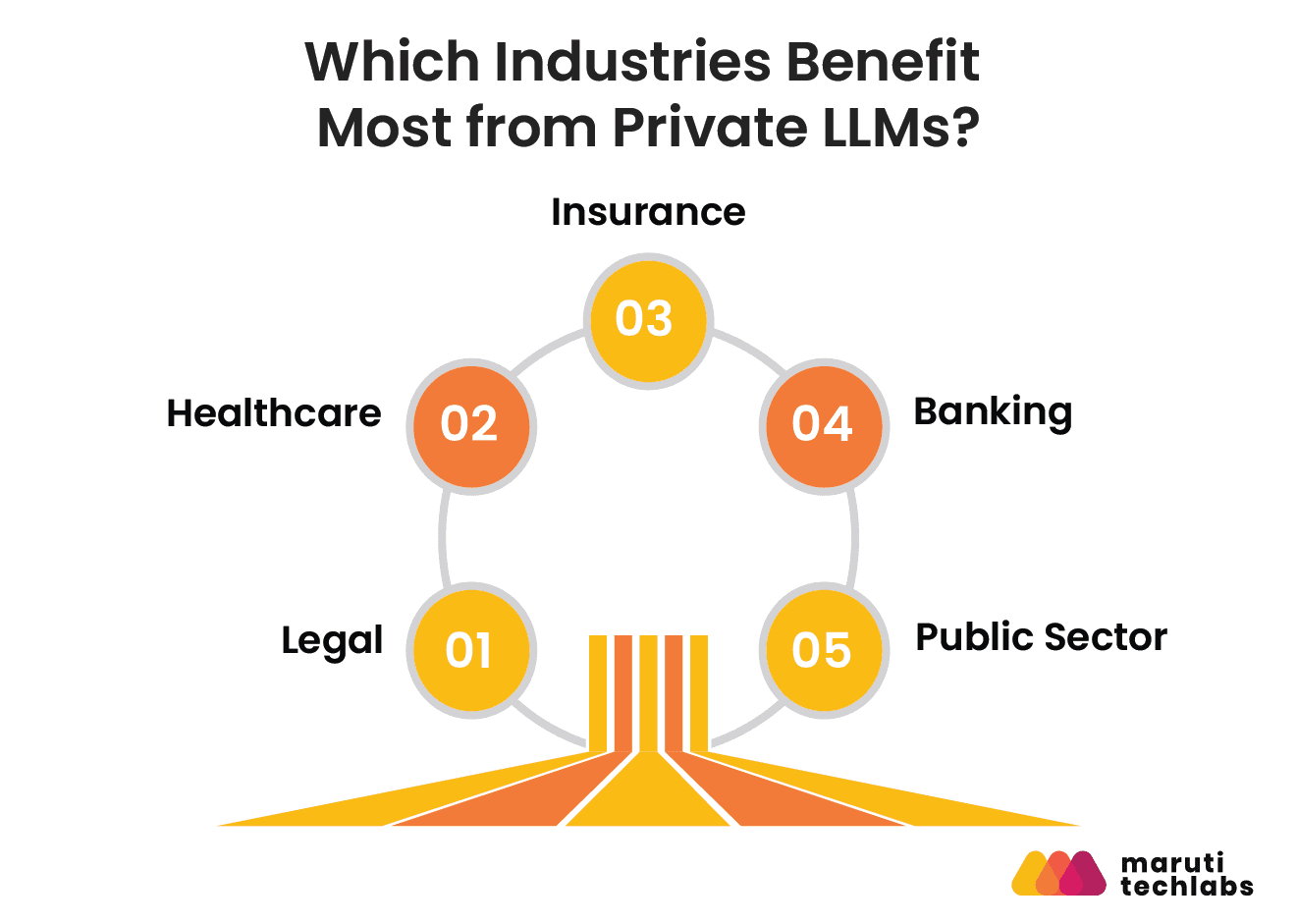
- Legal: Law firms deal with contracts, case files, and discovery documents that contain sensitive client information. A private LLM helps legal teams review and work with these documents without sharing confidential data with public AI tools.
- Healthcare: From clinical notes to medical research, healthcare organizations deal with information where privacy is critical. Private LLM deployments help teams use AI for documentation and analysis while keeping patient data protected.
- Insurance: Insurers handle thousands of claims, policies, and risk assessments that contain sensitive customer information. Private LLMs help teams apply AI to these workflows while keeping their internal data protected.
- Banking: Banks deal with sensitive information every day, from customer records and transaction data to internal compliance documents. Using AI on this information requires more control than a public LLM can usually provide, especially when security and regulatory requirements are involved.
- Public Sector: Many public sector organizations cannot send operational or citizen data to external AI services. Private LLMs allow them to use AI while keeping sensitive information within approved infrastructure and security boundaries.
Self-Hosted LLM vs Managed Private LLM: Which Deployment Model Fits Your Business?
Choosing a private LLM deployment model depends on how much control an organization needs and how much infrastructure it wants to manage. Some companies need complete ownership of their AI environment, while others prefer a managed setup that reduces operational complexity.
What is a self-hosted LLM?
A self-hosted LLM is a model that an organization runs and manages on its own infrastructure. The model can be deployed on private cloud resources, on-premises servers, or isolated environments where the organization controls the hardware, data, and supporting systems.
A managed private LLM takes a different approach. The model runs in a dedicated cloud environment, such as a private VPC or tenant, while the cloud provider or technology partner manages much of the underlying infrastructure.
Self-Hosted LLM vs Cloud-Hosted Private LLM
Area | Self-Hosted LLM | Managed Private LLM |
| Infrastructure | Managed by the organization's own teams | Managed through a dedicated cloud environment |
| Data control | Maximum control over where data is stored and processed | Data remains isolated within a private cloud setup |
| Customization | Greater flexibility for fine-tuning and specialized use cases | Supports customization with less infrastructure management |
| Operations | Requires internal expertise for scaling, security, and maintenance | Reduces operational workload through managed services |
| Best suited for | Air-gapped environments and organizations needing full control | Enterprises looking for faster deployment with strong security controls |
How to choose the right deployment architecture?
A managed private LLM is often a practical starting point for organizations that need enterprise security without building a large AI infrastructure team. It can help teams move faster while relying on established cloud security and compliance capabilities.
Self-hosted LLMs make more sense when organizations need complete control over infrastructure, operate in highly restricted environments, or process AI workloads at a scale where owning the infrastructure becomes more cost-effective.
The right choice depends on factors such as compliance requirements, available engineering resources, customization needs, and the level of control the business requires.
How to Build a Private LLM for Regulated Industries
Most organizations do not build an LLM from scratch. They start with an existing foundation model and adapt it for their own requirements by connecting it with internal data, improving how it handles specific tasks, and putting the right security measures in place before using it in production.
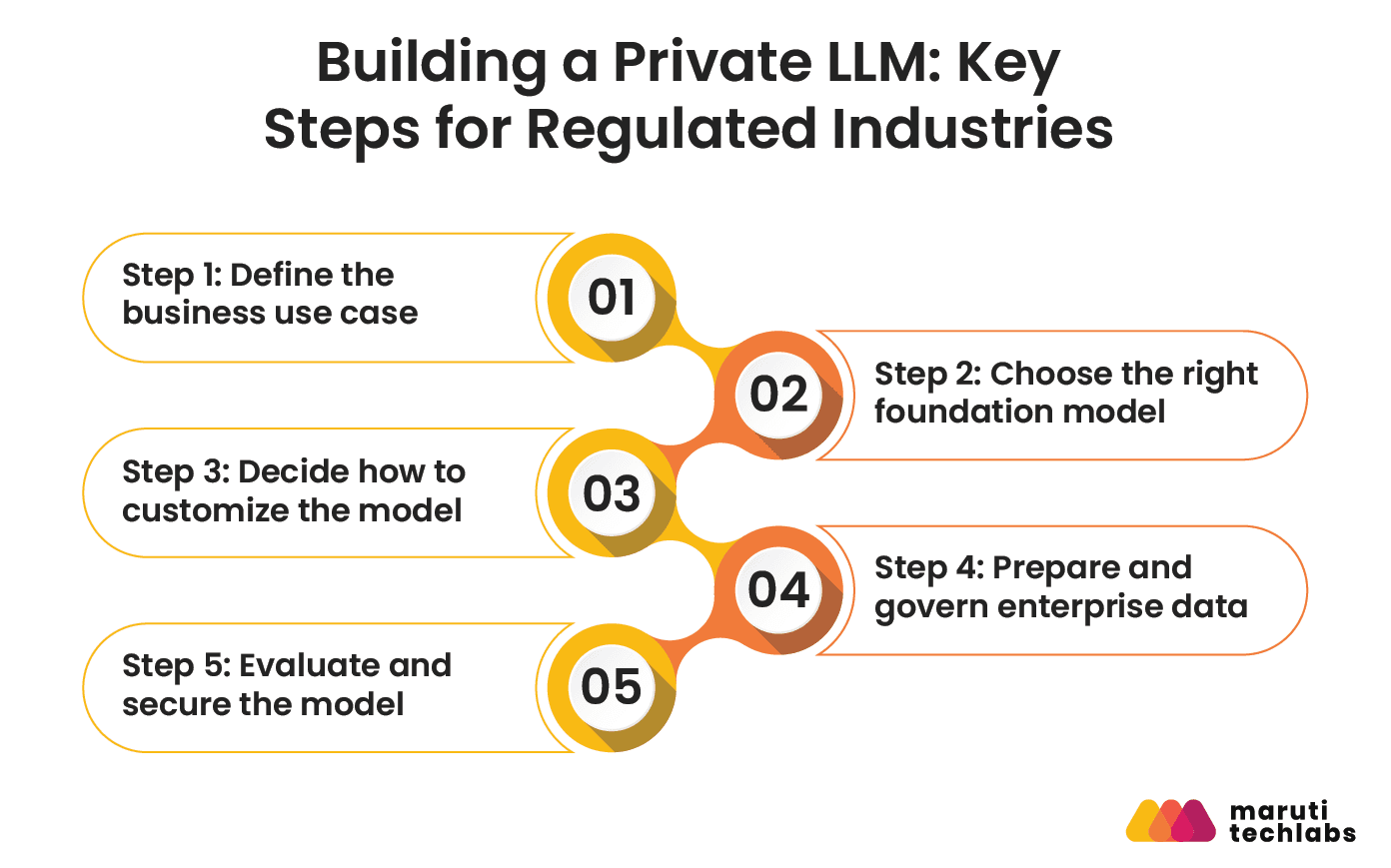
Step 1: Define the business use case
Before selecting a model, organizations need to understand what they want the LLM to handle. A model designed for reviewing legal contracts may require different data, accuracy benchmarks, and security controls compared to one used for healthcare documentation or financial analysis.
Defining the use case also helps determine whether the organization needs simple prompting, RAG, fine-tuning, or a more customized approach.
Step 2: Choose the right foundation model
Most private LLM deployments begin with open-weight models such as Llama, Mistral, or Qwen. The right choice depends on factors such as performance requirements, licensing, infrastructure availability, and the type of information the model needs to process.
Organizations should evaluate models based on their ability to support enterprise workloads rather than choosing only based on benchmark scores.
Step 3: Decide how to customize the model
The level of customization depends on the business requirement.
For some applications, prompt engineering may be enough to guide the model toward better responses. When the model needs access to internal knowledge, Retrieval-Augmented Generation (RAG) allows it to retrieve information from approved enterprise sources without changing the base model.
For more specialized use cases, organizations may use fine-tuning with domain-specific examples or continued pre-training with large amounts of industry-specific data. Training a model completely from scratch is usually considered only when organizations have unique requirements, extensive datasets, and significant infrastructure resources.
Step 4: Prepare and govern enterprise data
Most private LLM projects involve working with information that already exists inside the organization, such as contracts, policies, reports, or internal knowledge bases. Before connecting this data with the model, teams usually review its quality, remove outdated information, and decide what data the model should be allowed to access.
For applications using RAG, documents are converted into a format the system can search efficiently. This involves techniques such as chunking, embeddings, and vector databases, which help the model retrieve relevant information without giving it unrestricted access to enterprise data.
Step 5: Evaluate and secure the model
A model that performs well in testing may still struggle with real enterprise requests. Teams evaluate it using actual business scenarios to understand response accuracy, limitations, and cases where human review may still be required.
Security checks are also part of this process. Organizations review permissions, data handling practices, and compliance requirements before allowing employees to use the model with sensitive information.
Private LLM Deployment: Essential Steps for Regulated Industries
For regulated industries, private LLM deployment includes deciding how enterprise data will be connected, how users will access the system, and what security and governance controls are required before the model is used in production.
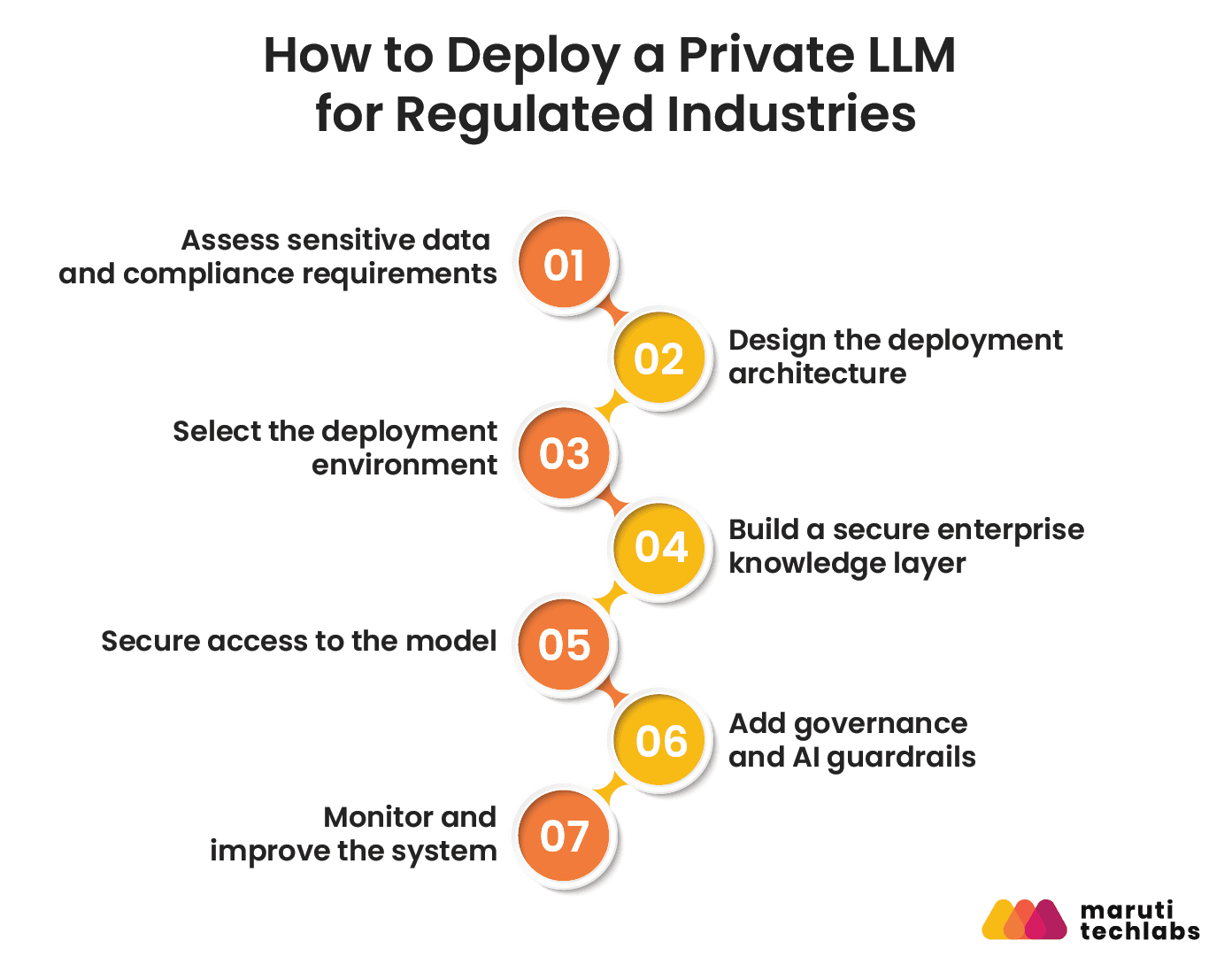
1. Assess sensitive data and compliance requirements
A private LLM may handle different types of enterprise information, from customer records and financial data to patient files, legal documents, and internal business content. Understanding what data enters the system helps teams decide how it should be stored, accessed, and protected.
These decisions also depend on the compliance requirements the organization needs to meet. A healthcare provider may need to consider HIPAA, while financial and global organizations may need to address GDPR, PCI DSS, SOC 2, ISO 27001, or the EU AI Act along with their internal data policies.
2. Design the deployment architecture
After understanding the data and compliance requirements, teams need to figure out how the different parts of the system will connect. A private LLM setup usually brings together a foundation model, inference server, embedding model, vector database, RAG pipeline, API gateway, identity controls, guardrails, and monitoring tools.
Designing this architecture early makes future scaling and maintenance much easier.
3. Select the deployment environment
There is no single deployment environment that fits every organization. Some prefer on-premises infrastructure for maximum control, while others use private cloud, VPCs, hybrid environments, or air-gapped setups based on their security and operational requirements.
GPU sizing, storage, networking, and expected workloads are usually planned at the same time to avoid performance issues after deployment.
4. Build a secure enterprise knowledge layer
For most enterprise applications, the model needs access to approved business information rather than relying only on what it learned during training. RAG allows organizations to connect internal repositories without retraining the model.
Documents are prepared through chunking, embeddings, and indexing before being stored in a vector database. Metadata filtering, document-level permissions, and source citations help ensure employees retrieve only the information they are authorized to access.
5. Secure access to the model
A private LLM does not operate outside the organization’s existing security practices. Access is managed through the same identity systems, permissions, and authentication controls used across the business, including RBAC, MFA, and secure API credential management.
In highly regulated environments, the model and related services are often placed in isolated network environments to control how data moves in and out of the system.
6. Add governance and AI guardrails
A private LLM can access sensitive business information, so teams need clear boundaries around how it responds and what it is allowed to process. This may include blocking prompt injection attempts, masking personal information, filtering unsafe responses, and adding human review for decisions that require additional oversight.
These controls are usually defined around the actual workflows where the model will be used, rather than added as a separate layer after deployment.
7. Monitor and improve the system
The way a model performs in production can be different from how it behaved during testing. Teams review real usage patterns, response quality, incorrect outputs, system performance, and audit records to understand where improvements are needed.
Over time, these insights help organizations update the model, refine workflows, and manage changes as business requirements evolve.
What Are the Common Private LLM Deployment Challenges and How Can You Address Them?
As private LLM adoption grows, organizations often face practical questions around data security, response accuracy, infrastructure costs, scalability, and compliance. Understanding these challenges early makes it easier to plan a deployment that works reliably in production.
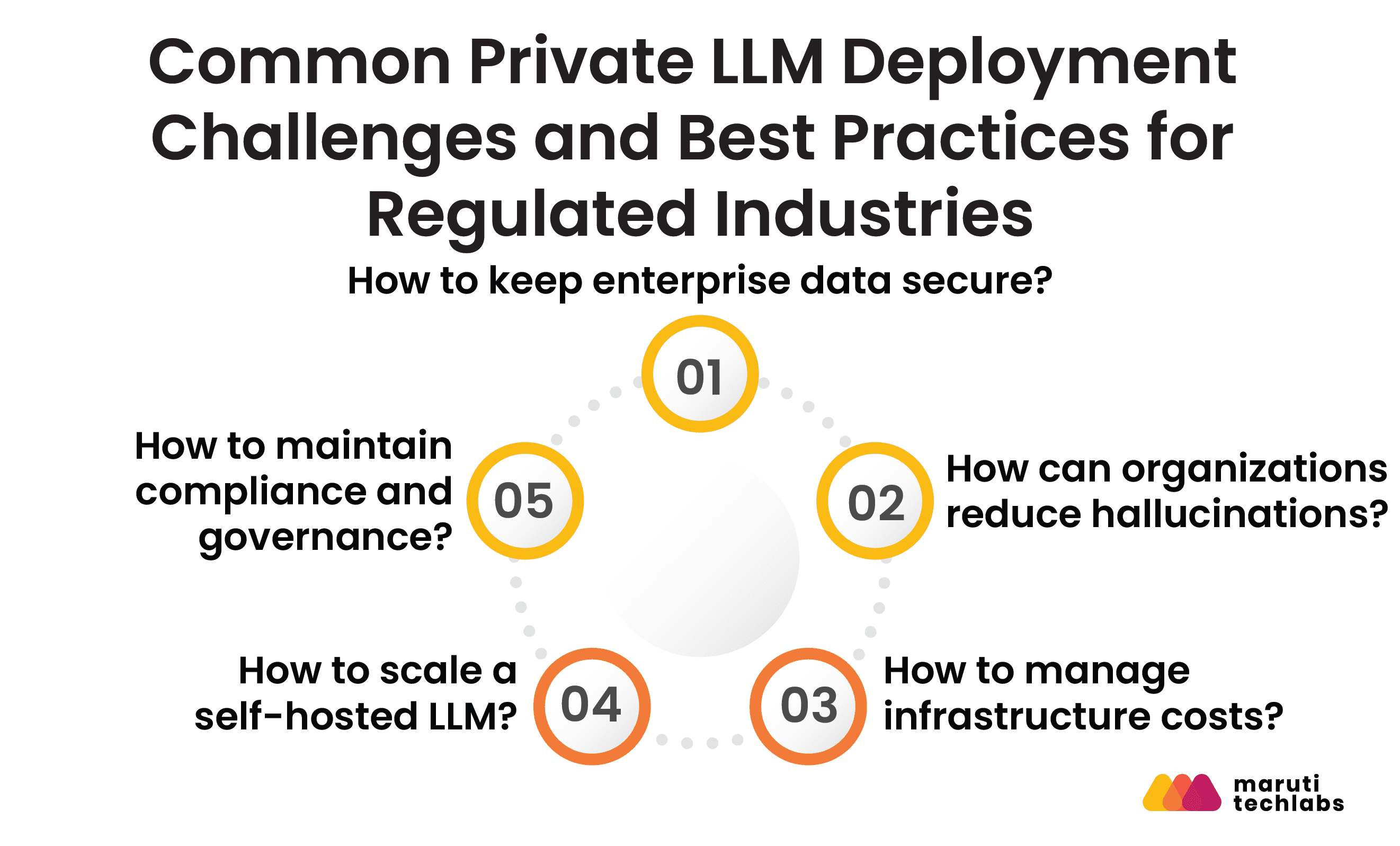
1. How to keep enterprise data secure?
Private LLMs are often adopted because public AI services may not meet the data control requirements of regulated organizations. The challenge is making sure sensitive information remains protected while still allowing employees to use AI for daily workflows.
Best practice: Keep data access controlled throughout the AI workflow:
Organizations typically deploy models in private environments and apply security measures such as encryption, role-based access, and identity-based permissions. Input filtering and prompt injection protection also help prevent unauthorized data exposure when users interact with the model.
2. How can organizations reduce hallucinations?
A private LLM does not automatically know an organization's internal processes, documents, or domain-specific information. Without the right data connections, the model may generate responses that sound correct but lack accurate business context.
Best practice: Ground responses using trusted enterprise data:
RAG allows the model to retrieve relevant information from approved knowledge sources before generating responses. Organizations can improve reliability further through better document preparation, domain-specific customization, and human review for sensitive use cases.
3. How to manage infrastructure costs?
Running a private LLM requires organizations to plan carefully because computing resources can become expensive as usage grows. Larger models may deliver stronger capabilities, but they are not always necessary for every business workflow.
Best practice: Choose infrastructure based on workload requirements:
Organizations can optimize the private LLM costs by selecting appropriate models, improving resource efficiency through techniques like quantization, and using hybrid infrastructure where suitable. This helps balance performance requirements with operational expenses.
4. How to scale a self-hosted LLM?
Self-hosted deployments give organizations more control, but scaling them requires careful management of infrastructure, GPU capacity, and user demand. Increasing adoption can put pressure on systems if the architecture is not designed for higher workloads.
Best practice: Build scalability into the deployment architecture:
Containerization, GPU orchestration, request management, and scalable private cloud environments help handle growing usage. Monitoring resource consumption also helps teams identify when additional capacity is required.
5. How to maintain compliance and governance?
Keeping a private LLM compliant requires knowing what is happening inside the system after it goes live. Organizations need visibility into who is using the model, what data it can access, and how the system changes as teams continue using it.
Best practice: Build tracking into everyday usage:
Teams should record important activities such as user access, model changes, and data interactions. This information helps them review decisions, investigate unexpected results, and provide clear answers when compliance teams need more details.
Conclusion
Adopting a private LLM is not simply a technology decision. For regulated organizations, it is about finding a way to use AI without compromising data security, compliance, or operational control.
The right approach depends on your business goals, existing infrastructure, and the regulations you need to follow. Some organizations may only need a secure RAG-based application, while others may benefit from fine-tuning or a more customized deployment. Taking the time to choose the right architecture early can make future AI initiatives easier to scale and manage.
As enterprise AI continues to evolve, organizations that build on a secure and well-governed foundation will be better prepared for new use cases and changing regulatory requirements. The following case study shows how a legal organization applied enterprise AI to improve day-to-day work while maintaining the security and accuracy expected in a regulated environment.
See How a Leading U.S. Law Firm Scaled Enterprise AI Adoption
A U.S.-based Am Law 200 firm with more than 1,000 attorneys wanted to introduce generative AI across its legal workflows. However, document review remained manual, AI initiatives lacked a clear direction, and processing large legal files was both time-consuming and difficult to scale. The firm partnered with Maruti Techlabs to build a secure AI platform that could support research, drafting, document analysis, and other day-to-day legal work.
Maruti Techlabs developed a custom enterprise AI platform with conversational search, source-grounded retrieval, and workflow-specific AI capabilities tailored to the firm's requirements. The solution reduced document review, legal research, and drafting from several hours to minutes while achieving more than 95% accuracy. It also helped the firm process large legal documents efficiently, reduce manual effort, and establish a clear roadmap for future AI adoption.
The success of enterprise AI depends on building solutions that fit existing workflows, handle sensitive information securely, and support the way teams work. Our AI Development Services help organizations build secure, scalable AI applications that integrate with existing systems and enterprise workflows. Our Generative AI Development Services help businesses develop private LLMs, RAG applications, and other enterprise AI solutions that keep sensitive data protected without limiting innovation.
Talk to our experts about your business goals, security requirements, and deployment plans to build an AI solution that fits your environment.
FAQs
1. How can I use an LLM with my company's private data?
Most organizations don't upload sensitive information to public AI tools. Instead, they deploy a private LLM and connect it to approved internal documents, databases, and knowledge repositories. This allows employees to work with company information while keeping access, security, and governance under the organization's control.
2. Do I need to train an LLM on my company's data?
Not necessarily. Most businesses start with an existing foundation model and customize it using techniques such as Retrieval-Augmented Generation (RAG), fine-tuning, or prompt engineering. The right approach depends on the use case, the quality of available data, and the level of customization required.
3. How do I choose between RAG and fine-tuning?
RAG works well when the model needs to retrieve up-to-date information from company documents without changing the model itself. Fine-tuning is a better option when the model needs to learn domain-specific language, writing styles, or specialized tasks. Many organizations use both approaches together.
4. Does a private LLM need to be built from scratch?
No. Most organizations begin with an open-weight foundation model such as Llama, Mistral, or Qwen instead of building a new model from scratch. They then customize it to fit their business processes, enterprise data, and security requirements.
5. Where should a private LLM be deployed?
The right deployment environment depends on business and regulatory requirements. Some organizations choose on-premises infrastructure, while others use a private cloud, virtual private cloud (VPC), hybrid environment, or air-gapped deployment based on their security and operational needs.
6. How do I know if my organization needs a private LLM?
A private LLM is worth considering when AI needs to work with confidential business information, customer data, intellectual property, or regulated records. Organizations in legal, healthcare, banking, insurance, and the public sector often choose private deployments because they need greater control over how enterprise data is accessed and used.