

A Practical Framework for Human-in-the-Loop Clinical AI
Key Takeaways
- Human oversight belongs at the decision point where an error becomes irreversible.
- A risk-tiered framework (verification, augmentation, human-in-command) matches review depth to clinical stakes.
- Enforcement patterns like interrupt hooks, per-tool logic, and async or real-time approval make checkpoints impossible to skip.
- Rubber-stamping, alert fatigue, and undefined reviewer-unavailability behavior are engineering problems, not clinician failures.
- A defensible audit log needs model version, policy version, reviewer identity, timestamps, and stated rationale, logged independently of the system it monitors.
- Building this well requires agentic architecture, compliance-grade logging, and graduated autonomy working together, whether built in-house or with outside expertise.
Introduction
If your team is building AI into a clinical decision support system right now, the pressure is coming from two directions at once. Leadership wants the system shipped before a competitor gets there first. Compliance keeps asking what happens when the model gets it wrong, and a patient is on the other end of that mistake.
A June 2026 study in JAMA Network Open reviewed 903 FDA-authorized AI-enabled medical devices and found that 43 of them, close to 5 percent, were later recalled. The leading cause was not an exotic model failure. It was the device being used outside the boundaries it was actually validated for.
Meanwhile, the FDA's January 2026 guidance loosened oversight for many clinical decision support tools, transitioning more of that responsibility onto the engineering team building healthcare AI services.
Most teams respond by adding a review step and calling it human oversight, and that rarely survives contact with real clinicians under real-time pressure.
This guide covers exactly that: where human review belongs, what happens when a reviewer disagrees with the model, and how to prove that oversight was real.

Where Human Oversight Actually Belongs in a Clinical AI Pipeline?
Most teams treat "human in the loop" as a single design decision, applied once, somewhere near the end of the pipeline. That alignment is the root of most failed implementations.
A clinical AI system moves through several distinct decision points before it reaches a patient, and each one carries a different level of risk. Oversight needs to be placed where an error becomes irreversible, not where inserting a review is operationally convenient.
Four decision points in a clinical AI pipeline and where oversight actually matters
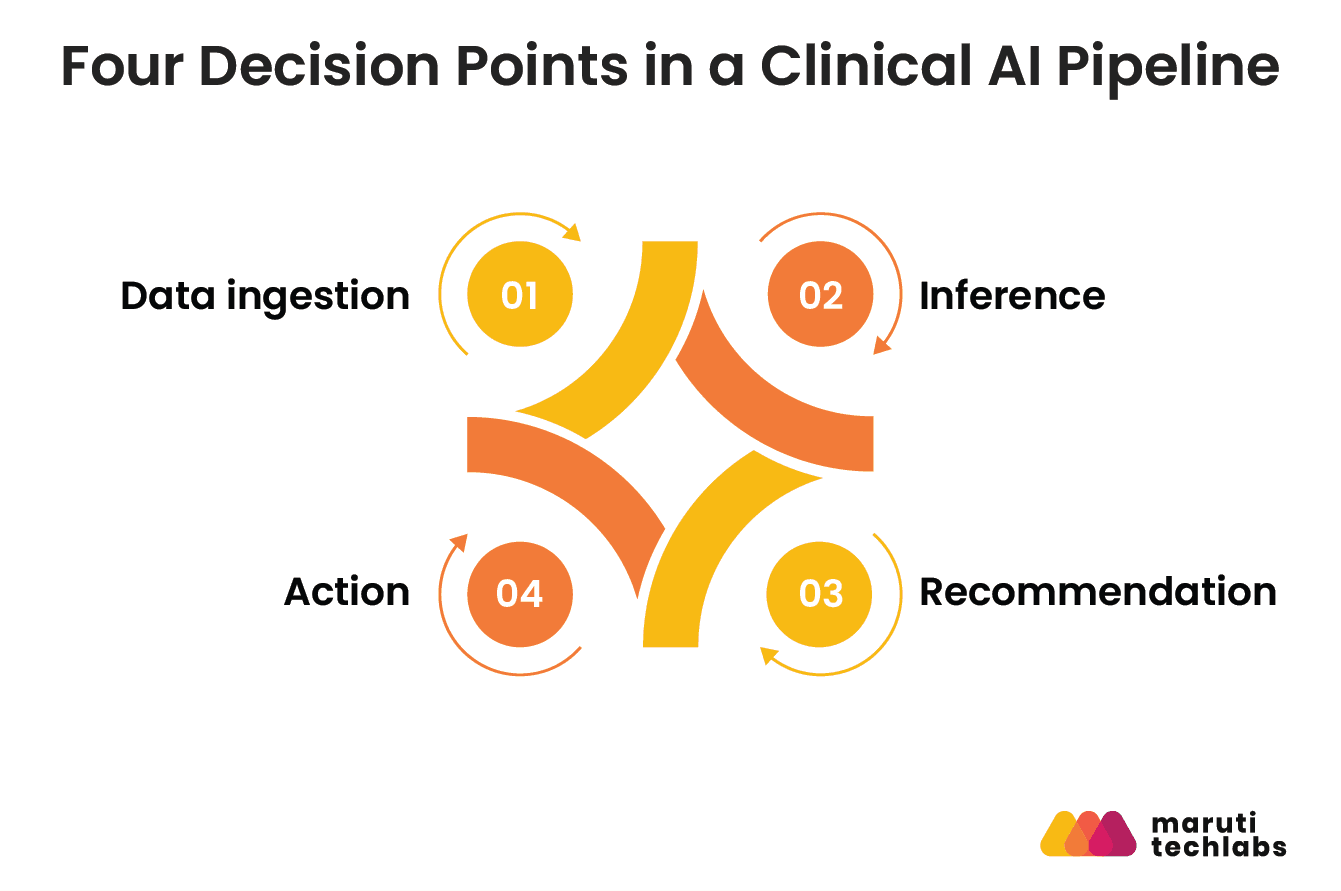
1. Data ingestion
This stage defines the factual boundary of the system. Whatever enters here becomes the basis for every downstream decision the model makes.
A stale medication list or a missing allergy flag introduced at this point propagates silently across outputs. These errors are the least visible but the cheapest to correct, which is why they are often overlooked.
2. Inference
At this stage, the model translates input data into predictions or recommendations that will later influence clinical judgment. It is the point most teams associate with “the AI” itself.
Review here can intercept flawed reasoning before it is formalized into advice, but it only works if the system can expose how the output was derived, not just what it produced.
3. Recommendation
Here, the model’s output is contextualized and presented to the clinician as a score, rank, or alert that shapes decision-making. The risk shifts from correctness to interpretation.
Oversight at this layer must evaluate whether the output is framed in a way that encourages critical evaluation. Poor presentation increases automation bias, even when the underlying prediction is technically sound.
4. Action
This is the point where the system’s output translates into real clinical intervention, such as ordering treatment, adjusting dosage, or initiating discharge. The consequence is no longer theoretical.
A checkpoint placed here identifies errors only after they have influenced care. In scenarios where actions are irreversible, this stage is too late for meaningful intervention.
Why this sequencing matters
- Placing the human checkpoint at inference or recommendation catches an error before it becomes consequential.
- Placing it at action means oversight exists on paper but arrives too late to change the outcome.
- The JAMA Network Open recall analysis points to exactly this gap. Devices were not failing at the model level. They were being used past the boundary of what they were validated to do, which is a decision-point problem rather than an accuracy problem.
Human-in-the-loop v/s Human-on-the-loop
- Human-in-the-loop means the system cannot act until a person approves that specific output.
- Right fit for high-risk, low-volume decisions where every case needs individual sign-off.
- Right fit for high-risk, low-volume decisions where every case needs individual sign-off.
- Human-on-the-loop means the system acts autonomously, and a person supervises the pattern of behavior, intervening only when something looks wrong.
- Right fit for high-volume, lower-risk decisions where per-case review would be a bottleneck rather than a safeguard.
- Right fit for high-volume, lower-risk decisions where per-case review would be a bottleneck rather than a safeguard.
- Both are legitimate architectures. Neither is a default. Choosing between them by convenience instead of by risk tier is how oversight ends up decorative instead of functional.
The actual question to answer for every clinical AI decision
- Which of the four decision points does the human sit at?
- Can that person actually stop the action in question before it happens, not just log a disagreement after?
- Does that placement match the clinical stakes of what the model is doing?
How Do You Build a Risk-Tiering Framework for Clinical AI?
Once oversight is placed at the right decision point, the next question is how much oversight a given decision actually needs. Treating every AI output with the same level of scrutiny wastes review capacity on low-risk cases and starves the genuinely dangerous ones of attention.
The fix is a risk tier that maps directly to the clinical stakes of the decision, not to how the engineering team happened to build the pipeline.
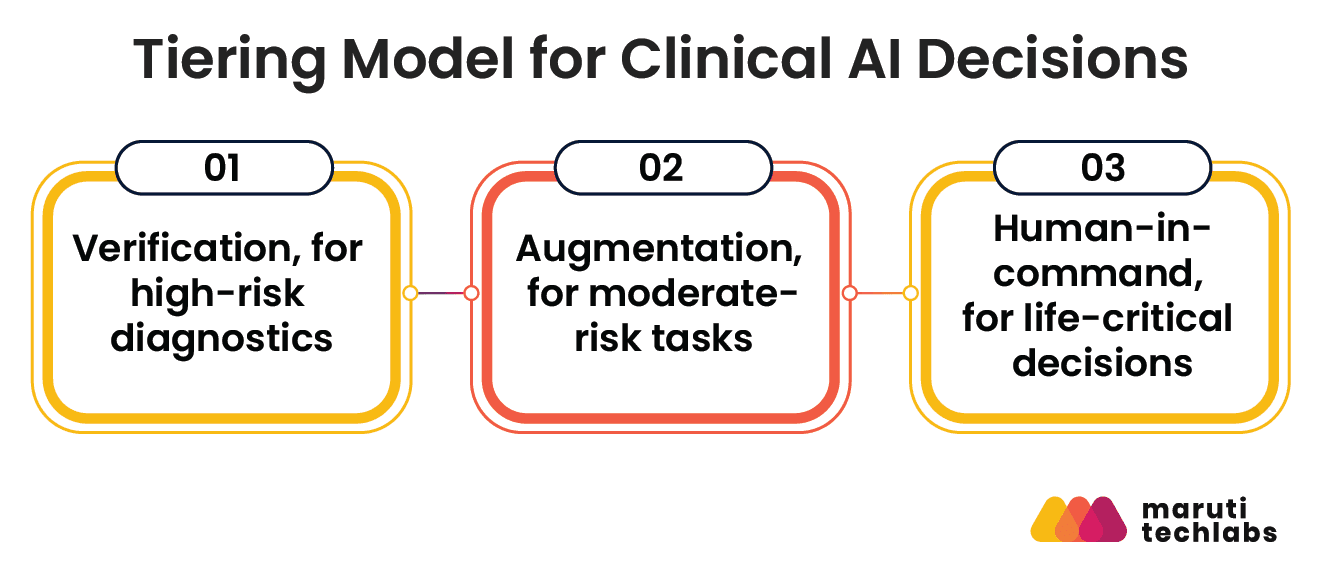
Tier 1 - Verification, for high-risk diagnostics
- Applies to radiology, pathology, and any case where a wrong output directly changes a treatment path.
- Every AI recommendation gets reviewed before it reaches the patient record. No exceptions, no confidence-based bypass.
- This tier accepts slower throughput as the cost of catching errors that would otherwise be irreversible.
Tier 2 - Augmentation, for moderate-risk tasks
- Applies to patient triage, risk scoring, and similar decisions where the AI assists but does not make the final call.
- The clinician sees the AI output alongside their own judgment rather than as a replacement for it.
- This is also where placement inside the workflow matters most. Clinicians who review AI output at the same time as forming their own judgment get better results than clinicians who form a judgment first and check the AI second.
Tier 3 - Human-in-command, for life-critical decisions
- Applies to ICU management, surgical planning, and any context where the consequences of an error are immediate and severe.
- The clinician retains full control. The AI provides information and options, never a default action.
- Speed is not the priority here. Getting the decision right is.
What decides which tier a use case falls into
- Reversibility - Can a wrong output be caught and corrected before it affects the patient, or is the action final the moment it happens?
- Ambiguity - Does the case sit inside the AI's training distribution, or does it involve rare presentations, conflicting data, or incomplete history?
- Regulatory Exposure - The FDA's 2026 guidance and the EU AI Act's Article 14 both put the burden of proving appropriate human oversight on the deploying organization, not on the model's stated accuracy.
- Clinician Expertise on the Receiving End - The same AI assistance produces different results depending on who is reviewing it, with less experienced clinicians benefiting more than senior ones. A tier built around a junior-heavy team may need tighter review than one built around senior specialists.
Why this framework has to be explicit, not implicit
- An undocumented risk tier means the tier was decided by whoever built the pipeline, under whatever time pressure existed that sprint, not by a deliberate risk assessment.
- A documented tier gives compliance something concrete to audit and gives engineering a clear target to build against, instead of a vague instruction to "add human oversight."
- The tier also determines which architecture pattern fits, which is the subject of the next section.
Architecture Patterns for Enforcing the Loop (Not Just Requesting It)
A risk tier only matters if the system actually enforces it. Telling an AI agent to "ask for approval" is an instruction, not a constraint, and instructions get skipped under load, misconfigured, or quietly bypassed by a well-meaning engineer trying to unblock a demo.
The patterns below are ways to make the checkpoint structurally impossible to skip, not just documented as a best practice.
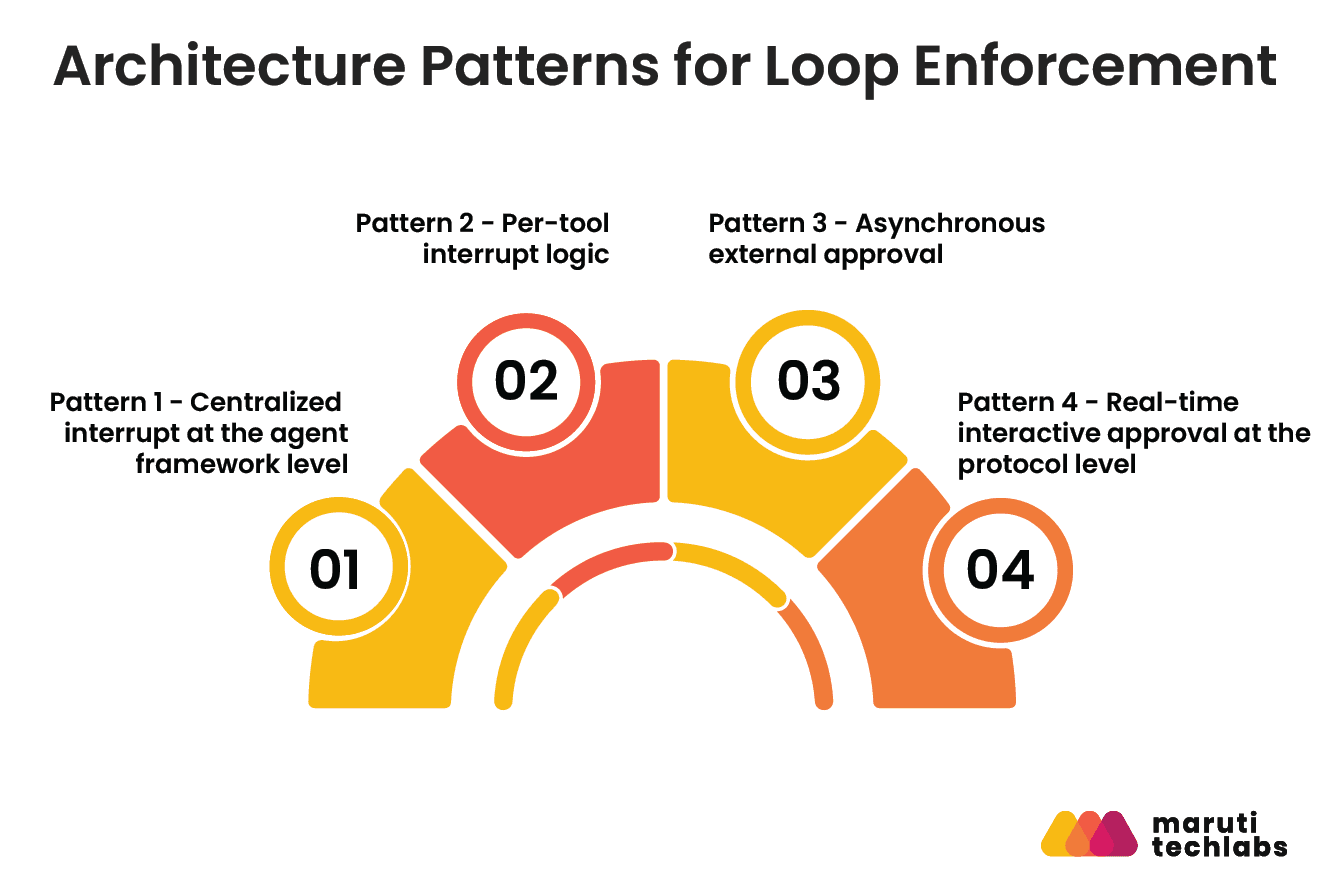
Pattern 1 - Centralized interrupt at the agent framework level
- A hook or middleware layer intercepts every sensitive tool call before it executes, regardless of which part of the codebase triggered it.
- Tools themselves stay unaware of the approval logic, which means new tools inherit the safeguard automatically instead of needing it re-implemented each time.
- Best fit for Tier 1 decisions where the same blanket rule needs to apply across many different actions.
Pattern 2 - Per-tool interrupt logic
- Approval logic lives inside the specific tool rather than in a shared layer, so each tool can enforce its own rule based on context like user role or patient sensitivity.
- More flexible than a centralized hook, at the cost of needing to maintain consistency across every tool individually.
- Best fit for Tier 2 decisions where different actions carry meaningfully different approval requirements.
Pattern 3 - Asynchronous external approval
- Used when the approver is not the person operating the system in real time, for example a supervising physician signing off on a discharge initiated by someone else.
- The workflow continues without blocking, sends the approval request out to the right person, and resumes once a decision comes back.
- Keeps a complete, timestamped record of who was asked, when, and what they decided, which matters as much for the audit trail as for the approval itself.
Pattern 4 - Real-time interactive approval at the protocol level
- The system pauses mid-action and prompts the person directly, waiting on a live response before proceeding.
- Keeps the approval logic entirely at the protocol layer, so the core system does not need to know in advance which actions will require sign-off.
- Best fit for Tier 3 decisions where a person needs to weigh in on the specific situation as it unfolds, not on a general policy.
What separates enforcement from a request
- A "Safety Kernel" design blocks the recommendation from reaching anyone until a clinician has actively validated it, rather than surfacing it and hoping someone reviews it before acting.
- The test for whether a pattern is enforcement or a request: can the action proceed if the human simply does nothing? If yes, it is a request. If not, it is enforcement.
- Every pattern above should default to blocking, not defaulting to proceed, when the reviewer is unavailable, disagrees, or times out. What that default behavior should actually be is the subject of the next section.
What Are the Biggest Failure Modes in Human-in-the-Loop AI?
Every pattern in the last section assumes the human actually engages with what they're reviewing. That assumption breaks down faster than most teams expect, and the failure is rarely dramatic.
It looks like a clinician clicking approve on the fortieth alert of the shift without reading it, or a system that has no defined behavior for the moment a reviewer disagrees with the model. These are design problems, not clinician-competence problems, and they need engineering solutions.
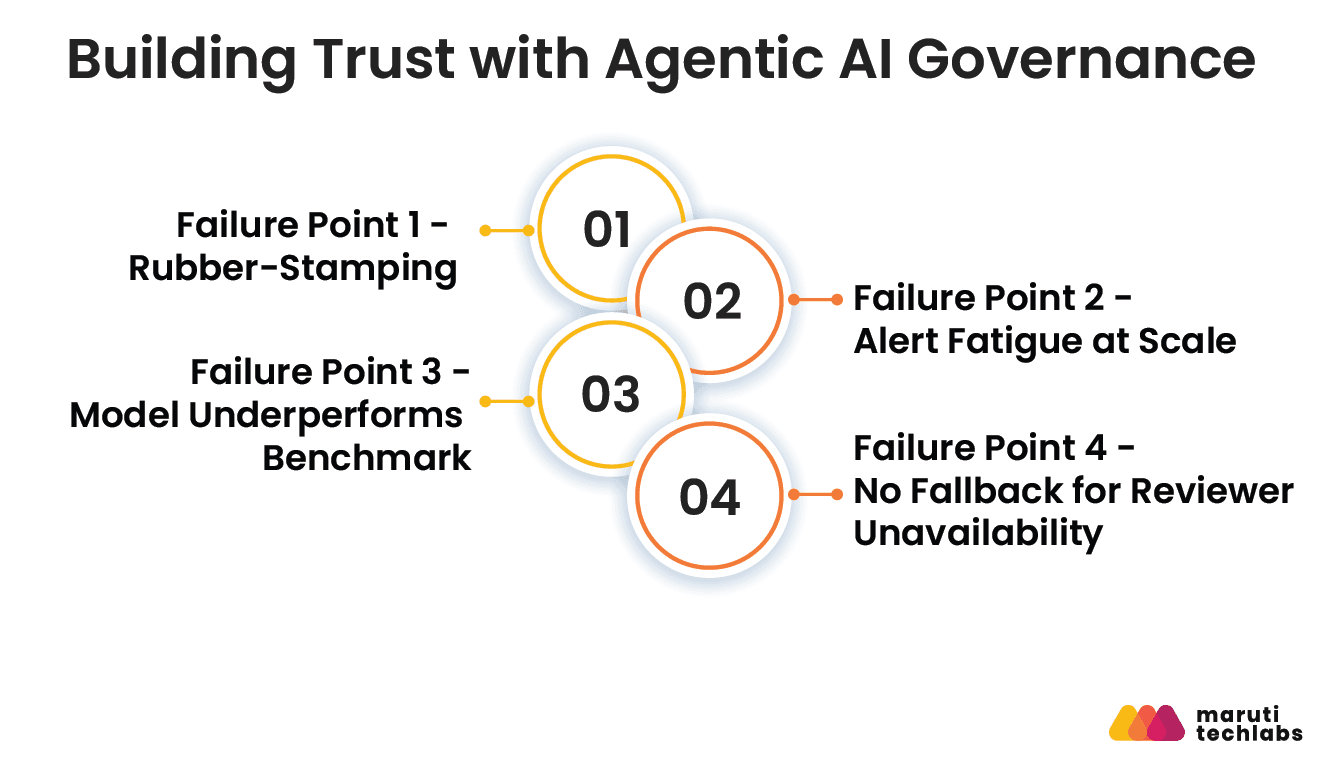
Failure Point 1 - Rubber-Stamping
The challenge
- Review volume outpaces a person's actual capacity to evaluate each case, so approval becomes a formality rather than a judgment.
- A binary accept-or-reject button makes this worse, since it asks for a decision without asking for engagement with the reasoning behind it.
The fix
- Replace blanket review with exception-based review, so routine outputs proceed automatically and only genuine deviations reach a person.
- Require a brief written rationale for agreement or disagreement, rather than a single click.
- Use confidence-gradient visual cues instead of a flat list, so attention goes where the model is least certain.
Failure Point 2 - Alert Fatigue at Scale
The challenge
- High volumes of low-value alerts train reviewers to triage by speed rather than accuracy, which quietly erodes the entire point of the checkpoint.
- Once triage-by-speed becomes the norm, the checkpoint stops catching the cases it was built to catch.
The fix
- Use threshold-based routing, where high-confidence outputs proceed without review and only low-confidence outputs escalate.
- Run periodic calibration sessions where reviewers independently assess the same cases, which surfaces disagreement and measures whether the review process itself is still reliable.
Failure Point 3 - The Model Behaving Worse Than Its Benchmark Suggests
The challenge
- A 2026 evaluation found one widely used model's diagnostic accuracy dropped from 95.0 percent to 32.5 percent once relevant information became sparse in the input, a gap invisible in a clean benchmark test.
- This is a preprint and hasn't been peer-reviewed yet, but it shows a consistent pattern: strong performance on clean, curated cases and weaker performance on messy real-world data.
- The same evaluation found the model approved close to half of outputs that were later confirmed clinically incorrect when it was asked to judge its own reasoning. A model cannot be trusted as its own safety check.
The fix
- Test against messy, information-sparse cases before deployment, not just against clean benchmark data.
- Keep the review function outside the system generating the output. Never let the same model grade its own reasoning.
Failure Point 4 - No Defined Behavior for Reviewer Unavailability or Disagreement
The challenge
- Most HITL designs specify what happens when a reviewer approves. Far fewer specify what happens when a reviewer is unreachable, runs out of time, or actively disagrees with the model under pressure.
- A system without a default here defaults to the worst possible answer by accident, either blocking indefinitely in a time-sensitive scenario or proceeding without approval because no one built the timeout logic.
The fix
- Define, explicitly, what happens at each branch (timeout, disagreement, unavailability) before the system goes live, not after the first incident forces the question.
- Set the default to the safer failure state for the clinical context, which is usually blocking rather than proceeding, and document that choice as a deliberate decision rather than a leftover default.
What Should a Compliance-Ready AI Audit Log Include?
A human checkpoint that leaves no record might as well not have happened, at least from a regulatory or legal standpoint. If a treatment decision is ever questioned, the organization needs to show, on record, who reviewed what, when, and why they approved or overrode it.
Most teams treat logging as an engineering afterthought. It needs to be treated as a specification, built before the system goes live, not patched in after an auditor asks for it.
What a defensible decision log actually needs to capture
- The specific model version that generated the output, since a fix shipped next month doesn't help defend a decision made today.
- The policy version in effect at the time, since risk tiers and approval rules change over time and the log needs to reflect what applied in that moment.
- The reviewer's identity and role, not just a system user ID that could belong to anyone with those credentials.
- A timestamp for every stage: the moment the output was generated, the moment it reached a reviewer, and the moment a decision was made, since the gap between these tells you whether the review was meaningful or rushed.
- The reviewer's stated rationale, particularly for any override or disagreement, since a bare approve or reject gives an auditor nothing to evaluate later.
Mapping the log to actual regulatory requirements
- The FDA's January 2026 guidance and the EU AI Act's Article 14 place the burden of proving human oversight on the deploying organization. The log must demonstrate that oversight was real, not just that a review step existed somewhere in the workflow.
- Software-as-a-medical-device frameworks expect traceability from input to output to action, which means the log needs to connect all three, not just record the final decision in isolation.
- The leading cause of device recalls has been the use of AI devices outside their validated boundaries, rather than model errors. The log should explicitly capture whether a given case fell inside or outside the system's validated scope, not only whether the output itself looked correct.
Keeping the governance layer independent of the model it monitors
- A dashboard that pulls its data from the same pipeline it is meant to oversee can be silently blinded by whatever caused the underlying failure.
- The AI governance layer should read from an independent log store, with write access that the AI system itself cannot alter after the fact.
- Access to that log should be role-gated, so a reviewer can see their own decisions, but modifying historical entries requires a separate, audited permission.
How Do You Scale Human Oversight from Pilot to Production?
A risk tier, an enforced architecture pattern, and a solid audit trail solve the design problem. They don't solve what happens six months later, when the same review capacity that worked for a hundred cases a day has to somehow work for ten thousand.
Scaling a clinical AI system without scaling the human bottleneck alongside it is a distinct engineering problem, and it needs to be planned for from the pilot stage, not discovered during it.
Starting in shadow mode, before any output touches a decision
- The system runs and generates recommendations, but nothing it produces reaches a clinical decision or a patient record yet.
- This stage exists to measure things that only show up under real data volume, alert quality, false positive rates, and how often clinicians would have agreed with the output if it had been live.
- Skipping this stage to move faster is exactly how a device ends up deployed past the boundary it was actually validated for, which remains the leading cause of AI medical device recalls according to the JAMA Network Open analysis.
Graduated autonomy, tied to evidence rather than to a launch date
- Autonomy should expand in stages, moving from full review of every output, to review of only flagged exceptions, to autonomous operation with periodic audit sampling.
- Each stage should require a defined amount of demonstrated reliability before advancing to the next, not a calendar deadline.
- Moving stages based on a release schedule rather than performance evidence reintroduces the exact risk shadow mode was meant to catch.
Treating the confidence threshold as an ongoing operational setting, not a one-time configuration
- The threshold that decides which outputs escalate to a human should be revisited on a schedule, using real outcome data, not adjusted reactively whenever review queues get long.
- Raising the threshold to reduce reviewer workload without evidence that accuracy holds at the new setting quietly trades safety for throughput.
- This is a decision worth documenting the same way the risk tier itself is documented, since it is just as consequential.
Recognizing when the in-house team needs outside architecture expertise
- Building the four enforcement patterns from Section 3, a compliance-grade logging layer, and a graduated autonomy pipeline is a meaningfully different scope of work than building the underlying model or integrating it into an EHR.
- Teams that are strong on the clinical model itself often don't have this specific architecture experience in-house, and that gap tends to surface only after the pilot stage, when scaling exposes it.
- Bringing in outside engineering expertise at this stage is not a sign the internal team failed. It's a recognition that oversight architecture is its own discipline, one that determines whether the system that worked in the pilot still holds up in production.
The actual measure of success
A clinical AI system is ready to scale when its oversight architecture can answer, with evidence, three questions at once.
- Where does the human sit in this pipeline?
- What happens when they disagree or aren't available? And
- Can the organization prove, on record, that all of it held up the way it was designed to?
Building Clinical AI That Holds Up Under Scrutiny
A clinical AI system is not made safe by the model underneath it. It is made safe by the architecture around it, where a human stands between an output and a patient, the enforcement pattern that makes that checkpoint impossible to skip, and the record that proves it held up. None of this is a one-time build.
A risk tier that worked at pilot scale needs revisiting as volume climbs. A reviewer handling fifty cases a day will start rubber-stamping at five hundred unless the system prevents it. An audit trail that satisfies an internal review must also hold up against a regulator who was not in the room.
Getting this right requires deciding where human review belongs in the pipeline and defining what happens if the reviewer is wrong, unavailable, or disagrees with the AI, whether you build the system in-house or work with an experienced partner. The standard either way is the same. Oversight that can be proven, not just claimed.
How Maruti Techlabs Accelerated Healthcare Record Processing by 87% for a UK Healthcare Provider
Maruti Techlabs partnered with UKHealth, one of the largest healthcare service providers in the UK, managing thousands of hospitals, multispecialty clinics, diagnostic centers, and pharmacies, to solve a data processing bottleneck that was slowing down patient record management at scale.
UKHealth's doctors generated a massive daily volume of discharge, referral, and follow-up letters across every facility. Data teams had to manually read, classify, and update each letter into the correct category before it could be entered into the central Hospital Information Management System (HIMS).
Maruti Techlabs built a machine learning solution combining Optical Character Recognition (OCR) and Natural Language Processing (NLP). The team used OCR to scan and digitize physical letters into structured text, then applied an NLP model trained to recognize context-specific phrases and classify each letter as a Discharge, Follow-up, or Referral.
The model was integrated directly with UKHealth's central HIMS so classified records updated automatically, and the team ran supervised training over six months to raise the model's confidence score from 80% to 85%.
The Impact
- Diagnosis letter processing time dropped by 87%
- Patient data management accuracy increased to 93%
- Data became easier to maintain and visualize for downstream decision-making
- Hospitals reduced their data assessment and classification teams from 12 people to just 2 per hospital
- The solution scaled reliably across thousands of hospitals and clinics instead of relying on manual, facility-by-facility processing
Our highly experienced AI team works closely from defining the risk tier to deployment and ongoing tuning. With our AI Development service, organizations can build and scale AI systems with oversight architecture built in from the start.
Our AI Strategy and Readiness service helps assess where an organization actually stands first, so the right level of human review gets designed in before deployment rather than added on after an incident.
FAQs
1) What is human-in-the-loop AI in clinical decision support?
Human-in-the-loop AI in clinical decision support is a system design where a clinician actively reviews and approves an AI-generated recommendation before it can affect a patient, rather than the AI acting autonomously. The defining feature is that the system cannot proceed to action without that human approval.
2) How is human-in-the-loop different from human-on-the-loop?
Human-in-the-loop requires a person to approve every individual output before the system acts, which fits high-risk, lower-volume decisions like a specific diagnostic recommendation.
Human-on-the-loop lets the system act autonomously while a person supervises the overall pattern of behavior and intervenes only when something looks wrong, which fits high-volume, lower-risk decisions where per-case approval would create a bottleneck.
3) Where should the human checkpoint sit in an AI pipeline?
The checkpoint should sit as early as possible, ideally at inference or recommendation, before the model's output has been framed as advice or triggered an action. A checkpoint placed after the action has already occurred can only catch an error after the fact, which defeats its purpose for any irreversible clinical decision.
4) How do you prevent clinicians from rubber-stamping AI recommendations?
Rubber-stamping is usually a volume problem, not an attention problem. Effective fixes include exception-based review, where only genuine deviations reach a person instead of every output. Require a short written rationale rather than a single click. Use confidence-based visual cues so attention goes to the cases where the model is least certain.
5) What should a system do if a reviewer disagrees with the AI or is unavailable?
This needs to be defined explicitly before deployment, not discovered during an incident. The safer default in most clinical contexts is to block the action rather than let it proceed, and this default should be documented as a deliberate decision tied to the risk tier of the use case, not left as an unhandled edge case.
6) What does a compliant audit log need to include?
At minimum, capture the model version that generated the output and the policy or risk-tier version in effect at the time. Record the identity and role of the reviewer. Include timestamps for generation, review, and decision, along with the reviewer’s stated rationale for any override or disagreement.
Regulatory frameworks, including the EU AI Act's Article 14, place the burden of proving oversight was real on the deploying organization, which makes this log a compliance requirement, not just good engineering practice.