A Practical Guide to Healthcare Data Security in 2026
A simple guide to healthcare data security trends, risks, and compliance in 2026.
Cybersecurity
A Practical Guide to Healthcare Data Security in 2026
A simple guide to healthcare data security trends, risks, and compliance in 2026.
Table of contents
Table of contents
Key Takeaways
Introduction
What Is Healthcare Data Security
The Importance of Data Security in Healthcare
5 Major Healthcare Security Breaches in Recent Years
8 Major Risks and Threats to Healthcare Data Security in 2026
Healthcare Data Security Trends to Watch in 2026
Healthcare Data Security Regulations and Compliance in 2026
6 Healthcare Data Security Best Practices
Conclusion
Why Maruti Techlabs
FAQs
Key Takeaways
Healthcare data security protects sensitive patient information and is essential for safe care and trust.
Cyber threats can disrupt operations, delay treatments, and impact patient outcomes.
Common risks include ransomware, phishing, outdated systems, and poor access control.
Strong practices like access control, encryption, and backups help reduce security gaps.
A practical approach focused on risks, compliance, and real needs helps organizations stay secure.
Introduction
Healthcare organizations are seeing a steady rise in cyberattacks, with hospitals and clinics becoming frequent targets. They manage large volumes of sensitive patient data, which makes them highly valuable to cybercriminals. As a result, security risks continue to grow across the industry.
This shift has made cybersecurity a core priority, not just an IT responsibility. Security gaps can impact patient safety, delay treatments, and disrupt critical healthcare operations. It also affects how much trust patients place in healthcare providers.
Recent data shows a short-term improvement, but the overall risk remains high. Between September 2025 and January 2026, around 7.2 million individuals were affected by breaches. At the same time, large incidents involving third parties continue to expose millions of records.
The financial impact also remains significant, with healthcare breaches being the most expensive across industries.
In this blog, we explain what healthcare data security means, key risks to watch, and how organizations can stay secure and compliant in 2026.
What Is Healthcare Data Security
Healthcare data security is about keeping sensitive medical information safe from unauthorized access, loss, or misuse. This includes patient records, test results, and other health data. It ensures that only the right people can access this information when needed.
It also focuses on keeping data accurate and available at all times. If data is changed, lost, or unavailable, it can affect patient care and decision-making. That’s why both security and reliability are important.
There are a few key parts to it. Patient data protection keeps personal details like medical history and treatment plans private. Medical data protection secures clinical information such as lab results and scans.
Healthcare information protection takes a broader view. It ensures all data, including electronic health records, is protected while being stored, shared, or accessed across systems.
The Importance of Data Security in Healthcare
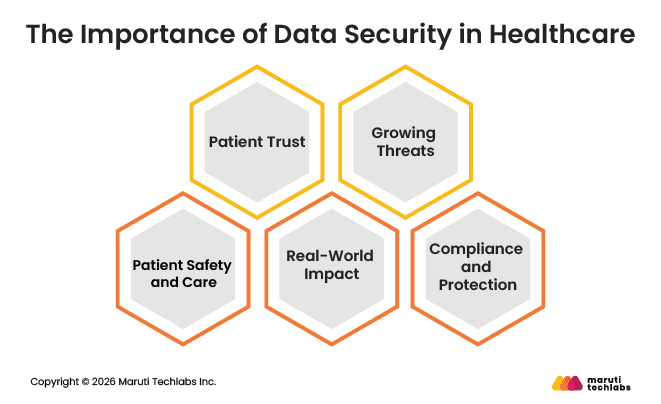
Healthcare data security is important because it directly affects patient safety, trust, and care delivery, while also ensuring smooth operations and reducing the risk of costly disruptions.
Patient safety and care: Security failures can delay treatments and disrupt hospital operations. Ransomware attacks can lock systems or even force ambulances to be diverted.
Patient trust: If patients feel their data is not safe, they may avoid sharing important information. This can impact diagnosis and treatment decisions.
Real-world impact: Recent breaches and ransomware attacks have exposed millions of records and disrupted services, showing that even large providers are vulnerable.
Growing threats: Risks like phishing, insider misuse, and insecure medical devices continue to increase across healthcare systems.
Compliance and protection: Strong security helps prevent breaches, ensures regulatory compliance, and protects both patients and healthcare organizations.
Overall, strong healthcare data security helps prevent breaches, ensures compliance with regulations, and protects both patients and healthcare organizations.
5 Major Healthcare Security Breaches in Recent Years
Major healthcare security breaches have increased in recent years, driven by ransomware and system vulnerabilities. Incidents like the 2026 Stryker attack, the Bell Ambulance breach affecting 238,000 individuals, the UMMC ransomware disruption, and 2025 breaches at Aflac (13 million individuals) and Yale New Haven (5.5 million people) highlight the urgent need for stronger data security.
1. Stryker (March 2026):A cyberattack on this medical device company disrupted parts of the U.S. healthcare supply chain, affecting the availability of critical systems and services.
Why it happened: The attack likely exploited system vulnerabilities or weaknesses in third-party vendor connections, which are common entry points in large healthcare ecosystems.
Impact and loss: The disruption raised concerns about delays in essential surgeries like hip and knee replacements. It showed how cyberattacks can go beyond data breaches and directly affect patient care and medical operations.
2. Bell Ambulance (March 2026): This breach affected around 238,000 individuals after unauthorized access to internal systems exposed sensitive personal information.
Why it happened: The incident was likely caused by gaps in internal security controls or repeated weaknesses in system protection, as the organization has faced similar issues before.
Impact and loss: Sensitive data such as names, Social Security numbers, and driver’s license details was exposed. This increased the risk of identity theft and raised concerns about ongoing security practices within the organization.
3. University of Mississippi Medical Center (February 2026): A ransomware attack forced systems offline for more than a week, significantly disrupting hospital operations.
Why it happened: The attack likely entered through phishing emails or unpatched system vulnerabilities, which are common in large healthcare environments.
Impact and loss: Clinics had to temporarily shut down, delaying treatments and patient services. The incident caused major operational disruption and showed how ransomware can bring healthcare systems to a standstill.
4. Aflac (2025): One of the largest breaches of the year, impacting around 13 million individuals through unauthorized system access.
Why it happened: The breach likely involved compromised credentials or weaknesses in access controls, allowing attackers to gain entry into sensitive systems.
Impact and loss: A large volume of customer data was exposed, creating financial, legal, and reputational risks. It also highlighted how even well-established organizations remain vulnerable to cyber threats.
5. Yale New Haven Health System (2025): This breach exposed data of more than 5.5 million individuals after attackers accessed internal healthcare systems.
Why it happened: The attack likely took advantage of system vulnerabilities or gaps in monitoring and access controls.
Impact and loss: Compromised data included personal and medical information. The breach affected patient trust and showed the long-term compliance and reputational risks healthcare providers face after such incidents.
8 Major Risks and Threats to Healthcare Data Security in 2026
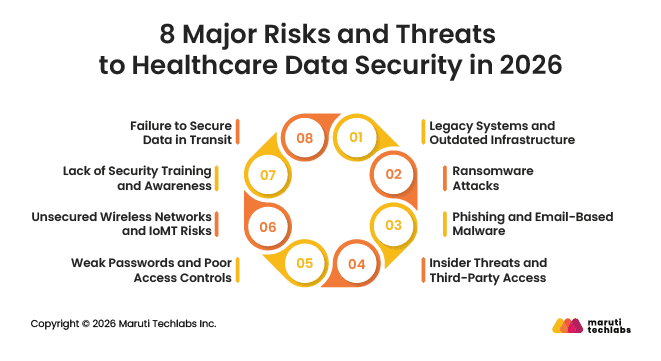
In 2026, healthcare data security faces multiple risks, from ransomware and phishing attacks to insider threats and weak access controls. Challenges like outdated systems, unsecured networks, and connected medical devices further increase vulnerabilities. Together, these risks make healthcare a prime target for cyberattacks, impacting patient care, operations, and data privacy.
1. Legacy Systems and Outdated Infrastructure
Modernizing legacy systems is essential to reducing vulnerabilities and maintaining resilient, secure healthcare operations.
Many healthcare providers still rely on old systems that no longer receive updates. Without proper legacy system modernization, these systems continue to run with known security gaps.
Why this is a challenge:
Outdated systems are easier for attackers to exploit. They also make it harder to detect threats and recover data quickly, increasing the risk of long-term damage.
2. Ransomware Attacks
Preventing ransomware is critical to ensure patient care continuity and protect sensitive healthcare data.
Ransomware is a type of attack where hackers lock systems or data and demand payment to restore access.
Why this is a challenge:
It can shut down hospital systems, delay treatments, and disrupt critical services. In many cases, organizations are forced to choose between paying and losing access to important data.
3. Phishing and Email-Based Malware
Cybercriminals exploit staff to gain system access, risking data loss and operational disruption.
Attackers send fake emails that look real to trick staff into clicking links or downloading harmful files.
Why this is a challenge:
Once inside, malware can spread across systems, steal data, or give attackers full access to networks.
4. Insider Threats and Third-Party Access
Access by employees, contractors, and vendors creates potential exposure points for sensitive healthcare data.
Healthcare systems rely on employees, contractors, and external vendors for daily operations. While necessary, this wide access increases the risk that sensitive data could be mishandled or compromised across multiple touchpoints.
Why this is a challenge:
If any of these accounts are misused, hacked, or poorly managed, it can lead to data leaks. Even unintentional actions, like accessing the wrong records or sharing data incorrectly, can result in serious breaches.
5. Weak Passwords and Poor Access Controls
Weak or reused passwords make healthcare systems easy targets for attackers.
Many healthcare systems still rely on basic password protection or shared login credentials. In some cases, access is not limited based on roles or responsibilities.
Why this is a challenge:
Weak or reused passwords are easy for attackers to crack or steal. Without proper access controls, even a single compromised account can give attackers broad access to sensitive systems and data.
6. Unsecured Wireless Networks and IoMT Risks
Open networks and unsecured devices increase attack points for hackers.
Hospitals often provide open or lightly secured Wi-Fi networks for staff, patients, and visitors. At the same time, connected medical devices like monitors and pumps are added to these networks.
Why this is a challenge:
Unsecured networks can be easily targeted by attackers to gain access. Once inside, they may move across systems or even interfere with connected medical devices, creating both data and patient safety risks.
7. Lack of Security Training and Awareness
Human error due to insufficient training is a major cause of data breaches.
Healthcare organizations have large teams, and not all staff receive regular or updated security training. Many employees may not fully understand common cyber threats.
Why this is a challenge:
Human error remains one of the biggest causes of breaches. Simple actions like clicking on a phishing link or mishandling sensitive data can give attackers access to critical systems.
8. Failure to Secure Data in Transit
Unencrypted data transfers create easy opportunities for attackers to intercept sensitive patient information.
Healthcare data is frequently shared between hospitals, labs, insurance providers, and other systems as part of daily operations.
Why this is a challenge:
If this data is not properly encrypted during transfer, it can be intercepted by attackers. This creates a major risk, especially when sensitive patient information is being exchanged across networks.
Healthcare Data Security Trends to Watch in 2026
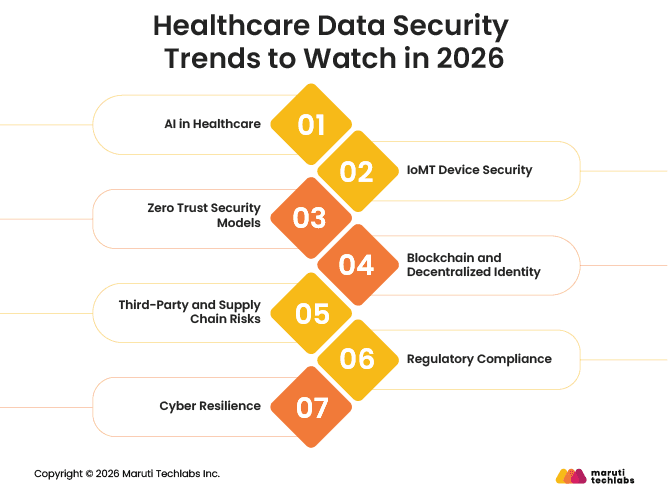
Healthcare data security is evolving quickly as new technologies and threats continue to grow. In 2026, organizations are focusing more on proactive security, better visibility, and stronger control over data. Below are the key trends shaping healthcare data security.
1. AI in Healthcare
Trend:
AI in healthcare is being widely used to automate processes and improve decision-making across healthcare systems. At the same time, attackers are using AI to create more advanced phishing attacks and malware.
Why it matters:
As AI adoption increases, both its use and misuse are growing. This makes it a key focus area for healthcare security in 2026.
2. IoMT Device Security
Trend:
Connected medical devices like patient monitors, infusion pumps, and wearables are rapidly increasing across healthcare systems. Many of these devices run on outdated software or are deployed without strong built-in security controls.
Why it matters:
Each connected device becomes a potential entry point for attackers. As the number of devices grows, it becomes harder to monitor and secure them, increasing the risk of both data breaches and direct impact on patient care.
3. Zero Trust Security Models
Trend:
Healthcare organizations are moving toward a Zero Trust approach, where no user or device is trusted by default and every access request is verified.
Why it matters:
With more cloud systems, remote work, and third-party access, traditional perimeter-based security is no longer enough. Strong identity checks and continuous verification are now needed to prevent unauthorized access.
4. Blockchain and Decentralized Identity
Trend:
Healthcare providers are exploring blockchain and decentralized identity solutions to store and share patient data more securely.
Why it matters:
As concerns around data privacy, ownership, and data misuse grow, these technologies offer better transparency and control. They allow patients to manage access to their own data while reducing the risk of tampering.
5. Third-Party and Supply Chain Risks
Trend:
Healthcare systems depend heavily on vendors for services like billing, cloud storage, and software platforms. This creates a highly connected ecosystem.
Why it matters:
A single security gap at a vendor can expose multiple healthcare organizations at once. As reliance on third parties increases, managing vendor security becomes critical to overall data protection.
6. Regulatory Compliance
Trend:
Healthcare regulations are becoming stricter, with a shift toward continuous monitoring instead of periodic compliance checks.
Why it matters:
Rising breach incidents and high financial losses are pushing regulators to enforce stronger accountability. Organizations are now expected to prove ongoing security, not just meet requirements once a year.
7. Cyber Resilience
Trend:
Healthcare organizations are placing more focus on resilience, including backup systems, incident response, and recovery planning.
Why it matters:
Since cyberattacks cannot always be prevented, the ability to recover quickly is becoming essential. Faster recovery helps reduce downtime, protect patient care, and limit financial and operational damage.
Healthcare Data Security Regulations and Compliance in 2026
Healthcare data security regulations are getting stricter in 2026, but they are also becoming more practical. Instead of one-time compliance checks, organizations are expected to follow security practices regularly. This shift is mainly due to rising cyber threats and the growing impact of data breaches.
Healthcare Regulatory Changes and Trends for 2026
Regulatory updates in 2026 focus on stronger data privacy, better consent management, and more transparent data sharing across healthcare systems.
HIPAA and 42 CFR Part 2 Alignment
Rules around sensitive data, especially related to substance use, are now more aligned with HIPAA. This makes data sharing easier for treatment and operations. At the same time, organizations need better control over patient consent.
Notice of Privacy Practices (NPP)
Healthcare providers need to update their privacy policies to reflect new changes. Patients should clearly understand how their data is used and protected. There is also more focus on sensitive health information.
CMS Interoperability and Prior Authorization
Healthcare systems and insurers are expected to share data more smoothly. There is also pressure to improve how prior authorizations are handled. This helps reduce delays in patient care.
ONC HTI-1 Rule
This rule focuses on how health IT systems manage and share data. It supports better data exchange while keeping security in place. It also encourages more transparency in how systems handle information.
Security Priorities and Standards in 2026
2026 Healthcare Data Security expectations are shifting toward stronger access control, continuous monitoring, and better protection across systems and users.
Zero Trust Architecture (ZTA)
As discussed earlier, healthcare providers are adopting a Zero Trust approach. Access is limited based on roles and continuously monitored. This helps reduce unauthorized access and keeps sensitive data secure.
Encryption Mandates
Encryption is becoming a basic requirement. Data needs to be protected both when stored and when shared. This reduces the risk of data leaks.
Identity and Access Management (IAM)
Managing who can access what is becoming increasingly important. IAM frameworks, along with tools like multi-factor authentication and role-based access control, help ensure that only authorized users can access sensitive data.
AI Governance
As AI tools are used more in healthcare, there is a need to manage them carefully. Organizations must make sure data is used responsibly. Clear policies help avoid misuse and risks.
Compliance Enforcement and Penalties
Enforcement is becoming stricter, with more focus on faster reporting, higher penalties, and better control over third-party risks.
HIPAA Penalties
Penalties for non-compliance can be high, depending on the severity of the issue. Failing to protect patient data can lead to serious financial and legal consequences.
Breach Notification
Organizations must report breaches within a set time. Quick reporting helps reduce damage and keeps patients informed. Delays can lead to further penalties.
Third-Party Risk
Vendors and partners can also create security risks. A single breach at a third party can affect multiple organizations. This is why vendor security checks are now more important than before.
6 Healthcare Data Security Best Practices
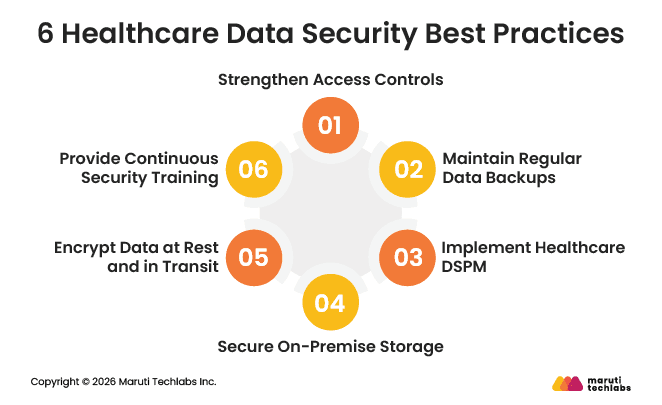
Protecting healthcare data requires a consistent and practical approach. As cyber threats continue to grow, organizations need to focus on everyday security habits, not just tools. The following best practices help reduce risks and protect sensitive patient data.
1. Strengthen Access Controls
Limit access to sensitive data based on roles and responsibilities. Use multi-factor authentication to add an extra layer of security. Regularly monitor user activity to quickly detect any unusual behavior.
2. Maintain Regular Data Backups
Keep secure backups of healthcare data using cloud data security practices or off-site locations. This ensures data can be restored quickly in case of a cyberattack or system failure. Backups are especially important to recover from ransomware incidents.
3. Implement Healthcare DSPM
Use data security posture management tools to understand where sensitive data is stored. These tools help identify risks and gaps in data protection. This allows teams to fix issues before they turn into major problems.
4. Secure On-Premise Storage
Protect local storage systems from unauthorized access and tampering. Regularly update systems with the latest security patches. This helps reduce risks linked to outdated software and known vulnerabilities.
5. Encrypt Data at Rest and in Transit
Always encrypt sensitive data, whether it is stored or being shared. Avoid using plain text formats that can be easily intercepted. Secure protocols help ensure data stays protected across systems.
6. Provide Continuous Security Training
Train employees regularly on how to handle data securely. Help them identify phishing emails and other common threats. Ongoing training builds awareness and reduces the chances of human error.
Conclusion
Healthcare data security now plays a critical role in patient safety, daily operations, and compliance. Even small security gaps can lead to serious disruptions, financial loss, and reduced patient trust.
At the same time, the demand for skilled cybersecurity professionals is growing faster than the available talent. This makes it harder for organizations to manage risks effectively.
Instead of chasing every new technology, healthcare providers should focus on their actual needs. Building a strong security foundation, understanding risks, and aligning efforts with patient care and business goals will help create a more secure and reliable environment.
Why Maruti Techlabs
Choosing the right partner for healthcare data security requires both technical expertise and a clear understanding of real-world challenges. It’s not just about tools, but building secure and scalable systems that actually work in practice.
Maruti Techlabs brings 14+ years of experience, with 250+ professionals and 100+ projects delivered. We support healthcare organizations through our data security services, helping manage, analyze, and use data effectively. Our security architecture & advisory services ensure your systems are designed with strong, built-in security from the start.
In a recent healthcare project, we improved record processing using a machine learning model. This resulted in an 87% reduction in processing time and 93% accuracy in patient data, while also reducing manual effort and team dependency.
If you are planning to strengthen your healthcare data security or build secure data systems, talk to our experts to get started.
FAQs
1. What Is Data Security in Healthcare?
Healthcare data security means protecting patient information from unauthorized access, loss, or misuse. It includes securing medical records, personal details, and billing data. The goal is to ensure that only authorized people can access this information while keeping it safe from cyberattacks, leaks, or accidental exposure.
2. Why Is Data Security Important in Healthcare?
Data security is important because healthcare data is highly sensitive. If exposed, it can harm patients and damage trust. It also affects hospital operations and compliance with regulations. Strong security helps prevent data breaches, ensures patient privacy, and keeps healthcare systems running smoothly without disruption.
3. What Are the Best Practices for Healthcare Data Security?
Some common best practices include using strong access controls, encrypting data, and maintaining regular backups. Healthcare organizations should also monitor systems, update software regularly, and train employees on security awareness. These steps help reduce risks and protect sensitive patient information from cyber threats and human errors.
4. How Can Healthcare Data Be Protected?
Healthcare data can be protected by using encryption, secure networks, and multi-factor authentication. Regular system updates and backups also help prevent data loss. Monitoring user activity and limiting access based on roles ensures better control. Employee training is equally important to avoid mistakes that can lead to breaches.
5. How Does Healthcare Data Security Differ from General Data Security?
Healthcare data security focuses more on patient privacy and regulatory compliance. It deals with highly sensitive medical information, which requires stricter controls. Unlike general data security, it must also ensure data availability for patient care while maintaining confidentiality and integrity at all times.
6. What Are the Components of Healthcare Data Security?
Healthcare data security includes access control, encryption, network security, and data monitoring. It also involves backup systems, identity management, and compliance with regulations. Together, these components help protect patient data, prevent unauthorized access, and ensure systems remain secure and reliable.
7. What Are the Risks of Poor Healthcare Data Security?
Poor data security can lead to data breaches, financial loss, and legal penalties. It can also disrupt hospital operations and delay patient care. Most importantly, it damages patient trust. Cyberattacks, insider threats, and human errors become more likely when proper security measures are not in place.
8. What Is the Significance of the Health Insurance Portability and Accountability Act in Healthcare Data Security?
The Health Insurance Portability and Accountability Act (HIPAA) sets rules for protecting patient data. It ensures healthcare organizations follow proper security and privacy practices. HIPAA helps standardize how data is handled, reduces the risk of breaches, and holds organizations accountable for protecting sensitive health information.
Lalit Bhatt works across cloud infrastructure, DevOps, and project delivery, bringing 18+ years of experience across cloud migration, AWS architecture, infrastructure improvements, and team mentoring, depending on what clients need.
Stuck with a Tech Hurdle?
We fix, build, and optimize. The first consultation is on us!