AI Legal Research: Use Cases, Benefits, Challenges & More
Explore AI's extensive and transformational role in legal research and analysis.
Artificial Intelligence and Machine Learning
AI Legal Research: Use Cases, Benefits, Challenges & More
Explore AI's extensive and transformational role in legal research and analysis.
Table of contents
Table of contents
Introduction
What is AI Legal Research & Analysis?
Understanding AI with Legal Research
Comparison: Traditional Vs. AI Legal Research
How to Use AI for Legal Research? 9 Widely Adopted Use Cases
Top 6 Benefits of AI in Legal Work
Top 5 Categories of Legal AI Tools
Risks, Challenges, and Ethical Considerations with Legal AI Tools
Challenges and Concerns of Employing AI in Legal Research
Future Trends in Legal AI
Conclusion
FAQs
Introduction
AI is reshaping legal work by accelerating research, improving accuracy, and reducing administrative burden. Rising case complexity, mounting compliance requirements, and increasing client expectations make AI essential.
Firms use AI to boost productivity, strengthen decision-making, and deliver faster, more consistent outcomes across litigation, transactions, and regulatory processes.
Legal AI tools support research, case analysis, contract drafting, document review, due diligence, litigation preparation, and compliance monitoring. They organize information, detect patterns, and automate repetitive steps.
This allows lawyers to focus on strategy, advocacy, and negotiation while improving quality, reducing risk, and meeting growing demands for efficient legal service delivery.
This blog outlines the top categories of legal AI tools, challenges of using them, and future trends in the Legal AI space.
What is AI Legal Research & Analysis?
AI legal research and analysis refers to the use of artificial intelligence to search, review, and interpret legal information such as cases, statutes, regulations, and contracts.
Instead of relying only on manual keyword searches, AI systems analyze context, patterns, and relationships across large volumes of legal data. These tools can surface relevant precedents, summarize complex documents, identify risks, and support legal reasoning.
By learning from historical data and user behavior, AI helps legal professionals reach more accurate insights faster, reduce repetitive work, and focus on higher-value legal judgment and strategy rather than time-intensive document review tasks.
Understanding AI with Legal Research
The legal domain has observed a promising shift with subfields of Artificial Intelligence like Natural Language Processing (NLP), Machine Learning (ML), and AI-powered search engines. These technologies offer more productivity when used proactively than traditional legal research and analysis methods.
Here are some challenges observed when attending legal research tasks the conventional way.
1. Traditional Methods of Legal Research and Analysis
Conventional legal research methods are inclined to visit law libraries, browse their way with legal encyclopedias and case reporters, and use tools to track case history while cross-referencing them manually.
Indexes and catalogs were the primary sources of reliance for researchers. They necessitated a lot of reading and interpreting legal text for analysis. It consumed ample time, offered minimal resources, was prone to outdated information, and heavily depended on the professional's research abilities.
2. Limitations of Manual Research
Manual research with legal presents various hurdles like excess time consumption and physical overload of browsing through heaps of legal materials. It hinders productivity due to such comprehensive information that can overwhelm law professionals.
It also comprises the research quality due to improper research methodologies. Furthermore, this process poses inherent risks like subjectivity, bias, and inefficiency in updating and tracking changes. Another significant limitation arises with knowledge sharing and collaboration.
These widespread challenges speak volumes about introducing advanced approaches to enhance AI legal research.
How AI Legal Research Revolutionizes Law?
AI legal research and analysis uses many subsets, such as NLP, ML, and AI-powered search engines.
Natural Language Processing (NLP): NLP allows AI systems to glean and scrutinize information from legal documents, streamlining document analysis.
Machine Learning (ML): Machine learning assists with legal thinking by analyzing innumerable cases, learning trends, and predicting outcomes in similar situations. It promotes informed decision-making and devising future strategies with cases.
AI-Powered Search Engines: AI legal research accelerates the process of case analysis, saving time and effort for professionals by offering thorough and precise insights.
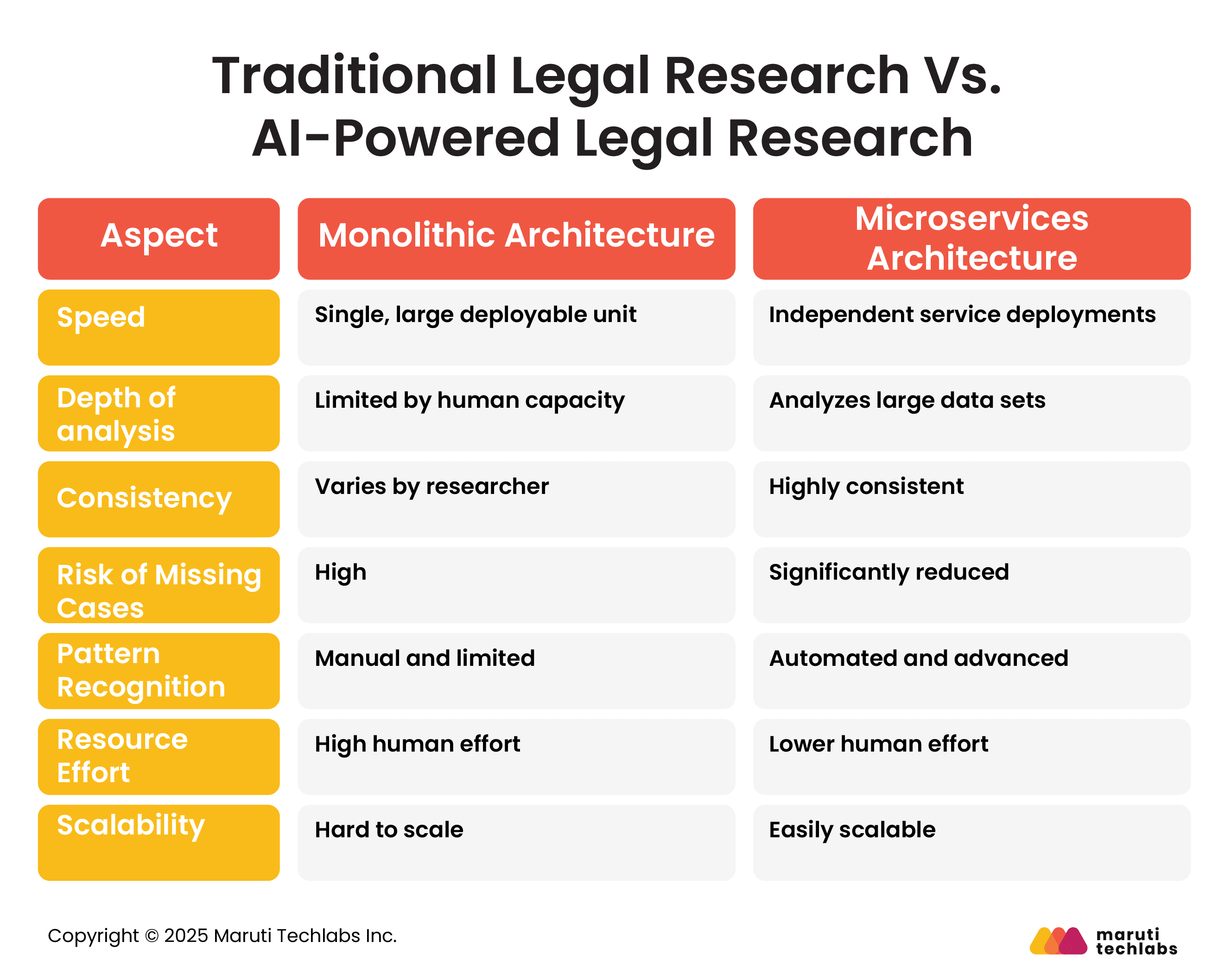
Comparison: Traditional Vs. AI Legal Research
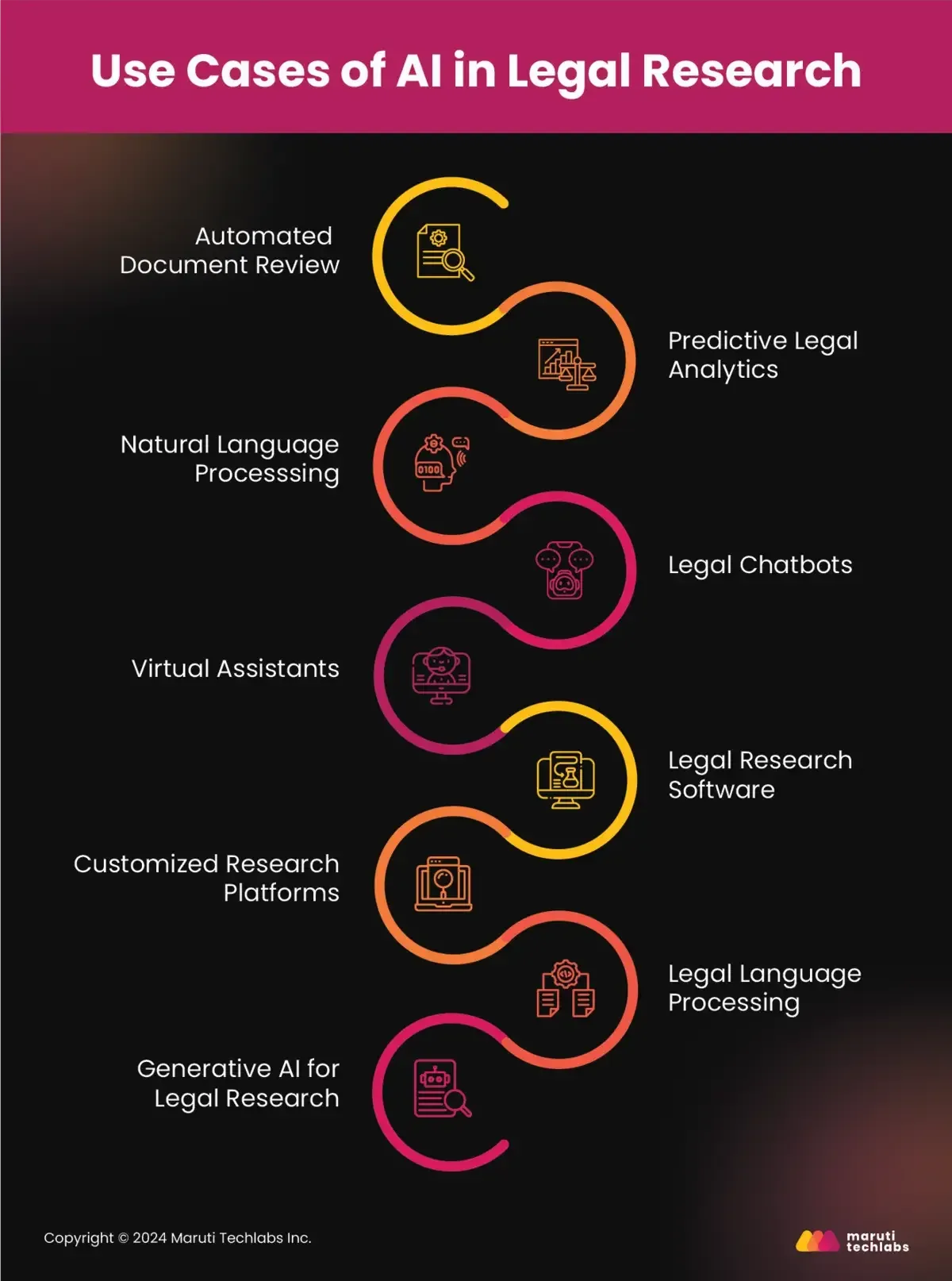
How to Use AI for Legal Research? 9 Widely Adopted Use Cases
Artificial intelligence is transforming various domains, including legal research. These advancements allow law professionals to streamline legal research processes and offer better client services with informed decision-making.
Here’s a breakdown of the primary applications of AI in legal research.
1. Automated Document Review
AI-powered legal research can analyze huge collections of legal documents like case law, contracts, and statutes within minutes or seconds. These tools abstract pertinent information, learn patterns and offer content-based classification using natural language processing and machine learning algorithms.
They allow legal professionals to conduct other essential tasks that demand expertise, buying time that would otherwise be spent manually reviewing and analyzing records. Such advanced tech can also be leveraged by case management software. It assists lawyers in adhering to deadlines, automating daily tasks, and managing their case files.
Luminance is an AI Tool that automates contract analysis and generation. Matt Forsyth, Vice President and Deputy General Counsel at Idexx Laboratories, attests to the significant time savings of adopting Luminance.
He said, “This type of review would have taken us weeks to complete using a traditional CLM or manual review methods. We would have also had a low degree of confidence that every piece of essential information had been captured, since these traditional approaches can be quite unreliable. With Luminance’s AI, I have a very high degree of confidence that we identified absolutely everything of relevance among our contracts.”
2. Predictive Legal Analytics
AI can best garner insights by studying historical legal resources such as judges’ rulings, legal precedents, and case outcomes. Professionals can leverage these insights to devise future strategies, predict outcomes, and gauge risks.
A clear understanding of AI tools like ChatGPT helps legal professionals inspect the strengths of their arguments, learn relevant laws, and determine the possibility of success. This reliable foresight empowers lawyers to provide informed legal assistance, saving many resources and time.
3. Natural Language Processing
AI fused with NLP is crucial to enhancing legal research capabilities. Legal research can be time-consuming and challenging. NLP shortens this timeline significantly.
Legalese is the unique terminology used by lawyers in legal documents. Using an NLP-powered legal research engine, it's easier to browse cases and documents and translate plain language into "legalese."Other advanced NLP programs allow lawyers to find what they need, not just specific keywords, facilitating a search for concepts.
Natural language processing also assists lawyers by suggesting prior or current similar cases by studying a case study or document. These recommendations can help lawyers understand the intricacies of a case thoroughly.
4. Legal Chatbots
New clients expect prompt responses when they reach out. This requisite can be addressed using AI-powered chatbots. It eliminates the need for lawyers to sift through emails, understand the context, and reply.
They can also serve as virtual receptionists, handle routine client inquiries, and streamline the intake process. Automating these easy but time-consuming tasks allows lawyers to add more billable hours.
Furthermore, chatbots also present a competitive advantage to law firms or lawyers.
5. Virtual Assistants
AI-powered virtual assistants use ML and NLP to assist lawyers in their daily tasks. Law practitioners must categorize and organize documents, which can be tedious even with the right software when dealing with complex and high-volume cases.
Virtual assistants can offer quick results by accurately indexing and retrieving documents, reducing a lawyer’s time spent on administrative tasks.
Virtual assistants can help lawyers stay organized and focused on their core legal tasks by scheduling meetings and sending timely reminders for court dates and appointments.
Virtual assistants boost overall satisfaction and stronger attorney-client relationships by sharing case updates and addressing client concerns promptly.
6. Legal Research Software
AI legal research software helps lawyers save time and effort as it’s proficient with rapidly sifting through massive legal databases, learning relevant sources, and summarizing essentials.
Assistants powered with AI have an upside as they can enhance their search capabilities with increased interactions, adding more accuracy and relevance to their abilities.
7. Customized Research Platforms
The primary aim behind designing AI-powered legal research platforms is to yield personalized legal research experiences.
For instance, AI research platforms can imbibe a user’s browsing behavior, search queries, and feedback to classify search results, present insights, and share relevant recommendations. Such personalizations can enhance the precision and coherence of legal research, increasing the authenticity and relevance of the desired information.
8. Legal Language Processing
One of the other objectives of leveraging AI for legal purposes is to decrease the complexity of legal terms, making them more understandable and accessible. This feat is achieved using NLP algorithms that dissect legal jargon into simple forms, making legal terms understandable for non-legal individuals.
Legal professionals who must impart this knowledge and understanding to their stakeholders or clients find this extremely helpful. Legal language processing also assists with learning legal abbreviations, terminology, and acronyms, minimizing the risk of confusion with relevant legal information and increasing the accuracy of legal searches.
9. Generative AI for Legal Research
Generative AI can revolutionize legal research capabilities. Law firms depend on extensive research to prepare cases and make sound decisions. Gen AI automates browsing through statutes, precedents, and case law to present legal information rapidly.
The utilization of Gen AI expedites the research process by sharing concise summaries, underscoring crucial arguments, and forecasting potential outcomes utilizing historical data. Contract analysis and review are also areas where Gen AI plays a valuable role by spotting essential terms, risks, and discrepancies within agreements.
Gen AI fosters intelligible decision-making by flagging potential issues, determining relevant data points, and extracting significant insights for attorneys.
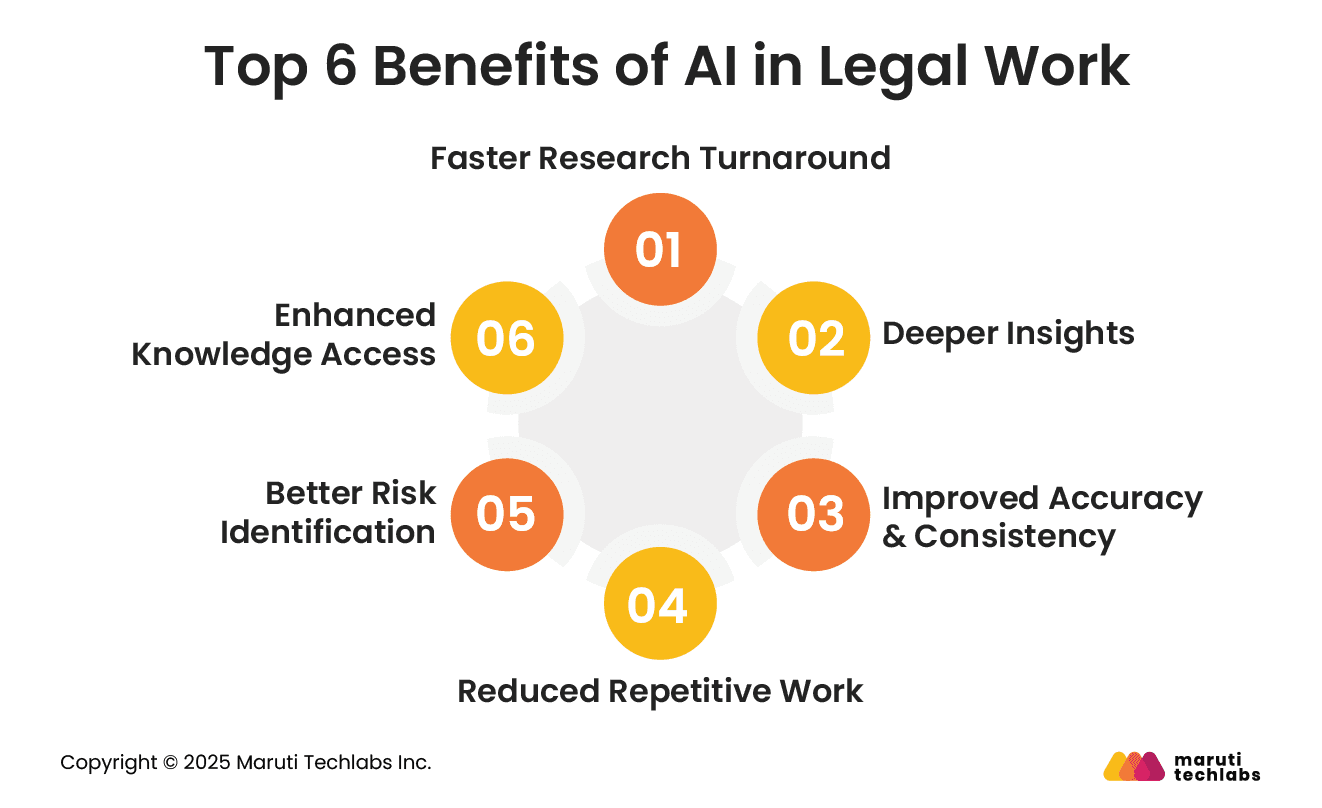
Top 6 Benefits of AI in Legal Work
AI is transforming legal work by improving speed and insight while allowing professionals to focus more on judgment, strategy, and client value rather than manual research tasks.
1. Faster Research Turnaround
AI tools scan thousands of cases and documents within seconds. What once took days can now be completed in minutes, helping lawyers respond faster to clients and meet tight deadlines with greater confidence.
2. Deeper Insights
AI analyzes patterns across judgments and rulings, revealing trends and connections humans may overlook. This allows lawyers to build stronger arguments supported by broader and more relevant legal precedents.
3. Improved Accuracy & Consistency
By reducing reliance on manual searches, AI lowers the risk of missing critical cases or statutes. Consistent analysis improves research quality and ensures similar issues are handled uniformly across matters.
4. Reduced Repetitive Work
Tasks like document review, citation checking, and initial case screening are automated. This reduces fatigue and frees legal teams to focus on complex reasoning, negotiation, and client advisory work.
5. Better Risk Identification
AI highlights potential legal risks by comparing documents against known outcomes and regulatory expectations. Early risk visibility supports better decision-making and more proactive legal strategies.
6. Enhanced Knowledge Access
Junior and senior lawyers gain equal access to institutional knowledge through AI tools. This shortens learning curves and improves collaboration across legal teams and practice areas.
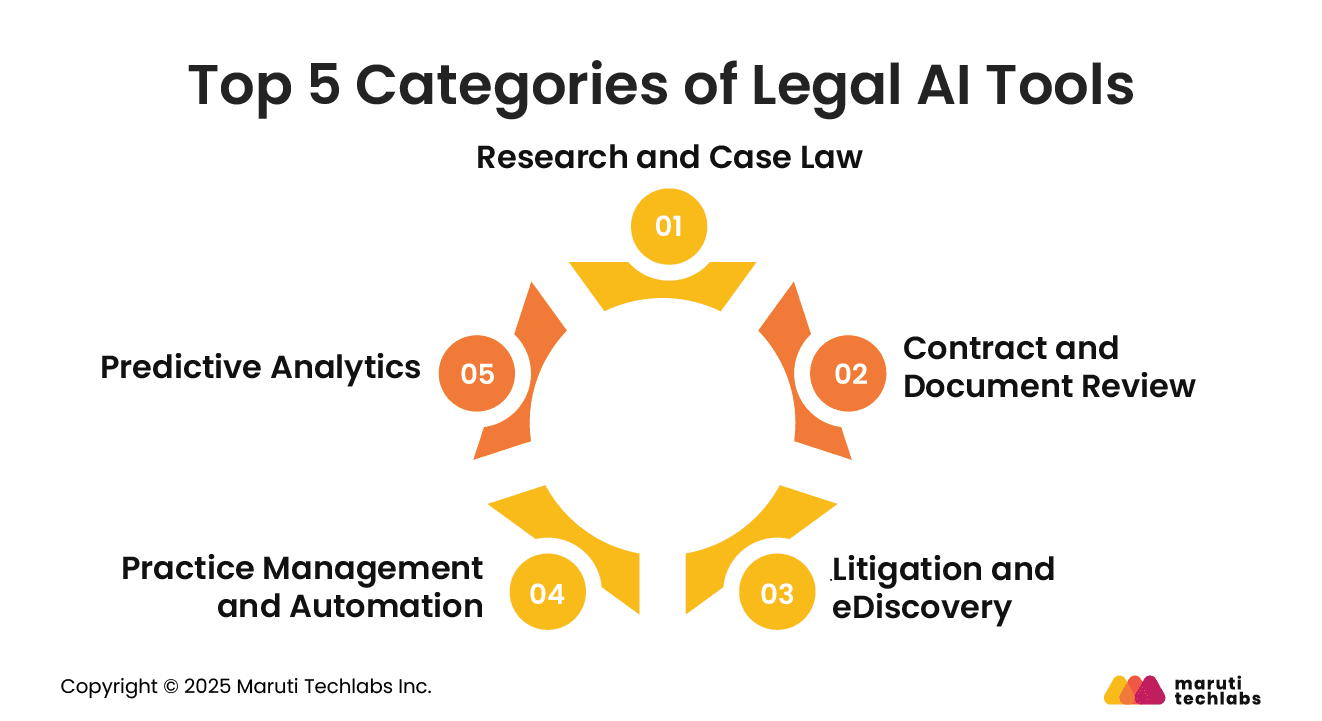
Top 5 Categories of Legal AI Tools
Legal AI tools fall into distinct categories, each solving specialized problems across research, drafting, litigation, operations, and decision support.
Understanding these categories helps firms choose tools that align with their practice needs and improve overall efficiency.
1. Research and Case Law
AI research tools scan large databases of cases, statutes, and regulations to quickly surface relevant authority. They summarize rulings, extract key reasoning, and highlight conflicting interpretations.
These systems significantly reduce research time, improve accuracy, and help lawyers build stronger arguments by identifying patterns and insights that traditional methods may overlook.
2. Contract and Document Review
AI-powered review systems analyze contracts, flag risks, and detect inconsistencies. They identify missing clauses, compare against playbooks, and streamline negotiations.
These tools accelerate diligence, improve compliance, and maintain drafting standards across teams. They reduce manual burden while allowing legal professionals to focus on judgment-driven analysis and strategic decision-making.
3. Litigation and eDiscovery
Litigation AI tools filter large volumes of documents, detect relevance, and identify privileged information. They analyze communication patterns, timelines, and sentiments to support case strategy.
eDiscovery automation reduces costs, improves accuracy, and speeds preparation by surfacing insights that inform arguments, depositions, and settlement positions with greater confidence.
4. Practice Management and Automation
Automation platforms manage workflows, matter tracking, intake, billing, and routine communications. They reduce administrative effort, streamline coordination, and support consistent client service.
By integrating calendars, templates, and automated reminders, these systems help firms improve productivity, maintain compliance, and operate more efficiently across teams, departments, and client engagements.
5. Predictive Analytics
Predictive systems use historical data to forecast case outcomes, litigation timelines, settlement likelihoods, and regulatory risks. Lawyers use these insights to evaluate strategy, manage expectations, and allocate resources.
Predictive analytics strengthens decision-making, enhances transparency, and supports more informed discussions with clients about risks, costs, and potential results.
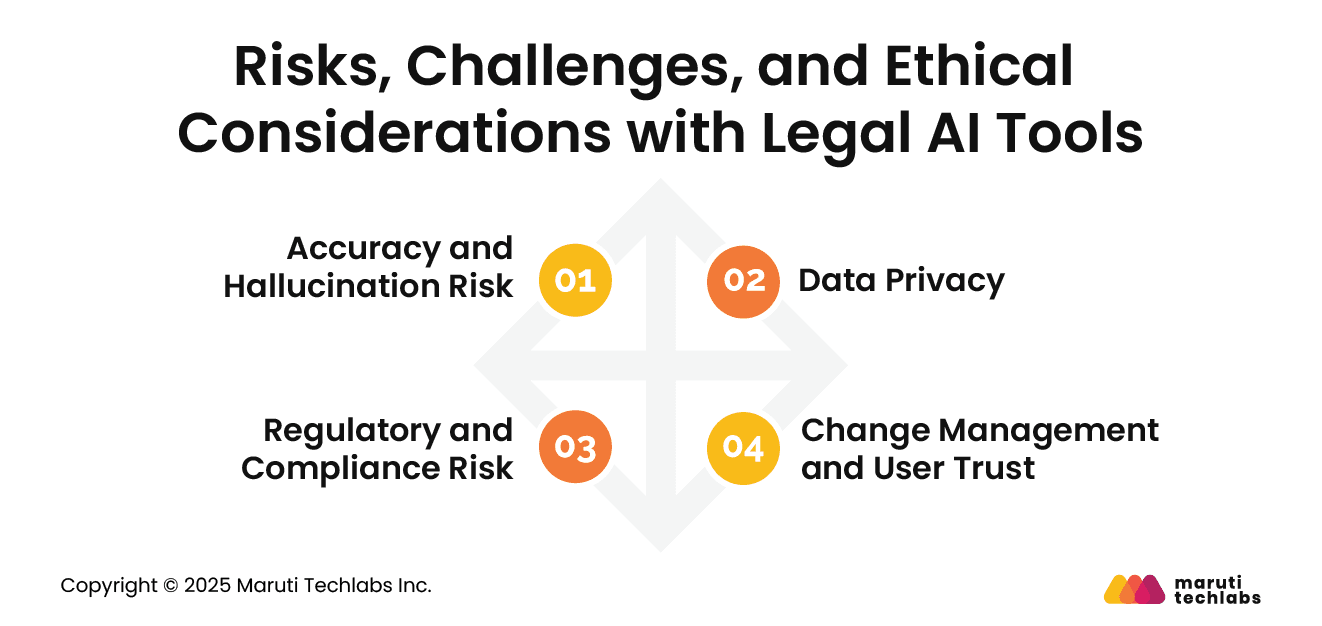
Risks, Challenges, and Ethical Considerations with Legal AI Tools
AI in legal workflows introduces risks related to accuracy, confidentiality, compliance and user trust, requiring careful governance and responsible adoption.
1. Accuracy and Hallucination Risk
AI systems may generate inaccurate summaries, misinterpret legal principles or cite irrelevant authority. Hallucinations can lead to flawed arguments and reputational damage.
Continuous validation, expert review, and reliable retrieval improve accuracy. Firms should apply strict oversight, verify output,s and adopt tools that provide transparent reasoning and traceable sources.
2. Data Privacy
Legal AI often processes highly sensitive client information. Weak controls may expose privileged material or violate privacy laws. Strong encryption, access restrictions, and secure data environments are essential.
Vendors must maintain strict confidentiality practices and comply with jurisdiction-specific requirements to protect client trust and preserve legal privilege.
3. Regulatory and Compliance Risk
AI tools must meet evolving regulations governing data protection, professional conduct, and automated decision making. Non-compliance can lead to penalties or ethical violations.
Firms should choose vendors that support auditing, transparenc,y and secure data handling. Clear policies help ensure responsible use, especially in areas related to client representation and disclosure.
4. Change Management and User Trust
Lawyers may hesitate to adopt AI due to concerns over accuracy or job relevance. Successful implementation requires training, clear communication, and demonstrating value through real use cases.
Trust grows when tools consistently improve efficiency and provide verifiable results. Collaborative adoption ensures AI becomes an asset rather than a disruption.
Challenges and Concerns of Employing AI in Legal Research
Many legal industries are adopting AI globally. From efficient information gathering to pinpointing errors accurately, AI undeniably introduces many positives to the legal sphere.
However, this change comes with specific challenges and concerns for legal professionals that should be addressed when monitoring this transition.
Let’s briefly examine what these potential hurdles can be.
1. Bias and Discrimination
Data is the life and blood of any AI system. Therefore, the bias in any AI legal research tool results from the data it’s trained on. AI extends these discriminatory patterns, leading to unjust or dissatisfactory outcomes if the historical data used to prepare your models is compromised.
2. Data Privacy and Security
AI offers relevant results specific to your queries by learning, fetching, and relying on vast amounts of data fed into it. AI engines necessitate potentially confidential information about organizations and individuals to offer the best results.
Law professionals must incorporate robust measures to protect this information from breaches, unauthorized access, and misuse.
3. Accuracy
AI possesses a considerable downside where it generates false responses known as 'hallucinations.' AI-created content must strictly be cross-checked and validated against authentic sources by experienced law professionals to maintain the integrity of legal standards.
4. Tactical Shift in Legal Roles and Responsibilities
The rise of AI will reshape legal professionals' roles, emphasizing new skills like navigating complex workflows, risk assessment, and extracting insights from data. While organizational skills are crucial, the shift doesn't diminish the need for lawyers; instead, it signifies a change in approach.
Resources for legal tasks, including analysis and contract drafting, will change, reflecting an evolution in legal roles. Lawyers must redirect their focus from routine tasks to critical activities like devising strategies and addressing intricate legal issues. This transition highlights the positive aspects of human-AI collaboration.
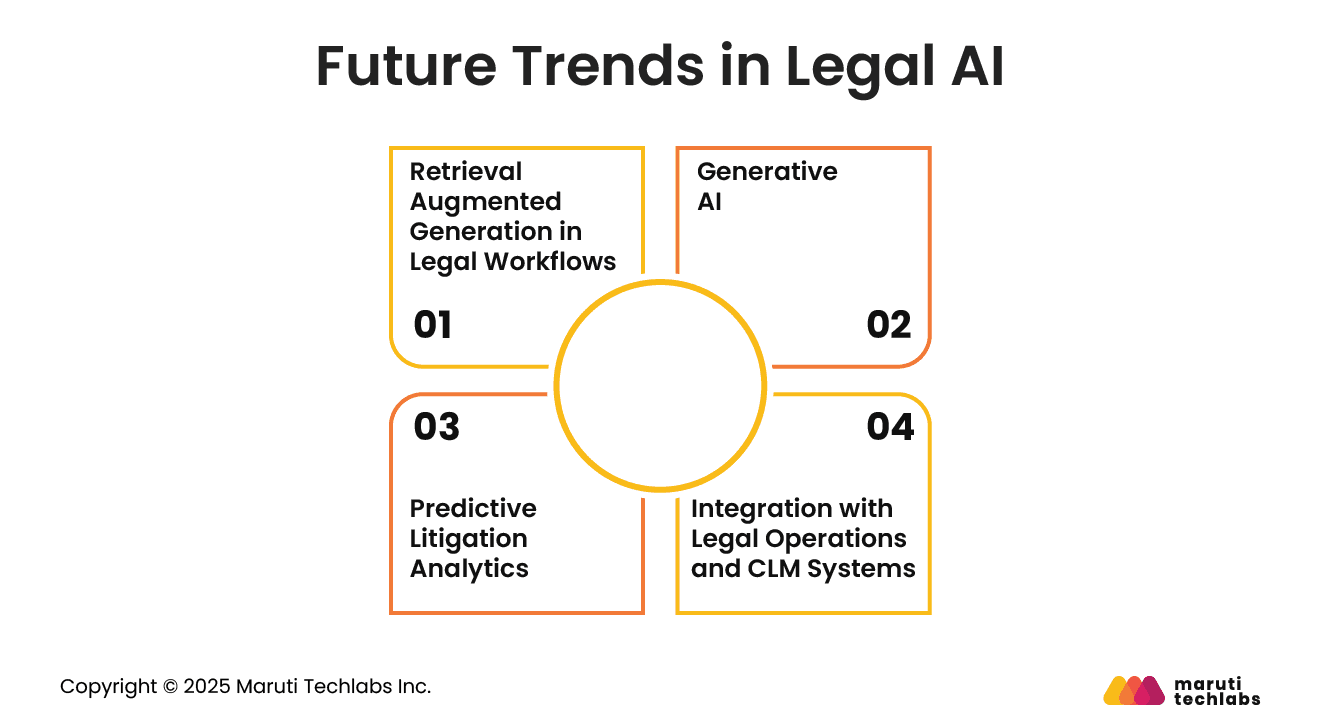
Future Trends in Legal AI
1. Retrieval Augmented Generation
RAG combines generative AI with reliable source retrieval, ensuring outputs are grounded in authentic legal texts. It reduces hallucinations, improves citation accuracy, and supports transparent reasoning.
RAG-powered systems dramatically enhance research, summarization, and drafting by connecting prompts directly to verified cases, statutes, and regulations.
2. Generative AI
Generative AI assists with drafting contracts, briefs, and internal documents by using templates, negotiation guidelines, and contextual data. It accelerates early versions, flags risk language, and proposes alternative clauses.
Lawyers refine and validate outputs, enabling faster negotiations and reducing repetitive drafting while maintaining strong quality and consistency.
3. Predictive Litigation Analytics
Advanced systems forecast litigation outcomes using historical decisions, judge behavior, jurisdiction trends, and settlement patterns. Lawyers leverage these insights to shape strategy, assess risk, and advise clients more effectively.
Predictive models improve decision-making, resource planning, and litigation budgeting, creating a more data-informed approach to dispute resolution.
4. Integration with Legal Operations and CLM Systems
AI will integrate deeply with legal operations platforms and contract lifecycle management systems. Unified workflows simplify intake, drafting, negotiation, and compliance tracking.
Seamless integration improves visibility, enhances reporting, and supports standardized processes across teams.
This cohesion strengthens operational discipline and elevates overall efficiency in legal service delivery.
Conclusion
The emergence of AI-powered legal research promises new possibilities for the justice system. Legal firms empowered with AI-powered tools and applications offer crucial enhancements to customized legal research and analysis, document review, decision-making, and language processing, promoting more accessible access to justice.
Natural language processing, machine learning, and search engines powered by AI are transforming legal research by overcoming challenges like time constraints, information overload, and resource limitations.
Key AI applications in law include automated document review, predictive legal analytics, customized legal research using NLP, virtual assistants, chatbots, and generative AI. These technologies offer improved efficiency, more profound insights through document analysis, and better-informed decision-making.
Despite these advantages, implementing AI in law introduces challenges like algorithmic bias, data privacy, accuracy concerns, and shifts in legal roles.
Integrating AI for legal research and analysis demands assistance from a legal tech service provider. At Maruti Techlabs, we excel in this domain with hands-on experience incorporating AI into legal services. Connect with us today to leverage our artificial intelligence services to enhance operational efficiency, streamline processes, and access innovative solutions tailored to your legal needs.
FAQs
1. What is the future of AI in legal practice?
AI has already been employed in some legal practices to parse data and query documents. Soon, AI will also automate routine tasks such as contract review, research, and generative legal writing.
2. How can AI improve the efficiency and accuracy of legal research?
AI has the ability to seamlessly integrate multiple research tools and databases into a unified system, reducing the time spent on browsing through numerous documents and streamlining the research workflow.
3. How can AI be used to predict case outcomes?
AI tools can garner insights from historical documents like judges’ rulings, legal precedents, and case outcomes that can be leveraged to predict future outcomes, strategies, and associated risks.
4. Is it safe to rely on AI for legal research?
AI can have both positive and negative effects on legal research. Therefore, it’s crucial to verify the research done with AI and avoid overreliance.
5. How can lawyers ensure the security of sensitive legal data when using AI tools?
Lawyers can ensure the security of sensitive legal data when using AI tools by implementing robust encryption, access controls, regular audits, compliance with legal standards, and selecting trusted AI tools and platforms with stringent data protection policies.
Pinakin Ariwala has over 20 years of experience in AI/ML, data engineering, and software development. He has led AI and machine learning projects across industries, including agriculture, finance, and healthcare, and has been featured on the Clutch Leaders Matrix podcast discussing real-world AI/ML applications.
Stuck with a Tech Hurdle?
We fix, build, and optimize. The first consultation is on us!





![[GetPaidStock.com]-65b9d3432ecc1.webp](https://cdn.marutitech.com/small_Get_Paid_Stock_com_65b9d3432ecc1_c1b16b05fb.webp)