
AI-Driven Predictive Analytics in Legal Tech: Benefits, Use Cases & Top Tools (2026)
Key Takeaways
- AI-Driven predictive analytics uses machine learning trained on historical case data to estimate probable outcomes, settlement ranges, and litigation costs.
- The technology delivers measurable value in document review, contract evaluation, risk assessment, and eDiscovery, with several vendors publishing verified time and cost reductions.
- Prediction accuracy varies significantly by jurisdiction and practice area, and is strongest where historical data is well digitized, such as IP litigation and commercial contracts.
- Algorithmic bias, explainability gaps, and over-reliance on unverified AI output remain the biggest risks, and courts have already sanctioned attorneys for skipping human verification.
- Choosing the right tool depends on accuracy benchmarks specific to your practice area, data security standards, and integration compatibility, not just brand recognition.
- Firms that build a human validation step into every AI workflow get the most reliable results from these tools
Introduction
Every case a law firm takes on carries risk that's hard to quantify.
- Will a judge follow precedent or diverge from it?
- Will a jury respond to the evidence the way the trial team expects?
For decades, firms have answered these questions with experience, legal research, and professional instinct, an approach that works but scales poorly as caseloads and data volume grow.
AI-Driven Predictive Analytics changes that equation. By training machine learning models on large volumes of historical court records, past rulings, and case outcomes, these systems calculate the probability of specific results before a case ever reaches trial.
For firms exploring how to structure and execute a predictive analytics initiative, this process typically involves several stages, from defining the business problem and preparing data to building, validating, and deploying the model.
Investment in this space is accelerating. MarketsandMarkets projects the global legal AI software market to grow from $3.11 billion in 2025 to $10.82 billion by 2030, a 28.3% CAGR. Interest is outpacing implementation, though.
Deloitte’s research with senior legal leaders found that 79% expect generative AI to have a moderate to significant long-term impact on how legal work is performed, while 88% identify efficiency and productivity gains as its biggest potential benefit. Yet financial and resource constraints remain the leading barrier to adoption.
This guide breaks down how AI-Driven Predictive Analytics works in legal tech, the benefits and use cases driving adoption across practice areas, and a framework for evaluating and selecting the right legal analytics tool for your firm.

How AI-Driven Predictive Analytics Works in Legal Tech?
AI-Driven Predictive Analytics in legal tech follows a five-step process that turns raw case data into usable probability scores.
- Data ingestion: Court records, case filings, statutes, and rulings are pulled from public and licensed legal databases.
- NLP preprocessing: Natural language processing extracts entities, citations, and legal concepts from unstructured text such as opinions and briefs.
- Pattern recognition: Machine learning models identify correlations between case facts and outcomes across thousands of historical cases.
- Prediction output: The system generates probability scores, risk flags, and cost estimates based on the patterns it has learned.
- Lawyer review: An attorney validates, contextualizes, and acts on the AI's output before it informs any client-facing decision.
This process plays out differently depending on the practice area.
Criminal Law
AI models trained on historical sentencing data can estimate likely sentence ranges within a given jurisdiction, helping defense attorneys calibrate plea negotiation strategy and set realistic expectations with clients.
Coverage here varies significantly by jurisdiction, since sentencing data is far less standardized and less publicly available than civil litigation records, so prediction accuracy depends heavily on how much historical data exists for a given court.
Civil Law
In IP litigation, AI analyzes patent claim language, prior art databases, and historical outcomes in similar disputes to estimate the likelihood a claim survives review.
Platforms like Lex Machina, which covers all 94 federal district courts plus more than 100 enhanced state courts, let litigators pull judge-specific and venue-specific analytics before filing, reducing the risk of pursuing litigation that historical data suggests has a low probability of success.
Family Law
AI models trained on custody ruling patterns by jurisdiction and judge can help attorneys set realistic client expectations early, reducing the emotional and financial toll of contested proceedings that the data suggests are unlikely to succeed.
What Are the Benefits of AI-Driven Predictive Analytics in Legal Tech?
AI-driven predictive analytics improves case strategy, reduces operational costs, and strengthens risk management for legal teams by applying historical case data to current decisions. The following are the most significant benefits firms are realizing from predictive analytics today.
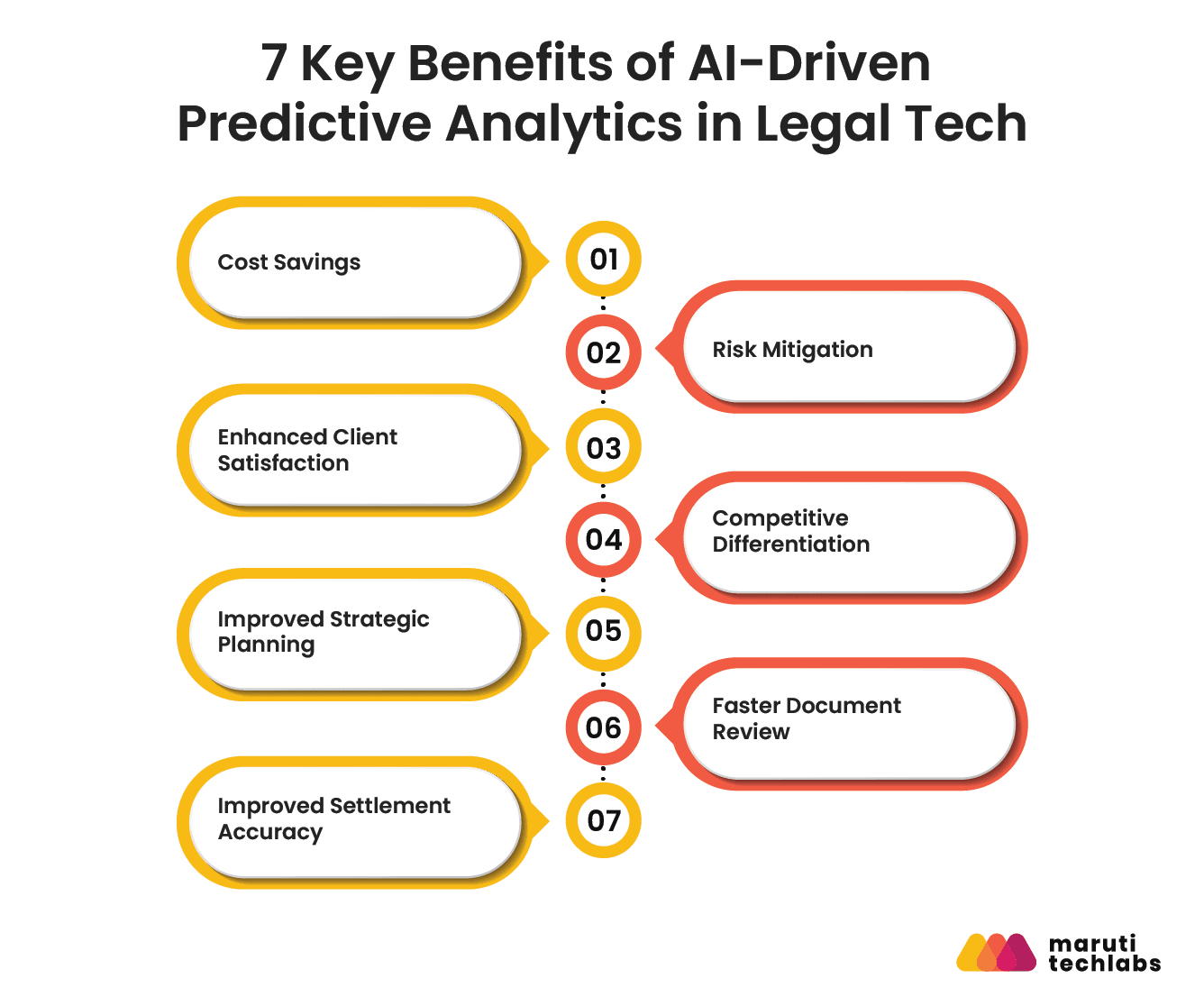
1. Cost Savings
AI-driven predictive analytics reduces the manual labor firms spend on repetitive tasks such as document review and legal research.
On document-heavy work specifically, Litera reports its Kira contract review platform cuts review time by 60% to 80% on M&A due diligence, which translates directly into lower cost per matter.
More broadly, McKinsey's April 2026 analysis of law firm AI adoption found that, in a conservative scenario, AI-enabled automation and augmentation could affect 15% to 25% of total net legal hours over the next five to seven years, an indication of how much of a firm's current cost base is exposed to this kind of efficiency gain.
2. Risk Mitigation
AI and predictive analytics excel at estimating a case's probability of success or failure before resources are committed to it.
With a clearer picture of the risks likely to surface, legal teams can build contingency plans earlier and avoid pursuing matters the data suggests are unlikely to succeed.
3. Enhanced Client Satisfaction
AI lets lawyers paint a fuller picture of what a client should expect from the outset, including risks, likely outcomes, and legal trends relevant to their case.
Data-driven insight paired with strategic guidance builds more client confidence than intuition alone.
4. Competitive Differentiation
Firms that use predictive analytics can back their pitches with data instead of relying purely on relationship history and reputation.
Demonstrating a data-backed case assessment during a pitch shifts business development from a purely relationship-driven exercise to an evidence-driven one, which matters increasingly to sophisticated corporate clients evaluating outside counsel.
5. Improved Strategic Planning
The volume of data AI can process, combined with the speed of analysis, helps lawyers build intelligent, data-backed strategies.
This supports more thorough due diligence and lets firms address issues proactively rather than reactively, giving early adopters a real advantage over firms still relying on manual review.
6. Faster Document Review
Document-heavy work is where AI's speed advantage is most measurable. Thomson Reuters reports that its CoCounsel Legal platform delivers an average one-third reduction in time spent on document review, research, and drafting.
For firms handling high contract or discovery volumes, that compounds fast, freeing associates for higher-value strategic work instead of first-pass review.
7. Improved Settlement Accuracy
AI helps identify realistic settlement windows by analyzing how similar cases are resolved at each stage of litigation, rather than relying purely on a lawyer's read of the room.
This won't replace negotiation judgment, but it gives attorneys a data point to check that judgment against before advising a client to hold out or settle.
What Are the Top Use Cases of AI-Driven Predictive Analytics in Legal Services?
AI-driven predictive analytics supports six primary applications in legal practice today, spanning case strategy, contract work, compliance, budgeting, and discovery.
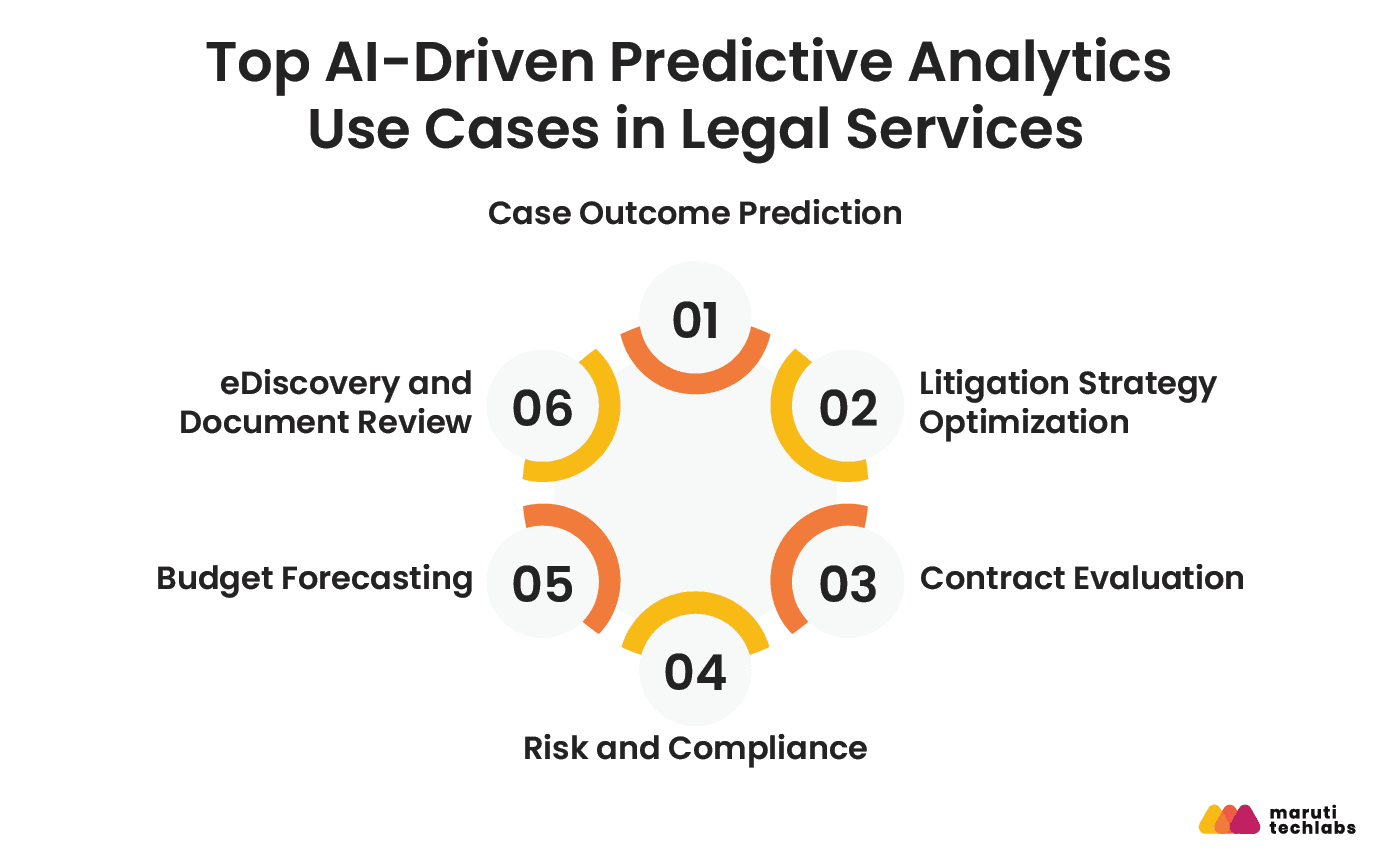
1. Case Outcome Prediction
AI analyzes thousands of historical rulings to calculate the probability of specific outcomes for a pending case, factoring in jurisdiction, judge history, and case type.
This gives lawyers an evidence-based starting point for advising clients on settlement versus trial, rather than relying solely on experience with similar past matters.
2. Litigation Strategy Optimization
Beyond predicting an outcome, AI models the opposition's likely arguments, relevant precedent, and how comparable juries have responded to similar evidence.
This supports building a full trial strategy, including anticipated counterarguments, rather than just an outcome probability.
3. Contract Evaluation
NLP models flag high-risk clauses, including uncapped liability, unilateral termination rights, and ambiguous indemnification language, far faster than manual review.
Deloitte research found that 46% of legal operations professionals are already using or considering generative AI for contract review, while 43% are exploring it for clause suggestions and 20% for risk analysis. These capabilities allow legal teams to identify potentially problematic provisions faster and focus human review on higher-risk contracts.
4. Risk and Compliance
AI monitors regulatory changes across jurisdictions and flags when existing contracts or practices may fall out of compliance, reducing the lag between a regulatory shift and a firm's response.
NLP and ML models also help detect irregularities and anomalies in legal documentation and communication records that could signal compliance risk.
5. Budget Forecasting
Legal proceedings can take months or years to resolve, and firms need to estimate attorney fees, court costs, and administrative expenses early.
AI analyzes similar past cases to help forecast litigation costs and timelines, supporting more accurate client expectations and better resource allocation across a caseload.
6. eDiscovery and Document Review
AI-powered eDiscovery platforms use predictive coding to prioritize relevant documents within large discovery sets, cutting review volume significantly compared to linear manual review. This isn't new or unproven.
Predictive coding was first formally approved for use in US federal court in Da Silva Moore v. Publicis Groupe (S.D.N.Y. 2012), where the court found computer-assisted review at least as accurate as manual review, and it has since become standard practice in large-volume litigation.
What Are the Top AI-Driven Predictive Analytics Tools in 2026?
The top AI-driven predictive analytics tools in legal tech today are Lex Machina, Westlaw Edge, Harvey AI, Kira Systems, Relativity, and CoCounsel, each built for a different part of the legal workflow, from litigation analytics and contract review to eDiscovery and general-purpose legal research.
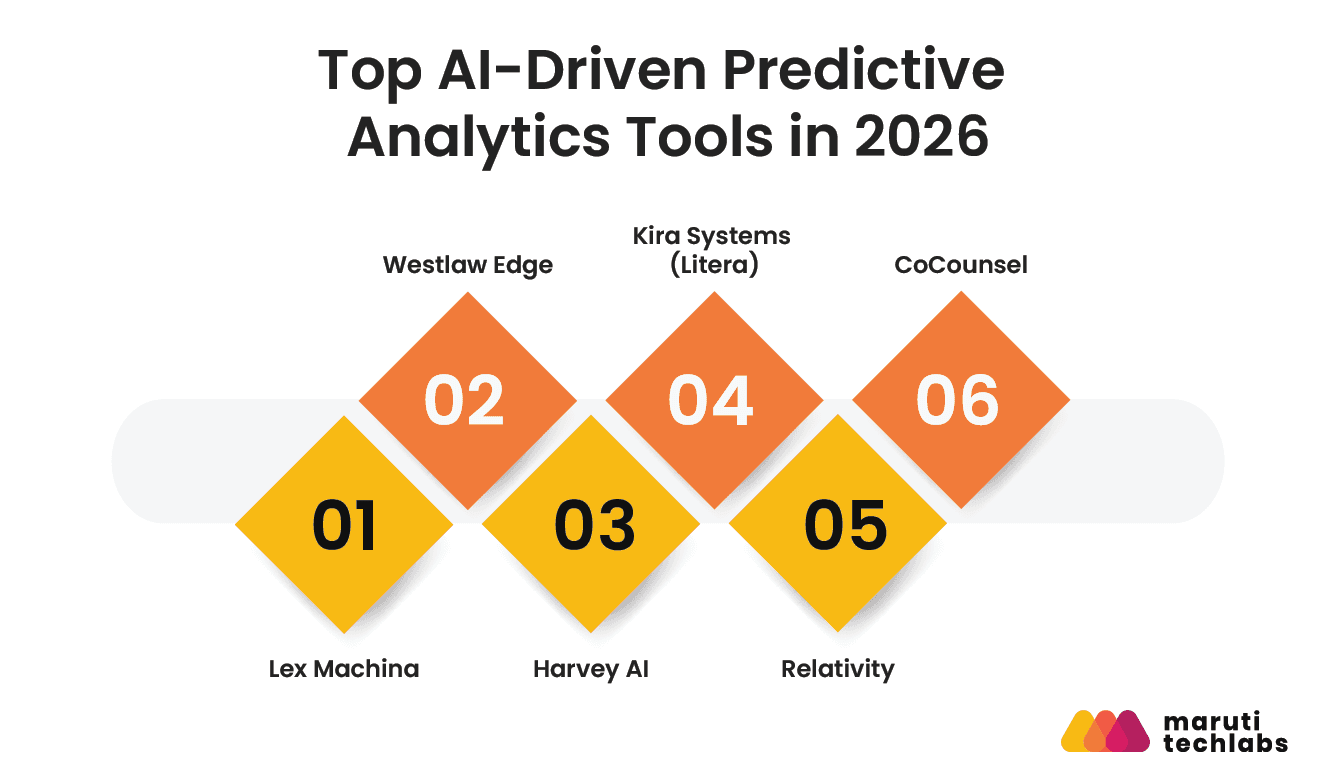
1. Lex Machina
- What it does: Litigation analytics and case outcome prediction based on judge, court, and party history
- Best for: Litigators building case strategy and evaluating venue or judge tendencies
- Key feature: Coverage across all 94 federal district courts, 13 courts of appeal, the PTAB, and 100+ enhanced state courts
- Pricing model: Custom enterprise licensing, typically sold firmwide rather than per seat
2. Westlaw Edge
- What it does: Legal research with AI-powered citation analysis, and litigation analytics layered on Westlaw's core research database
- Best for: Large firms that need research depth combined with outcome and judge analytics in one platform
- Key feature: AI-driven citation checking that flags overturned or questionable case law automatically
- Pricing model: Subscription-based, Pricing ranges from $107 to $455+ per user/month, depending on the plan and contract.
3. Harvey AI
- What it does: General-purpose legal AI assistant for drafting, research, and document review across practice areas
- Best for: Firm-wide adoption where multiple practice groups need one assistant rather than a point solution
- Key feature: Workflow flexibility, handling everything from legal ai due diligence to memo drafting inside one interface
- Pricing model: Enterprise, sales-led, Quote-only; median contract reported estimated pricing at $175,000/year
4. Kira Systems (Litera)
- What it does: Contract analysis and due diligence review, identifying and extracting clauses across large document sets
- Best for: Corporate and M&A teams handling high contract volumes
- Key feature: Cuts due diligence document review time by 60% to 80%, with reference customers at roughly 70 of the top 100 global law firms
- Pricing model: Module-based licensing within the Litera platform. Pricing starts at $100 to $500/user/month, or $12,000 to $60,000+/year for 10 users.
5. Relativity
- What it does: eDiscovery and document review platform built around predictive coding and review workflow management
- Best for: Litigation support teams managing large-scale document review and discovery
- Key feature: Predictive coding workflows that meet the technology-assisted review standards courts have accepted since Da Silva Moore
- Pricing model: Usage-based, typically priced by data volume or per-user hosting. Processing $25 to $75/GB one-time; hosting/licensing adds $75 to $250/user/month.
6. CoCounsel (Thomson Reuters)
- What it does: AI legal assistant for research, document review, drafting, and deposition prep, grounded in Westlaw and Practical Law content
- Best for: Mid-size firms and in-house teams wanting research-grounded AI without building their own tooling
- Key feature: Reached 1 million users across 107 countries as of February 2026, reflecting broad production use rather than pilot-stage adoption
- Pricing model: Subscription, sold through Thomson Reuters' existing Westlaw/Practical Law relationships. Price around $104 to $639/user/month depending on tier and Westlaw bundle
Quick Glance: Comparison of Top AI-Driven Predictive Analytics Tools for Legal Tech
| Tool | Primary Use Case | Best For | Pricing Model |
| Lex Machina | Litigation analytics | Litigators, case strategy | Custom enterprise |
| Westlaw Edge | Legal research + analytics | Large firms | Tiered subscription |
| Harvey AI | General legal AI assistant | Firm-wide adoption | Enterprise, sales-led |
| Kira Systems (Litera) | Contract analysis | Corporate/M&A teams | Module licensing |
| Relativity | eDiscovery | Litigation support | Usage-based |
| CoCounsel | Research-grounded AI assistant | Mid-size firms, in-house | Subscription |
Want to explore more legal AI solutions beyond predictive analytics? Our guide to Top 12 Legal AI Tools in 2026 breaks down the leading platforms, their key capabilities, use cases, and how they compare, helping you identify the right tools for your firm's specific needs.
What Are the Challenges & Limitations of AI-Driven Predictive Analytics in Legal Tech?
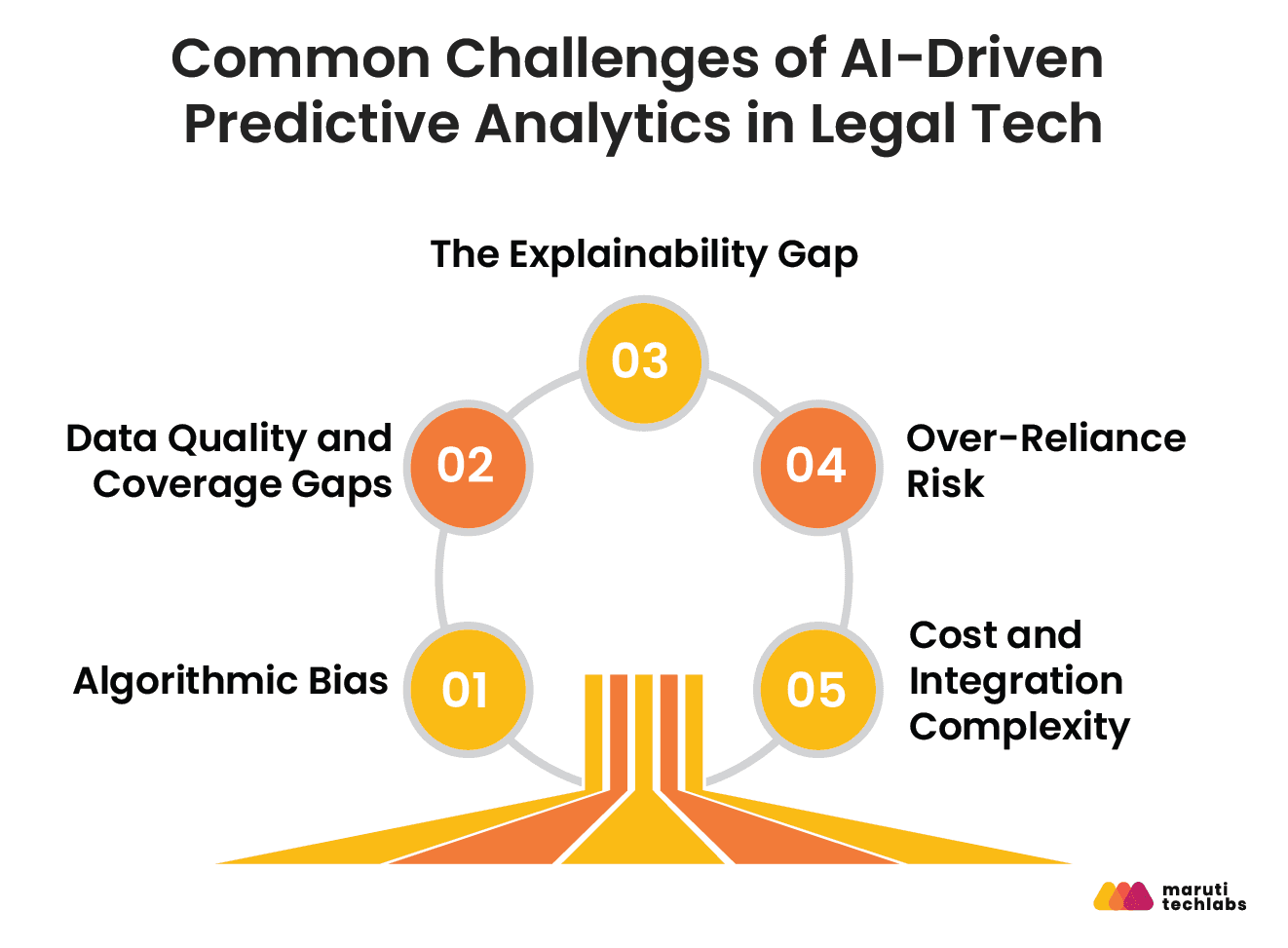
AI-driven predictive analytics carries real limitations around bias, data quality, transparency, over-reliance, and integration cost, but each of these is solvable with the right technology partner and a structured engineering approach.
1. Algorithmic Bias
Predictive models trained on historical legal data can absorb and reproduce the biases embedded in that data. If past court outcomes reflect systemic disparities, such as harsher sentencing patterns for certain demographics or inconsistent bail decisions across similar cases, a model trained on that data will learn those patterns as if they were neutral signals rather than problems to correct for.
This is especially risky in criminal law, where predictive tools trained on historical arrest and sentencing records can quietly reinforce the very disparities the legal system is supposed to guard against, even when no one involved intends that outcome.
How Maruti Techlabs Overcome This Challenge?
Every custom AI engagement starts with a feasibility study phase that includes a full qualitative and quantitative audit of the training data before any model development begins.
For a legal predictive analytics tool, that means reviewing case data for skew across demographics, jurisdictions, and case types before it ever trains a model, rather than discovering bias after deployment.
2. Data Quality and Coverage Gaps
Predictive analytics is only as reliable as the data behind it.
Civil litigation data is relatively well digitized through systems like PACER, but criminal sentencing data, family court records, and state-level filings are far less consistent from jurisdiction to jurisdiction.
How Maruti Techlabs Overcomes This Challenge?
The feasibility study process defines, preprocesses, and refines client datasets before model development begins.
This helps identify data gaps, siloed sources, and inconsistent formatting across jurisdictions early, preventing unreliable predictions later.
3. The Explainability Gap
Many predictive models, particularly deep learning systems, function as a black box, producing a probability score without a clear, traceable explanation of how it was reached.
This creates a problem when an attorney needs to justify a recommendation to a client or a court.
How Maruti Techlabs Overcomes This Challenge?
Maruti Techlabs builds AI systems designed to augment human decision-making rather than replace it. Every model includes a validation and traceability layer, incorporating explainable AI to make outputs transparent, interpretable, and source-verifiable.
In a legal research platform Maruti Techlabs built for a 475-attorney national law firm, this traceability layer was central to the design, giving attorneys a documented path back to the source behind every AI-generated insight instead of an unexplained score.
4. Over-Reliance Risk
AI output still requires human verification, and skipping that step carries real professional consequences.
In Mata v. Avianca (S.D.N.Y. 2023), a federal judge sanctioned two attorneys and their firm $5,000 after they submitted a brief containing six fabricated case citations generated by ChatGPT, none of which they had verified before filing.
How Maruti Techlabs Overcomes This Challenge?
This is the same design philosophy behind the traceability layer above.
For that national law firm's research platform, keeping a human validation step in the workflow drove a 3x improvement in insight accuracy and cut research time by 60%, proving that human-in-the-loop design speeds work up rather than slowing it down.
5. Cost and Integration Complexity
Enterprise-grade legal AI platforms carry significant licensing costs, and integrating them with a firm's existing case management systems, whether that's Clio, iManage, or NetDocuments, often requires dedicated implementation work.
How Maruti Techlabs Overcomes This Challenge?
Maruti Techlabs' AI integration capabilities connect custom AI models to a firm's existing systems through APIs and automation tooling built around each firm's specific workflow and infrastructure, rather than forcing a firm to replace its case management stack.
Most AI integration projects run 4 to 12 weeks depending on complexity, with role-based access, encryption, and audit logging built in from the start.
How to Choose the Right AI Legal Analytics Tool: A 6-Point Framework
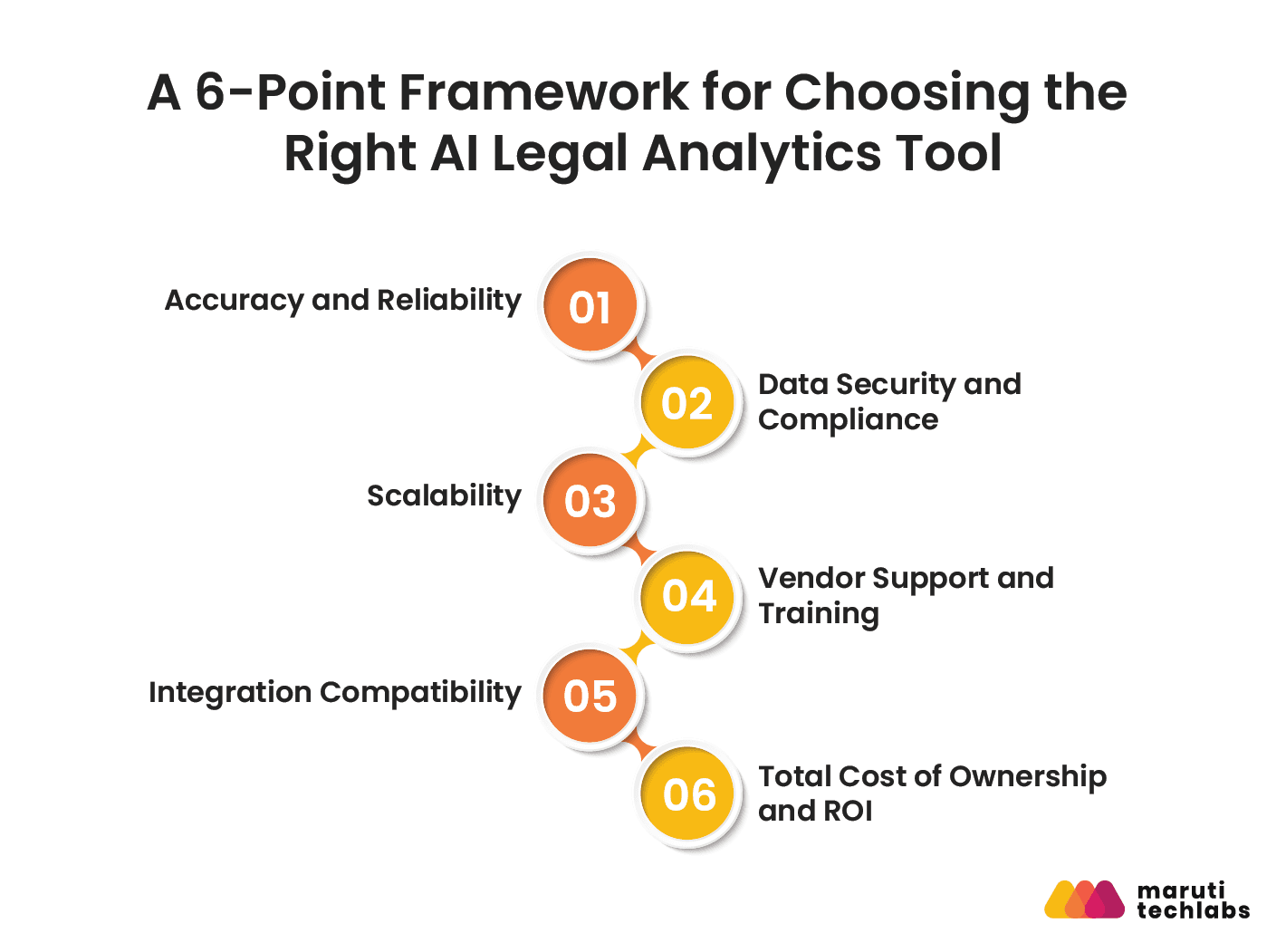
Choosing the right AI legal analytics tool comes down to six criteria: accuracy and reliability, data security and compliance, scalability, vendor support, integration compatibility, and total cost of ownership relative to ROI.
1. Accuracy and Reliability
The tool's predictions are only as useful as they are trustworthy. Ask vendors for accuracy benchmarks specific to your practice area and jurisdiction, not just an aggregate figure across all case types, since a tool's overall accuracy can mask much weaker performance in the specific area you need it for.
2. Data Security and Compliance
Legal data carries privilege and confidentiality obligations that most enterprise software doesn't have to account for. Confirm the vendor's encryption standards, data residency options, and compliance certifications before any client data touches the platform, and get clarity on whether your data is used to train the vendor's models for other customers.
3. Scalability
A tool that works well for a 20-attorney practice group may not hold up across a 500-attorney firm handling thousands of matters simultaneously. Evaluate how the platform performs under your actual document and case volume, not just the vendor's demo environment.
4. Vendor Support and Training
Adoption fails more often from poor onboarding than from poor technology. Look for vendors that provide structured training for your team and responsive technical support, since even an accurate tool delivers little value if attorneys don't trust it enough to use it consistently.
5. Integration Compatibility
The tool needs to work with the systems your firm already runs on, including your case management platform, document management system, and existing research tools. A platform that requires manual data transfer between systems adds friction that erodes the efficiency gains you're trying to capture in the first place.
6. Total Cost of Ownership and ROI
The license fee is only part of the cost. Factor in implementation time, staff training hours, ongoing support fees, and any infrastructure changes required, then weigh that total against the time and cost savings the tool is actually expected to deliver for your specific caseload.
Wondering where AI-Driven Predictive Analytics can deliver the most value for your law firm?
Our AI experts can assess your workflows, from litigation strategy and contract review to eDiscovery and compliance, and identify where predictive analytics can improve decision-making, reduce manual effort, and manage risk. Talk to an AI Solution Architect about building a custom AI legal analytics solution.
The Takeaway: Where AI-Driven Predictive Analytics Fits in Your Firm's Future
AI-driven predictive analytics is now more than an experimental add-on for legal teams. It's a practical decision support system built on three things:
- Better data
- Faster analysis, and
- More accurate risk assessment
Firms that adopt it well share three habits.
- First, they treat AI output as a starting point for attorney judgment, not a replacement for it, keeping a human validation step in every workflow.
- Second, they pick tools matched to their actual practice area and case volume rather than the most heavily marketed platform.
- Third, they plan for integration and training costs upfront instead of treating them as an afterthought once the tool is already purchased.
The technology itself keeps evolving, from litigation analytics platforms like Lex Machina to general-purpose assistants like CoCounsel, and the gap between firms using these tools well and firms still relying purely on manual review is only going to widen.
Ready to see where your firm stands? Take our free AI Readiness Assessment to identify the highest-impact places to start.
FAQs
1. What ethical concerns exist around AI in legal prediction, from a professional responsibility standpoint?
Attorneys have a duty of competence that extends to understanding the tools they use, including AI.
Bar associations in several states now require lawyers to understand the basic mechanics and limitations of AI tools before relying on them, verify AI-generated output before filing it, and maintain client confidentiality when feeding case data into third-party AI platforms.
Failing any of these can expose an attorney to malpractice or sanctions risk, not just an ethical gray area.
2. What are the risks of predictive analytics in legal tech?
Predictive analytics risks include biased training data, inaccurate forecasts in under-covered jurisdictions, client data privacy exposure, and over-reliance on AI output without verification.
Misinterpreting a probability score as a guarantee can lead to flawed strategic decisions, while a lack of explainability makes it harder to justify a recommendation to a client or a court.
3. Can AI help with predicting legal costs and billing estimates?
Yes. AI analyzes historical case data, billing patterns, and case complexity to forecast litigation costs and timelines. This improves budget accuracy for both firms and clients, supports better resource allocation across a caseload, and reduces the frequency of unexpected fees or billing disputes partway through a matter.
4. How are courts themselves adopting or regulating the use of AI-driven predictions?
Court adoption is uneven and moving faster than most firms expect.
Some jurisdictions now require attorneys to disclose AI use in filings, and several courts have issued standing orders addressing AI-generated content specifically, largely in response to the wave of sanctions for fabricated AI citations.
Courts remain far more cautious about AI making or influencing judicial decisions than about lawyers using it for research or drafting support.
5. How do law firms keep their AI models accurate over time?
Firms maintain model accuracy by continuously updating training data with new rulings, monitoring for emerging bias as case law evolves, validating predictions against actual outcomes, and conducting regular audits with expert oversight.
Without this maintenance cycle, a model's accuracy degrades as case law and regulations shift.
6. What is legal predictive analytics?
Legal predictive analytics uses machine learning models trained on historical court data, including past rulings, judge decisions, and case outcomes, to estimate the probability of specific outcomes in a current or future case.
It helps lawyers gauge case strength, evaluate settlement timing, and forecast litigation costs based on how similar cases are resolved.
7. Can AI accurately predict court outcomes?
AI can estimate outcome probabilities, but accuracy varies significantly by practice area and jurisdiction.
Prediction tends to be strongest in areas with large, well-digitized historical datasets, such as IP litigation and commercial contract disputes, and weakest for novel legal questions, unusual fact patterns, or courts with limited digitized case history.
No tool guarantees an outcome, and providers that claim otherwise should be evaluated with caution.
8. What is the best AI tool for legal research?
The right tool depends on your practice area and firm size:
- Westlaw Edge suits firms that need deep US case law coverage paired with citation analytics,
- CoCounsel fits teams that want AI-assisted research grounded directly in Westlaw and Practical Law content, and
- Harvey AI works well for firms wanting one general-purpose assistant across research, drafting, and document review.
How Maruti Techlabs Cut Deposition Review Time by 95% for a 500-Attorney Law Firm?
One of Maruti Techlabs' clients, a U.S. law firm with over 500 attorneys, found that case preparation didn't start with legal strategy.
It started with the mechanics of reviewing lengthy deposition transcripts, searching for the specific testimony that mattered to a case, and piecing together evidence scattered across multiple witnesses and documents. That process created real friction for the firm's litigation teams.
Attorneys and paralegals were manually scanning hundreds of pages of transcript per deposition to find a handful of relevant statements. There was no structured way to cross-reference testimony across witnesses, which meant hours of attorney time went into work that had little to do with actual case strategy.
The sheer volume of material also created real risk of missing relevant testimony simply because of how much had to be reviewed by hand.
Maruti Techlabs built an AI-powered platform by utilizing our custom AI/ML development capabilities that automated deposition transcript analysis and generated citation-backed summaries.
As a leading custom legal software development company, our legaltech experts gave the firm's litigation teams a searchable, structured view of testimony instead of a stack of raw transcripts to work through manually.
The platform was designed so every summary traces directly back to its source citation in the original transcript. That gives attorneys a verifiable path to the underlying testimony, rather than a black-box summary they'd have to double-check by hand.
This traceability layer was central to the design, since litigation teams need to cite specific testimony in filings and can't afford to work from a summary they can't independently verify.
The impact:
- 95% reduction in deposition transcript review time
- 95%+ citation accuracy in AI-generated summaries
- Significantly faster identification of relevant testimony across witnesses
- The platform is now a standard part of the firm's case preparation workflow across matters