

How LLMs Work: Tokenization vs. Embedding vs. Transformer
Key Takeaways
- Tokenization breaks text into smaller units and maps them to token IDs that an LLM can process.
- Embeddings convert token IDs into numerical vectors that capture learned language patterns.
- Transformers use self-attention and neural network layers to process token relationships and build contextual representations.
- LLMs generate responses by predicting the next token repeatedly until a stopping condition is reached.
- Production LLM applications need more than a capable model: they also need efficient context management, relevant retrieval, security controls, and monitoring.
When you type a prompt into ChatGPT, Claude, or Llama and receive a coherent response, it feels almost magical. The model appears to understand language, reason about facts, and generate fluent text. In reality, something far more mechanical is happening.
At their core, large language models do only one thing: they predict the next token.
That single objective, repeatedly guessing the most probable next piece of text given everything that came before, is enough to produce the remarkable capabilities we now take for granted. To make this prediction, the model never “reads” words the way humans do. Instead, it converts language into mathematics through three essential stages:
- Tokenization: Breaking raw text into discrete units the model can process
- Embedding: Turning those units into numerical vectors that capture meaning
- The Transformer: Using attention and layered computation to build context and decide what comes next
These three components form the complete pipeline of every modern LLM:
Text → Tokens → Embeddings → Transformer layers → Probabilities → Next token
Understanding each stage's distinct role, and how they differ, is key to demystifying how large language models actually work.
In this guide, we will examine tokenization, embedding, and the transformer architecture in turn, compare them clearly, and walk through a concrete example that shows how a single sentence travels through the entire system. Understanding these components is also essential when building production-ready generative AI solutions.

We help enterprises assess data readiness, identify the right LLM use cases, and build the technology foundation for production AI.
How Do Large Language Models (LLMs) Work?
Large Language Models (LLMs) are AI models trained on large amounts of text to recognize language patterns and generate human-like responses. For enterprise teams, how this works determines three things you pay for: context limits, retrieval quality, and latency.
At their core, LLMs work by predicting the next token based on the text that came before it. A token can be a complete word, part of a word, or a punctuation mark. The model repeats this prediction process to generate a complete response.
Here's how the process works when you enter a prompt into an LLM:
- Tokenization: The model's tokenizer breaks your prompt into smaller units called tokens and maps them to numerical IDs.
- Embeddings: These token IDs are converted into numerical vectors that the model can process. Positional information also helps the model account for token order.
- Transformer processing: The Transformer uses mechanisms such as self-attention to process relationships between tokens and build contextual representations.
- Next-token prediction: The model calculates probabilities for possible next tokens and selects one according to its decoding strategy.
- Response generation: The process repeats, with each generated token becoming part of the context for subsequent predictions, until the model reaches a stopping condition.
For example, when you enter "The capital of France is...", the model uses the context to assign a high probability to "Paris." It then continues predicting subsequent tokens if more text is needed.
The three core concepts work together, but each has a distinct role. Tokenization prepares the text, embeddings represent tokens numerically, and the Transformer processes their context to help generate the response.
Understanding these differences makes it easier to see how an LLM turns a text prompt into a meaningful sequence of output tokens.
What Is Tokenization in an LLM?
Tokenization is the process of breaking input text into smaller units called tokens that an LLM can process. Depending on the tokenizer, a token may represent a complete word, part of a word, punctuation, or another text unit.
Before an LLM can process your prompt, its tokenizer splits the text into tokens and maps them to numerical IDs. These IDs are then used to retrieve the corresponding token embeddings that the model processes.
For example, consider the sentence:
“AI makes businesses smarter.”
A simplified tokenization might look like this:
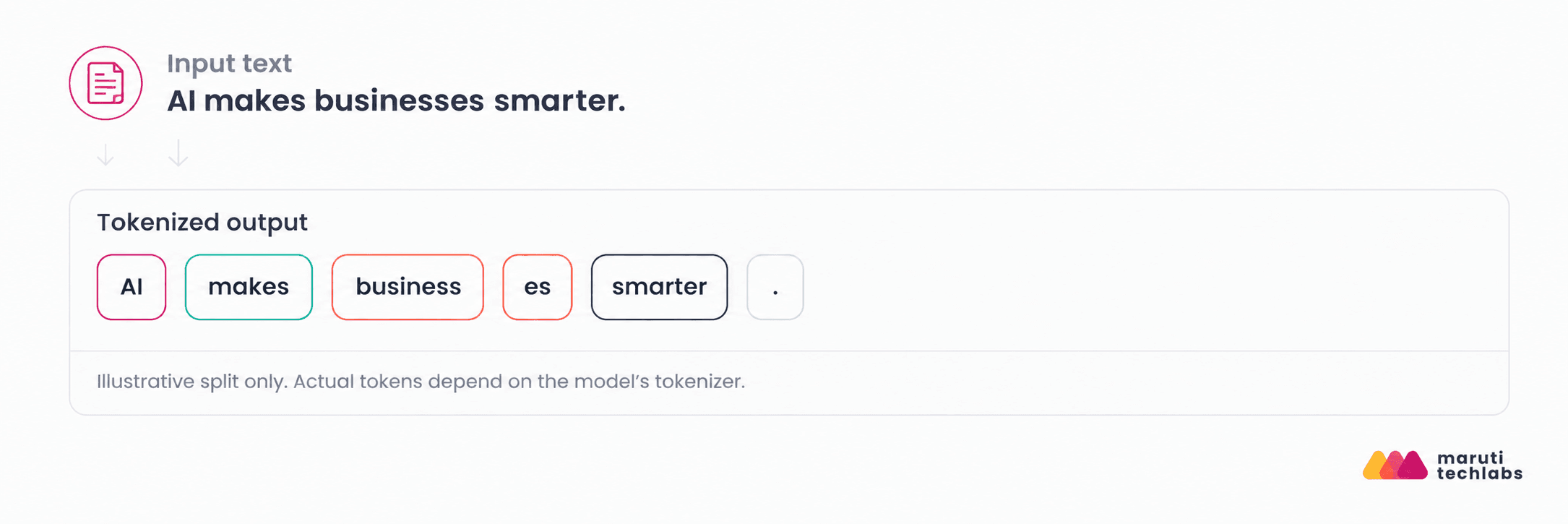
Notice that a word such as "businesses" may be split into multiple tokens rather than treated as one complete word. Tokenizers use learned vocabularies and specific rules to determine these boundaries.
How Does Tokenization Convert Text into Token IDs?
Once the text is split into tokens, the tokenizer maps each token to a numerical ID from its vocabulary. These IDs allow the model to work with a consistent, machine-readable representation of the input.
The process looks like this:
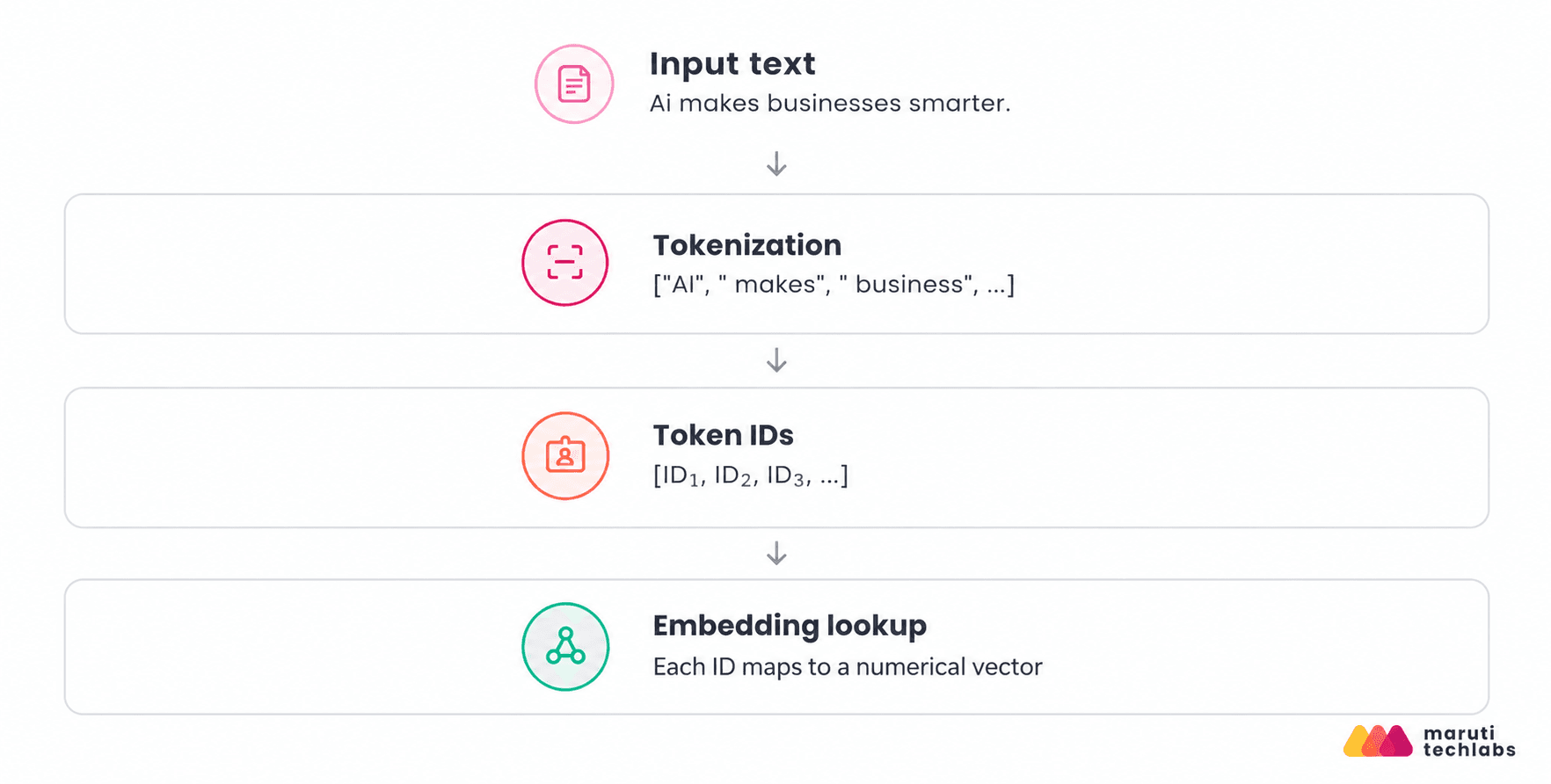
The IDs shown here are placeholders, not actual IDs from a particular model. The same text can produce different token boundaries and IDs when processed by different tokenizers.
Words vs. Subwords vs. Characters: What Counts as a Token?
LLMs can use different tokenization approaches, but many modern models rely on subword tokenization. This approach balances vocabulary size with the ability to handle unfamiliar words.
| Tokenization approach | How it works | Example |
| Word-level | Treats complete words as units | learning |
| Subword-level | Splits words into smaller, reusable units | learn + ing |
| Character-level | Treats individual characters as units | l + e + a + r + n |
These examples are conceptual. Actual segmentation depends on the tokenizer.
Subword tokenization is particularly useful because a model can represent unfamiliar words by combining known pieces instead of requiring a separate vocabulary entry for every possible word.
How Tokenization Affects Context Windows, API Costs, and Model Performance
Tokenization directly affects how much text an LLM can process and how much it costs to run.
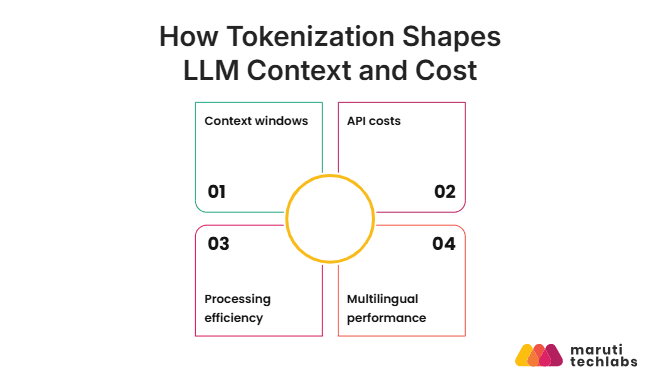
- Context windows: Models have a maximum context capacity measured in tokens. The prompt, conversation history, system instructions, and other input content all contribute to that limit.
- API costs: Many hosted LLMs charge based on input and output token counts. Longer tokenized prompts or responses can increase usage costs.
- Processing efficiency: Different tokenizers may represent the same text with different numbers of tokens. This can affect how much information fits within a context window and how efficiently text is processed.
- Multilingual performance: Some languages and writing systems may require more tokens than others to express comparable content, depending on the tokenizer. This can affect cost and how you use context.
For engineering teams, token counts are therefore more than a technical detail. They influence prompt design, model selection, application architecture, and inference budgets.
Tokenomics: Understanding the Cost of Using LLMs
Tokenomics refers to the economics of token consumption: how token usage affects inference costs, context utilization, and the overall cost of running an AI application. Effective strategies can help you reduce LLM costs. Let’s understand tokenomics with an example.
Consider an AI assistant that processes customer support queries. Each request may contain a system prompt, the user's question, conversation history, retrieved documents, and the model's response. All of this can contribute to token consumption.
The following factors determine how token usage translates into operating costs:
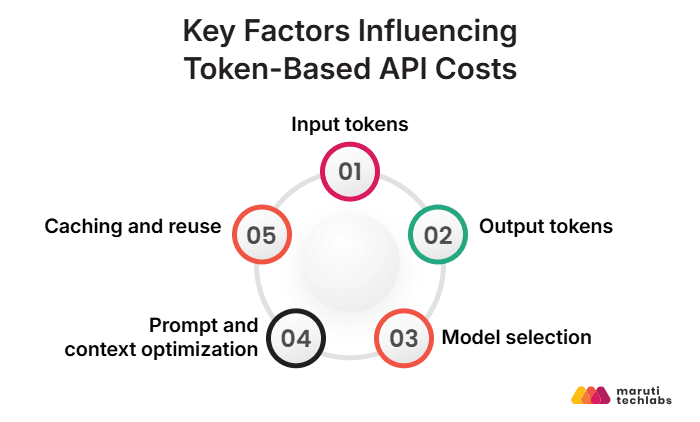
- Input tokens: Instructions, user prompts, conversation history, and retrieved context sent to the model.
- Output tokens: The text generated by the model. Output tokens often have different pricing from input tokens.
- Model selection: Different models can have different token prices, capabilities, and latency characteristics.
- Prompt and context optimization: Removing redundant instructions, limiting unnecessary history, and retrieving only relevant documents can reduce input token usage.
- Caching and reuse: Where supported, caching repeated prompts or reusing results can reduce repeated processing costs.
For example: if each request carries 3,000 tokens of history and the app handles 20,000 requests a day, that is 60 million input tokens daily from history alone. Trimming history to the 500 most relevant tokens cuts it to 10 million.
Tokenization determines how text is represented and counted. Understanding token usage helps teams manage context limits and make informed decisions about the cost of running LLM-powered applications.
Watch how Maruti Techlabs applies its AI expertise to build intelligent, enterprise-ready solutions.
What Are Embeddings in an LLM?
Embeddings are numerical vectors that represent tokens or pieces of text in a form an LLM can process. Tokenization converts text into token IDs, and embeddings map those IDs to learned numerical vectors.
These vectors help the model capture language patterns, including relationships between words, phrases, and their surrounding context. For example, tokens that appear in similar contexts during training tend to end up with similar vectors. That is why “doctor” and “nurse” sit close together.
Embeddings are not fixed definitions of words. Their values are learned during model training, and their interpretation depends on the model and how the vectors are used.
How Do Token IDs Become Numerical Vectors?
After tokenization, an embedding matrix maps each token ID to a vector. This matrix contains learned parameters that the model updates during training.
Consider the sentence: “AI helps businesses grow.”
The process looks like this:
Input text → “AI helps businesses grow.”
Tokenization → [AI] [ helps] [ businesses] [ grow] [.]
Token IDs → [ID₁, ID₂, ID₃, ID₄, ID₅]
Embedding lookup → Each ID maps to a numerical vector.
For illustration, a token might map to a vector such as [0.21, -0.47, 0.83, ...]. Real models typically use vectors with hundreds or thousands of dimensions, depending on their architecture.
At this stage, each token has a numerical representation. The Transformer layers then process these representations to account for the other tokens in the sequence.
How Do Embeddings Capture Relationships Between Words?
During training, an LLM adjusts its embedding values as it learns patterns from text. Tokens that appear in related linguistic contexts can develop related representations, although the exact relationships depend on the model and training process.
For example, “Paris” may be associated with concepts such as France, cities, and capitals. These associations are not manually assigned definitions. They emerge from patterns the model learns during training.
The distinction between initial embeddings and contextual representations is important:
- Token embeddings provide the model's initial learned vector for each token.
- Contextual representations are produced as the Transformer processes those vectors alongside the surrounding sequence.
This lets the same token take on different meanings depending on context. For instance, “bank” means something different in “river bank” than in “bank account.” The Transformer uses context to build representations that reflect these differences.
Why Do LLMs Need Positional Information?
Self-attention on its own has no sense of word order. Without positional information, the model would treat “The API calls the database” and “The database calls the API” as the same input.
Compare these two prompts:
- “The API calls the database.”
- “The database calls the API.”
Both sentences use the same key terms, but their meanings differ because the subject and object switch positions. In the first sentence, the API initiates a request to the database. In the second, the database calls the API.
This distinction matters when an LLM processes technical documentation, interprets system architectures, or generates code-related responses. Positional information helps the model account for token order and relationships within the input.
Token Embeddings vs. Text Embeddings: What Is the Difference?
The term embedding is also used in semantic search and retrieval-augmented generation (RAG). Although both approaches represent language numerically, token embeddings and text embeddings typically serve different purposes.
| Aspect | Token embeddings in an LLM | Text embeddings for search |
| Input | Individual token IDs | A word, sentence, paragraph, or document |
| Output | A vector for each token | Typically, one vector representing the input text |
| Main purpose | Provide token representations for model processing | Represent semantic similarity for retrieval |
| Common use | Language generation and understanding within the model | Semantic search, document retrieval, and RAG |
| Context | Processed further by Transformer layers | Compared with other vectors using a similarity measure |
For example, a RAG system may convert a user's question and a collection of documents into text embeddings. It can then retrieve documents whose vectors are similar to the question's vector.
By contrast, an LLM's token embeddings are part of the model's internal processing pipeline. Some embedding models also use Transformer architectures, but their output and training objectives may differ from those of a text-generating LLM.
Embeddings convert token IDs into learned numerical representations. Positional information helps account for sequence order, and Transformer layers build contextual representations that support next-token prediction.
Tokenization vs. Embeddings vs. Transformers: What Is the Difference?
Tokenization, embeddings, and Transformers are different stages of the LLM processing pipeline. They are closely connected, but they perform fundamentally different jobs.
Tokenization converts text into tokens and token IDs. Embeddings convert those IDs into numerical vectors. Transformers process those vectors in context and learn relationships between them.
| Component | What it does | Input | Output | Role in an LLM |
| Tokenization | Breaks text into manageable units | Raw text | Tokens and token IDs | Converts human-readable text into a machine-processable format |
| Embeddings | Represents tokens as numerical vectors | Token IDs | Embedding vectors | Gives tokens a learned numerical representation |
| Transformer | Processes relationships between tokens | Embeddings and positional information | Contextual representations | Uses context to support understanding and next-token prediction |
| Next-token prediction | Estimates what comes next | Contextual representation | Token probabilities | Drives text generation |
What Happens to a Prompt at Each Stage?
The easiest way to understand the difference is to look at what happens to a technical prompt as it moves through an LLM.
Suppose you ask:
“Why is my API returning a 401 error?”
The process can be simplified into four stages:
1. Tokenization
The tokenizer breaks the prompt into tokens.
Why | is | my | API | returning | a | 401 | error | ?
The exact token boundaries depend on the tokenizer and model.
2. Token IDs
Each token is mapped to an ID from the model's vocabulary.
[ID₁, ID₂, ID₃, ID₄, ID₅, ID₆, ID₇, ID₈, ID₉]
3. Embeddings
The token IDs are mapped to numerical vectors that represent the tokens within the model's learned embedding space.
ID₄ → [0.12, -0.38, 0.74, ...]
The vectors shown here are illustrative. Real embedding dimensions and values depend on the model.
4. Transformer processing
The Transformer processes these representations using self-attention and other neural network components. It considers relationships between terms such as API, 401, and error along with the rest of the available context.
The resulting contextual representations are then used to calculate probabilities for possible next tokens.
How Do the Three Components Work Together?
Think of the process as a pipeline:
Text
↓
Tokenization
Break text into tokens and assign token IDs
↓
Embeddings
Convert token IDs into numerical vectors
↓
Positional information
Represent where tokens occur in the sequence
↓
Transformer layers
Process contextual relationships using attention and neural network layers
↓
Output probabilities
Calculate the likelihood of possible next tokens
↓
Next token
Select a token and add it to the sequence
↓
Repeat
Continue until the model reaches a stopping condition
This pipeline explains why it is inaccurate to say that an LLM simply "understands a sentence" as soon as it receives it. The input passes through multiple numerical transformations before the model produces an output.
The three components also operate at different levels:
- Tokenization is a text-processing step.
- Embeddings are a numerical representation step.
- The Transformer is the neural network architecture that processes those representations.
This distinction matters most when designing LLM applications. For example, tokenization affects context and usage costs, embeddings are central to many retrieval systems, and Transformer-based inference influences latency and computational requirements.
The components are therefore best understood as parts of one processing pipeline rather than competing technologies.
How Does an LLM Generate a Response? A Clear Step-by-Step Process
When you enter a prompt into an LLM, the model does not generate the entire response in one operation. It processes the available context and predicts the response one token at a time.
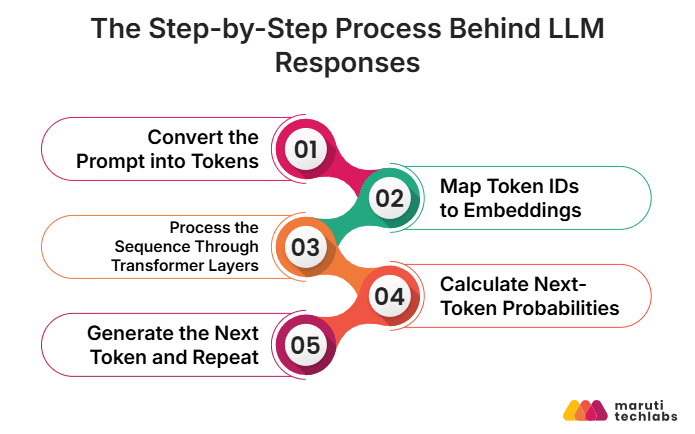
Consider a technical prompt:
“Explain why an API gateway returns a 401 error.”
A simplified version of what happens next looks like this:
Prompt → Tokenization → Embeddings → Transformer layers → Next-token prediction → Generated token → Repeat
Let's break down each stage.
Step 1: Convert the Prompt into Tokens
The tokenizer first breaks the prompt into tokens and assigns each token a numerical ID.
For example:
“Explain why an API gateway returns a 401 error.”
might be represented conceptually as:
Explain | why | an | API | gateway | returns | a | 401 | error | .
The actual tokenization can differ between models. A term such as “gateway” may be represented as one token or multiple subword tokens depending on the tokenizer's vocabulary.
The resulting token IDs become the input the model processes.
Step 2: Map Token IDs to Embeddings
The token IDs are then mapped to learned embedding vectors.
Instead of processing:
API → "API"
the model works with a numerical representation associated with that token.
For example:
API → [0.18, -0.42, 0.67, ...]
The numbers above are illustrative. Real models use high-dimensional vectors whose values are learned during training.
Positional information is also incorporated so that the model can distinguish between different token positions.
This matters because:
“The API calls the database”
and
“The database calls the API”
contain similar terms but describe different relationships.
Step 3: Process the Sequence Through Transformer Layers
The embeddings are passed through multiple Transformer layers.
Within these layers, self-attention allows the model to calculate relationships between tokens. For the API troubleshooting prompt, the model can process relationships between terms such as API, gateway, 401, and error along with other available context.
Each Transformer layer transforms the representations it receives. As information passes through multiple layers, the model builds increasingly contextual representations of the input.
In decoder-only models such as GPT-style LLMs, causal attention lets each token look only at earlier tokens, so the model can't see text it hasn't written yet.
Step 4: Calculate Next-Token Probabilities
After processing the available context, the model produces scores for possible tokens in its vocabulary.
These scores are converted into probabilities.
For example, after the prompt:
“An HTTP 401 error usually indicates...”
Suppose the model has already started its answer with “An HTTP 401 error usually indicates”. Its next prediction might look like this:
| Possible next token | Illustrative probability |
| authentication | 42% |
| authorization | 21% |
| invalid | 9% |
| a | 5% |
| other tokens | 23% |
These numbers are purely illustrative. The actual probability distribution depends on the model, prompt, and decoding configuration.
The model then selects a token based on its decoding strategy.
Step 5: Generate the Next Token and Repeat
Suppose the model selects:
“authentication”
That token is added to the sequence.
The model then processes the updated context to predict the next token.
It might generate:
“An HTTP 401 error usually indicates an authentication problem...”
The process continues:
Context → Predict next token → Add token → Predict again
This repeats until the model hits a stopping condition, such as generating an end-of-sequence token or reaching a configured output limit.
This is why LLMs are often described as next-token prediction systems. The model repeatedly estimates what token should come next based on the context available at that point.
What Happens to the Generated Tokens?
The application eventually converts the generated tokens back into text that it displays to the user.
The application converts the generated token IDs back into text, a step called detokenization, and displays the response.
The important point is that tokenization, embeddings, and Transformer processing are not separate features that an LLM chooses between. They are interconnected parts of the model's processing pipeline.
For an enterprise LLM application, this pipeline also has practical implications. Input and output tokens affect usage costs, context length affects memory and latency requirements, and model architecture influences the computational resources needed for inference.
Why Do These Components Matter When Building LLM Applications?
Understanding tokenization, embeddings, and Transformers helps engineering teams make informed decisions about LLM application costs, retrieval quality, performance, and reliability.
Tokenization: Managing Context and Costs
Every prompt and generated response consumes tokens. Longer prompts and conversation histories can increase API costs, processing time, and context window usage.
For example, an enterprise AI assistant analyzing cloud logs can reduce unnecessary token consumption by filtering irrelevant records and sending only the context needed to investigate an incident.
Embeddings: Improving Information Retrieval
Embeddings enable semantic search, letting applications retrieve information by meaning rather than exact keyword matches.
In a retrieval-augmented generation (RAG) system, an AI assistant can retrieve relevant incident reports, technical documentation, or internal knowledge base articles before generating an answer. Retrieval quality also depends on chunking, metadata, access controls, and the embedding model.
Transformers: Balancing Performance and Latency
Transformer architecture, model size, input length, and output length influence inference performance and resource requirements.
Engineering teams can evaluate model selection, context management, optimized inference, and output limits to balance response quality, latency, and computational cost.
Why Isn't a Working LLM Pipeline Enough for Production?
A well-functioning LLM pipeline does not guarantee accurate or secure outputs. Production applications also need evaluation, access controls, reliable data retrieval, output validation, monitoring, and human approval for consequential actions.
For example, an AI assistant analyzing cloud security findings should validate recommendations and enforce permissions before any production infrastructure changes are made.
Tokenization affects token consumption, embeddings support semantic retrieval, and Transformers enable contextual processing and generation. Reliable enterprise LLM applications require these components, along with sound data engineering, security, and operational controls.
Connecting the Dots: Tokenization, Embeddings, and Transformers
Tokenization, embeddings, and Transformers perform distinct but interconnected roles in how large language models process and generate text. Understanding these fundamentals helps engineering teams make informed decisions about model selection, inference costs, retrieval quality, and application performance.
For businesses building enterprise AI solutions, this knowledge provides a foundation for developing efficient, secure, and reliable LLM applications in production.
Frequently Asked Questions
1. What Is the Difference Between Tokenization and Embeddings?
Tokenization breaks text into smaller units called tokens and maps them to token IDs. Embeddings convert those IDs into numerical vectors that an LLM can process. Tokenization represents text as discrete units, while embeddings provide learned numerical representations for those units.
2. Is a Transformer the Same as an LLM?
No. A Transformer is a neural network architecture, while a large language model (LLM) is an AI model trained to process and generate language. Many widely used LLMs use Transformer architectures, but the terms describe different things. An LLM also includes learned parameters, a tokenizer, and other components required for inference.
3. Do All LLMs Use Transformers?
No. Many modern LLMs use Transformer architectures, but language models can also be built using other neural network architectures, including recurrent neural networks and state-space models such as Mamba. Transformer-based models remain widely used because attention mechanisms effectively learn relationships across token sequences.
4. How Do Embeddings Help LLMs Process Language?
Embeddings represent tokens as numerical vectors learned during training. These vectors provide the numerical input that Transformer layers process to build contextual representations.
In a separate use case, text embeddings represent sentences or documents as vectors for semantic search, document retrieval, and retrieval-augmented generation (RAG).
5. Why Do LLMs Predict One Token at a Time?
Autoregressive LLMs generate text by predicting the next token from the context available so far. After selecting a token, the model adds it to the sequence and predicts the next one.
This process repeats until the model reaches a stopping condition, such as an end-of-sequence token or an output limit. Some language models use different generation approaches, so this description applies specifically to autoregressive generation.
6. How Many Tokens Are in a Word?
For English text on OpenAI's tokenizers, one token averages about three-quarters of a word, so 100 tokens is roughly 75 words. The ratio varies by tokenizer, and non-English text usually needs more tokens.
How Did We Cut AI Costs from $15 to Under $1 per Operation in an Automotive Data Workflow?
A US-based automotive platform that connects used-car sellers with a large buyer network wanted to understand how users interact with its platform. It had invested in a general-purpose AI platform for autonomous data analysis. The results were accurate, but every request ran as a single end-to-end operation regardless of size or complexity.
As usage grew, the approach became unsustainable.
- Each run cost around $15.
- Processing often took up to 35 minutes.
- Token limits became a major concern as data volumes grew.
- Repeated or evolving queries were hard to handle.
Our team redesigned the workflow using n8n as the orchestration layer and an agent-driven architecture. Instead of one heavy operation, the work was split into smaller steps handled by specialized agents.
- Engineer Agent interprets the query and generates scripts dynamically.
- Data Analysis Agent processes the data using libraries such as pandas.
- Formatter Agent structures the output into a consistent format.
- Visualization Agent prepares the data for easier interpretation.
- Destination Agent delivers results to tools such as Slack or Asana.
The redesigned workflow brought cost per operation from $15 to under $1 and cut processing time from 35 minutes to under 5. It now scales to high-volume, frequent requests, and the workflows are easier to adapt as needs change.
If you're planning an LLM application and want to get cost, context, and reliability right from the start, connect with our AI experts today.
Our AI engineers design enterprise LLM applications around efficient context management, relevant retrieval, and secure, reliable performance.