Centralized views, continuous asset discovery, access management, and tool integration are critical for deeper visibility.
Organizations that invest in multi-cloud visibility today are better positioned to scale securely and operate with confidence in 2026 and beyond.
Introduction
Managing cloud environments today feels challenging for many teams. Things change fast, with new cloud accounts, tools, and users being added almost every day. It becomes difficult to track what exists and who owns it.
Most teams lack a single, clear view of their entire cloud setup. Each cloud provider shows only its own environment, not how everything connects. Because of this, teams miss important details, such as who has excessive access, where sensitive data is going, or when security settings change without notice. As the saying goes, “If you can’t see it, you can’t secure it.”
These gaps create blind spots where small issues go unnoticed, unused resources build up, shadow IT grows quietly, and problems are usually discovered only after something breaks or a security incident occurs.
This blog explains why cloud visibility feels overwhelming, how fragmented views increase risk, and why multi-cloud asset visibility is no longer optional.
Understanding Multi-Cloud Asset Visibility
Multi-cloud asset visibility means having a clear and complete view of everything running across your cloud environments. This includes public clouds such as AWS, Azure, and GCP, as well as private clouds and on-premises systems.
Instead of checking multiple dashboards, teams can understand what assets exist, how they are connected, and how they are being used from one place.
When visibility is in place, teams can focus on what really matters:
Infrastructure health: See how systems are performing and identify issues before they affect users.
Resource utilization: Understand which resources are actively used and which are sitting idle.
Cost management: Track spending patterns and identify opportunities to reduce cloud costs.
The real problem starts when visibility is fragmented. Most organizations see their cloud assets in silos, with each provider showing only its own part of the environment. This creates a visibility crisis across multi-cloud setups.
Here is how these gaps show up:
Mixed signals on standards: Without a single source of truth, teams struggle to follow the same security rules across clouds.
Disconnected risks: It becomes hard to link assets with risks such as vulnerabilities, excessive permissions, or data exposure.
Orphaned and misconfigured resources: Assets are created without clear owners, leaving no one responsible for securing them.
Over time, these blind spots increase risk. If left unchecked, they can lead to data breaches, compliance issues, and reputational damage. Strong multi-cloud asset visibility helps teams stay in control, reduce risk, and make better decisions as their cloud environments continue to grow.
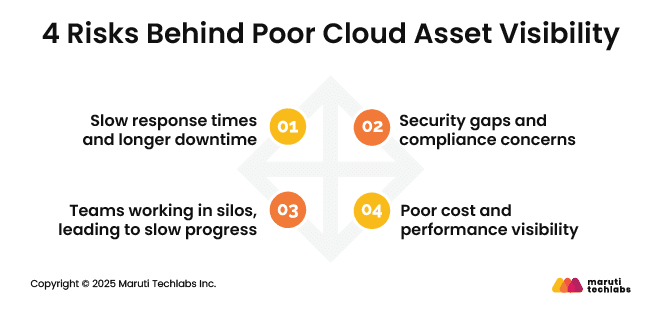
4 Risks Behind Poor Cloud Asset Visibility
When teams lack clear visibility into their cloud environment, everyday work becomes more difficult. What starts as small gaps in visibility slowly turns into bigger business problems. Teams spend more time reacting to issues instead of preventing them.
1. Slower response and longer downtime
When an application fails, teams often struggle to identify where to begin. Information is scattered across AWS, Azure, and other tools. People end up spending more time looking for answers than actually fixing the problem, leaving systems down and business teams frustrated.
2. Security gaps and compliance worries
When teams can’t clearly see all cloud resources, it’s hard to know who has access to what. Old permissions stay active, settings change without notice, and some resources are forgotten. Compliance checks turn into guesswork, and security issues surface only after a problem arises.
3. Teams working in silos and slower progress
When teams rely on different views of the cloud, collaboration suffers. During incidents, it is unclear who owns what. Instead of building and improving systems, teams spend their time putting out fires. Over time, this slows down releases and innovation.
4. Poor cost and performance clarity
Without a clear view of usage and performance, cloud spending becomes hard to control. Unused resources keep running, costs rise quietly, and performance problems are noticed only when users complain.
Poor visibility doesn’t just affect IT. It impacts stability, growth, and trust across the business.
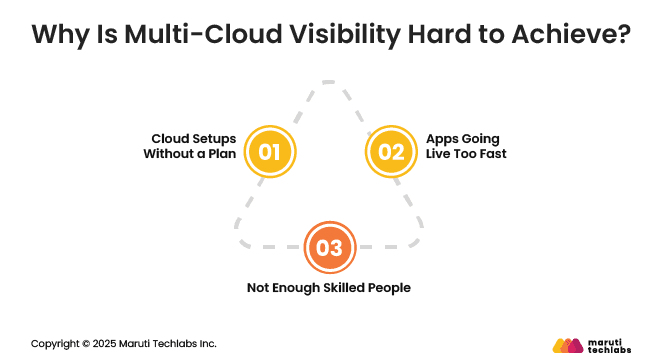
Why Is Multi-Cloud Visibility Hard to Achieve?
Getting a clear view of all your cloud environments is not as easy as it sounds. You have AWS here, Azure there, maybe some private cloud, and on-prem systems too.
As new applications launch and teams operate in different tools, visibility breaks down, and gaps begin to appear.
1. Cloud Setups Without a Plan
Many organizations adopt the cloud without a clear overall plan. AWS, Azure, and other platforms are set up independently, each with its own rules and monitoring. Over time, teams realize they lack a single, unified view.
2. Apps Going Live Too Fast
New applications, updates, and integrations are added almost every day. Teams often don’t have time to check if everything is set up safely. Things slip through the cracks simply because the cloud moves faster than the team can keep up.
3. Not Enough Skilled People
Monitoring multiple clouds and keeping track of all the resources takes experience. Many organizations don’t have enough trained staff to spot problems quickly. This leaves gaps where errors, misconfigurations, or wasted resources can quietly grow.
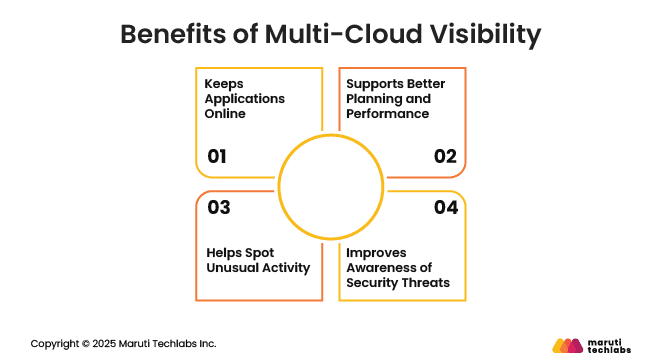
Benefits of Multi-Cloud Visibility
Having clear visibility across your cloud environments makes everyday operations easier and safer. When teams can see what is running, how it is performing, and what is changing, they can act early rather than react late.
Below are some key benefits of strong multi-cloud visibility.
1. Keeps Applications Online
Multi-cloud visibility helps teams spot issues early and fix them before users are affected. When problems are easier to see, applications stay online longer and run more smoothly. This also reduces pressure on IT teams, as they spend less time handling avoidable outages and repeated errors.
2. Supports Better Planning and Performance
When teams understand how applications are used, planning becomes simpler. Visibility shows when systems need more capacity and when resources are being underused. This helps teams adjust scaling rules, improve performance, and avoid slowdowns during peak usage, without wasting cloud resources.
3. Improves Awareness of Security Threats
Every change in an application or cloud setup can introduce new risks. Multi-cloud visibility helps teams notice these changes as they happen. When teams know what has changed and where, they can respond faster and reduce the chances of security issues going unnoticed.
4. Helps Spot Unusual Activity
Visibility helps teams see when something is not right. This could be unusual access, a sudden jump in usage, or changes in how applications handle data. Spotting this early allows teams to act quickly before issues become bigger.
Overall, multi-cloud visibility gives teams a clear picture. It helps them keep systems stable, plan ahead, monitor risks, and stay in control as cloud deployments grow.
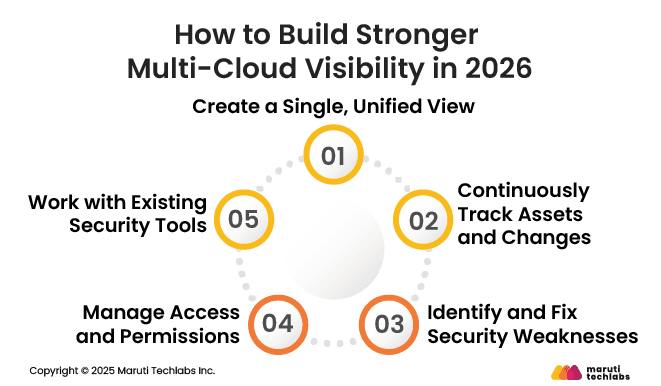
How to Build Stronger Multi-Cloud Visibility in 2026
As cloud environments grow, teams lose track of what is running and who owns it. In 2026, the focus needs to be on clearly seeing all cloud resources, tracking changes as they happen, and reducing risk without adding more tools to manage.
1. Create a Single, Unified View
Start by consolidating information from all cloud platforms into a single place. This removes the need to jump between different dashboards. With a single view, teams can clearly see what is running and spot issues faster.
2. Continuously Track Assets and Changes
Cloud resources are created and changed every day. Continuous discovery ensures new assets are automatically identified and changes are tracked over time. This helps teams maintain an accurate inventory and avoid blind spots in fast-moving environments.
3. Identify and Fix Security Weaknesses
Strong visibility includes knowing where vulnerabilities and unsafe configurations exist. Regular scanning helps teams focus on the most important issues and fix them early, before they are exploited.
4. Manage Access and Permissions
Understanding who has access to what is critical. Clear visibility into user activity and permissions helps teams remove unnecessary access, prevent misuse, and support compliance requirements.
5. Work with Existing Security Tools
Visibility should fit into the tools teams already use. Integrating with current security platforms helps teams use shared data effectively and keeps workflows simple.
By designing multi-cloud environments with visibility in mind, organizations can stay in control, reduce risk, and move forward with confidence.
Conclusion
Poor cloud visibility makes work harder than it should be. When teams cannot clearly see their cloud assets, problems go unnoticed, risks grow, and costs are difficult to track. In multi-cloud environments, this lack of clarity often leads to delays, confusion, and avoidable issues.
Clear visibility helps teams stay in control. When they know what is running, who can access it, and what has changed, they can fix issues early and plan better. It brings structure to cloud environments that can otherwise feel messy.
At Maruti Techlabs, we help teams get a clear view of their cloud environments. Our cloud services are designed to reduce blind spots and make cloud management easier and more predictable. If cloud visibility is a challenge for your team, we would be happy to help. Get in touch with us or explore our cloud services page to learn more.
Looking ahead, teams that focus on visibility today will find it easier to scale, stay secure, and manage their cloud environments with confidence.
FAQs
1. What are cloud assets?
Cloud assets are all resources running in the cloud, such as virtual machines, databases, storage, networks, applications, and user access settings managed online by teams.
2. What is an example of a cloud asset?
An example of a cloud asset is a virtual machine hosting an application, along with its storage, network settings, security rules, and user access permissions.
3. What are the hidden risks of poor cloud asset visibility?
Poor cloud asset visibility can hide security gaps, unused resources, excessive access rights, compliance issues, higher costs, and misconfigurations that attackers or outages can exploit.
4. What is shadow IT in multi-cloud environments?
Shadow IT in multi-cloud environments occurs when teams use or create cloud services without approval, tracking, or security oversight, increasing risk, cost, and compliance issues.
5. Why is multi-cloud visibility more complex than single-cloud?
Multi-cloud visibility is harder because each provider has different tools, services, permissions, and data formats, making it difficult to get one clear, consistent view across.
Lalit Bhatt works across cloud infrastructure, DevOps, and project delivery, bringing 18+ years of experience across cloud migration, AWS architecture, infrastructure improvements, and team mentoring, depending on what clients need.
Stuck with a Tech Hurdle?
We fix, build, and optimize. The first consultation is on us!