6 Best Practices to Reduce Shadow Data in an Enterprise
Explore practical strategies to prevent, detect, and manage shadow data risks.
Data Analytics and Business Intelligence
6 Best Practices to Reduce Shadow Data in an Enterprise
Explore practical strategies to prevent, detect, and manage shadow data risks.
Table of contents
Table of contents
Key Takeaways
Introduction
What is Shadow Data?
Understanding Unclassified Sensitive Information
Why is Shadow Data Dangerous?
Notable Shadow Data-Related Breaches
Top 5 Strategies for Shadow Data Detection and Management
6 Best Practices to Reduce Shadow Data in an Enterprise
Conclusion
FAQs
Key Takeaways
Shadow data creates hidden risks that weaken security and compliance efforts.
Unclassified sensitive information can cause serious harm if exposed.
Visibility into all data locations is essential for effective protection.
Clear ownership, retention rules, and monitoring reduce unmanaged data growth.
Embedding prevention into daily workflows limits future shadow data risks.
Introduction
Every organization holds data that operates beyond formal oversight, often unnoticed until it turns into a serious issue. Shadow data grows because people copy files to convenient locations, leave behind old test systems, or store work on unsanctioned tools, often without anyone knowing it exists.
As enterprises spread data across cloud, local, and third-party platforms faster than governance can keep up, these unseen copies accumulate, creating blind spots that increase the chance of security breaches, regulatory penalties, and costly recovery efforts.
In this blog, you will understand the root causes of shadow data, the risks it introduces, and six practical best practices to detect, govern, and eliminate it at scale.
What is Shadow Data?
Shadow data is information that exists within an organization but lives outside formal IT governance, security controls, or monitoring frameworks. It often includes copies, backups, or files stored in unmanaged or unsanctioned locations, making it invisible to IT teams and vulnerable to breaches, compliance violations, and misuse.
How Does Shadow Data Emerge?
Shadow data emerges when data is copied, stored, or shared outside the sanctioned data infrastructure, often without IT awareness. Common sources include production data replicated for development or testing but never deleted, legacy files left on decommissioned systems, and data exported to personal devices or unauthorized cloud services.
According to the 2024 Cost of a Data Breach Report by IBM, 35% of breaches involved data stored in unmanaged, “shadow” data sources.
Collaboration via unsanctioned SaaS applications and shadow IT tools also generates data that isn’t tracked in official inventories. Human error, decentralized cloud adoption, and rapid adoption of new platforms such as analytics and AI tools contribute to unmanaged data sprawl.
Once created, this data often lacks classification, access controls, or lifecycle management, increasing security and compliance risks.
Understanding Unclassified Sensitive Information
Unclassified sensitive information is data that isn’t formally classified by national security standards but still warrants protection because its disclosure could harm individuals, organizations, or operational interests.
It often includes identifiable personal information, proprietary business information, and regulated data that require administrative controls to prevent unauthorized access or misuse.
Why is this Data Often Overlooked?
Unclassified sensitive information is frequently overlooked because it lacks formal classification labels such as Confidential, Secret, or Top Secret, leading organizations to treat it as low risk.
Many teams mistakenly assume that “unclassified” means the information is safe to share or exempt from strict controls, when in reality its unauthorized exposure can harm privacy, reputational trust, or regulatory compliance.
This type of data also lives across diverse systems, often embedded in business records, emails, or analytics stores without consistent tagging or governance, making it invisible to traditional security inventories.
Without clear policies, classification frameworks, and monitoring, organizations fail to identify and protect this data, increasing exposure to breaches and compliance violations.
Why is Shadow Data Dangerous?
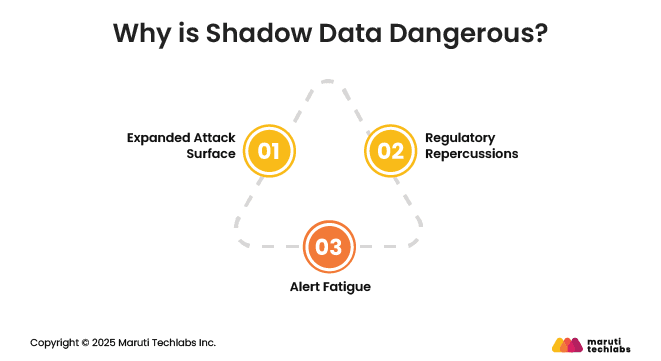
Shadow data introduces hidden risk into an organization’s data ecosystem. Because it exists outside formal governance and security controls, it often goes unnoticed until it becomes the source of a breach, compliance failure, or operational disruption.
Here are three key reasons shadow data is dangerous.
1. Expanded Attack Surface
Shadow data often lives in locations that aren’t monitored, controlled, or secured by central IT systems, such as forgotten cloud buckets, legacy database snapshots, or personal file stores, expanding the organization’s attack surface beyond recognized boundaries.
Because these data stores lack routine patching, access controls, and visibility, attackers can exploit them as low-resistance entry points into the wider environment.
Without comprehensive discovery and governance, these unmanaged data assets become blind spots that evade traditional security tooling, materially increasing the risk of unauthorized access, lateral movement, and data exfiltration across on-premises and cloud ecosystems.
2. Regulatory Repercussions
Regulators expect organizations to know where sensitive and personal data resides and to apply appropriate safeguards. Because shadow data operates outside standardized oversight frameworks, it is difficult to enforce encryption, access logging, or retention policies required by standards such as GDPR or HIPAA.
Ignorance of these hidden data stores isn’t an acceptable excuse; regulators hold organizations accountable for all data subject to compliance obligations.
Failure to identify and secure shadow data during audits or breach investigations can lead to significant fines, legal liabilities, and reputational damage, as non-compliance with unmanaged datasets demonstrates a lack of due diligence in data protection.
3. Alert Fatigue
From a security operations perspective, shadow data creates noise that overburdens monitoring systems and analysts. Each unmanaged data store can trigger a cascade of alerts, permission errors, backup failures, and anomalous access patterns because these assets don’t follow standardized controls.
As alert queues grow with signals from unknown or poorly configured sources, SOC teams spend disproportionate time filtering benign events while genuine threats may go unnoticed. This chronic alert fatigue dilutes analyst focus, slows incident response, and erodes the effectiveness of security measures.
Efficient cloud and data security requires reducing these unmanaged sources so that monitoring systems highlight real risks rather than noise.
Notable Shadow Data-Related Breaches
Shadow data is not just a theoretical risk. Over the past decade, several high-profile breaches have shown that unmanaged, overlooked, or improperly stored data can cause severe financial and reputational damage.
Here are two real-life examples of data-related breaches that made the headlines in the last decade.
1. Uber Data Breach
The 2016 Uber data breach highlighted risks associated with shadow data and poor credential management. Employees reportedly used personal storage services to back up company data, increasing exposure.
Attackers accessed a private GitHub repository, discovered AWS credentials, and used them to retrieve personal data of 57 million users and drivers.
2. Equifax Data Breach
In the 2017 Equifax breach, failure to identify and patch a known web application vulnerability enabled attackers to infiltrate systems and access sensitive personal and financial information of approximately 143 million individuals.
The incident highlighted how inadequate visibility, weak governance, and delayed remediation can amplify the impact of security lapses, exposing vast amounts of critical data.
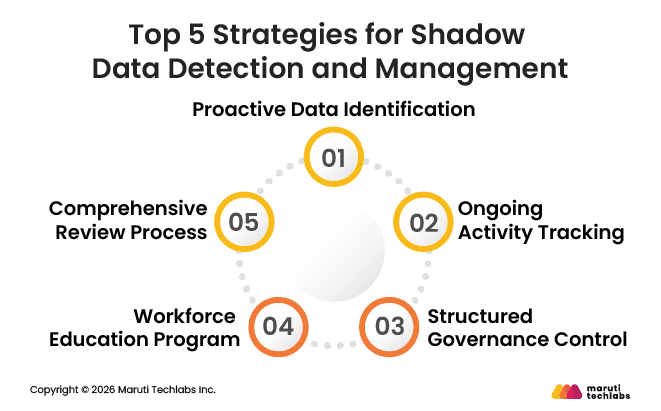
Top 5 Strategies for Shadow Data Detection and Management
Reducing the risks of shadow data requires more than awareness. Organizations need systematic approaches to uncover, control, and govern data that exists outside formal oversight.
Let’s explore the top 5 practices that one can use to detect and manage shadow data.
1. Proactive Data Identification
Adopt tools that scan cloud platforms, on-premises systems, and software services to automatically locate and label data. These solutions help uncover sensitive records wherever they reside.
By regularly mapping data assets, organizations gain clear visibility into what information exists, where it is stored, and which teams are responsible for managing it securely.
2. Ongoing Activity Tracking
Set up real-time monitoring to observe how data is accessed, shared, and copied across systems. Watch for unusual login behavior, bulk downloads, or the creation of new storage locations.
Early detection of irregular activity allows teams to respond quickly and reduce the risk of data exposure or misuse.
3. Structured Governance Controls
Define clear rules for how data should be stored, accessed, retained, and removed. Specify approved storage platforms, outline retention timelines, and set strict permission levels.
Require encryption for sensitive information and document response steps if unauthorized data is found. Clear governance reduces confusion and ensures consistent handling practices.
4. Workforce Education Programs
Provide regular training sessions focused on responsible data handling and the risks of unmanaged storage. Employees should understand where data can be stored, how to share it securely, and why informal storage exposes it.
Building awareness strengthens accountability and supports a culture of responsible data management.
5. Comprehensive Review Processes
Schedule routine reviews of storage accounts, development systems, backup repositories, and collaboration tools. These assessments should identify duplicate or unauthorized data and evaluate the extent of its protection.
Periodic reviews help close security gaps, maintain compliance, and confirm that governance standards are consistently followed across the organization.
6 Best Practices to Reduce Shadow Data in an Enterprise
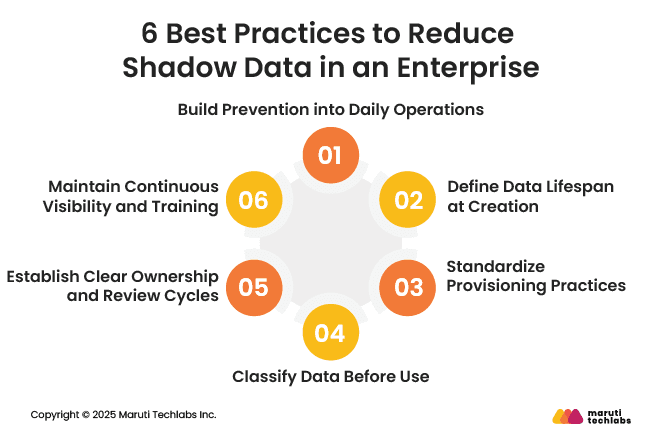
Successful shadow data reduction depends on integrating preventive controls into routine workflows rather than depending on occasional cleanup initiatives.
The following best practices outline practical steps that support both proactive prevention and effective mitigation efforts.
1. Build Prevention into Daily Operations
Reducing shadow data starts with embedding controls into everyday work instead of relying on occasional cleanup drives. Preventive steps must operate continuously so unmanaged data never accumulates unnoticed.
2. Define Data Lifespan at Creation
Apply clear retention rules from the moment storage is provisioned. Non-production environments should carry automatic expiration settings. Older development copies should be removed unless formally renewed with justification.
Test data should have shorter default retention periods. Automatic deletion helps prevent the buildup of forgotten or unused data.
3. Standardize Provisioning Practices
Require all infrastructure to be created through approved, version-controlled templates. These templates must include tagging, encryption, and ownership details.
Direct console-based creation should be restricted because it produces assets that are harder to track. Structured deployment ensures accountability and a clear record of resource ownership.
4. Classify Data Before Use
Mandate sensitivity labeling when data is created or copied. Systems should prompt users to select categories such as public, internal, confidential, or restricted before exports or new storage areas are approved.
Early classification reduces the risk of sensitive information being stored without proper safeguards.
5. Establish Clear Ownership and Review Cycles
Each data repository must have a named owner responsible for access decisions and retention oversight. Conduct quarterly access reviews to confirm that permissions remain necessary.
Resources without assigned owners should be flagged and reviewed promptly to avoid unmanaged exposure.
6. Maintain Continuous Visibility and Training
Use automated discovery tools to detect new or misconfigured storage immediately. Trigger alerts or corrective actions for open access or missing protections.
Support these controls with simple data handling guidelines and periodic training to reinforce responsible storage and sharing practices.
Conclusion
Shadow data and unclassified sensitive information create serious risks for any organization. When data exists outside formal oversight, it often lacks adequate protections, making it vulnerable to breaches, unauthorized access, and compliance violations that can result in financial penalties and reputational damage.
Because these blind spots are invisible to security teams, they weaken the overall security posture and make it impossible to enforce consistent safeguards. The foundation of strong security is visibility into where all sensitive data lives, how it is accessed, and who can reach it. Without knowing what you have and where it resides, you cannot effectively secure or govern it.
Through its Cloud Security services, Maruti Techlabs helps organizations regain visibility, reduce shadow data risk, and secure cloud environments at scale.
Contact us to identify hidden data exposure, restore governance, and strengthen your cloud security posture at scale.
FAQs
1. How can shadow data be identified using DSPM tools?
Data Security Posture Management (DSPM) tools identify shadow data by continuously scanning cloud environments, databases, data warehouses, and storage systems to discover unknown or unmanaged data assets.
These tools map data flows, detect sensitive data types, assess access permissions, and highlight datasets that fall outside governance policies. This enables organizations to uncover hidden data stores and prioritize remediation based on risk.
2. How can organizations avoid shadow IT in data analytics?
Avoiding shadow IT in data analytics requires a combination of governance, tooling, and enablement. Organizations should provide approved analytics platforms that meet business needs, enforce clear data access policies, and automate provisioning to reduce the need for workarounds.
Educating teams on secure data usage, monitoring unauthorized tools, and integrating analytics workflows into centralized data platforms helps prevent the creation of unmanaged data outside IT oversight.
Pinakin Ariwala has over 20 years of experience in AI/ML, data engineering, and software development. He has led AI and machine learning projects across industries, including agriculture, finance, and healthcare, and has been featured on the Clutch Leaders Matrix podcast discussing real-world AI/ML applications.
Stuck with a Tech Hurdle?
We fix, build, and optimize. The first consultation is on us!