How to Design a GenAI Architecture for Policy-Driven Workflows?
Learn how GenAI replaces rigid automation with smarter policy analysis and faster customer support.
Artificial Intelligence and Machine Learning
How to Design a GenAI Architecture for Policy-Driven Workflows?
Learn how GenAI replaces rigid automation with smarter policy analysis and faster customer support.
Table of contents
Table of contents
Key Takeaways
Introduction
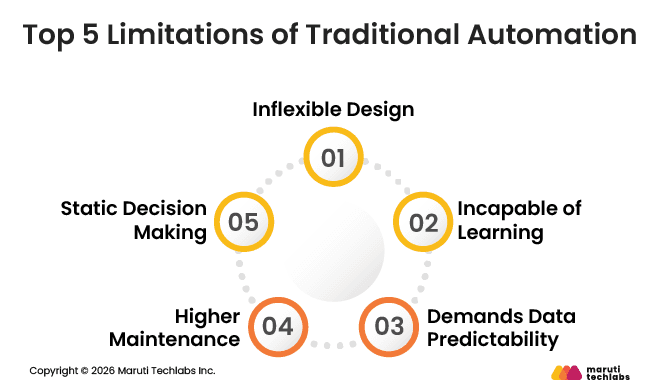
Top 5 Limitations of Traditional Automation
How GenAI Contributes to Policy Document Analysis?
How GenAI Enhances Customer Support Automation?
Key Engineering and Governance Considerations with GenAI
Designing a Safe and Scalable GenAI Architecture for Policy-Driven Workflows
Conclusion
FAQs
Key Takeaways
Traditional automation struggles with evolving policies, unstructured content, and context-driven decision-making needs.
Generative AI enables deeper document understanding by interpreting meaning, intent, and relationships within policy content.
Policy analysis and customer support benefit from faster insights, summaries, and natural language interaction.
Responsible adoption requires strong governance around accuracy, fairness, safety, privacy, and content ownership.
A policy-first, scalable architecture ensures GenAI systems remain controlled, auditable, and trustworthy over time.
Introduction
Across industries where rules and regulations bind every action, the sheer volume and complexity of policy documents are growing fast. 95% of businesses recognize unstructured data management as a significant issue, yet many still lack tools to handle it effectively.
Traditional automation tools have helped with repetitive tasks, but they struggle when documents require a real understanding of context, nuance, and continual changes in format or content. These systems often break when unexpected events occur, as they follow rigid instructions rather than interpreting meaning.
Generative AI is emerging as a new way to approach this problem by acting as a semantic layer that reads and understands policy content more like a person would.
It can make sense of unstructured text, extract key information, and support deeper tasks such as summarization or question answering, which traditional automation cannot reliably do.
This blog explains where traditional automation falls short in policy analysis and how generative AI fills the gap with flexible, context-aware support at scale.
Top 5 Limitations of Traditional Automation
Traditional automation played a key role in helping businesses streamline repetitive tasks. However, as digital systems became more complex and data volumes grew, their limitations became more visible.
Some of the most common challenges faced with traditional automation are outlined below.
1. Inflexible Design
Traditional automation relies on fixed rules written into code. Even a small change in input format or an unexpected scenario often requires manual changes or a complete reworking of the logic, making systems slow to adapt.
2. Incapable of Learning
Tools follow instructions exactly as programmed and do not learn from past outcomes. When business conditions change, teams must manually update workflows, which limits long-term efficiency.
3. Demands Data Predictability
Most traditional automation tools handle structured data such as forms or predefined fields. Content like emails, images, voice inputs, or context-based information usually falls outside their capabilities.
4. Higher Maintenance
As processes evolve or scale, traditional systems demand frequent maintenance. This increases operational costs and can slow down the implementation of new requirements.
5. Static Decision Making
Traditional automation runs on predefined rules and cannot respond in real time to new patterns or feedback. This limits its ability to support dynamic business decisions in fast-changing environments.
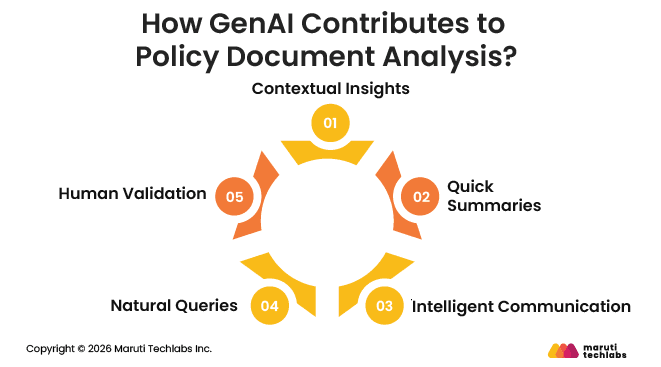
How GenAI Contributes to Policy Document Analysis?
GenAI helps organizations analyze policy documents by transforming unstructured text into structured, searchable insights. This reduces manual effort, improves accuracy, and enables teams to access critical information faster and with greater confidence.
1. Contextual Insights
GenAI analyzes documents such as contracts and letters to extract meaningful details, including names, dates, and clauses. It turns scattered information into organized data that teams can store, search, and use confidently.
2. Quick Summaries
Long documents can be time-consuming to review in full. This feature creates short, clear summaries that highlight the main points, helping readers quickly understand intent, key obligations, and outcomes without missing context.
3. Intelligent Classification
The system can identify the type of document, what it discusses, and why it exists. This makes it easier to organize files, route them correctly, and reduce manual effort across document collections.
4. Natural Queries
Instead of searching through pages, users can ask direct questions in plain language. The system understands the request and pulls relevant information such as dates or conditions, making document review faster and user-friendly.
5. Human Validation
When the system is unsure, it signals lower confidence and passes the result to a person for checking. This balance between automation and human judgment helps maintain accuracy while saving time and effort.
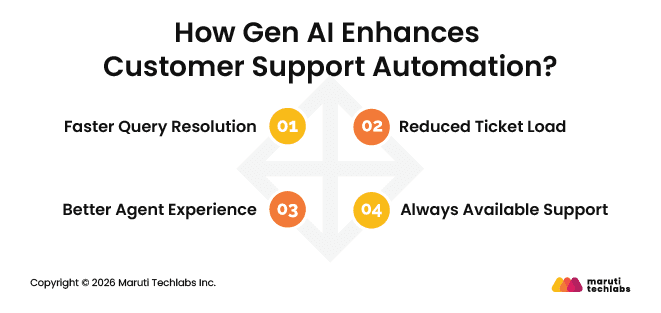
How GenAI Enhances Customer Support Automation?
Generative AI is reshaping customer service by making support faster, smarter, and easier to scale. Understanding customer intent and using information from past interactions and internal systems helps businesses respond more accurately, improving overall service quality and efficiency across support channels.
1. Faster Query Resolution
Generative AI understands customer intent and pulls relevant information from knowledge bases, previous tickets, and CRM records to create clear and personalized responses.
This reduces wait time, improves accuracy, and helps resolve many issues during the first interaction.
2. Reduced Ticket Load
By handling large volumes of common requests such as password resets, order tracking, or basic troubleshooting, generative AI reduces the overall support backlog.
This allows human agents to focus on complex problems that need deeper understanding and decision-making.
3. Better Agent Experience
Generative AI supports internal teams by automating repetitive tasks and offering real-time guidance during conversations. This reduces stress, improves productivity, and helps agents deliver better experiences, leading to higher satisfaction and stronger customer loyalty.
4. Always Available Support
AI-driven support systems operate continuously without being limited by working hours or time zones. Customers can get help at any time, improving satisfaction and ensuring consistent service even during peak demand.
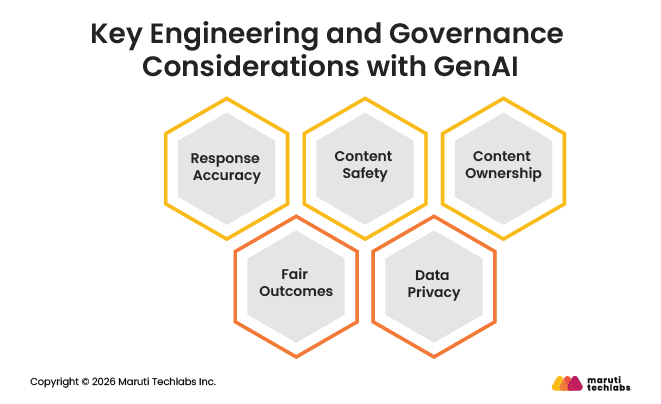
Key Engineering and Governance Considerations with GenAI
Let’s observe the engineering and governance factors that shape responsible AI adoption, focusing on reliability, fairness, safety, privacy, and ownership to ensure systems behave predictably and earn trust at scale.
1. Response accuracy
Generative systems can sometimes produce responses that sound convincing but are factually wrong. This is especially risky in areas where decisions depend on accuracy and trust.
Because these responses often appear confident, users may not question them until it's too late. Strong engineering practices focus on validating outputs through testing, review processes, and clear boundaries on what the system is allowed to answer.
Governance plays a key role by ensuring these checks are consistently applied before results are used in real situations.
2. Fair Outcomes
Models learn from data created by people, which means they can inherit unfair patterns or uneven representation. Over time, these issues can grow, particularly when systems are used repeatedly or exposed to large audiences.
Even subtle bias can affect user trust and business outcomes. Addressing this requires regular evaluation, diverse test scenarios, and a willingness to adjust models when problems are found. Fairness should be treated as an ongoing responsibility rather than a one-time task.
3. Content Safety
Without proper controls, systems may produce harmful, offensive, or misleading content. This can include language that violates company values or guidance that creates real-world risk.
Safe deployment depends on clear rules, filtering mechanisms, and continuous monitoring to catch new forms of misuse as they emerge.
4. Data Privacy
Generative systems can unintentionally reveal private or regulated information if safeguards are weak. Careful data handling, access controls, and output review processes help reduce the risk of sensitive details appearing in responses.
5. Content Ownership
Generated outputs may resemble protected content if usage boundaries are unclear. Clear policies and ongoing checks help ensure originality and responsible use across applications.
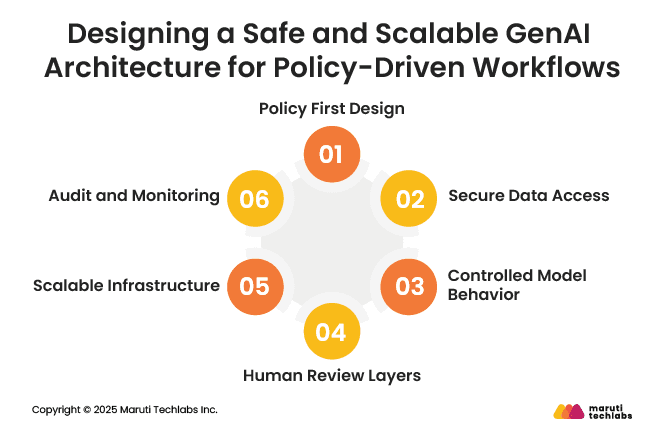
Designing a Safe and Scalable GenAI Architecture for Policy-Driven Workflows
Designing a safe and scalable GenAI architecture is critical for organizations that rely on policy-driven workflows. It ensures consistent outcomes, controlled decision-making, and reliable expansion across teams and systems.
1. Policy First Design
The foundation of a strong GenAI system is a clear policy definition. Business rules, compliance requirements, and approval logic must be embedded early to ensure AI outputs align with organizational standards and regulatory expectations.
2. Secure Data Access
GenAI systems should interact only with approved data sources. Role-based access, data masking, and strict permissions help protect sensitive information while allowing the model to retrieve relevant context when generating responses.
3. Controlled Model Behavior
Guardrails are essential to prevent unexpected or unsafe outputs. Prompt controls, output validation, and response filtering ensure the AI follows defined boundaries and produces reliable, policy-compliant results across use cases.
4. Human Review Layers
Critical decisions should include human oversight. Confidence thresholds and exception handling allow uncertain outputs to be routed for manual review, balancing automation speed with accountability and trust.
5. Scalable Infrastructure
A modular architecture enables easy scaling as demand grows. Decoupled components for models, policies, and data sources allow teams to update or expand workflows without disrupting existing operations.
6. Audit and Monitoring
Continuous monitoring and logging provide visibility into AI decisions. Audit trails help teams track behavior, improve performance, and demonstrate compliance during internal reviews or external assessments.
Conclusion
Traditional automation falls short in environments shaped by frequent change, complex rules, and unstructured information. Rule-based systems require constant upkeep and lack the flexibility needed to scale with evolving business processes.
Generative AI addresses these gaps by understanding context, learning from patterns, and adapting as workflows and data change.
In policy-driven environments, GenAI transforms dense documents into clear, actionable insights through summarization, classification, and natural language interaction.
In customer support, it reduces ticket volumes, accelerates response times, and enables consistent, round-the-clock assistance for both customers and internal teams. These gains become sustainable only when GenAI systems are designed with responsibility, governance, and long-term scalability in mind.
Organizations planning Generative AI Development should act with intent by prioritizing high-impact workflows and investing early in scalable governance and architecture.
Connect with Maruti Techlabs today to learn how your organization can leverage GenAI to its fullest potential, while keeping timelines and costs in mind.
FAQs
1. What is customer support automation?
Customer support automation uses technology to handle routine support tasks such as answering common questions, routing tickets, and updating customer records, reducing the need for manual intervention.
2. How does AI automation work in customer support?
AI automation analyzes customer queries using natural language processing, matches them with relevant responses or actions, and continuously improves through learning from past interactions and feedback.
3. How does automation reduce customer support costs?
Automation lowers costs by handling high-volume, repetitive requests, reducing response times, minimizing human effort, and allowing support teams to focus on complex, high-value issues.
4. What is document analysis?
Document analysis is the process of extracting, understanding, and organizing information from documents such as contracts, policies, and reports to make the content searchable and actionable.
Pinakin Ariwala has over 20 years of experience in AI/ML, data engineering, and software development. He has led AI and machine learning projects across industries, including agriculture, finance, and healthcare, and has been featured on the Clutch Leaders Matrix podcast discussing real-world AI/ML applications.
Stuck with a Tech Hurdle?
We fix, build, and optimize. The first consultation is on us!