A Practical Guide to Business Problems Machine Learning Can Solve
Explore how machine learning enables businesses to leverage their data accurately and solve some typical problems.
Artificial Intelligence and Machine Learning
A Practical Guide to Business Problems Machine Learning Can Solve
Explore how machine learning enables businesses to leverage their data accurately and solve some typical problems.
Table of contents
Table of contents
Key Takeaways
Introduction
What is Machine Learning?
Types Of Machine Learning
9 Real-World Problems That Can Be Solved with Machine Learning
Commonly Used Machine Learning Algorithms
How Is Machine Learning Used Across Industries?
Top 5 Challenges in Implementing Machine Learning
How to Get Started with Machine Learning for Your Business
Conclusion
FAQs
Why Maruti Techlabs for Machine Learning Services
Key Takeaways
Machine learning helps businesses turn large and complex datasets into meaningful patterns that support faster and more accurate decision-making.
It improves business efficiency by automating repetitive tasks like classification, prediction, and data analysis using trained algorithms.
Different ML techniques, such as supervised, unsupervised, and deep learning, are used based on the type of problem and available data.
Successful machine learning implementation depends heavily on data quality, model selection, and continuous monitoring for better performance over time.
When applied correctly, machine learning can solve real-world business challenges across industries like healthcare, finance, retail, and logistics with measurable impact.
Introduction
The global artificial intelligence market is expected to grow from nearly $260 billion in 2025 to over $1,200 billion by 2030, according to Statista. As AI adoption grows, businesses are increasingly using machine learning to solve practical challenges across operations, customer service, marketing, and forecasting.
From fraud detection and spam prevention to product recommendations and demand forecasting, machine learning helps businesses analyze data, identify patterns, and make faster decisions with better accuracy.
In this blog, we’ll look at nine practical business problems solved with machine learning and how businesses are using it across different functions.
What is Machine Learning?
Machine learning is a branch of artificial intelligence that enables systems to learn from data, identify patterns, and improve outcomes without being explicitly programmed for every task. It uses different algorithms and techniques to help computers analyze information, make predictions, and adapt based on new data.
As defined by IBM, “Machine learning is the subset of artificial intelligence (AI) focused on algorithms that can ‘learn’ the patterns of training data and, subsequently, make accurate inferences about new data. This pattern recognition ability enables machine learning models to make decisions or predictions without explicit, hard-coded instructions.”
Unlike traditional programming, a manually created program uses input data and runs on a computer to produce the output. In machine learning or augmented analytics, both input data and output are used to train algorithms to create the program itself, leading to more adaptive and scalable systems.
Machine learning algorithms use statistical techniques to find patterns in large volumes of data, including images, numbers, and text. If data can be stored digitally, it can be processed by machine learning systems to solve specific problems and generate insights.
Types Of Machine Learning
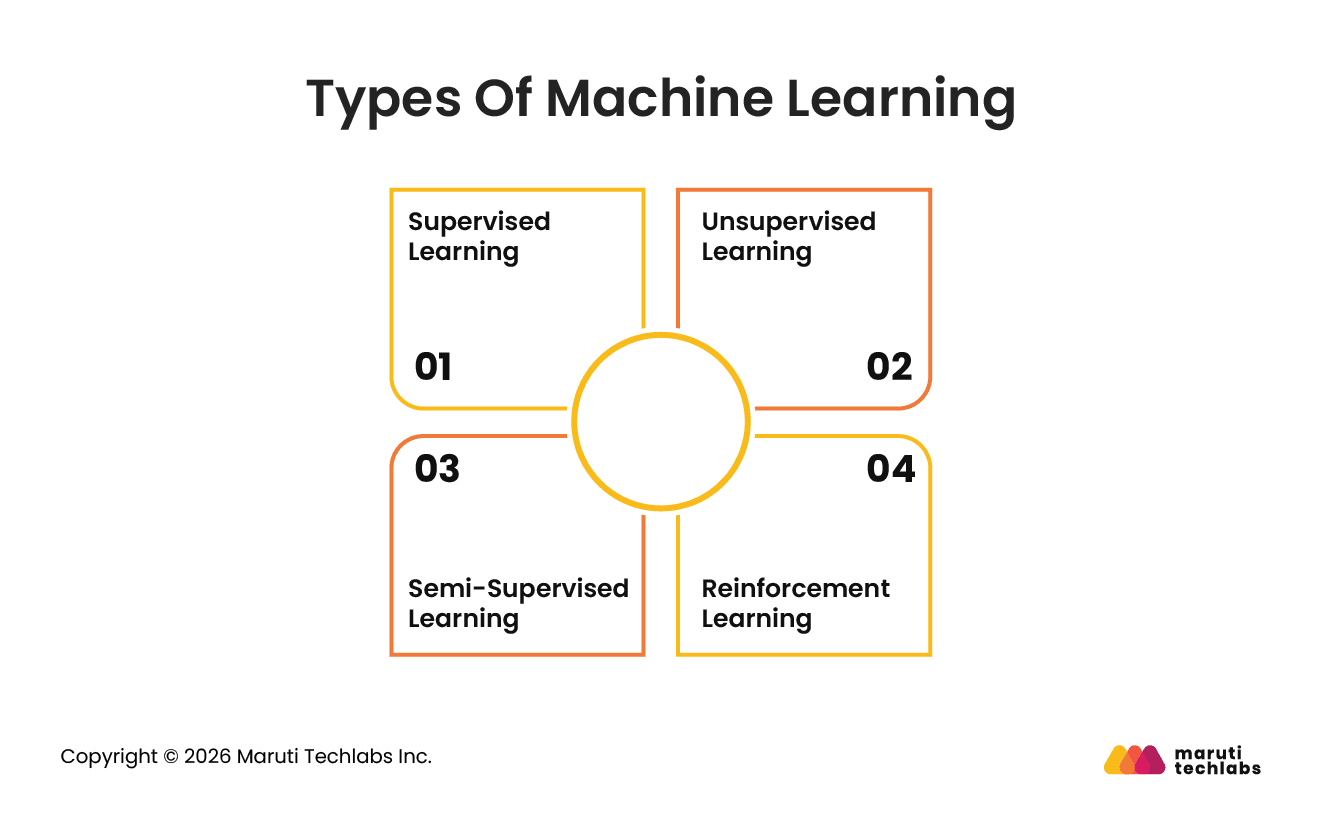
Machine learning is usually grouped based on how a model learns from data and the type of data it uses. There are several approaches, but the four most common types of machine learning are supervised learning, unsupervised learning, semi-supervised learning, and reinforcement learning.
1. Supervised Learning
Supervised learning works with labeled data, where the system already knows the correct output. The model learns from past examples to make predictions or decisions on new data.
Where it is commonly used:
Predicting numerical values like sales, prices, or demand
Classifying data into categories such as spam detection or image recognition
Use Cases: Fraud detection, sales forecasting, spam filtering, recommendation systems
2. Unsupervised Learning
Unsupervised learning works with unlabeled data. Instead of being told what the correct answer is, the model identifies patterns, relationships, or groups within the data on its own.
Where it is commonly used:
Customer segmentation
Pattern discovery
Data organization and analysis
Use Cases: Customer segmentation, market basket analysis, anomaly detection
3. Semi-Supervised Learning
Semi-supervised learning combines a small amount of labeled data with a large amount of unlabeled data. This approach is useful when labeling large datasets is expensive or time-consuming.
It helps improve model accuracy while reducing the effort required for manual data labeling.
Where it is commonly used:
Medical imaging
Speech recognition
Content moderation
Use Cases: Medical imaging, speech recognition, content moderation
4. Reinforcement Learning
Reinforcement learning is based on trial and error. The model learns by interacting with an environment and receiving rewards or penalties based on its actions. Over time, it improves its decision-making to achieve better outcomes.
Where it is commonly used:
Robotics
Autonomous vehicles
Game AI
Route optimization
Application: Robotics, autonomous vehicles, game AI, route optimization
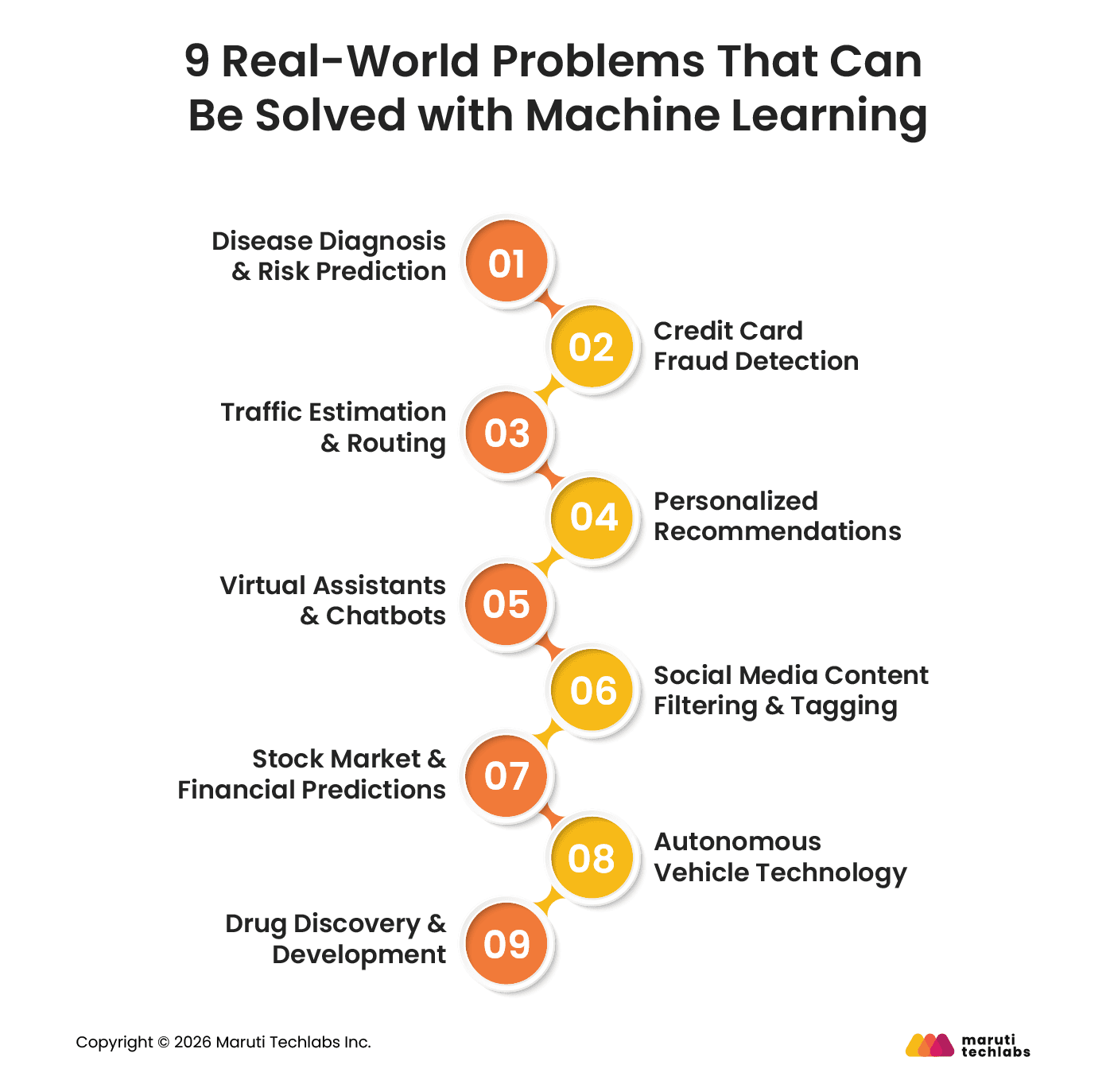
9 Real-World Problems That Can Be Solved with Machine Learning
Machine learning is helping businesses and industries solve complex real-world problems by analyzing large amounts of data, identifying patterns, and improving decision-making. Across industries such as healthcare, finance, and transportation, it is being used for applications like fraud detection, traffic management, and recommendation systems. Businesses are using machine learning to automate processes, improve accuracy, and work more efficiently.
As machine learning adoption continues to grow, businesses are using it to solve everyday challenges related to prediction, automation, and decision-making. These real-world examples show how organizations across industries are applying machine learning to improve efficiency, streamline operations, and make better use of their data.
Business Problem
How ML Solves It
Real-World Example
Disease Diagnosis & Risk Prediction
ML analyzes medical records, scans, and patient history to detect diseases early and predict health risks.
Hospitals use AI models to detect cancers from X-rays and MRIs with higher accuracy and faster diagnosis.
Credit Card Fraud Detection
Machine learning monitors transaction patterns in real time to identify suspicious activities.
Banks and payment platforms use ML systems to block fraudulent transactions before they are processed.
Traffic Congestion & Route Optimization
ML studies live and historical traffic data to predict congestion and suggest faster routes.
Google Maps uses machine learning to provide real-time traffic updates and route recommendations.
Low Customer Engagement & Personalization
Recommendation engines analyze user behavior, searches, and purchase history to suggest relevant content or products.
Netflix and Amazon use ML to recommend movies, shows, and products based on user preferences.
Slow Customer Support Response Times
NLP-based ML models understand voice and text commands to automate conversations and tasks.
Siri, Alexa, and customer support chatbots use ML to answer queries and schedule tasks.
Harmful Content Detection & Moderation
ML identifies images, text, and user behavior to filter harmful content and improve personalization.
Facebook uses ML for photo tagging and content moderation across its platform.
Financial Forecasting & Market Prediction
ML models analyze market trends and historical data to predict price movements and support trading decisions.
Financial firms use ML for algorithmic trading and investment risk analysis.
Road Safety & Collision Prevention
Computer vision and ML help vehicles detect roads, objects, and traffic conditions in real time.
Self-driving cars use ML to make driving decisions and avoid obstacles safely.
Slow Drug Discovery Processes
ML analyzes large chemical and medical datasets to identify potential drug candidates faster.
Pharmaceutical companies use ML to speed up drug research and treatment development.
Commonly Used Machine Learning Algorithms
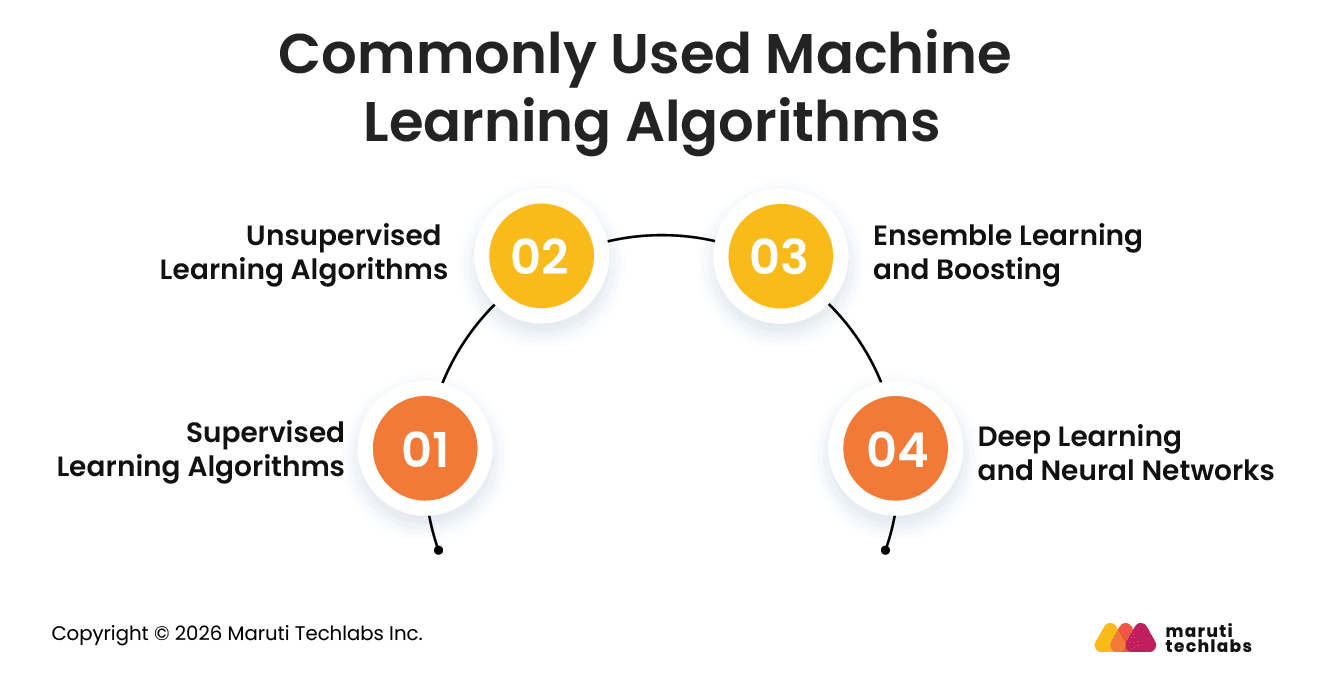
Machine learning algorithms are often categorized by the way they learn from data and the tasks they are designed to handle. Some are mainly used for making predictions, while others help identify patterns, organize information, or improve accuracy when working with large datasets.
Here are some of the most commonly used machine learning algorithms and their application.
1. Supervised Learning Algorithms
These algorithms learn from labeled data, where the correct output is already known. They are widely used for prediction and classification tasks.
Linear Regression: Used to predict numerical values such as sales, revenue, or house prices.
Logistic Regression: Helps classify data into categories like spam vs. non-spam emails.
Decision Trees: Break data into smaller decisions to reach an outcome in a simple, structured way.
Support Vector Machines (SVM): Identifies the best boundary between different data groups.
K-Nearest Neighbors (KNN): Classifies data based on similar nearby data points.
Naive Bayes: Commonly used for text classification and sentiment analysis.
Applications: Predictive analytics, risk assessment systems, recommendation engines, medical diagnosis support, image and text classification systems
2. Unsupervised Learning Algorithms
These algorithms work with unlabeled data and help identify hidden patterns, similarities, or relationships within datasets.
K-Means Clustering: Groups similar data points together for analysis.
Principal Component Analysis (PCA): Simplifies large datasets while retaining important information.
Association Rule Learning (Apriori): Finds relationships between items or behaviors in data.
Ensemble methods combine multiple machine learning models to improve prediction accuracy and reduce errors. These techniques are widely used for complex business problems.
Random Forest: Combines multiple decision trees to generate more reliable predictions.
Gradient Boosting (XGBoost, LightGBM): Builds models step-by-step to improve performance by correcting previous errors.
Machine learning is being used across industries to automate processes, improve decision-making, reduce operational inefficiencies, and enhance customer experiences. While the use cases differ by industry, the core goal remains the same: using data to solve business challenges more efficiently.
Here’s a quick look at how different industries are applying machine learning in real-world business scenarios and the common algorithms behind these applications:
Industry
Common Machine Learning Use Cases
Common Algorithms & Methods
Legal
Contract analysis, legal document classification, compliance monitoring, case research automation
NLP, Named Entity Recognition (NER), Classification Models
Healthcare
Disease diagnosis, medical imaging analysis, patient risk prediction, drug discovery
CNNs, Support Vector Machines (SVM), Neural Networks
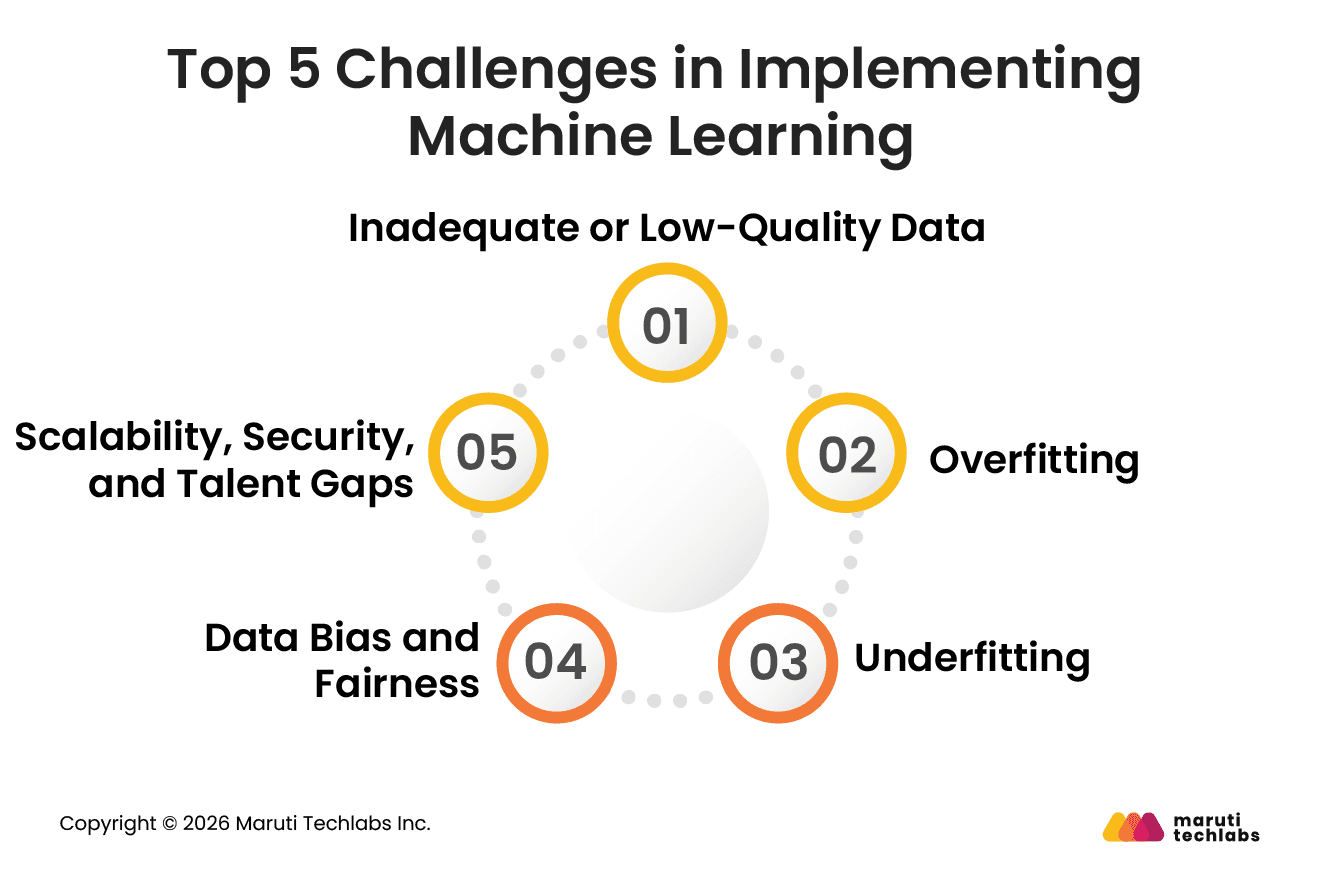
While machine learning can improve efficiency, automate tasks, and support better decision-making, implementing it successfully comes with several challenges. Many businesses encounter machine learning problems related to data quality, model performance, scalability, and fairness while building and deploying machine learning systems and machine learning solutions.
1. Inadequate or Low-Quality Data
Machine learning models rely heavily on data to learn patterns and generate accurate predictions. If the data is incomplete, outdated, inconsistent, or noisy, the model may produce unreliable results. Poor-quality data is one of the most common reasons why machine learning projects fail to deliver expected outcomes.
2. Overfitting
Overfitting happens when a machine learning model becomes too closely tied to the training data. Instead of learning general patterns, it memorizes small details and noise from the dataset. While the model may perform well during training, it often struggles to deliver accurate results on new or real-world data.
3. Underfitting
Underfitting occurs when a model is too simple to properly understand the data and identify meaningful relationships. As a result, it performs poorly on both training data and unseen data because it cannot capture important patterns effectively.
4. Data Bias and Fairness
Machine learning models are only as fair as the data they are trained on. If the training data lacks diversity or contains bias, the model can generate unfair or inaccurate predictions. This can negatively affect customer experiences, business decisions, and overall trust in AI systems.
5. Scalability, Security, and Talent Gaps
Beyond model training, businesses also face challenges related to scaling machine learning systems, securing sensitive data, meeting compliance requirements, and maintaining models over time. Additionally, finding experienced AI and machine learning professionals remains a challenge for many organizations.
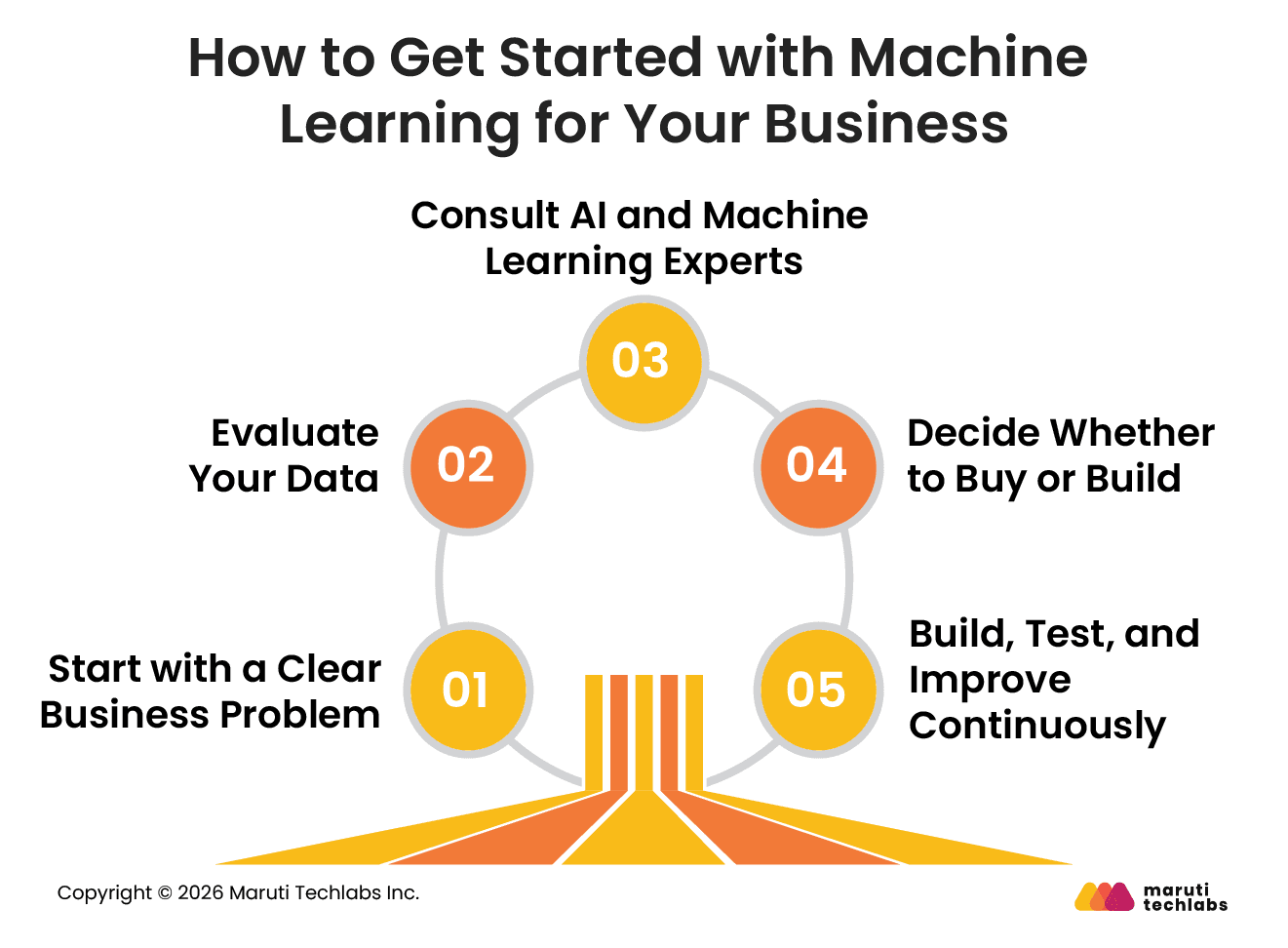
How to Get Started with Machine Learning for Your Business
Getting started with machine learning is not just about choosing algorithms or building AI models. The real focus should be on identifying the right business problem and understanding how data can help solve it.
1. Start with a Clear Business Problem
One of the most common mistakes businesses make is starting with “We need AI” instead of identifying the actual challenge they want to solve.
Focus on a specific and measurable problem. For example, instead of saying “improve customer service,” define a goal like reducing customer response time or improving support efficiency.
Machine learning works best for tasks that involve large amounts of data, repetitive processes, or pattern recognition.
2. Evaluate Your Data
Data is the foundation of every machine learning project. Before implementation, businesses should assess what data they already have and whether it is accurate, complete, and usable.
This can include:
Structured data like spreadsheets and CRM records
Unstructured data like emails, chats, images, or documents
Data cleaning and preparation are often the most time-consuming parts of an ML project, but they directly impact model performance.
3. Consult AI and Machine Learning Experts
Before investing in tools or development, many businesses work with an AI development company to evaluate feasibility, identify high-impact use cases, and define the right implementation approach.
This stage also helps businesses assess their AI readiness, including data availability, infrastructure, security requirements, and long-term business goals. An experienced partner can recommend suitable machine learning models and help determine whether a custom-built solution or an existing platform is the better fit for the business.
4. Decide Whether to Buy or Build
Not every business needs to build custom ML models or machine learning solutions from scratch. When evaluating build vs buy AI solutions, many companies start with existing AI platforms or cloud-based ML tools to reduce development time, costs, and implementation complexity.
A small proof of concept (PoC) is often the best way to test feasibility and measure business impact before scaling machine learning across operations.
5. Build, Test, and Improve Continuously
Machine learning is an ongoing process, not a one-time implementation. Models need regular testing, monitoring, and retraining as business data changes over time.
Starting with simpler models can also make implementation easier and help teams understand results more clearly before moving to advanced AI systems.
Conclusion
Machine learning is no longer just a future idea; it’s something businesses are actively using to solve real problems every day. From improving customer experience and predicting demand to detecting fraud and streamlining operations, its use cases are growing quickly across industries.
That said, it’s important to remember that machine learning is powerful but not perfect. Everything depends on the quality of data behind it. If the data is biased or incomplete, the results can also be misleading. In some cases, this can even raise ethical concerns, which is why careful planning and responsible use matter a lot.
When used thoughtfully, machine learning can uncover insights that are hard to spot otherwise and help businesses make faster, better decisions. The key is to start with the right problem, use the right data, and keep improving over time.
FAQs
1. Which industries benefit most from machine learning?
Industries like healthcare, finance, retail, manufacturing, and logistics benefit the most from machine learning. They deal with large amounts of data daily. Machine learning helps them detect patterns, improve decisions, reduce costs, and automate processes like fraud detection, demand forecasting, patient diagnosis, and personalized customer recommendations.
2. How long does it take to implement a machine learning solution?
It usually takes a few weeks to several months depending on project complexity, data availability, and business goals. Simple models can be built quickly, while advanced systems need more time for data preparation, training, testing, and deployment. Continuous improvement also continues after initial implementation.
3. What is the difference between machine learning and AI?
Artificial Intelligence is the broader concept of making machines act like humans. Machine learning is a part of AI that helps systems learn from data and improve over time without being explicitly programmed. In simple terms, AI is the goal, and machine learning is one way to achieve it.
4. What data do you need to get started with machine learning?
You need structured or unstructured data depending on the problem. This can include spreadsheets, customer records, transaction data, emails, images, or logs. The most important thing is that the data should be clean, relevant, and large enough to help the model learn meaningful patterns.
5. How much does it cost to build a machine learning model?
Simple machine-learning MVPs may start at around $20,000, while advanced enterprise-grade systems can exceed $500,000. Mid-level projects often range between $100,000 and $500,000, with major costs going toward data preparation, model training, cloud infrastructure, and development expertise. The overall cost depends on the complexity of the solution, available data, and customization requirements.
6. What exactly are machine learning algorithms?
Machine learning algorithms are step-by-step methods that help computers learn from data. They analyze patterns, make predictions, and improve with experience. Examples include decision trees, linear regression, and neural networks. Each algorithm is used for different tasks like classification, forecasting, or clustering based on the problem.
Why Maruti Techlabs for Machine Learning Services
At Maruti Techlabs, we focus on building machine learning solutions that solve real operational problems, not just experimental use cases. Our approach is simple: understand the business challenge first, then design solutions that fit into existing systems without adding complexity. This helps teams adopt AI faster and see value early.
Since machine learning outcomes depend heavily on data quality, we help businesses build a stronger foundation for their AI initiatives. From data preparation and processing to data analytics and infrastructure readiness, our teams support organizations in making their data more usable, reliable, and scalable for machine learning applications.
One example of this is our healthcare engagement, in which we built a machine learning model that improved record-processing efficiency by 87%. Our OCR and NLP-based patient record processing system helped automate the classification of discharge, referral, and follow-up letters that were earlier handled manually by large data teams. Accuracy improved to 93%, and a 12-member team per hospital was reduced to just 2 people overseeing the process.
Beyond execution, we also help businesses plan the right AI direction through services like Custom AI/ML development and AI strategy and readiness. This ensures companies don’t just build models, but build scalable and sustainable AI systems aligned with their goals.
If you’re looking to solve a specific business problem with machine learning, we can help you define the right approach and move from idea to implementation.
Pinakin Ariwala has over 20 years of experience in AI/ML, data engineering, and software development. He has led AI and machine learning projects across industries, including agriculture, finance, and healthcare, and has been featured on the Clutch Leaders Matrix podcast discussing real-world AI/ML applications.
Stuck with a Tech Hurdle?
We fix, build, and optimize. The first consultation is on us!